- ACSM updated its resistance training position stand for the first time in 17 years. Currier and colleagues (2026) pooled 137 systematic reviews covering more than 30,000 adults, the largest evidence synthesis ever assembled for resistance training prescription.
- Hypertrophy: at least 10 sets per muscle group per week. Loads from 30 to 100 percent of 1RM all worked, provided each set was taken close to failure. Eccentric overload was singled out as a hypertrophy-favorable variable.
- Strength: at least 80 percent 1RM, full range of motion, 2 to 3 sets, key lifts early, at least 2 sessions a week. A heavier, lower-volume prescription than hypertrophy.
- You do not have to train to failure. Stopping at 2 to 3 reps in reserve produces the same outcomes with less fatigue. The new stand says absolute failure is unnecessary.
- Equipment type does not matter much. Bodyweight, bands, machines, and free weights all work. The stand lists circuit, elastic-band, and home-based protocols alongside gym work. Lopes et al. (2019) found no superiority of conventional weights over bands.

The American College of Sports Medicine updated its resistance training position stand in April 2026. It is the first major refresh in 17 years. The previous version (Ratamess et al., 2009) was a foundational document, but it was written before the modern meta-analytic explosion. A lot has changed.
The new stand, led by Brad S. Currier at McMaster University and chaired by Stuart M. Phillips, is an overview of overviews. Currier and colleagues synthesized 137 systematic reviews covering more than 30,000 participants. That is roughly an order of magnitude more evidence than the 2009 document could draw on. The headline is simple. The prescription got cleaner, more permissive about equipment, and less obsessed with grinding sets to absolute failure.
Here is the plan. We will walk through what the new stand says for hypertrophy, strength, and power. We will look at the three variables that surprised people (effort versus failure, equipment type, periodization). We will read the new findings against the Pelland et al. (2026) dose-response meta-regression, which dropped a few months earlier and is the cleanest companion paper to the position stand. And we will translate the prescription into a practical, no-gym-required version anyone can run from home.
What Do the 2026 ACSM Guidelines Actually Say?
The short version: train every major muscle group at least twice a week, accumulate at least 10 hard sets per muscle per week for growth, lift at least 80 percent of your one-rep max for strength, and stop 2 to 3 reps short of failure. Any equipment that lets you do that counts.
| Goal | Load | Volume & Frequency | Key Details |
|---|---|---|---|
| Strength | At least 80% of 1RM | 2 to 3 sets per exercise, at least 2 sessions/week | Full range of motion; key lifts first in the session |
| Hypertrophy | Roughly 30 to 100% of 1RM (effort matters, not load) | At least 10 sets per muscle group per week | Each set within 2 to 3 reps of failure; eccentric emphasis helps |
| Power | 30 to 70% of 1RM | No more than ~24 reps per session, 2 sessions/week | Fastest possible concentric; jumps, throws, ballistic moves |
The Currier et al. (2026) overview is organized around four outcomes (strength, hypertrophy, power, physical performance) and a short list of prescription variables (load, volume, frequency, range of motion, fatigue/effort, exercise selection, periodization, equipment). For each outcome, the authors asked which variables consistently improved results across the underlying meta-analyses.
Strength: Heavier, Lower Volume, Early in the Session
For voluntary strength, Currier and colleagues (2026), in Medicine and Science in Sports and Exercise, found the consistent prescription was lifting heavier loads (at least 80 percent of one-rep max), through a complete range of motion, for 2 to 3 sets per exercise, performed at the beginning of the training session, at a frequency of at least 2 sessions per week. The "key lifts go first" detail matters more than it sounds. Pre-fatiguing the nervous system with accessory work blunts the strength signal of the main movement.
The strength dose-response is steep and tops out fast. The companion Pelland et al. (2026) meta-regression in Sports Medicine modeled this directly. Strength gains rose with weekly volume but showed pronounced diminishing returns, much steeper than for hypertrophy. Past a moderate weekly set count, adding more sets bought very little extra strength.
Hypertrophy: 10+ Sets a Week, Effort Across a Wide Load Range
For muscle growth, the consistent finding was higher weekly volume (at least 10 sets per muscle group per week) and eccentric overload (deliberately emphasizing the lowering phase of each rep). The load range that worked was strikingly wide. Hypertrophy occurred from roughly 30 to 100 percent of 1RM, provided effort was sufficient. That validates a decade of work from groups like Schoenfeld's showing that you can grow muscle with light loads if you take the sets close enough to failure.
The hypertrophy dose-response in Pelland et al. (2026) also keeps climbing with weekly volume, but with shallower diminishing returns than strength. For someone whose primary goal is size, the practical translation is: hit at least 10 hard sets per muscle per week, push toward 15 to 20 if you have the recovery budget, and do not stress about whether the load is 60 percent of 1RM or 85 percent. Effort and volume win.
Power: Moderate Loads, Fast Concentric, Low Volume
For power (the ability to express force quickly), the recommended prescription was moderate loads (30 to 70 percent of 1RM), low-to-moderate volume (no more than about 24 total reps per session for the power exercises), and an intentionally fast concentric phase. Olympic-style lifts and dedicated power-training movements (jumps, throws, ballistic push-ups) were highlighted as the most efficient power tools.
Frequency, Range of Motion, and Effort
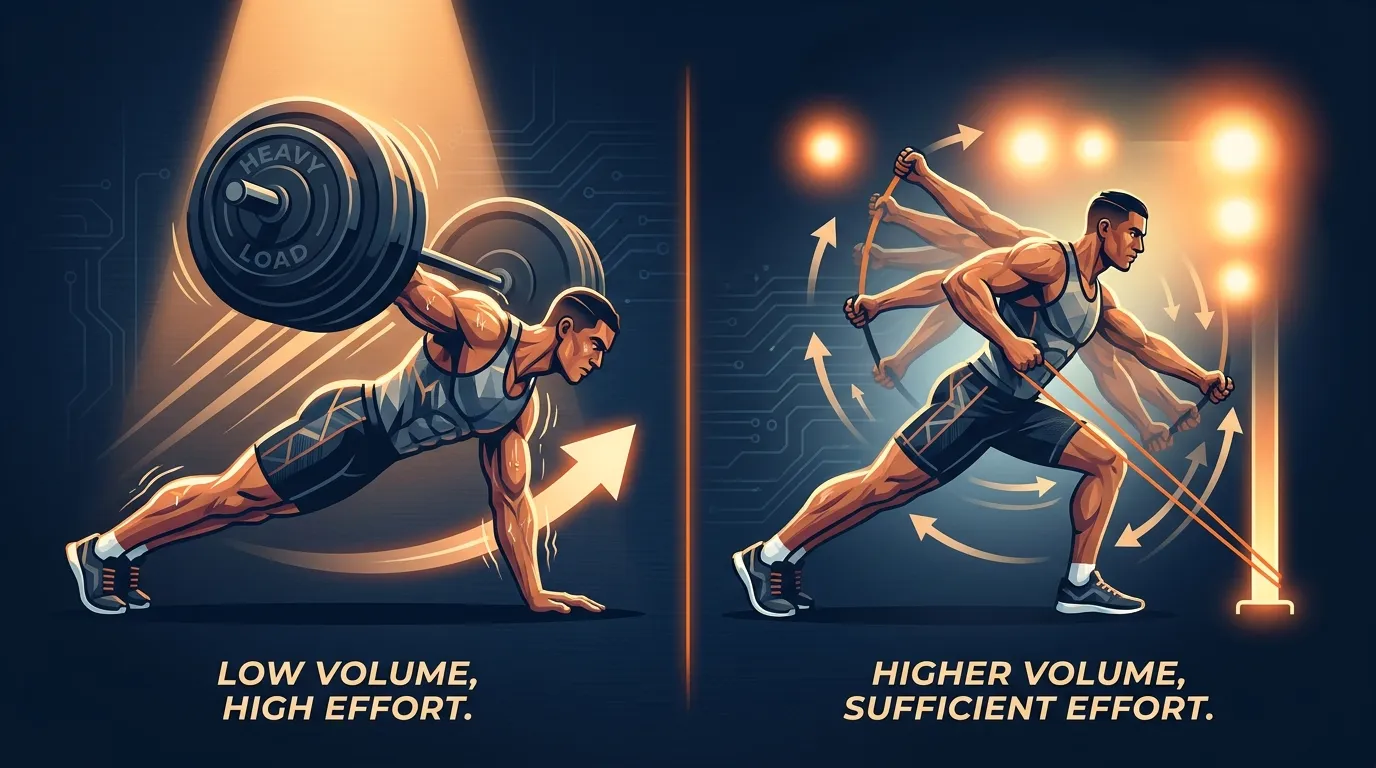
Three variables crossed all three outcomes. Training all major muscle groups at least 2 sessions per week is the universal frequency floor. Full range of motion was favored for both strength and hypertrophy. And sufficient effort, not absolute failure, was sufficient. Currier and colleagues explicitly noted that training near failure (roughly 2 to 3 reps in reserve) produced the same outcomes as taking every set to absolute failure, while accumulating less fatigue and lower injury risk. Our deeper read on this is in training to failure versus reps in reserve.
What Changed From the 2009 Position Stand?
Three things changed: complex periodization got demoted, equipment type got equalized, and training to absolute failure got dethroned. Everything else is refinement.
The 2009 document (Ratamess et al., 2009, also in Medicine and Science in Sports and Exercise) leaned heavily on linear and undulating periodization, prescribed specific load and rep schemes by training status (novice, intermediate, advanced), and treated free-weight multi-joint lifts as the default modality. Those choices reflected the evidence base of the time, which was rich in short-term mechanistic studies but thin on meta-analytic data.
The 2026 stand is meaningfully different. Three shifts stand out.
Periodization got demoted. Complex periodization (linear, daily undulating, block) did not consistently outperform straightforward progressive overload in the underlying meta-analyses. The new stand does not abandon periodization, but it stops treating it as a load-bearing variable for general populations. For most adults, just adding weight or reps over time on a consistent program is enough.
Equipment got equalized. The 2009 stand implicitly framed free weights as the gold standard. The 2026 stand explicitly lists circuit-based, elastic-band, and home-based protocols alongside traditional gym work as effective routes to the same outcomes. The Lopes et al. (2019) meta-analysis in SAGE Open Medicine was an early signal in this direction. It pooled 8 studies comparing elastic resistance with conventional weights and found no superiority for either approach in upper or lower body strength outcomes.
Failure got dethroned. The 2009 culture around resistance training (especially in the bodybuilding press) treated absolute failure as the gold-standard hypertrophy signal. The 2026 stand says effort matters, but the last few reps before failure are not magic. Stopping at 2 to 3 reps in reserve hits the same outcomes with less wear. This aligns with the broader research arc summarized in our reps in reserve breakdown.
Get an evidence-based plan built for you
FitCraft, our mobile fitness app, pairs you with an AI coach who builds you a personalized plan around your goals, schedule, and fitness level. Every FitCraft program is designed by Domenic Angelino, MPH (Brown University) and NSCA-CSCS, with research published in the Journal of Strength and Conditioning Research and Medicine & Science in Sports & Exercise.
Take the Free Assessment Free • 2 minutes • No credit cardHow Do You Apply the 2026 Guidelines Without a Gym?
This is where the new guidelines get genuinely useful for the at-home population. The prescription variables that move outcomes (load relative to capacity, weekly volume, range of motion, effort) can all be hit without a barbell. Here is the translation.
For general health (any healthy adult). Train all major muscle groups at least twice a week. That is the universal floor. A 2-day full-body bodyweight program (push-ups, rows on a sturdy table edge or with bands, squats, hinges, planks) clears this bar. Add bands for progressive overload as the moves get easy. Whether those sessions should stay full body or become a split once you add days is worked through in our guide to full body vs split workout programming.
For hypertrophy. Accumulate at least 10 hard sets per muscle group per week. With bodyweight, "hard" means working in the 8 to 30 rep range with each set ending within 2 to 3 reps of failure. Progress by manipulating leverage (incline push-up to standard push-up to feet-elevated to decline to one-arm progressions), adding bands for resistance, or doing slow eccentrics. Two to three sessions per week per muscle group is enough.
For strength. The 80 percent 1RM target sounds gym-specific, but you can hit a strength stimulus with bodyweight by picking moves where bodyweight itself is at least 80 percent of your max effort. Pull-ups, dips, pistol squats, one-arm push-up progressions, and weighted vest variations all qualify. Lower the rep range to 3 to 6 per set, prioritize the hardest moves first in the session, and aim for 2 sessions per week per movement pattern. Bands add the extra resistance for moves where bodyweight alone is too easy.
For power. Bodyweight power work is jumps, throws, ballistic push-ups, broad jumps, and skater bounds. Keep total reps low (no more than 24 contacts per session for the power exercises), focus on the fastest possible concentric (the takeoff or push phase), and give yourself full recovery between sets. Two sessions a week is sufficient.
The eccentric tax. The new stand singled out eccentric overload as a hypertrophy-favorable variable. With bodyweight, this is easy. Slow the lowering phase of every rep to 3 to 5 seconds. For pull-ups, use a chair to assist on the way up and lower yourself slowly. For push-ups, take 3 seconds to descend. This costs nothing and meaningfully increases the hypertrophy signal. We unpack the mechanism in our piece on eccentric training benefits.
Common Misconceptions
Misconception 1: "If you do not lift heavy, you do not build muscle."
The 2026 stand explicitly contradicts this. Hypertrophy was observed across the full load span from about 30 to 100 percent of 1RM, provided sets were taken close enough to failure. The translation: a set of push-ups taken near failure builds muscle the same way a heavy bench press does, as long as the effort matches. This matches a decade of work from Schoenfeld and colleagues. See our deeper read in why light weights can build muscle.
Misconception 2: "Periodization is essential for progress."
The new stand is gentle about this, but the data is clear. Across the underlying meta-analyses, complex periodization did not consistently outperform straightforward progressive overload for general populations. Periodization remains useful for advanced athletes peaking for competition. For everyone else, just adding weight, reps, or harder progressions over time on a consistent program does most of the work.
Misconception 3: "You have to grind every set to failure or you are leaving gains on the table."
Currier and colleagues directly address this. Training near failure (about 2 to 3 reps in reserve) produces the same hypertrophy and strength outcomes as training to absolute failure, with less accumulated fatigue and lower injury risk. For most adults, that is a strict upgrade. Stop a couple of reps short, recover faster, lift again sooner.
What the Research Suggests Going Forward
The 2026 ACSM Position Stand is a quiet document with loud implications. It does not unveil a new training method. It does the opposite. It looks at 17 years of accumulated meta-analytic evidence and says, in effect, that the simple things still work, the equipment you have is probably fine, and the obsession with grinding to failure was always more vibe than data. The four levers that consistently moved outcomes (appropriate load, sufficient weekly volume, full range of motion, sufficient effort) are exactly the levers an at-home trainee with bodyweight and a set of bands can pull.
Three honest limitations stay in play. First, the overview-of-reviews format means the conclusions inherit the quality of the underlying systematic reviews, most of which examined 6 to 16 week interventions. Long-term (multi-year) data on the optimal prescription is still thin. Second, the participant pool across the underlying studies skews toward healthy adults in their twenties through fifties. The dose recommendations should generalize to older adults and post-menopausal trainees in direction, but the specific numbers may shift in those populations. The stand does cover physical performance outcomes (gait speed, balance, stair climbing) where older adults are well represented. Third, the document is a population-level prescription. Individual response varies, and the standard sample-mean answer might not be optimal for any specific person.
The takeaway is simpler than 17 years of accumulated training discourse suggests. Pick a few movement patterns. Train each major muscle group at least twice a week. Take your sets close to failure but not to failure. Use whatever equipment makes it sustainable. Add progressively over time. Keep doing that for years, not weeks. The new ACSM stand does not promise anything more exotic than that, and the evidence base behind it is now the strongest it has ever been.

References
- Currier BS, D'Souza AC, Fiatarone Singh MA, et al. "American College of Sports Medicine Position Stand. Resistance Training Prescription for Muscle Function, Hypertrophy, and Physical Performance in Healthy Adults: An Overview of Reviews." Medicine and Science in Sports and Exercise 58.4 (2026): 851-872. PMID: 41843416
- Pelland JC, Remmert JF, Robinson ZP, Hinson SR, Zourdos MC. "The Resistance Training Dose Response: Meta-Regressions Exploring the Effects of Weekly Volume and Frequency on Muscle Hypertrophy and Strength Gains." Sports Medicine (2026). PMID: 41343037
- Ratamess NA, Alvar BA, Evetoch TK, et al. "American College of Sports Medicine position stand. Progression models in resistance training for healthy adults." Medicine and Science in Sports and Exercise 41.3 (2009): 687-708. PMID: 19204579
- Lopes JSS, Machado AF, Micheletti JK, et al. "Effects of training with elastic resistance versus conventional resistance on muscular strength: A systematic review and meta-analysis." SAGE Open Medicine 7 (2019): 2050312119831116. PMID: 30815258
Frequently Asked Questions
What changed in the 2026 ACSM resistance training guidelines?
The 2026 ACSM Position Stand (Currier et al., Medicine and Science in Sports and Exercise, April 2026) is the first major update in 17 years and replaces the 2009 Ratamess et al. progression-models stand. The new document synthesized 137 systematic reviews covering more than 30,000 participants. The biggest shifts: equipment type (machines, free weights, bands, bodyweight) showed inconsistent effects, training to absolute failure is not necessary (2 to 3 reps in reserve hits the same outcomes), and complex periodization is no longer treated as a load-bearing variable for general populations.
What is the 2026 ACSM recommendation for muscle growth?
At least 10 sets per muscle group per week, with sufficient effort on every set. Hypertrophy responded across a wide load range (roughly 30 to 100 percent of 1RM) provided each set was taken close enough to failure. Eccentric overload was flagged as a hypertrophy-favorable variable. The companion Pelland et al. (2026) dose-response meta-regression supports the same direction: more weekly sets keep adding hypertrophy, with shallower diminishing returns than for strength.
What is the 2026 ACSM recommendation for strength?
Heavier loads (at least 80 percent of one-rep max), full range of motion, 2 to 3 sets per exercise, key lifts performed early in the session, and at least 2 sessions per week. Strength is a heavier, lower-volume prescription than hypertrophy. The strength dose-response was steep and topped out earlier than the hypertrophy dose-response, which matches the Pelland et al. 2026 finding of more pronounced diminishing returns for strength than for size.
Do you need a gym or barbells to follow the 2026 ACSM guidelines?
No. The new position stand explicitly lists circuit-based resistance training, elastic-band training, and home-based resistance training alongside traditional gym work as effective routes to the same outcomes. The Lopes et al. (2019) meta-analysis in SAGE Open Medicine found no superiority of conventional weights over elastic resistance for muscle strength. The variables that matter most (load relative to your capacity, weekly set volume, range of motion, effort) can all be hit at home with bodyweight progressions and a set of bands.
Do you have to train to failure to build muscle under the 2026 guidelines?
No. The 2026 ACSM Position Stand states sufficient effort can be achieved by training near failure, roughly 2 to 3 repetitions in reserve, and that taking every set to absolute failure is not necessary. For most healthy adults, stopping a couple of reps short of failure delivers the same hypertrophy and strength gains as grinding out maximal-effort sets, with less fatigue and lower injury risk.