Most people in a gym spend their mental energy on the lift. The push. The pull. Getting the weight up. Then they let gravity do the rest on the way back down.
That's backwards. And a growing body of research keeps confirming it.
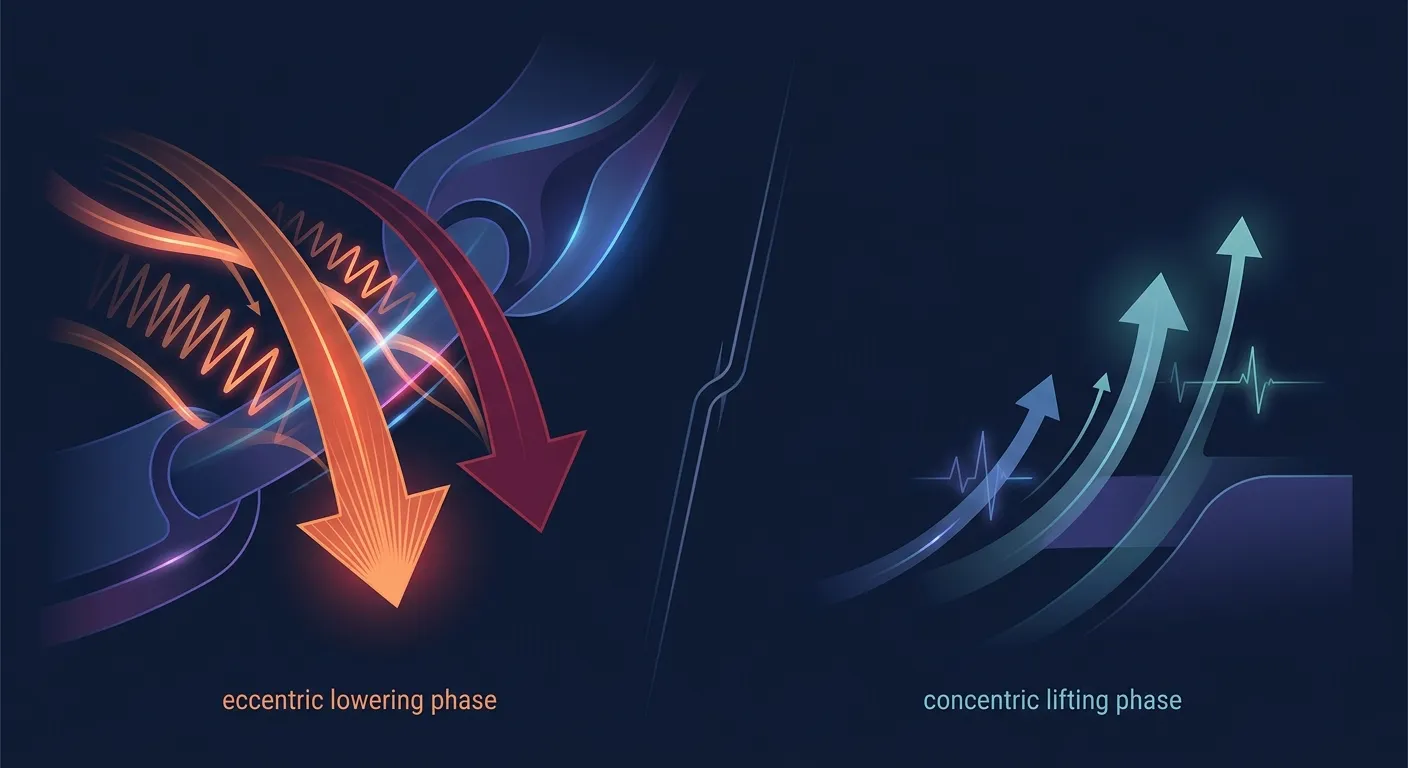
A 2022 study from Edith Cowan University, led by Professor Kazunori Nosaka, found that eccentric-only training produced 7.2% muscle growth compared to 5.4% for traditional training, while performing half the total work. The lowering phase of every rep, the part most people treat as a rest between the "real" effort, turns out to be where the biggest gains actually happen.
This isn't an isolated finding. It fits into a pattern that exercise scientists have been building for years, one that's reshaping how we think about efficient training. Here's what the research actually shows and how to use it.
The Study: Eccentric vs. Concentric vs. Both
Sato, Nosaka, and colleagues from Edith Cowan University, Niigata University, Nishi Kyushu University, and Londrina State University published their comparison in the European Journal of Applied Physiology (2022, vol. 122, pp. 2607-2614). The design was straightforward and the results were hard to argue with.
How They Set It Up
The team recruited non-resistance-trained young adults and randomly assigned them to three groups, all training the elbow flexors (biceps) twice per week for 5 weeks:
- Eccentric-only (ECC): Participants only performed the lowering phase of each rep
- Concentric-only (CON): Participants only performed the lifting phase
- Concentric-eccentric (CON-ECC): Traditional training with both the lift and the lower
Training used an isokinetic dynamometer, which standardized speed and allowed researchers to isolate each contraction type precisely. The eccentric group performed half the total repetition volume of the CON-ECC group because they only did one phase of each movement.
What They Found
Muscle thickness (measured via ultrasound at the biceps brachii and brachialis) told the clearest story:
- Eccentric-only: 7.2% increase in muscle thickness
- Concentric-eccentric: 5.4% increase
- Concentric-only: 2.5% increase
The eccentric group built more muscle while doing less total work. That's not a small detail. It means the lowering phase alone was responsible for more hypertrophy than both phases combined in traditional training.
Strength results reinforced the pattern. The eccentric-only group improved across isometric, concentric, and eccentric strength measures. They matched the CON-ECC group in most categories and outperformed the concentric-only group across the board.
Citation: Sato S, Nosaka K, et al. Comparison between concentric-only, eccentric-only, and concentric-eccentric resistance training of the elbow flexors for their effects on muscle strength and hypertrophy. Eur J Appl Physiol. 2022;122:2607-2614.
Why the Lowering Phase Builds More Muscle
If you've been told that the "lifting" part of an exercise is what builds muscle, the Sato/Nosaka results probably seem counterintuitive. But the physiology behind eccentric superiority is well-documented, and multiple mechanisms work together to explain it.
Greater Mechanical Tension Per Fiber
When you lower a weight, your muscles produce roughly 20-50% more force than when you lift it. Your body can handle heavier loads on the way down than on the way up. At the same time, your nervous system recruits fewer motor units during eccentric contractions compared to concentric ones at the same absolute force (Douglas et al., 2017).
Think about what that means: fewer fibers are doing more work per fiber. Each active muscle fiber experiences greater mechanical tension during the lowering phase. And mechanical tension is the primary driver of muscle hypertrophy. It's the signal that tells your body "this muscle needs to get bigger."
This is a foundational finding from Schoenfeld's work on hypertrophy mechanisms. Mechanical tension outweighs metabolic stress and muscle damage as a driver of growth. Eccentric contractions maximize that tension at the individual fiber level.
Unique Molecular Signaling
Eccentric and concentric contractions don't just differ in force production. They activate different molecular pathways inside muscle cells. Franchi et al. (2017) published a landmark review in Frontiers in Physiology showing that eccentric loading specifically activates the p38MAPK and ERK1/2 signaling cascades, which play central roles in muscle protein synthesis and fiber remodeling.
These pathways weren't activated to the same degree by concentric training. The muscle "heard" a different signal from the lowering phase than from the lifting phase, and that signal triggered a stronger growth response.
Citation: Franchi MV, Reeves ND, Narici MV. Skeletal Muscle Remodeling in Response to Eccentric vs. Concentric Loading. Front Physiol. 2017;8:447.
Longer Fascicles, Better Architecture
Here's where it gets interesting beyond just "bigger muscles." Franchi's research also showed that eccentric training produces different structural changes in muscle architecture compared to concentric training. Specifically, eccentric training increased fascicle length by 12% versus just 5% for concentric training.
Longer fascicles mean your muscles can produce force over a greater range of motion and at higher velocities. This has direct implications for athletic performance, injury prevention, and functional movement. Concentric training, by contrast, primarily increased pennation angle (the angle at which muscle fibers attach to the tendon), which is associated with force production at shorter muscle lengths.
Both architectural changes have value. But if you're training for real-world movement, not just isolated strength at a single joint angle, the fascicle length gains from eccentric training are a meaningful advantage.
This Isn't a One-Study Finding
The Sato/Nosaka study is compelling on its own. But it sits inside a body of evidence that's been building for over a decade. Here's what else supports the eccentric advantage.
Douglas et al. (2017): The Comprehensive Review
Douglas and colleagues published an extensive review in Sports Medicine examining the physiological characteristics of eccentric exercise. Their conclusions: eccentric contractions involve distinct neural control strategies, with greater cortical activation despite lower overall motor unit recruitment. The nervous system processes eccentric movement differently from concentric movement at every level, from the brain to the individual motor unit.
This review also documented that eccentric exercise produces greater force per unit of metabolic cost. You burn fewer calories during eccentric work, but you produce more mechanical tension. For hypertrophy, that trade-off favors the eccentric side. Calories aren't the goal. Mechanical tension is.
Citation: Douglas J, Pearson S, Ross A, McGuigan M. Eccentric Exercise: Physiological Characteristics and Acute Responses. Sports Med. 2017;47(4):663-675.
Hody et al. (2019): Risks and Benefits
Hody and colleagues published a balanced review in Frontiers in Physiology covering both the advantages and potential downsides of eccentric training. Their key finding: eccentric exercise produces superior adaptations in muscle strength, muscle-tendon stiffness, and functional outcomes when compared to concentric exercise. However, it also carries a higher risk of delayed-onset muscle soreness (DOMS), particularly in untrained individuals during the first few sessions.
The practical note: the soreness is temporary. The repeated bout effect, one of the best-documented phenomena in exercise science, means the second eccentric session causes dramatically less soreness than the first. By sessions three or four, most people report minimal discomfort. The adaptations last. The soreness doesn't.
Citation: Hody S, Croisier JL, Bury T, Rogister B, Leprince P. Eccentric Muscle Contractions: Risks and Benefits. Front Physiol. 2019;10:536.
The 3-Second Strength Study
The same research team (Sato and Nosaka) also demonstrated that just one 3-second eccentric contraction per day, performed 5 days per week for 4 weeks, increased muscle strength by up to 12.8%. That study focused on strength rather than hypertrophy, but it confirmed the same underlying principle: eccentric loading produces disproportionately large adaptations relative to the volume of work performed.
When you stack these findings together, the pattern is consistent. Eccentric training does more with less. Not because it's magic, but because the lowering phase creates a unique combination of high mechanical tension, distinct molecular signaling, and favorable neural adaptations that concentric-only training can't match.
Ty builds the lowering phase into every workout
FitCraft's AI coach prescribes eccentric tempos based on the research above, adjusting automatically as you progress. Start free.
Take the Free Assessment Free • 2 minutes • No credit cardHow to Actually Use This
Knowing that eccentric training builds more muscle per rep is only useful if you know how to apply it. Here's how to put the research into practice with exercises you're already doing.
Slow the Lowering Phase to 3-5 Seconds
This is the simplest and most effective change you can make today. On any resistance exercise, take 3-5 seconds to complete the lowering portion: The clearest example of a lift built entirely around that slow lowering phase is the jefferson curl, where a five-second descent under a light weight is the whole exercise.
- Push-ups: Take 4 seconds to lower your chest to the floor. Push up at normal speed.
- Squats: Take 4 seconds to descend to the bottom. Stand up at normal speed.
- Lunges: Take 3 seconds to lower into each lunge. Drive back up normally.
- Rows (dumbbell or resistance band): Pull the weight to your body at normal speed. Take 4 seconds to extend your arm back out.
You'll notice immediately that fewer reps feel much harder. That's the point. You're increasing time under tension during the phase that produces the most mechanical stress per fiber. Ten slow-eccentric push-ups will challenge you more than twenty regular ones.
Try Eccentric-Only Reps for Exercises You Can't Do Yet
This is one of the best practical applications of eccentric research: you can use the lowering phase of exercises that are too hard to perform concentrically. Can't do a pull-up? Jump or step to the top position and lower yourself over 5 seconds. Can't do a full push-up? Start at the top and lower yourself slowly to the floor, then reset.
The Sato/Nosaka data shows that these eccentric-only reps aren't just a stepping stone. They're building more muscle per rep than the full movement would. You're not doing a "modified" version. You're doing the most effective part.
Don't Overcook It
Eccentric training produces more muscle damage than concentric training, especially early on. If you go from zero eccentric emphasis to maximum eccentric emphasis overnight, you'll be sore enough to skip your next three workouts. That defeats the purpose.
Start by adding eccentric emphasis to 2-3 exercises per session. Use a 3-second lowering tempo, not a 10-second one. Let the repeated bout effect kick in over your first week. Then gradually increase the eccentric duration or add more exercises. The goal is consistency over intensity, and consistency matters more than any single session's stimulus. Research on rest periods and recovery backs this up: your muscles need adequate recovery to translate training stimulus into actual growth.

What This Study Does NOT Tell Us
The Sato/Nosaka findings are strong, but they come with real limitations. Being honest about what the data can't tell us is just as important as understanding what it can.
It Tested One Muscle Group in Untrained People
The study measured elbow flexors (biceps) in young, non-resistance-trained adults. We don't know if the same 7.2% vs. 5.4% advantage holds for legs, back, chest, or shoulders. We also don't know if trained individuals, who have already adapted to eccentric loading through years of training, would see the same relative benefit. The principle is physiologically sound, but the exact percentages might look different for a different population or muscle group.
Five Weeks Is Short
The study ran for 5 weeks. That's enough to detect meaningful changes in muscle thickness and strength, but it doesn't tell us what happens at 12, 24, or 52 weeks. It's possible that the eccentric advantage narrows over time as both training modalities produce diminishing returns. Or it's possible it compounds. We don't have the long-term data to know.
Isokinetic Dynamometers Aren't Dumbbells
The training was performed on laboratory equipment that controls movement speed and isolates specific contraction types perfectly. That's ideal for research. It's not how anyone trains in a gym or at home. Real-world eccentric training involves gravity, momentum, fatigue, and imperfect form. The results translate, but the precision of the laboratory setting inflates the cleanness of the data relative to real-world application.
Sample Size and Generalizability
Like most exercise physiology studies, this one used a relatively small sample of young adults. The effect sizes were meaningful and the results align with the broader literature, but no single study proves a universal principle. The strength of this finding comes from the convergence of multiple studies (Franchi 2017, Douglas 2017, Hody 2019, Sato 2022) all pointing in the same direction.
What This Means for Your Training
If you take one thing from the research, it's this: stop rushing the lowering phase of your exercises. That's not a vague suggestion. It's backed by multiple peer-reviewed studies showing that the eccentric phase produces greater mechanical tension, triggers unique growth signals, and builds more muscle per unit of work than the concentric phase.
You don't need to overhaul your entire program. You don't need special equipment. You just need to slow down the part of every rep that you've probably been treating as dead time.
The research on bodyweight training shows that equipment-free exercise can produce meaningful strength and hypertrophy gains. Adding eccentric emphasis to bodyweight movements makes them even more effective, which is especially relevant if you're training at home without access to heavy weights.
How FitCraft Applies This Research
FitCraft's workout programming incorporates eccentric training principles because the evidence supporting them is strong, replicated, and practical. Here's how it shows up in the app:
- Tempo prescriptions in every workout. Ty, FitCraft's 3D AI coach, prescribes specific eccentric tempos based on the exercise and your training level. A beginner might get a 3-second lowering phase on push-ups. As you progress, Ty adjusts the tempo to keep the stimulus appropriate.
- Eccentric-only progressions for challenging exercises. If you can't do a full pull-up or push-up yet, Ty programs eccentric-only reps as a primary training tool, not just a modification. The research shows that's actually the most productive phase of the movement.
- Progressive overload beyond just reps and sets. FitCraft doesn't just add reps. It manipulates time under tension, eccentric duration, and contraction speed. These are the variables the research identifies as key drivers of adaptation.
- Adaptive difficulty based on your progress. Ty adjusts workout difficulty as you improve, keeping you in the zone where training is challenging enough to stimulate growth but manageable enough to maintain consistency. This addresses the challenge-skill mismatch that drives dropout.
FitCraft's free version includes everything you need to start training with eccentric emphasis today. Every workout is designed by exercise scientist Domenic Angelino (MS, MPH, CSCS), and every tempo prescription is grounded in the research above.
References
- Sato S, Nosaka K, et al. "Comparison between concentric-only, eccentric-only, and concentric-eccentric resistance training of the elbow flexors for their effects on muscle strength and hypertrophy." Eur J Appl Physiol. 2022;122:2607-2614. doi:10.1007/s00421-022-05035-w
- Franchi MV, Reeves ND, Narici MV. "Skeletal Muscle Remodeling in Response to Eccentric vs. Concentric Loading: Morphological, Molecular, and Metabolic Adaptations." Front Physiol. 2017;8:447. doi:10.3389/fphys.2017.00447
- Douglas J, Pearson S, Ross A, McGuigan M. "Eccentric Exercise: Physiological Characteristics and Acute Responses." Sports Med. 2017;47(4):663-675. doi:10.1007/s40279-016-0624-8
- Hody S, Croisier JL, Bury T, Rogister B, Leprince P. "Eccentric Muscle Contractions: Risks and Benefits." Front Physiol. 2019;10:536. doi:10.3389/fphys.2019.00536
- Schoenfeld BJ, Ogborn DI, Krieger JW. "Dose-response relationship between weekly resistance training volume and increases in muscle mass." J Sports Sci. 2017;35(11):1073-1082. doi:10.1080/02640414.2016.1210197
Frequently Asked Questions
Does lowering weights build more muscle than lifting them?
Research suggests yes. A 2022 study by Sato and Nosaka in the European Journal of Applied Physiology found that eccentric-only training (lowering weights) produced 7.2% muscle growth compared to 5.4% for traditional concentric-eccentric training, despite performing only half the total work. The eccentric group also showed comparable or superior strength gains across multiple measurements.
Why is eccentric training more effective for muscle growth?
Eccentric contractions produce roughly 20-50% more force than concentric contractions while recruiting fewer motor units. This creates greater mechanical tension per active muscle fiber, which is the primary driver of hypertrophy. Eccentric loading also triggers unique molecular signaling pathways (including p38MAPK and ERK1/2) and produces distinct architectural adaptations like increased fascicle length.
How do I add eccentric training to my workouts?
Slow down the lowering phase of any exercise to 3-5 seconds. On push-ups, take 4 seconds to lower your chest toward the floor. On squats, take 4 seconds to descend. Focus on controlling the weight against gravity rather than just dropping it. You can also try eccentric-only variations like slow negatives, where you lower yourself from the top of a pull-up over 5 seconds and use your feet to return to the top.
Will eccentric training make me more sore than regular training?
Initially, yes. Eccentric exercise produces more delayed-onset muscle soreness (DOMS) than concentric exercise, especially during your first few sessions. However, the repeated bout effect means soreness decreases rapidly. By the third or fourth session, most people experience minimal soreness. Starting with lighter loads and fewer sets reduces initial discomfort.
Can I do eccentric training with bodyweight exercises?
Absolutely. Every bodyweight exercise has an eccentric phase. The descent in a push-up, the lowering in a squat, the downward motion in a lunge. You can emphasize the eccentric by slowing that phase to 3-5 seconds. For exercises you can't yet perform concentrically, like pull-ups, you can do eccentric-only reps by jumping to the top position and lowering yourself slowly.