- The intensity range is the benefit. The 2011 Compendium of Physical Activities puts stationary cycling anywhere from 3.5 METs at 30 watts to 12.5 METs at 230 watts. One machine covers recovery riding and near-maximal work.
- Aerobic and cardiometabolic gains are consistent. Chavarrias and colleagues (2019) pooled 13 indoor cycling studies and 372 participants: VO2 max up 8 to 10.5 percent, systolic blood pressure down 2 to 17 mmHg, total cholesterol down 6.8 to 33.8 mg/dL.
- It is the knee prescription. Luan and colleagues (2021) pooled 724 people with knee osteoarthritis and found stationary cycling cut pain by a weighted mean difference of 12.86 against non-exercising controls.
- Intervals work better here than anywhere else. Milanovic and colleagues (2015) found interval training raised VO2 max by 5.5 mL/kg/min versus 4.9 for continuous training, and the cycle ergometer is where most of that research was run.
- The gap is loading. No ground contact means no bone stimulus and no upper body. A bike needs a strength program beside it, not after it.
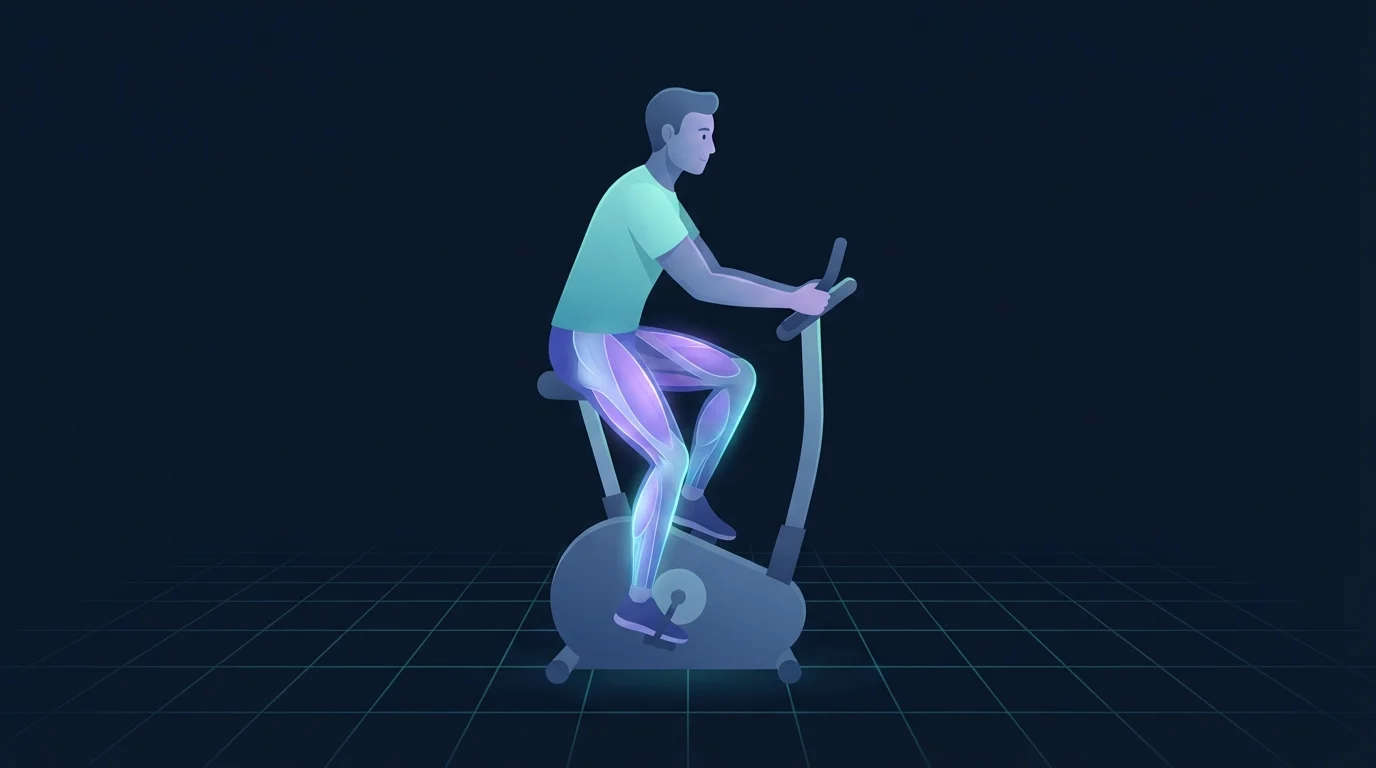
An exercise bike has no story. There is no stroke to learn, no gait to fix, nothing that makes a good social video. What it has instead is a dial that runs from almost nothing to almost everything, and the ability to keep working for a person who cannot put weight through a knee.
That unglamorous pairing is exactly why the research on stationary cycling is deeper and cleaner than the research on most home machines. Riders can be prescribed a precise wattage, held to it, and measured. So this article goes through what the trials found on aerobic capacity, blood pressure, blood lipids, body composition and knee pain, then answers the question people actually ask next: how a bike stacks up against a mini stepper, and which bike shape to buy.
If you are still deciding between riding and running, our guide to cycling versus running handles that comparison head on. This page is about what the bike itself delivers.
What an Exercise Bike Trains, and What It Skips
Pedalling is a closed-chain, concentric-dominant movement. Your foot never leaves the pedal, so the muscle work is almost entirely shortening contractions with very little of the lengthening, braking work that produces soreness after a run or a set of squats. That is why you can ride hard on consecutive days and why cycling produces so little delayed muscle soreness.
The muscles doing the work, in rough order of contribution:
- Quadriceps: the primary driver through the downstroke, from roughly 12 o'clock to 5 o'clock on the pedal circle.
- Glutes: hip extension through the same phase, contributing more as you rise out of the saddle or push heavier gears.
- Hamstrings and calves: the transition through the bottom of the stroke and the pull-through if you ride clipped in.
- Trunk: isometric stabilisation only. Real, but small, and the reason a bike does not count as core work.
What it skips matters just as much. There is no impact, so there is no osteogenic loading signal for the hip or spine. There is no upper body. There is no balance challenge, since the frame does the balancing. A bike is a cardiovascular and lower-body-endurance machine, and it is honest about being nothing else.
Reading the Watts: What the Screen Number Means
Most exercise bikes show a resistance level, a watts figure, or both. The watts number is the useful one, because it's a direct measure of mechanical power output and it maps cleanly onto energy cost. The 2011 Compendium of Physical Activities by Ainsworth and colleagues in Medicine and Science in Sports and Exercise is the reference table sports scientists use for this:
- 30 to 50 watts: 3.5 METs. Warm-up and recovery riding.
- 50 watts: 4.0 METs.
- 70 to 80 watts: 5.8 METs.
- 90 to 100 watts: 6.0 METs. A genuine moderate session for most adults.
- 126 to 150 watts: 8.0 METs.
- 151 to 199 watts: 10.3 METs.
- 230 to 250 watts: 12.5 METs. Trained-rider territory.
- Studio spin class: 9.0 METs on average across the session.
A MET is roughly one kilocalorie per kilogram of body weight per hour. For a 70 kilogram adult, 30 minutes at 100 watts (6.0 METs) is about 210 kilocalories, and 30 minutes at 150 watts (8.0 METs) is about 280. Scale it by multiplying your weight in kilograms by the MET value by the hours ridden.
Two practical notes. First, the on-board calorie readout on a cheap bike is usually generated from a resistance level and a default body weight rather than from measured power, so treat it as a training log and nothing more. Second, and more usefully, the wattage range above is the single best argument for a bike over most home cardio equipment. The same machine that gives a deconditioned 70-year-old a moderate session gives a fit 30-year-old a vigorous one, with no change other than a dial.
Aerobic Capacity, Blood Pressure and Blood Lipids
Chavarrias, Carlos-Vivas, Collado-Mateo and Perez-Gomez (2019) in Medicina screened 300 studies on indoor cycling and kept 13, covering 372 participants (306 women, 66 men) aged roughly 13 to 62. Their protocols ran 8 to 24 weeks, 2 to 6 sessions a week, 30 to 100 minutes a session, at 55 to 91 percent of maximum heart rate. Twelve weeks was the most common length.
Aerobic capacity
Across six studies and 135 participants, VO2 max improved by 8 to 10.5 percent in most groups. A fibromyalgia group improved less (about 4.8 percent) on 71 percent attendance, while the healthy controls in the same trial improved 8.5 percent on 81 percent attendance. That attendance detail is worth pausing on. The dose-response here is largely an attendance-response.
Blood pressure
Six studies measured blood pressure. Systolic reductions ran 2 to 17 mmHg and diastolic reductions 0.6 to 6.5 mmHg, with the largest effects appearing after 12 weeks or more and in programs that also changed diet. One combined intervention produced an 11.8 percent systolic reduction over six months. For context, a 5 mmHg systolic drop is the size of effect that changes cardiovascular risk at a population level.
Blood lipids and body composition
Six studies and 177 participants covered lipids. Triglycerides fell 5 to 29.4 mg/dL, total cholesterol 6.8 to 33.8 mg/dL and LDL 6.7 to 9.2 mg/dL, with HDL rising by up to 3.3 mg/dL from exercise alone. Nine studies tracked body mass, with reductions of 0.2 to 7.3 kg, and seven tracked body fat, with within-group reductions of 0.8 to 7.2 percent.
The most quotable finding in the whole review is about what happens to lean tissue. Diet alone reduced body mass but cost participants about 2.2 kg of lean mass. The groups that rode kept theirs. That is the clearest argument for putting cardio next to a calorie change rather than relying on the calorie change alone, and it's the same pattern our review of body recomposition research documents across other modalities.
The Knee Case: Why Bikes Are the Default Aerobic Prescription
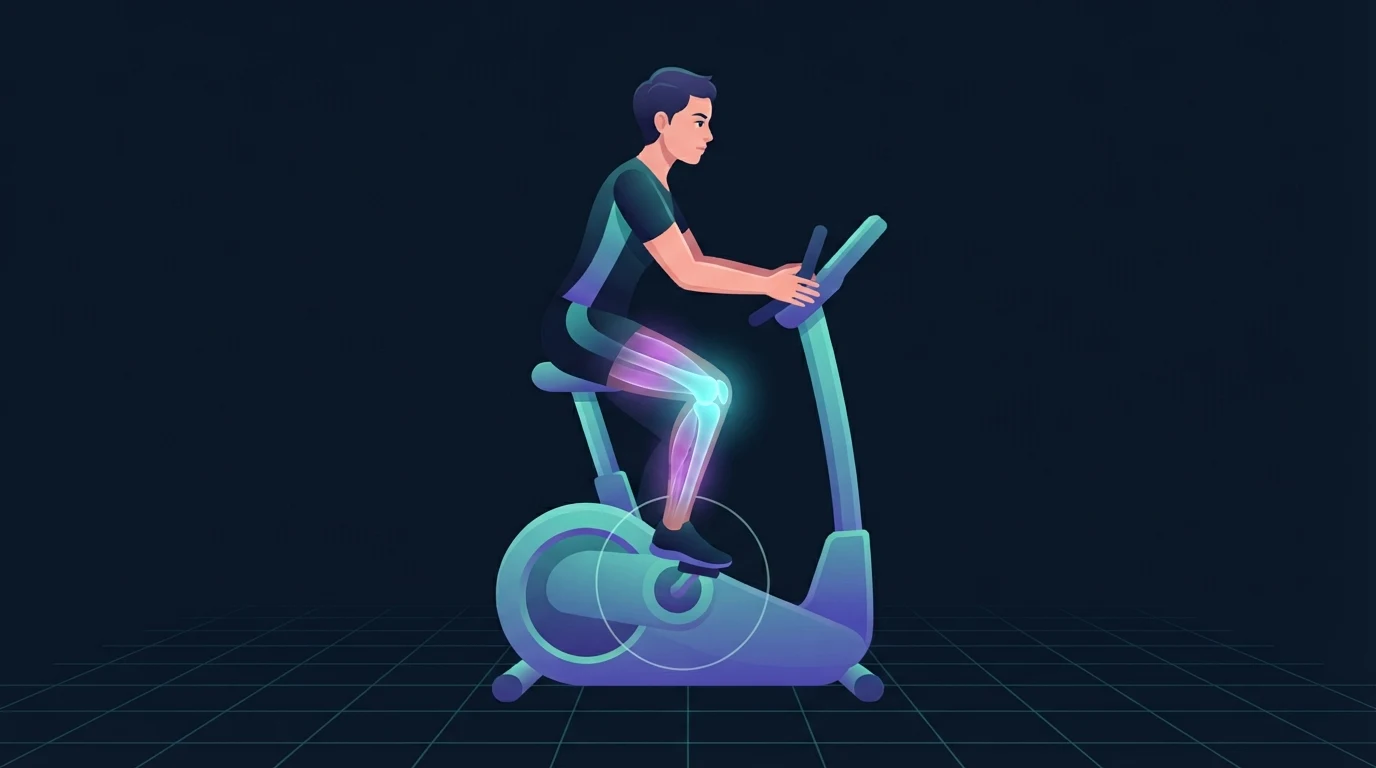
If one finding justifies owning an exercise bike, this is it. Luan, Bousie, Pranata, Adams and Han (2021) in Clinical Rehabilitation identified 11 studies covering 724 participants with knee osteoarthritis and meta-analysed eight of them against non-exercising controls:
- Pain: weighted mean difference 12.86 (95% CI 6.90 to 18.81). A clear, clinically meaningful reduction.
- Sport and recreation function: WMD 8.06 (95% CI 0.92 to 15.20). Statistically real, below the minimal clinically important difference.
- Stiffness: WMD 11.47 (95% CI 4.69 to 18.25). Also below the clinical threshold.
- Daily activities and quality of life: improved, but not to a clinically significant degree.
The honest summary is that cycling reliably reduces knee pain in osteoarthritis and improves function less dramatically than the pain number suggests. That is still a strong result for a low-risk, self-administered intervention, and it lines up with the broader modality comparisons in our review of exercise for knee osteoarthritis, where aerobic work ranks first among single modalities.
A newer biomechanics paper adds a programming detail that most cycling advice misses. Ebbecke and colleagues (2026) in Scandinavian Journal of Medicine and Science in Sports modelled both instantaneous and cumulative knee joint loading during cycling in riders with and without medial knee osteoarthritis. Their conclusion: cumulative exposure is governed by the interaction of load magnitude and pedal frequency, so anyone trying to protect a knee should control power output rather than simply spinning at a high cadence. Light and fast is not automatically safe if the wattage is high. Lower the watts first.
Get an evidence-based plan built for you
FitCraft, our mobile fitness app, pairs you with an AI coach who builds you a personalized plan around your goals, schedule, and fitness level. Every FitCraft program is designed by Domenic Angelino, MPH (Brown University) and NSCA-CSCS, with research published in the Journal of Strength and Conditioning Research and Medicine & Science in Sports & Exercise.
Take the Free Assessment Free • 2 minutes • No credit cardWhy Interval Research Lives on a Bike
Read almost any landmark interval-training study and you will find a cycle ergometer in the methods section. There is a reason. A bike lets a researcher set an exact power output, hold a participant to it, change it instantly between intervals, and measure gas exchange from a seated position with no risk of a fall. No other modality gives that much experimental control.
Milanovic, Sporis and Weston (2015) in Sports Medicine meta-analysed 28 studies covering 723 healthy adults with a mean age of 25.1 years. Against non-exercising controls, continuous endurance training raised VO2 max by 4.9 mL/kg/min (95% confidence limits 1.4) and interval training raised it by 5.5 mL/kg/min (1.2). Head to head, intervals beat continuous training by 1.2 mL/kg/min (0.9), described by the authors as a possibly small beneficial effect.
Read that carefully, because it argues for balance rather than for intervals only. Both approaches produced large gains. The interval advantage is real and modest. Since intervals also cost more recovery and more willingness, the sensible structure is a base of easy riding with one or two hard sessions on top. Our reviews of zone 2 training and the Tabata protocol cover both ends of that distribution, and the original Tabata work was itself done on cycle ergometers.
Mini Stepper Benefits Compared With an Exercise Bike
Mini steppers get searched alongside exercise bikes constantly, and they deserve an honest answer rather than a dismissal. A mini stepper is a pair of hydraulic pedals with a short stroke, usually under 20 centimetres, sometimes with resistance cords for the arms. It stores under a desk. It costs a fraction of a bike.
Here is the problem. There is almost no dedicated trial evidence on mini steppers as a training tool, and the mechanical reason is the short stroke and narrow resistance range. A bike moves from 3.5 to over 12 METs on one machine. A mini stepper occupies a thin slice near the bottom of that range and cannot be progressed meaningfully once you adapt to it.
The closest supporting research is on low-impact stepping programs rather than the devices. Chan and Yu (2022) in Archives of Gerontology and Geriatrics randomised 124 community-dwelling older adults with multimorbidity (mean age 78.1, 83.8 percent women) to thrice-weekly low-impact stepping exercise, progressed from low to moderate intensity over 12 weeks, or to control. The stepping group showed greater reductions in fatigue and frailty and greater improvements in physical activity level, exercise tolerance and mood, and the benefits held at a 12-week follow-up.
So the fair reading of mini stepper benefits is this. Stepping at a low to moderate intensity, done consistently, produces real functional gains in deconditioned and older adults. A mini stepper is a reasonable device for that specific job and an excellent way to break up long sitting. As a machine you will still be progressing on in a year, a bike wins on range, comfort, joint safety and measurability. If the stepper is the thing you will actually use daily and the bike is the thing that will hold laundry, buy the stepper.
Upright, Recumbent or Spin Bike
All three produce the same physiology at the same watts. The differences are postural, and each one solves a different problem.
- Upright. The general-purpose choice. Smallest footprint, most familiar position, widest price range. The weak point is saddle comfort, which is the single most common reason a home bike stops getting used.
- Recumbent. A reclined seat with a backrest and no saddle pressure. This is the default for lower back pain, balance problems, higher body weight, and early rehabilitation after a joint replacement. It is also the easiest bike to read a book on, which is not a trivial adherence feature.
- Spin bike. A heavy flywheel and a forward, road-style position. Best for standing efforts and hard intervals, worst for the wrists, neck and lower back if your position is poor. The 9.0 MET average for a studio class tells you what it is designed around.
Fit matters more than type. Saddle height should leave a slight bend in the knee at the bottom of the stroke, roughly 25 to 35 degrees from straight. Too low is the most common error and it's the one that makes knees ache. If a connected bike ecosystem is what you are weighing against a coaching app, our FitCraft and Peloton comparison lays out where each approach fits.
What an Exercise Bike Will Not Do
It will not load your bones
Cycling is non-weight-bearing by design, which is why it works for painful joints and also why it sends no osteogenic signal to the hip or spine. Riders who do nothing else are a known bone-density concern. Two strength sessions or a couple of walks with impact each week solve it, and it is worth doing deliberately rather than hoping.
It will not train your upper body
Nothing above the hips does meaningful work on a bike. Arm resistance cords on budget machines add almost nothing measurable.
It will not challenge your balance
The frame balances for you. That is a feature when instability is the problem and a gap when falls prevention is the goal. If balance is what you're training for, an unstable surface does that job better, which is the case our rebounder research review makes.
It will not out-ride your diet
The Chavarrias review is clear that the biggest body-composition changes came from riding plus a dietary change, not from riding alone. A bike is an excellent tool for protecting lean mass while you eat less. It is a mediocre one for creating the deficit by itself.
How to Program an Exercise Bike Week
The protocols that produced results in the literature sit between 2 and 6 sessions a week for at least 8 to 12 weeks. Here is a version most people can hold.
Weeks 1 to 4: build the seat time
- 3 sessions a week, 20 to 30 minutes, at a pace you could talk through (roughly 60 to 70 percent of maximum heart rate).
- Set resistance by watts if the display has them. Aim for a wattage you could hold for twice as long as the session.
- Fix saddle height in the first session. Most early knee complaints are a fit problem, not a training problem.
Weeks 5 to 8: add the third dimension
- 3 to 4 sessions a week. Keep two easy and 40 to 45 minutes long.
- Add one session of intervals: 4 blocks of 4 minutes at a hard but repeatable effort, with 3 minutes of easy spinning between. This is the structure most of the interval literature Milanovic pooled actually used.
- Add two strength sessions on non-riding days. This is the part the bike cannot cover.
Weeks 9 to 12: hold it and measure
- Keep the same shape. Add duration to the easy rides before adding intensity to the hard one.
- Retest the same benchmark every four weeks: average watts over a fixed 10 minutes, or heart rate at a fixed wattage. Either one shows the adaptation the trials measured.
- If a knee is the reason you are riding, hold the watts down and let duration do the work. Ebbecke's cumulative load finding says the wattage is what accumulates.
What the Research Suggests Going Forward
What the literature supports today:
- Stationary cycling spans 3.5 to 12.5 METs on a single machine, which is a wider usable range than any other common home cardio device (Ainsworth et al., 2011).
- Indoor cycling programs of 8 to 24 weeks improve VO2 max by roughly 8 to 10.5 percent and lower systolic blood pressure by 2 to 17 mmHg (Chavarrias et al., 2019).
- Riding alongside a dietary change protects lean mass that dieting alone costs you (Chavarrias et al., 2019).
- Stationary cycling produces a clinically meaningful reduction in knee osteoarthritis pain (Luan et al., 2021).
- Interval work on a cycle ergometer produces slightly larger VO2 max gains than continuous riding, with both producing large gains (Milanovic et al., 2015).
What is still unresolved:
- Whether the class-style content on connected bikes improves long-term adherence over self-directed riding. It is the loudest claim in the category and it has not been rigorously tested.
- How much of the indoor cycling literature generalises beyond its sample, which skews heavily female, young to middle-aged and self-selected.
- The optimal cadence and power combination for protecting an osteoarthritic knee over months rather than within a single session.
- Whether mini steppers produce any measurable cardiorespiratory adaptation at all. Nobody has run the trial.
The practical read is unfussy. Three to four rides a week between 20 and 45 minutes, most of them easy, one of them hard, with two strength sessions beside them, will produce the aerobic, blood pressure, lipid and knee-pain changes the machine is genuinely capable of. Get the saddle height right and the rest is attendance.
References
- Chavarrias M, Carlos-Vivas J, Collado-Mateo D, Perez-Gomez J. "Health benefits of indoor cycling: a systematic review." Medicina (Kaunas). 2019;55(8):452. doi:10.3390/medicina55080452
- Luan L, Bousie J, Pranata A, Adams R, Han J. "Stationary cycling exercise for knee osteoarthritis: a systematic review and meta-analysis." Clin Rehabil. 2021;35(4):522-533. doi:10.1177/0269215520971795
- Ainsworth BE, Haskell WL, Herrmann SD, et al. "2011 Compendium of Physical Activities: a second update of codes and MET values." Med Sci Sports Exerc. 2011;43(8):1575-1581. doi:10.1249/MSS.0b013e31821ece12
- Milanovic Z, Sporis G, Weston M. "Effectiveness of high-intensity interval training (HIT) and continuous endurance training for VO2max improvements: a systematic review and meta-analysis of controlled trials." Sports Med. 2015;45(10):1469-1481. doi:10.1007/s40279-015-0365-0
- Ebbecke J, Hansen L, Viellehner J, Edwards WB, Naeckel N, Potthast W. "Instantaneous and cumulative knee joint loading in cycling with and without medial knee osteoarthritis." Scand J Med Sci Sports. 2026;36(3):e70259. doi:10.1111/sms.70259
- Chan MLT, Yu DSF. "The effects of low-impact moderate-intensity stepping exercise on fatigue and other functional outcomes in older adults with multimorbidity: a randomized controlled trial." Arch Gerontol Geriatr. 2022;98:104577. doi:10.1016/j.archger.2021.104577
Frequently Asked Questions
What are the benefits of an exercise bike?
The exercise bike benefits with the strongest evidence are aerobic fitness, blood pressure, blood lipids and joint tolerance. Chavarrias and colleagues (2019) reviewed 13 indoor cycling studies covering 372 participants and reported VO2 max gains of 8 to 10.5 percent, systolic blood pressure reductions of 2 to 17 mmHg, diastolic reductions of 0.6 to 6.5 mmHg, and reductions in total cholesterol of 6.8 to 33.8 mg/dL. Because the pedal path is fixed and your body weight sits on the saddle rather than on your joints, cycling also carries the best evidence of any home cardio machine for people with painful knees.
How many calories does an exercise bike burn?
It depends almost entirely on the watts, not on the machine. The 2011 Compendium of Physical Activities from Ainsworth and colleagues puts stationary cycling at 4.0 METs at 50 watts, 6.0 METs at 90 to 100 watts, 8.0 METs at 126 to 150 watts, and 10.3 METs at 151 to 199 watts. A studio-style spin class averages 9.0 METs. A MET is roughly one kilocalorie per kilogram of body weight per hour, so a 70 kilogram adult riding 30 minutes at 100 watts burns about 210 kilocalories. Multiply your weight in kilograms by the MET value by the hours ridden to scale it to yourself.
Is an exercise bike good for bad knees?
It is the most evidence-backed cardio machine for painful knees. Luan and colleagues (2021) in Clinical Rehabilitation pooled 11 studies and 724 participants with knee osteoarthritis and found stationary cycling reduced pain with a weighted mean difference of 12.86 (95% CI 6.90 to 18.81) against non-exercising controls, and improved sport function (WMD 8.06). Improvements in stiffness, daily activities and quality of life were real but below the threshold considered clinically important. The reason is mechanical: there is no ground contact, the pedal path is fixed, and you control the resistance to the watt.
Is an exercise bike better than a mini stepper?
For measurable fitness change, yes, mostly because a bike gives you a calibrated resistance range and a mini stepper does not. A bike scales from 3.5 METs to over 12 METs on the same machine, so it keeps working as you get fitter. Mini steppers have a short stroke, a narrow resistance range and almost no dedicated trial evidence. The closest supporting research is on low-impact stepping programs rather than the devices themselves: Chan and Yu (2022) randomized 124 older adults with multimorbidity to thrice-weekly low-impact stepping for 12 weeks and reduced fatigue and frailty while improving exercise tolerance and mood. A mini stepper is a legitimate way to break up sitting. It is a weak tool for progressive cardio training.
How long should you ride an exercise bike to see results?
The indoor cycling trials that produced results clustered at 8 to 24 weeks, 2 to 6 sessions per week, 30 to 100 minutes per session, at 55 to 91 percent of maximum heart rate, with 12 weeks the most common length. Aerobic and blood pressure changes typically appear within 8 to 12 weeks at three sessions a week. Body composition change in those same trials was much larger when riding was paired with a dietary change, and diet alone cost participants about 2.2 kg of lean mass while the exercise groups held on to theirs.
Should you get an upright, recumbent or spin bike?
Match the bike to the constraint that is actually stopping you. A recumbent bike supports the lower back and removes saddle pressure, which makes it the usual pick for back pain, balance problems, obesity and early rehabilitation. An upright bike is the general-purpose option and takes the least floor space. A spin bike has a heavy flywheel and a road-style position, which suits standing efforts and hard intervals but loads the wrists, neck and lower back more. All three produce the same physiology at the same watts, so the deciding factor is which one you will sit on four times a week.