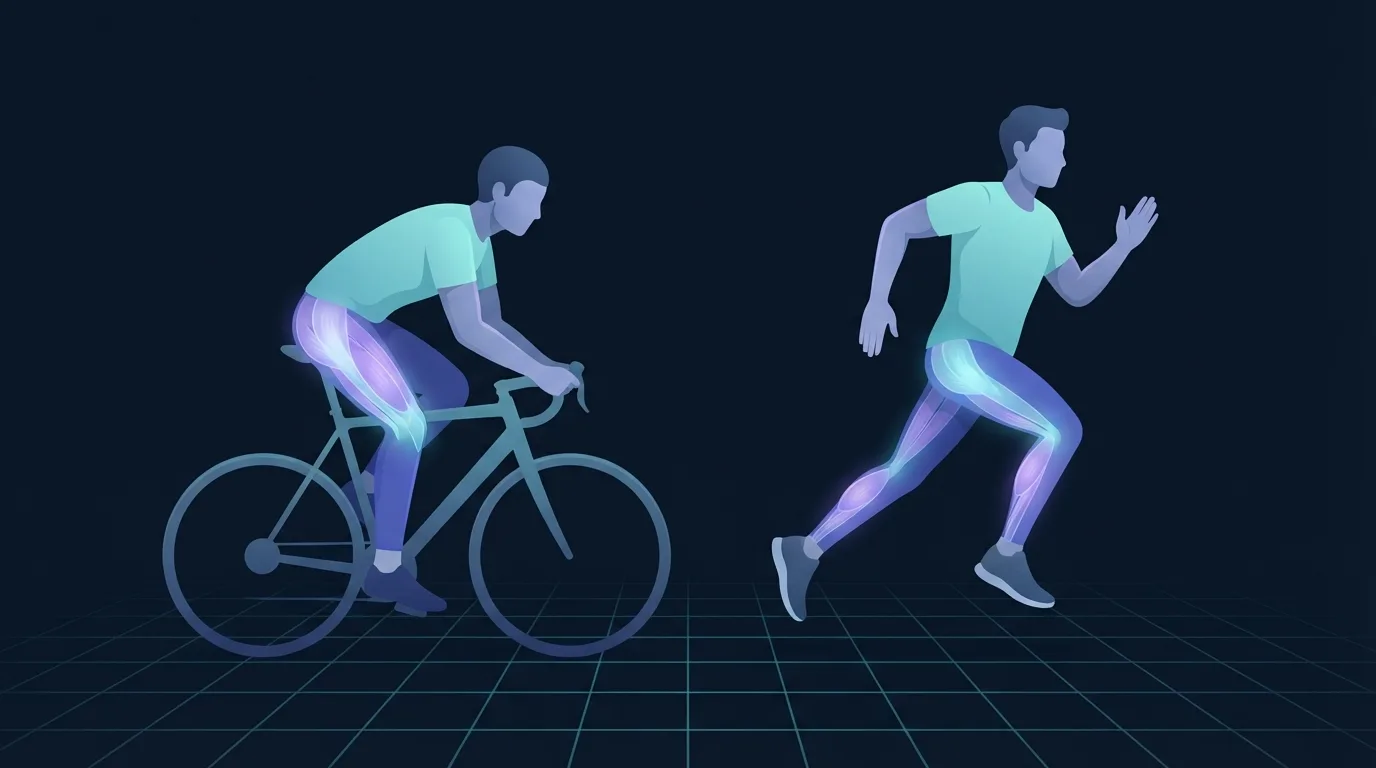
Pick running if you are short on time, want the bone and tendon benefits of impact, and your joints can take a landing. Pick cycling if running hurts, if you're carrying weight that makes impact miserable, or if you want to accumulate a lot of aerobic minutes without wrecking yourself. On heart and lung adaptation the two are close enough that the tiebreaker is almost never physiology. It is what your body tolerates and what fits in your week.
The argument usually gets framed as which one burns more, which is the least interesting question available. Both burn plenty. What separates them is what they charge you for the privilege, and those bills arrive in completely different currencies.
What Actually Separates Cycling and Running
| Cycling | Running | |
|---|---|---|
| Impact per session | None. Feet never leave the pedals | Thousands of landings, each several times bodyweight |
| Time to a hard stimulus | Longer. You can coast, so easy minutes accumulate fast | Shorter. There is no freewheel on foot |
| Main muscles | Quadriceps and glutes, mostly concentric | Calves, hamstrings and glutes, with heavy eccentric loading |
| Bone effect | Little to none. Road cyclists often show low spine density | Osteogenic. Impact is the signal bone responds to |
| Typical injuries | Lower back pain, anterior knee pain, crash trauma | Knee, shin, Achilles, plantar fascia, stress reactions |
| Equipment | Bike, helmet, lights, pump, tools, somewhere to store it | Shoes, replaced every few hundred miles |
| Weather tolerance | Poor outdoors. Good indoors on a trainer | Good. Cold and rain are an inconvenience, not a hazard |
| Scales to a commute | Easily, which is where its best outcome data comes from | Rarely, unless your workplace has a shower |
Which Burns More Calories per Hour?
Neither, in any way that should decide your training. The honest comparison uses METs, the multiple of resting metabolism an activity costs, and those come from the 2024 Adult Compendium of Physical Activities compiled by Herrmann et al. in the Journal of Sport and Health Science, which pooled 2,356 measured energy-expenditure values from 701 studies. One MET is roughly one calorie per kilogram of bodyweight per hour, so a 70 kg adult burns about 70 calories an hour per MET.
| Activity | METs | Approx. calories per hour at 70 kg |
|---|---|---|
| Cycling, 10 to 12 mph, easy | 6.8 | 475 |
| Running, 12-minute mile | 8.5 | 595 |
| Cycling, 12 to 14 mph, moderate | 8.0 | 560 |
| Running, 10-minute mile | 9.3 | 650 |
| Cycling, 14 to 16 mph, vigorous | 10.0 | 700 |
| Running, 8:30 mile | 11.0 | 770 |
| Cycling, 16 to 19 mph, very fast | 12.0 | 840 |
Read the table by row pairs and the pattern is obvious. Matched for effort, the two are interchangeable. A vigorous ride outburns a steady jog. A hard run outburns a moderate ride. Nothing about the machine or the road is doing the work here, your heart rate is.
Where running genuinely wins is time density. You cannot coast on foot, so a running hour is an hour of continuous work, while a riding hour usually contains junk minutes at traffic lights, on descents and in the wheel of the person in front of you. That is why per-mile comparisons are so misleading: a bike covers two to three times the ground, so five miles of each are not remotely the same session. Compare minutes and effort, never distance.
Cardiovascular Adaptation and VO2 Max
Both raise VO2 max, and that number matters more than almost any other fitness marker, as we covered in our review of VO2 max and longevity. What most people miss is that VO2 max is partly mode-specific. Millet et al. (2009), reviewing the cycling and running literature in Sports Medicine, found that runners reach a higher VO2 max on a treadmill than on a bike, cyclists reach values on a cycle ergometer similar to what they hit running, and triathletes show no difference between the two. Your test score follows your training, not your heart.
The same review found other genuine differences. Ventilation is more impaired during cycling, delta efficiency is higher in running, and prolonged running produces more central fatigue than prolonged cycling. None of those should change your choice. They explain why a strong cyclist feels clumsy on their first run back and why the reverse feels merely slow.
For hard outcomes rather than lab numbers, cycling has the better cohort. Celis-Morales et al. (2017) followed 263,450 UK Biobank participants for a median of 5 years and found cycle commuting associated with a 41 percent lower risk of all-cause mortality (hazard ratio 0.59), a 46 percent lower risk of cardiovascular disease and a 45 percent lower risk of cancer, all in fully adjusted models. Walking to work showed a smaller cardiovascular benefit and no significant all-cause effect. There was no running arm in that study, so this is not evidence that cycling beats running. It's evidence that a mode of exercise people actually repeat five days a week, for years, produces the kind of numbers single training studies never capture.

Impact and Injury: The Real Dividing Line
Running injury rates are high and well documented. van Gent et al. (2007), a systematic review in the British Journal of Sports Medicine, found lower-extremity injury incidence in distance runners ranging from 19.4 to 79.3 percent depending on the population and definition used, with the knee as the most commonly injured site. Videbaek et al. (2015) pooled 13 prospective studies in Sports Medicine and expressed the risk per hour instead: 17.8 injuries per 1,000 hours of running in novices against 7.7 per 1,000 hours in recreational runners, with the whole range running from 2.5 in long-distance track athletes to 33.0 in novices.
Read that carefully, because the gap between novice and recreational is the actual finding. Running is not inherently dangerous. Being new to running and adding load faster than your tendons can adapt is dangerous, and the first three months are where almost all of it happens.
Cycling is not injury-free, it just hurts differently. Clarsen et al. (2010) surveyed 109 professional road cyclists in the American Journal of Sports Medicine and found 58 percent had experienced lower back pain in the previous 12 months, with 41 percent seeking medical attention for it, and 36 percent had anterior knee pain. Knee injuries caused 57 percent of the cases that took riders off the bike. Those are professionals riding enormous volumes, so the absolute numbers don't transfer to your commute. The pattern does: cycling loads the lower back and the front of the knee through thousands of repetitions in a fixed position, and a bad saddle height compounds it every single revolution.
Then there is the part no training study measures. Riding on roads carries crash risk that running on a footpath does not, and a crash is a different category of event from a sore Achilles. If your only safe riding is on open roads at dusk, that belongs in your decision.
Find out what's really holding you back
FitCraft, our mobile fitness app, pairs you with an AI coach who builds you a personalized plan around your goals, schedule, and fitness level. Every FitCraft program is designed by Domenic Angelino, MPH (Brown University) and NSCA-CSCS, with research published in the Journal of Strength and Conditioning Research and Medicine & Science in Sports & Exercise.
Take the Free Assessment Free • 2 minutes • No credit cardWhat Each One Does to Muscle and Bone
Cycling builds more leg muscle than running does, which surprises people who assume neither builds any. Ozaki et al. (2015), reviewing the evidence in Acta Physiologica Hungarica, concluded that cycle training does induce hypertrophy and strength gains, but it takes longer than resistance training to produce the same change, and younger adults generally need higher-intensity intermittent cycling rather than steady riding to get strength out of it. Older adults show larger strength improvements from the same work.
Running does far less for size. Beyond the first few months, a runner's legs adapt by getting more efficient rather than bigger, and the calves are the only group that reliably thickens. Neither activity is a substitute for lifting. If muscle matters to you, two strength sessions a week sit on top of whichever one you pick, not instead of it.
Bone is where the two genuinely diverge, and it runs the other way. Olmedillas et al. (2012) reviewed 31 studies in BMC Medicine and found adult road cyclists in regular training carry low bone mineral density in key regions, particularly the lumbar spine. Their explanation is mechanical rather than nutritional: riders spend hours in a weight-supported position and then spend their recovery sitting or lying down, so the skeleton never receives the impact signal it adapts to. The review noted that mountain biking, or combining cycling with another sport, appears to soften the effect.
That finding is the strongest practical argument against cycling as your only activity, especially past 40. It is also easy to solve. Two runs a week, or a couple of strength sessions with real load, restores the signal cycling never sends.
Time, Cost and the Logistics Nobody Mentions
Running is the cheapest and fastest form of cardio there is. Shoes, a door, and thirty minutes. Nothing to store, nothing to maintain, no route planning, and the session starts the second you step outside. That matters more than most training variables, because the friction between deciding to train and starting to train is where consistency dies.
Cycling asks for more up front and repays it in volume. A bike, a helmet, lights, a pump and a basic tool kit, plus somewhere to keep them and a route that doesn't terrify you. A useful ride is usually 60 to 90 minutes rather than 30, partly because of the coasting problem and partly because it takes ten minutes at each end just to get out of your neighbourhood. An indoor trainer removes the weather, the traffic and the route planning, and turns cycling into the most controllable cardio available. It also makes the boredom worse, which is a real cost and not a character flaw.
If the honest answer is that neither will happen unless something makes you turn up, the format matters less than the accountability wrapped around it. Our rundown of the workout apps worth starting with compares the ones built for people whose problem is showing up rather than programming.
Who Should Choose Which
| If this is you | Start with | Why |
|---|---|---|
| Short on time, 30 minutes at most | Running | No coasting and no setup. Every minute is working time |
| Carrying significant extra weight | Cycling | Bodyweight sits on the saddle instead of the joints |
| Knee or hip osteoarthritis | Cycling | Range of motion without ground reaction force |
| Worried about bone density | Running | Impact is the only signal in this pair that builds bone |
| Returning from a running injury | Cycling | Holds aerobic fitness while tissue load comes down |
| Commuting to work | Cycling | Turns training into transport, which is why it gets repeated |
| Chronic lower back pain | Running, cautiously | A forward-flexed riding position is the last thing a cranky back wants |
| Training for a hilly hike or an obstacle race | Running | Specificity. Nothing prepares legs for descending like descending |
Two of those rows deserve a caveat. Cycling for arthritic knees is well supported, but it isn't automatic: saddle too low and you will find the exact position that irritates a kneecap. And running for back pain assumes the pain is not mechanically provoked by impact, which is a conversation for a clinician rather than a table.
A Hybrid Week That Uses Both
Doing both is the answer for most people, and it is not complicated. Run for the bone, the tendon conditioning and the time efficiency. Ride for the extra aerobic hours your legs could never absorb on foot. Keep exactly two hard sessions and make everything else genuinely easy.
| Day | Session | Why it is there |
|---|---|---|
| Monday | Easy ride, 45 to 60 min | Aerobic volume at almost no tissue cost |
| Tuesday | Run, 30 min easy, plus 4 to 6 strides | Keeps the legs used to landing |
| Wednesday | Strength, 40 min, lower body focus | The muscle and bone neither mode supplies |
| Thursday | Hard bike intervals, 5 x 4 min | High intensity with no impact to recover from |
| Friday | Rest or an easy walk | Absorb the week |
| Saturday | Run, 35 to 45 min, one tempo block | The session that moves threshold pace |
| Sunday | Long easy ride, 75 to 120 min | Volume you would never survive on foot |
Two rules protect that week. Never stack the hard bike day next to the tempo run, and cap total running increases at roughly 10 percent a week while your tendons catch up. If you want the tempo block done properly rather than guessed at, our guide to finding your threshold pace walks through the effort, the duration and the common mistake of running it too hard.
If impact is the thing stopping you and a bike is not an option, a machine is the third door. We compared the two most common ones in elliptical vs treadmill, including how each one loads the knee.
The Bottom Line
Cycling vs running comes down to what you can afford to spend. At matched effort the calorie burn and the cardiovascular stimulus are close enough to ignore. Running costs joints and tendons, pays you back in bone, tendon stiffness and time saved. Cycling costs time, gear and bone, pays you back in far more aerobic volume than your legs would ever tolerate on foot.
Practical rule: if your joints are fine and your calendar is not, run. If your joints complain or you have a lot of weight to move, ride. If neither is true, do two of each a week and add strength training, because that combination has no meaningful weakness.
The thing that decides your result is not on this page. It's whether you're still doing either one in six months. Both of these activities produce their entire effect through repetition, and every injury rate quoted above is really a story about people who progressed faster than their tissue allowed. Go slower than feels necessary at the start. That is the whole trick.
Frequently Asked Questions
Is cycling or running better for weight loss?
Per hour of hard effort they're close, so the better one is the one you will do more hours of. Running is more time-efficient because you can't coast, and the Compendium of Physical Activities puts a 10-minute-mile run at 9.3 METs against 8.0 METs for riding at 12 to 14 mph. Cycling wins back the difference by being easier to sustain for 90 minutes and easier on a body carrying extra weight.
Is cycling as good as running for cardiovascular fitness?
Yes, if you ride hard enough. VO2 max is partly mode-specific: runners test higher on a treadmill, cyclists test at similar values on a bike, and triathletes show no difference between the two. The catch is that riding lets you freewheel, so a lazy hour on a bike is not the same stimulus as a lazy hour of running, which doesn't exist.
Is cycling easier on your knees than running?
It removes the impact but not the knee load. Cycling has no footstrike, so nothing slams through the shin, knee and hip several thousand times an hour. It still loads the kneecap through a long, repetitive range: 36 percent of professional road cyclists reported anterior knee pain in a single year, and knee problems caused most of their time away from the bike.
Does cycling build more leg muscle than running?
A little more, and mostly in the quadriceps. Hard cycling can produce real hypertrophy, but it needs longer than resistance training to get there and usually needs higher-intensity intervals rather than steady riding. Running builds very little leg size in anyone past the beginner stage. If you want visible muscle, neither one replaces two strength sessions a week.
How long do you have to cycle to match a run?
Roughly two to three times the distance, or about 1.2 to 1.5 times the minutes at a matched perceived effort. Distance is the wrong currency here because a bike covers ground so much faster. Compare sessions by time and effort instead: 40 hard minutes on a bike and 40 hard minutes of running are far more alike than 5 miles of each.
Can you cycle and run in the same week?
Yes, and for most people that beats picking one. Two runs and two rides a week give you the bone loading and time efficiency of running with the extra aerobic volume of cycling at a much lower tissue cost. Keep the two hard sessions on separate days and let everything else stay genuinely easy.