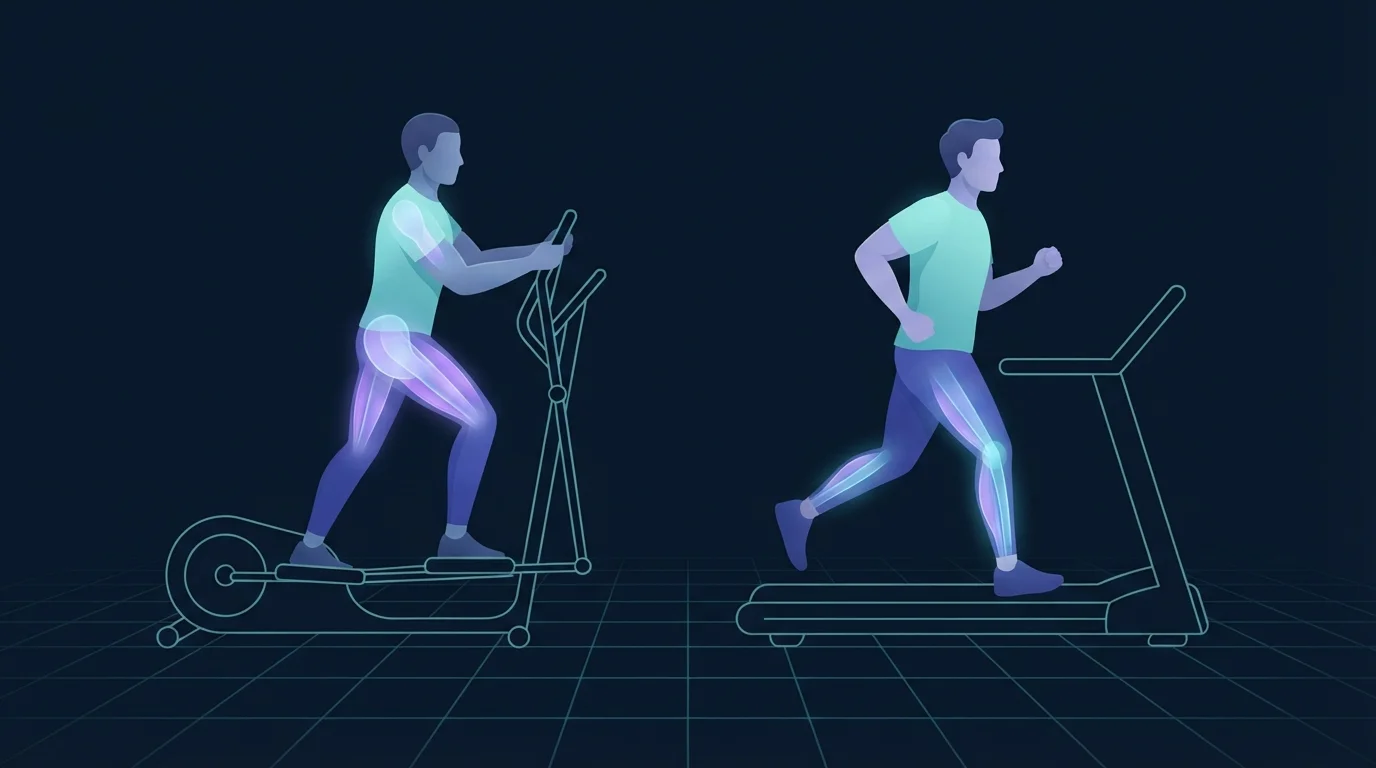
Choose the treadmill if your goal involves getting better at moving your own bodyweight over ground: walking further, hiking, climbing stairs without stopping, or building toward running. Choose the elliptical if impact hurts, if you're coming back from a lower body injury, or if the reason you skip cardio is that running feels miserable. On calorie burn, cardiovascular fitness and fat oxidation, the two are close enough that the difference shouldn't decide anything.
That's not how the machines get sold. Ellipticals are marketed as the low-impact option that somehow burns more. Treadmills get marketed as the serious one. Both claims lean on a number on a display panel, and that number is the least reliable thing in the room.
What Actually Separates an Elliptical From a Treadmill
Both machines drive the same engine. You move large muscles rhythmically for a sustained period, your heart rate climbs, and your aerobic system adapts. What changes is how force gets into your body and which muscles have to produce it.
| Elliptical | Treadmill | |
|---|---|---|
| Foot contact | Continuous, feet never leave the pedals | Repeated strike, plus a flight phase when running |
| Impact loading | Loading rates measured lower than ordinary walking | Walking is moderate, running is several times bodyweight |
| Muscles emphasised | Quadriceps dominant, plus arms if you push the handles | Calves, hamstrings and glutes, more so with incline |
| Heart rate at matched effort | Runs higher for the same oxygen cost | Tracks oxygen cost more closely |
| How it gets harder | Resistance level, ramp height, stride rate | Speed and incline |
| Carryover outside the gym | Limited, the movement pattern is machine-specific | Direct, you're walking or running |
| Best argument for it | Lets you train hard without punishing your joints | The skill you train is a skill you use |
| Weakest claim made for it | "Burns more calories than running" | "Running is the only real cardio" |
One of those weak claims deserves a specific correction, because it costs people real progress.
Does the Elliptical or Treadmill Burn More Calories?
Neither. Brown et al. (2010), in the Journal of Strength and Conditioning Research, had 9 men and 9 women complete two separate 15-minute submaximal tests, one on a treadmill and one on an elliptical, both regulated to a rating of perceived exertion of 12 to 13. Oxygen consumption didn't differ between machines. Energy expenditure didn't differ either. Heart rate did: 164 beats per minute on the elliptical against 145 on the treadmill, a gap of nearly 20 beats for the same actual work.
That heart rate gap is why the elliptical feels like it should be burning more. It isn't evidence of a bigger burn. Holding and pushing the handles brings the arms into the effort, and upper body work drives heart rate up out of proportion to oxygen cost. Your pulse monitor reads higher. Your metabolism doesn't care.
The console makes it worse. Glave et al. (2018), writing in Exercise Medicine, put 34 adults through a 30-minute elliptical session (5 minutes of warm-up, 20 minutes of moderate work, 5 minutes of cool-down) while measuring energy expenditure by indirect calorimetry at the same time. The machine's own algorithm overstated the total by roughly 128 calories. The error grew as the session ran on, from about 19 calories at the five-minute mark to about 120 by minute 25.
A practical rule: use the display to compare today's session with last week's session on the same machine, and never to decide what you've earned back at dinner. If losing weight is the actual goal here, the machine matters far less than what the rest of your week looks like. We went through which tools help people hold a week together in our roundup of the best workout apps for weight loss.
What About Joints, Impact and Injury?
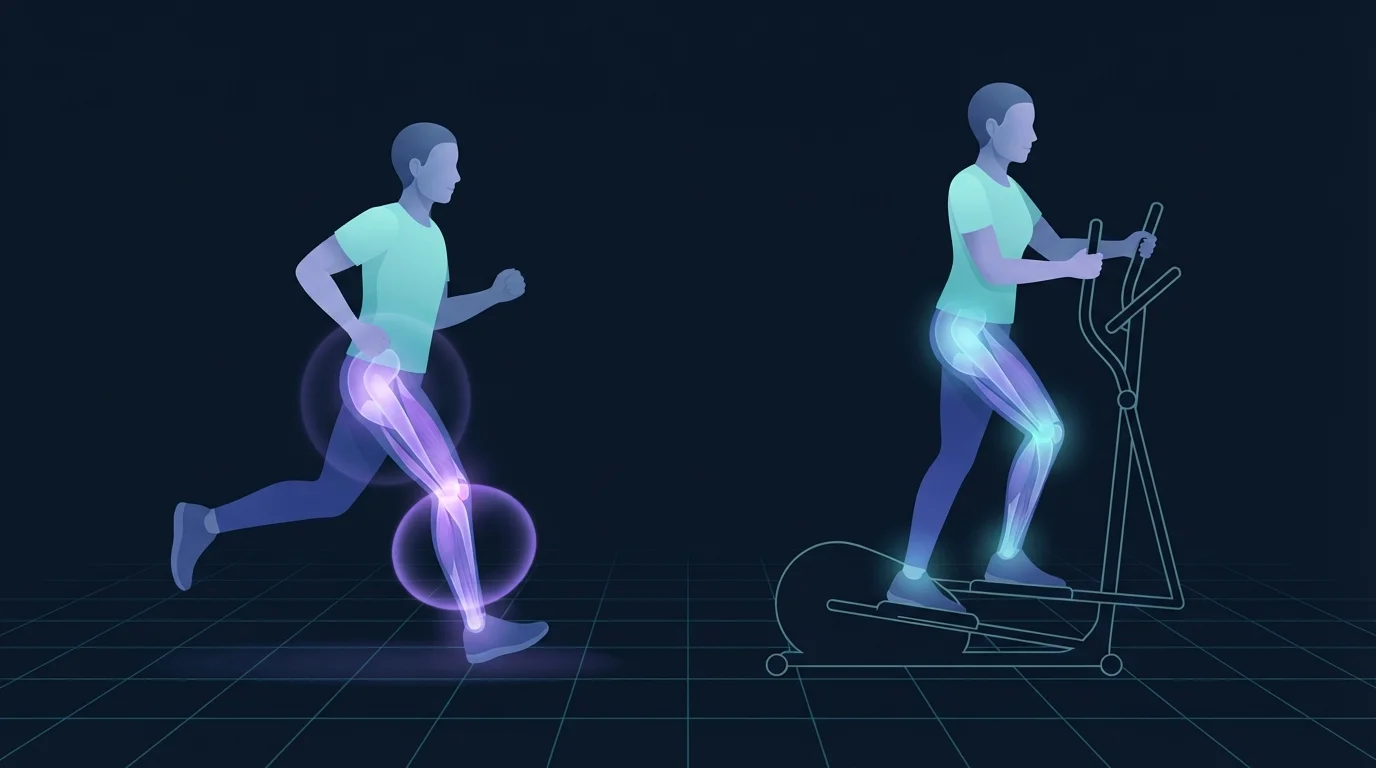
Here the two machines genuinely separate, and the elliptical wins the impact argument by more than most people expect.
Lu et al. (2007), in Medicine and Science in Sports and Exercise, ran a three-dimensional dynamic analysis on 15 men during level walking and during elliptical exercise matched to each person's own walking cadence and step length. During early stance the vertical pedal reaction force on the elliptical was smaller than the ground reaction force of walking, and every loading rate around heelstrike was lower. That's the elliptical beating walking, never mind running.
There's a cost attached. In the same study, peak flexion angles at the hip, knee and ankle were greater on the elliptical, and so were peak hip flexor and knee extensor moments. Prosser et al. (2011) in Gait and Posture backs that up from the muscle side. Across 10 healthy adults tested on overground walking, treadmill walking, cycling and elliptical training, the elliptical produced greater quadriceps activity and greater quadriceps-hamstring co-contraction than all three other conditions. So the elliptical isn't a universal joint saver. It swaps impact spread through the whole leg for sustained demand at the front of the thigh and the kneecap.
For running, the injury numbers aren't subtle. Videbaek et al. (2015) pooled 13 prospective studies in Sports Medicine and reported a weighted incidence of 17.8 running-related injuries per 1,000 hours of running in novice runners, against 7.7 per 1,000 hours in recreational runners. Across the individual studies the range ran from 2.5 to 33.0 per 1,000 hours. Beginners are the people getting hurt, and beginners are exactly who tends to get handed a treadmill and told to run on it.
If knee pain is what sent you to this page, the load question matters more than the machine question. Our summary of the trial evidence on exercise for knee osteoarthritis covers what actually helps, and a short set of calf raises two or three times a week does more for how your knees tolerate walking than any choice of cardio machine.
Find out what's really holding you back
FitCraft, our mobile fitness app, pairs you with an AI coach who builds you a personalized plan around your goals, schedule, and fitness level. Every FitCraft program is designed by Domenic Angelino, MPH (Brown University) and NSCA-CSCS, with research published in the Journal of Strength and Conditioning Research and Medicine & Science in Sports & Exercise.
Take the Free Assessment Free • 2 minutes • No credit cardDoes Elliptical Training Carry Over to Running?
For your heart and lungs, yes. For your legs, only partly.
Bosch et al. (2021), in the International Journal of Sport Nutrition and Exercise Metabolism, tested 18 trained runners (9 men and 9 women, average age 23) on a treadmill, an elliptical trainer and a stepper at 60, 70 and 80 percent of peak workload on each. Peak oxygen uptake came out at 49.3, 48.0 and 46.7 ml per kg per minute respectively, which isn't a meaningful spread. Oxygen consumption, heart rate and the balance of carbohydrate and fat burned all shifted with intensity, as they should, and didn't shift with the machine. The authors' conclusion was direct: the elliptical trainer and the stepper are suitable substitutes for running when running load has to come down, such as during rehabilitation from a running injury.
What the elliptical can't give you is the tissue conditioning. Tendons, bone and the small stabilising muscles adapt to the specific loading pattern you feed them, and the elliptical deliberately removes that pattern. Six weeks of elliptical work will keep your aerobic base intact. It won't prepare your calves and Achilles for a 10K. If running is your goal, the elliptical is your injury insurance, not your training plan. A little direct strength work covers the gap: single leg deadlifts build the hip and hamstring control running asks for and neither machine trains.
The carryover runs the other way too. Treadmill walking and running transfer cleanly to hills, stairs, airports and the rest of ordinary life, because the movement is the movement. If a bigger aerobic engine is what you're after in general, our guide on how to increase stamina lays out the weekly structure that builds one, on any machine.
Which One Should You Pick?
| If this is you | Start with | Why |
|---|---|---|
| Knee, hip or back pain with impact | Elliptical | Loading rates measured lower than ordinary walking |
| Kneecap pain specifically | Treadmill, walking incline | Elliptical striding raises knee extensor demand |
| Complete beginner, low confidence | Elliptical | No impact, no moving belt, nothing to fall off |
| Training for a race or a hike | Treadmill | Only one of the two trains the actual movement |
| Injured runner holding fitness | Elliptical | Matched oxygen uptake without the footstrike |
| Losing weight is the goal | Whichever you'll repeat | Energy expenditure is identical at matched effort |
| Over 60 or back after a long gap | Treadmill, brisk walk | Walking speed and stair capacity are the outcomes that matter |
| Bored within ten minutes | Treadmill | Speed and incline give you more variables to play with |
Only two rows in that table are about physiology. The rest are about pain, confidence and boredom, which is roughly the right ratio. The machine that produces results is the one you get on.
How to Use Each One Well
Most people use both machines badly in the same way: one unchanging intensity, forever. Here's what changes that.
| Goal | On the elliptical | On the treadmill |
|---|---|---|
| Aerobic base | 35 to 50 min at a resistance you can hold a conversation through | Brisk walk at 3 to 6 percent incline, same duration |
| Hard session | 6 x 2 min at high resistance, 2 min easy between | 6 x 2 min uphill at 8 to 10 percent, walk the recovery |
| Stronger legs | Raise the ramp, lower the stride rate, push through the heels | Raise the incline before you raise the speed |
| Coming back from injury | Start at 15 min, add 5 min a week | Walk first, then add running in 1 min blocks |
| Short on time | 20 min alternating 1 min hard, 1 min easy | 20 min of incline walking, no speed changes needed |
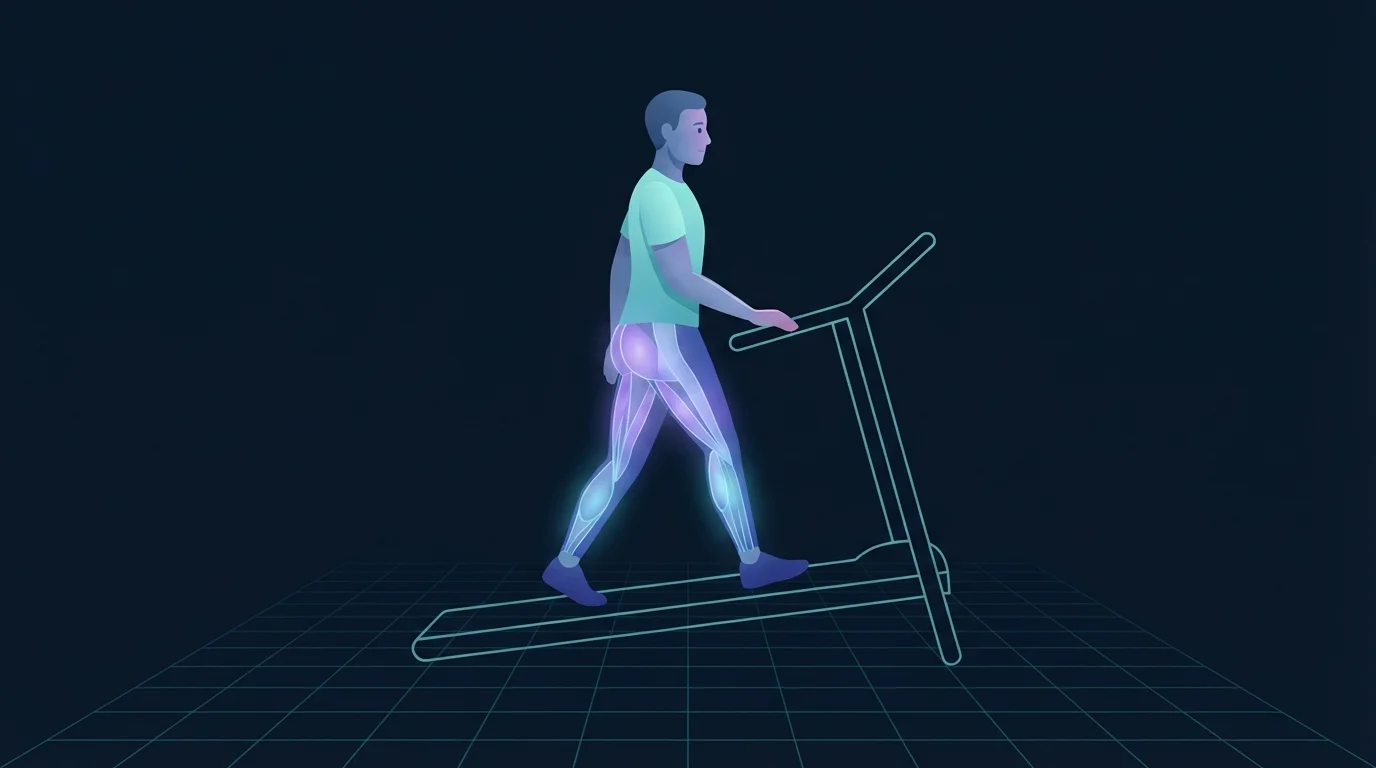
Three things worth applying today. On the elliptical, stop leaning your bodyweight into the handles: the moment your arms hold you up, your legs stop doing the work and the session goes soft. Let go for a minute at a time and you'll feel exactly how much you were cheating. On the treadmill, raise the incline before the speed, because incline buys intensity without adding footstrikes. And on both, spend most of your weekly minutes at an easy conversational effort rather than in the vague middle, which is the principle behind zone 2 work and part of why the incline walking research keeps producing results that look too good for how easy the sessions feel.
The Bottom Line
Elliptical vs treadmill is a joint decision, not a calorie decision. Matched for effort, the two produce the same oxygen consumption, the same energy expenditure and the same fuel mix. The elliptical loads your legs more gently than walking does and asks more of your quadriceps. The treadmill trains a movement you use every day and carries the injury risk that comes with repeated impact.
Practical rule: if impact is the thing stopping you from training, take the elliptical. If you want to be better at moving your own body over ground, take the treadmill and raise the incline. If neither describes you, take whichever one you'll still be using in twelve weeks.
There's a version of this question that has nothing to do with machines. Barry, 42, lost 28 pounds in four months and described it this way: "Lost weight during breakfast while kids ate, worked around my life." He didn't find the optimal cardio modality. He found a slot in his day that survived contact with real life. That's the variable this whole article has been circling.
Frequently Asked Questions
Is the elliptical or treadmill better for weight loss?
Neither has an edge once effort is matched. Brown et al. (2010) found identical oxygen consumption and energy expenditure on a treadmill and an elliptical when 18 adults worked at the same perceived exertion. Weight loss tracks total weekly energy expenditure and food intake, so the machine you will actually use three or four times a week is the one that works better for you.
Does the elliptical burn as many calories as the treadmill?
Yes, at the same effort level. The catch is the console. Glave et al. (2018) compared an elliptical's own calorie readout against indirect calorimetry in 34 adults and found the machine overstated the total by roughly 128 calories across a 30-minute session. Treat any machine display as a rough relative guide rather than a number you can eat back.
Is the elliptical better for bad knees than the treadmill?
For impact, yes. Lu et al. (2007) measured 15 adults and found vertical pedal reaction forces and loading rates on an elliptical were lower than the ground reaction forces of ordinary walking, because the feet never leave the pedals. The trade-off is that elliptical striding asks more of the knee extensors, so people with kneecap pain sometimes prefer a treadmill at a walking incline.
Can elliptical training replace running?
It can hold your aerobic fitness, but it cannot replace the specific tissue conditioning running requires. Bosch et al. (2021) tested 18 trained runners and found oxygen uptake, heart rate and fuel use did not differ between a treadmill, an elliptical and a stepper at matched intensities. That makes the elliptical a good substitute during a period of reduced running, not a way to prepare your legs for race day.
Which is better for beginners, an elliptical or a treadmill?
Start on whichever one feels less intimidating. The elliptical is usually the gentler entry point because there's no impact, no risk of falling off a moving belt and no pressure to run. A treadmill at a brisk walk with the incline raised gets you to the same heart rate with better carryover to walking and stair climbing outside the gym.
How long should you spend on an elliptical or treadmill?
Aim for 150 minutes a week of moderate effort, which is the public health target most guidelines converge on, split across three to five sessions of 30 to 50 minutes. If you're short on time, two of those sessions can be 20 minutes of harder intervals instead. Either machine delivers the same physiological stimulus at the same effort.