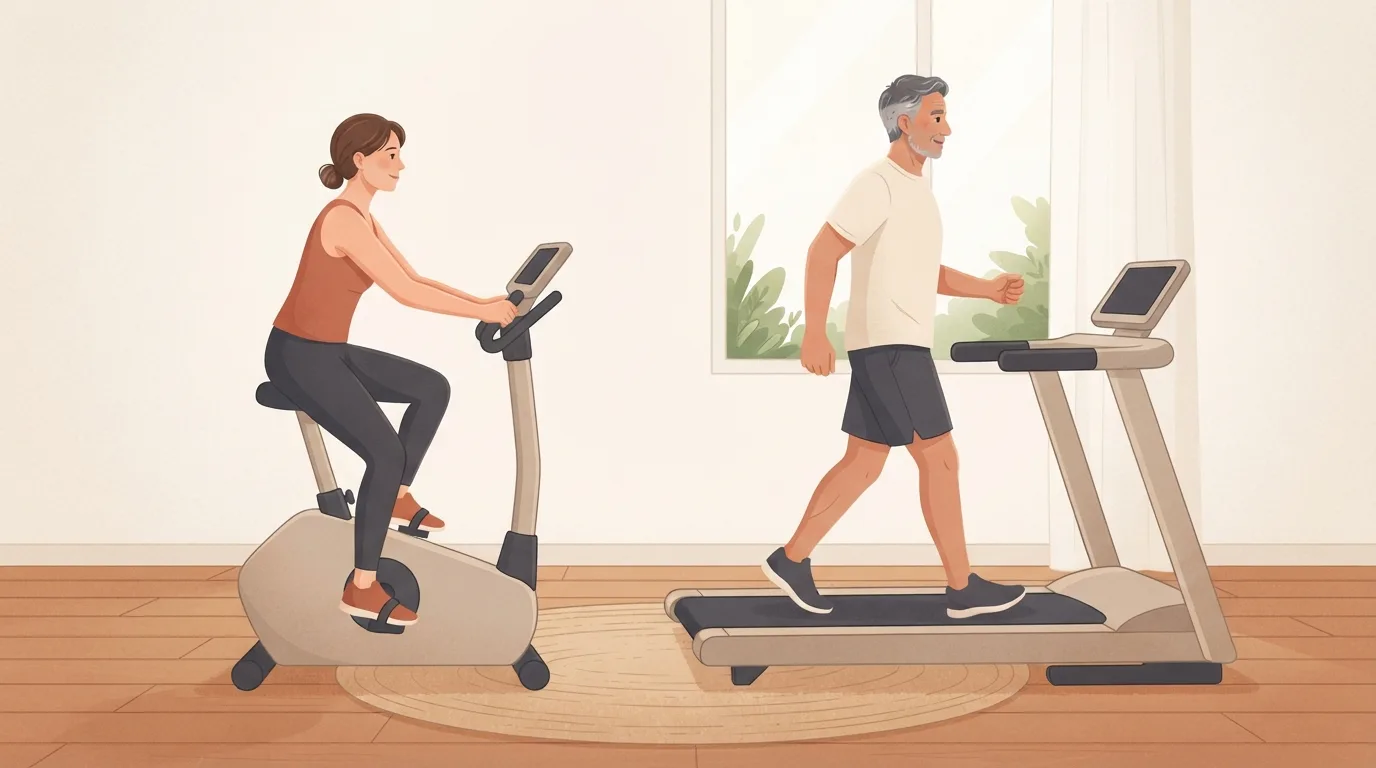
If you're weighing up an exercise bike vs treadmill for your home, you've probably noticed that every comparison ends with "it depends". It does, but on a short list of things you can check: how many calories you want per minute, how your knees feel when you walk or run, what you're training for, and how much floor you can spare.
The bigger risk is buying the wrong one and quietly stopping. A machine that hurts your knees or rattles the neighbors below doesn't get used, however good its calorie numbers look. And a machine that gathers dust can feel like proof that you can't stick with exercise, when the real problem was the fit.
So this guide puts the stationary bike and the treadmill side by side on the things that decide whether you'll keep using one, with the studies behind each claim, and ends with who should pick which.
Exercise Bike vs Treadmill at a Glance
| Stationary bike | Treadmill | |
|---|---|---|
| Calories at a very hard effort | About 11 to 12.5 per minute (upright, spin and recumbent bikes) | About 15 per minute |
| Impact through the feet | None, your feet stay on the pedals | About 1.2 times body weight walking, up to about 2.5 times running |
| Force inside the knee | About 1.2 times body weight at 120 watts | About 2.6 times body weight at an ordinary walk |
| Main muscles | Quadriceps and glutes | Calves, hamstrings, glutes and quadriceps, with the trunk and arms helping |
| Bone loading | Very little | Yes, every step is weight-bearing |
| Fat-loss trials | Works; same total fat loss as running intervals when energy is matched | Works; a small, borderline edge for belly fat in one trial |
| Floor space | Roughly 1 m by 0.6 m for an upright bike | Roughly 2 m by 0.9 m, plus a clear zone behind the deck |
| Noise | Quiet, especially with magnetic resistance | Motor hum, plus footfall that travels through floors |
| Power and upkeep | Many bikes need little or no power and few repairs | Needs a grounded outlet, plus belt and deck care |
| Cost | Usually the cheaper machine | Usually costs more, especially models built for running |
| Best for | Sore knees, higher body weight, small or shared spaces | Most calories per minute, run training, bone health |
Which Burns More Calories: Treadmill or Exercise Bike?
In the cycling vs treadmill calorie race, the treadmill burns more per minute at the same perceived effort. The clearest head-to-head test comes from Prieto-González and Yagin (2024), who had 30 recreationally active men aged 35 to 49 practice on seven cardio machines for four weeks, then exercise for 12 minutes on each at a "very hard" effort and again at their maximum. At the very hard effort, the treadmill burned 15.2 calories a minute, against 12.5 on a spin bike, 11.9 on an upright bike and 11.1 on a recumbent bike. At maximum it was 17.4 against 14.3, 13.6 and 13.3. The treadmill also drove heart rate highest, to about 160 beats a minute against 136 on the upright bike.
Over 30 minutes at that effort, that's roughly 455 calories on the treadmill against 360 on an upright bike, about 100 calories apart. The study only included men, and maximum heart rate and fitness were estimated rather than measured, so treat the exact numbers as a guide.
The reason is mechanical. On a treadmill you carry your whole body weight with every step and use more muscle to do it. On a bike the saddle holds your weight and the work sits mostly in your thighs, so for most people the legs tire before the heart and lungs reach their limit. You can close part of the gap on a bike with intervals and higher resistance, and spin bikes, built for standing efforts and hard intervals, scored a little higher than upright ones.
For planning your own sessions, the 2024 Adult Compendium of Physical Activities (Herrmann and colleagues, 2024) gives typical values for common settings:
| 30 minutes of | Compendium rating | Calories at 70 kg (154 lb) |
|---|---|---|
| Treadmill walk, 3.0 to 3.4 mph, flat | 3.8 METs | About 135 |
| Treadmill walk, 3.5 to 3.9 mph, flat | 4.8 METs | About 170 |
| Treadmill walk, 4.0 to 4.4 mph, flat | 5.8 METs | About 205 |
| Uphill walk, 6 to 10% grade, brisk | 7.0 METs | About 245 |
| Run, 6 mph (10-minute mile) | 9.3 METs | About 325 |
| Bike, 90 to 100 watts | 6.0 METs | About 210 |
| Bike, 126 to 150 watts | 8.0 METs | About 280 |
Is riding a stationary bike for 30 minutes the same as walking for 30 minutes?
Not quite. A moderate 30-minute ride at 90 to 100 watts burns about 210 calories for a 70 kg adult, more than a 30-minute walk at 3.0 to 3.4 mph (about 135) or a brisk 3.5 to 3.9 mph walk (about 170). It roughly matches a very brisk walk above 4 mph. Add a hill to the walk and the treadmill pulls ahead.
How many miles on a stationary bike equals 10,000 steps?
Go by minutes rather than miles, because bike consoles calculate distance from flywheel speed in ways that differ from one machine to the next. Ten thousand steps at an ordinary walking pace takes about 85 to 100 minutes. The same energy on a bike takes roughly 60 to 70 minutes of moderate riding, or about 50 minutes of hard riding.
Are Treadmills High Impact? Joint Load Compared
Treadmill walking is low impact; treadmill running is high impact. Keller and colleagues (1996) measured the vertical ground reaction force in 23 recreational athletes at speeds from a walk to a fast run. Peak force rose from about 1.2 times body weight when walking to about 2.5 times when running, and slow jogging produced peak forces more than 50 percent higher than walking. On a bike there's no landing at all, because your feet never leave the pedals.
Inside the knee, the gap is just as clear. Kutzner and colleagues (2010) measured forces directly with sensor-equipped knee replacements in five people: ordinary level walking averaged peaks of 261 percent of body weight, and going down stairs 346 percent. Ericson and Nisell (1986) calculated the force in the knee during ergometer cycling at 120 watts and 60 rpm at about 1.2 times body weight, rising as the workload went up. The methods differ, but the size of the difference is hard to miss: pedaling puts roughly half the knee load of walking through the joint, with no impact.
That's why the bike is the usual pick for sore knees, a higher body weight or a return from injury. If you prefer the treadmill, incline walking at a slower speed raises the effort without the landing forces of running. Our treadmill vs outside running guide covers how running on a belt differs from running on the road. If you go with the bike, our stationary bike workout for weight loss explains how saddle height and cadence change the load on your knees.

Stationary Bike vs Treadmill for Weight Loss
Both machines work for weight loss, and when the energy burned is matched, the results are close. Couvert and colleagues (2024) randomly assigned 16 men with overweight or obesity, average age 54, to 12 weeks of interval training three times a week, either on a bike (10 bouts of 45 seconds) or running (9 bouts of 45 seconds), both at 80 to 85 percent of maximum heart rate with 90 seconds of active recovery. The programs were matched for energy and diet was controlled. Body weight, abdominal fat and visceral fat fell overall, with no difference between the groups in weight, total fat or visceral fat. The running group lost more abdominal fat, 16.1 percent against 8.3 percent, but that difference was only borderline significant.
A meta-analysis points the same way. Maillard, Pereira and Boisseau (2018) pooled 39 studies and 617 people and found that interval training cut total, abdominal and visceral fat. In their subgroup comparison, running intervals reduced total and visceral fat more than cycling intervals did, though the authors warned that cycling protocols varied widely and were often poorly described.
So the treadmill has a small edge per minute and possibly per session. That edge disappears if the bike is the machine you'll actually use more often, or if your knees cap how long you can stay on the treadmill. A 40-minute ride you do four times a week beats a 30-minute run you manage once.
Treadmill or exercise bike for belly fat?
The treadmill has a slight edge in the one direct trial, but neither machine targets belly fat. Fat comes off where your body decides, and abdominal fat falls along with total fat when you burn more than you eat over weeks. Choose the machine you'll use most, and keep the calorie deficit modest so you can hold it.
Find out what's really holding you back
FitCraft, our mobile fitness app, pairs you with an AI coach who builds you a personalized plan around your goals, schedule, and fitness level. Every FitCraft program is designed by Domenic Angelino, MPH (Brown University) and NSCA-CSCS, with research published in the Journal of Strength and Conditioning Research and Medicine & Science in Sports & Exercise.
Take the Free Assessment Free • 2 minutes • No credit cardMuscles Worked on a Bike vs a Treadmill, and What It Means for Bone
A stationary bike works mainly your quadriceps and glutes, with the hamstrings and calves helping through the bottom of each stroke. The work is smooth and continuous, and because you're seated, your trunk and arms do very little. A treadmill spreads the work wider. Walking and running use the calves, hamstrings, glutes and quadriceps, and your trunk and arms help keep you balanced and moving. Raise the incline and more of the work shifts to the glutes and calves.
The bigger difference is bone. Bone responds to impact and weight-bearing, and a bike provides neither. Rector and colleagues (2008) compared 27 male cyclists with 16 male runners of similar age, weight and body composition. The cyclists had lower bone mineral density in the whole body and spine. Sixty-three percent of the cyclists had osteopenia in the spine or hip against 19 percent of the runners, and the cyclists were seven times more likely to have spinal osteopenia. They were road riders, but the stationary bike has the same missing ingredient.
If bone health matters to you, for example after menopause, the treadmill earns a point here, or the bike needs strength training and some walking beside it. Our guide to cycling vs running covers the bone and tendon trade-offs between the two sports in more depth.
Recumbent Bike vs Treadmill
A recumbent bike has a backrest and puts your legs out in front of you, and in the Prieto-González test it burned the fewest calories of the seven machines: 11.1 a minute at a very hard effort against 15.2 on the treadmill. Heart rate ran lowest too.
What it gives you instead is access. You sit down onto it rather than climbing on, there's nothing to balance, and your back is supported. That makes it a strong choice for older adults, people with back pain or balance problems, people with a higher body weight, and anyone rebuilding after surgery or a long break. If walking on a moving belt makes you nervous, a recumbent bike removes the worry completely, and a workout you're relaxed doing is one you'll repeat.
Cost, Space and Noise at Home
For a home setup, these practical points often decide more than the physiology does.
- Floor space: an upright bike needs roughly a 1 m by 0.6 m patch of floor. A treadmill needs closer to 2 m by 0.9 m, and its manual will ask for a clear zone behind the deck so a stumble doesn't send you into a wall. Folding treadmills help, but only if you'll actually fold and unfold them.
- Ceiling height: a treadmill deck raises you off the floor. If you plan to run, check that your head clears the ceiling with room to spare at the top of each stride.
- Noise: magnetic-resistance bikes are close to silent. A treadmill adds motor hum, and running footfall carries through floors, which matters in an upstairs apartment.
- Power and upkeep: a treadmill motor needs a grounded outlet, and many manuals recommend a dedicated circuit. Belts need occasional alignment and lubrication. Many bikes need little more than a wipe-down.
- Cost: at similar build quality, a treadmill usually costs more than a bike, and a deck sturdy enough for regular running costs more again.
- Safety: clip the treadmill's safety key to your clothing and keep children and pets well away from a moving belt.
Which Is Better: Treadmill or Exercise Bike?
Here's how the treadmill vs stationary bike decision usually shakes out. Pick the treadmill if:
- You want the most calories in the least time.
- You're training for a run, or you want to walk and run indoors when the weather turns.
- Bone health is a priority, for example after menopause or with a family history of osteoporosis.
- You enjoy walking, especially incline walking, and your knees, hips and ankles are comfortable doing it.
- You have the space, a ground-floor room or understanding neighbors, and a suitable outlet.
Pick the stationary bike if:
- Walking or running makes your knees, hips, ankles or feet hurt.
- You're carrying a lot of weight and want cardio that doesn't pound your joints while you lose it.
- You live upstairs, share walls or have a small room.
- Balance is a concern, in which case choose a recumbent model.
- You like to read or watch something while you exercise, which is far easier seated.
If you have room for both, they complement each other well: the treadmill for walks and bone loading, the bike for hard intervals and easy recovery days. And if you only buy a bike, walking outside on a few days a week covers most of what the treadmill would add.
Pair Either Machine With Strength Training
Neither machine trains your upper body in any useful way, and neither replaces lifting for keeping muscle as you get older or lose weight. Two short strength sessions a week with dumbbells and body weight fill that gap, whichever machine you choose.
That's the part FitCraft is built for. Its programs use dumbbells and your own body weight, with 3D AI coaches who show you each exercise, say your name as you train and adapt your workouts as you progress. Streaks and leaderboards give you a reason to show up for the strength days, not just the cardio. If you're comparing options, our roundup of the best dumbbell workout apps sets them side by side.
The Bottom Line
In the stationary bike vs treadmill choice, the treadmill wins on calories per minute, run training and bone loading. The bike wins on knee load, impact, noise, space and cost, and for fat loss the two land close when you match the work. Pick the one that fits your joints and your home, because the machine you use four times a week beats the better machine you avoid.
As Katie put it: "I've tried everything. This is the first time I've stuck with something past two weeks." The right machine, and the right plan around it, is what gets you past week two.
Frequently Asked Questions
Is an exercise bike better than a treadmill?
Neither is better for everyone. A treadmill burns about a quarter more calories at the same hard effort and loads your bones, so it suits runners, walkers and people focused on bone health. An exercise bike puts much less force through the knee, takes less space and makes less noise, so it suits sore joints, higher body weights and apartments.
What are the key differences between an air bike and a treadmill?
An air bike uses a fan for resistance, so it gets harder the faster you pedal, and its moving handles bring your arms into every stroke. It has no impact and suits short, very hard intervals. A treadmill is weight-bearing, works your legs through walking or running, and is the better tool for steady walking, incline walking and run training.
What are the health benefits of using a cycling machine?
A cycling machine improves aerobic fitness, helps lower blood pressure and lets you train with very little load on your knees, hips and ankles. Because you sit on a saddle with no impact, it's one of the easiest ways to build regular cardio if walking or running hurts. It doesn't load your bones or train your upper body, so pair it with strength training. The research is summarized in our exercise bike benefits review.
Which is better for bad knees, a treadmill or a stationary bike?
A stationary bike. Pedaling at 120 watts loads the knee with about 1.2 times body weight, while ordinary walking produced about 2.6 times body weight in sensor-equipped knee implants, and running adds landing impact on top. Incline walking at a slow pace is the gentlest treadmill option if you prefer to walk.
Can you lose weight on a stationary bike as well as on a treadmill?
Yes. In a 12-week trial that matched the energy burned, cycling and running intervals produced the same loss of body weight, total fat and visceral fat in men with overweight, with a borderline edge for running on abdominal fat. The treadmill burns more per minute, so on the bike you may need a few extra minutes per session.