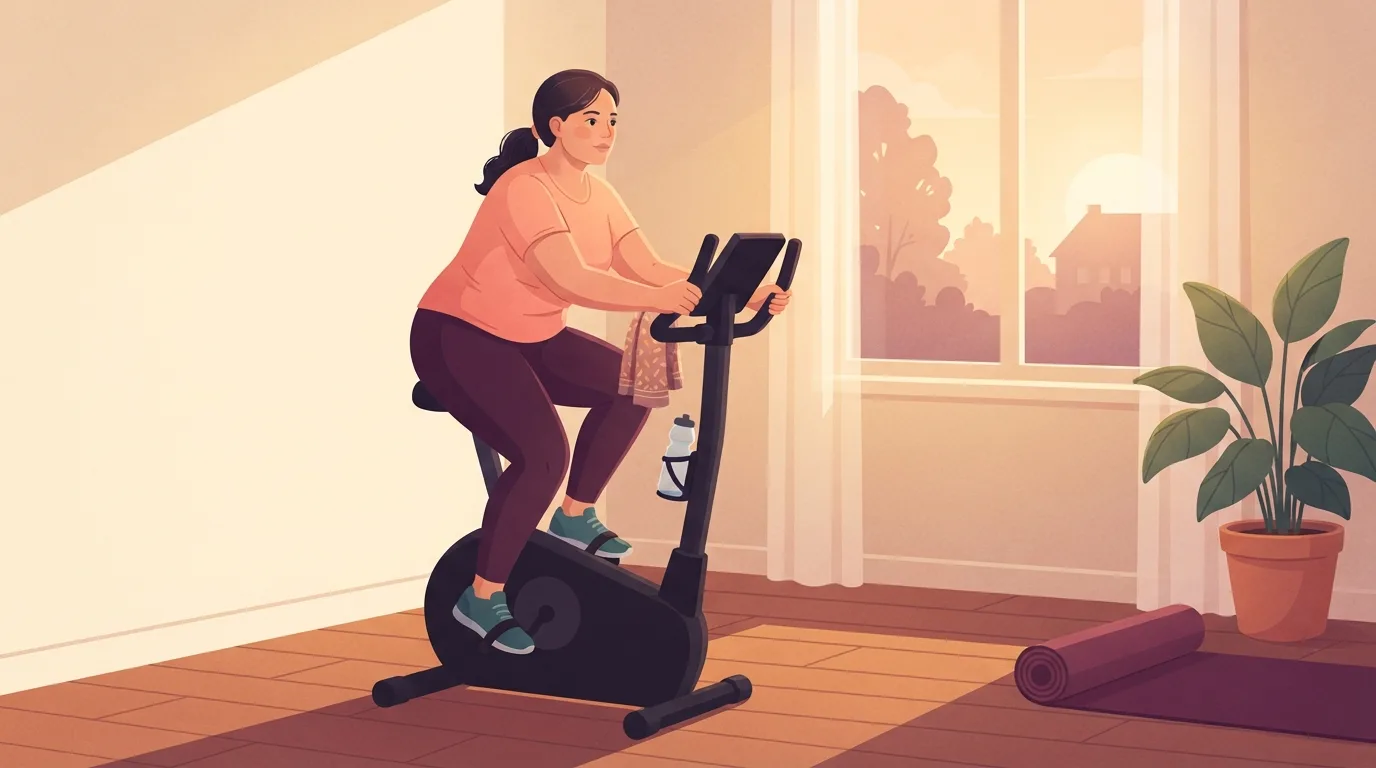
Maybe the bike was a pandemic purchase, or a birthday present to yourself. For a few weeks you rode it most evenings with a show on, the console promised a big calorie number, and the scale stayed exactly where it was. Now it holds jackets.
That's a frustrating place to be, and it's easy to decide the problem is you. It usually isn't. Most home bike routines fail for design reasons: the same ride at the same effort every night, no way to progress it, and nothing at all for the rest of your body.
This guide fixes the design. You'll get four stationary bike workouts with a time, cadence and effort for each, the calories you can realistically expect, how to set the bike up so your knees stay happy, a 4-week plan for beginners and returning riders, and what the cycling trials found when people rode for fat loss.
4 Stationary Bike Workouts for Weight Loss
Every workout uses two targets. Cadence is how fast your legs turn, in revolutions per minute (rpm). Many bikes display it; if yours doesn't, count your right foot's pedal strokes for 15 seconds and multiply by four. Effort is your RPE, a 0 to 10 rating of how hard the ride feels, where 0 is sitting on the sofa and 10 is the hardest you could pedal for a few seconds.
| Workout | Time | Cadence | Effort (RPE) | Use it for |
|---|---|---|---|---|
| 1. Steady ride | 35 to 50 min | 80 to 90 rpm | 4 to 5 | Most of your weekly minutes |
| 2. One-on, two-off intervals | 28 to 34 min | 95 to 105 rpm hard, 80 rpm easy | 8 hard, 3 easy | Fitness when time is short |
| 3. Seated hill ride | About 37 min | 60 to 70 rpm on climbs | 6 to 7 | Leg endurance and variety |
| 4. 8-12 sprint ride | 30 min | 110+ rpm sprints, about 40 rpm easy | 8 on sprints | Experienced riders short on time |
1. The Steady Ride (35 to 50 Minutes)
- Warm-up: 5 minutes at RPE 2 to 3, light resistance, 85 to 90 rpm.
- Main set: 25 to 40 minutes at RPE 4 to 5 and 80 to 90 rpm. You're breathing deeper than normal, but you could still hold a conversation.
- Cool-down: 5 minutes of easy pedaling.
This ride does most of the work in a weight-loss plan. It's close to the continuous session in a 2014 trial by Keating and colleagues, covered below, which built up to 45 minutes at a moderate effort three times a week. If your resistance knob shows levels rather than watts, find the level that lands at RPE 4 to 5 at about 85 rpm and note it. That level is your baseline, and you'll see it creep up as you get fitter.
2. One-On, Two-Off Intervals (28 to 34 Minutes)
- Warm-up: 5 minutes, building from RPE 2 to RPE 4.
- Main set: 6 to 8 rounds of 1 minute hard at RPE 8 and 95 to 105 rpm, with enough resistance that the last 15 seconds bite, then 2 minutes easy at RPE 3.
- Cool-down: 5 minutes easy.
The structure mirrors the interval group in the Keating trial, which worked up to six 1-minute efforts with 2-minute recoveries. Those riders gained as much fitness as the steady group in about half the riding time. They didn't lose body fat, though, so treat this as your weekly fitness session rather than a fat-loss shortcut.
3. The Seated Hill Ride (About 37 Minutes)
- Warm-up: 5 minutes easy.
- Main set: 3 climbs of 6 minutes. Turn the resistance up until your cadence settles at 60 to 70 rpm and the effort reads RPE 6 to 7. Stay seated and keep your upper body quiet.
- Between climbs: 3 minutes of light spinning at 85 to 90 rpm.
- Cool-down: 5 minutes easy.
Climbing builds the leg endurance that makes your steady rides feel easier, and it breaks up the routine. It also raises the load on your knees, because knee forces on a bike climb with resistance and fall as cadence rises. Skip this one on a day a knee is grumbling and do a steady ride instead.
4. The 8-12 Sprint Ride (30 Minutes)
- Warm-up: 5 minutes, finishing with two or three 8-second practice sprints.
- Main set: 20 minutes of repeats: 8 seconds pedaling as fast as you can (110 rpm or more), then 12 seconds slow at about 40 rpm without touching the resistance. That's 60 sprints.
- Cool-down: 5 minutes easy.
This is the protocol from the University of New South Wales trials described below, where it cut body fat in young women and in young men with overweight. It's the hardest session on this page. Start with a 10-minute block, build toward 20 minutes over three or four weeks, and wait until steady rides feel routine before you try it.
How to Set Up a Stationary Bike Before You Ride
Five minutes of setup decides whether the bike feels good for months or makes your knees ache by week two. Saddle height matters most. Bini and colleagues (2011) reviewed 62 studies on saddle position and found that a 5 percent change in saddle height changed knee joint motion by about 35 percent and the turning forces at the knee by about 16 percent. Pressure behind the kneecap went up as the saddle went down.
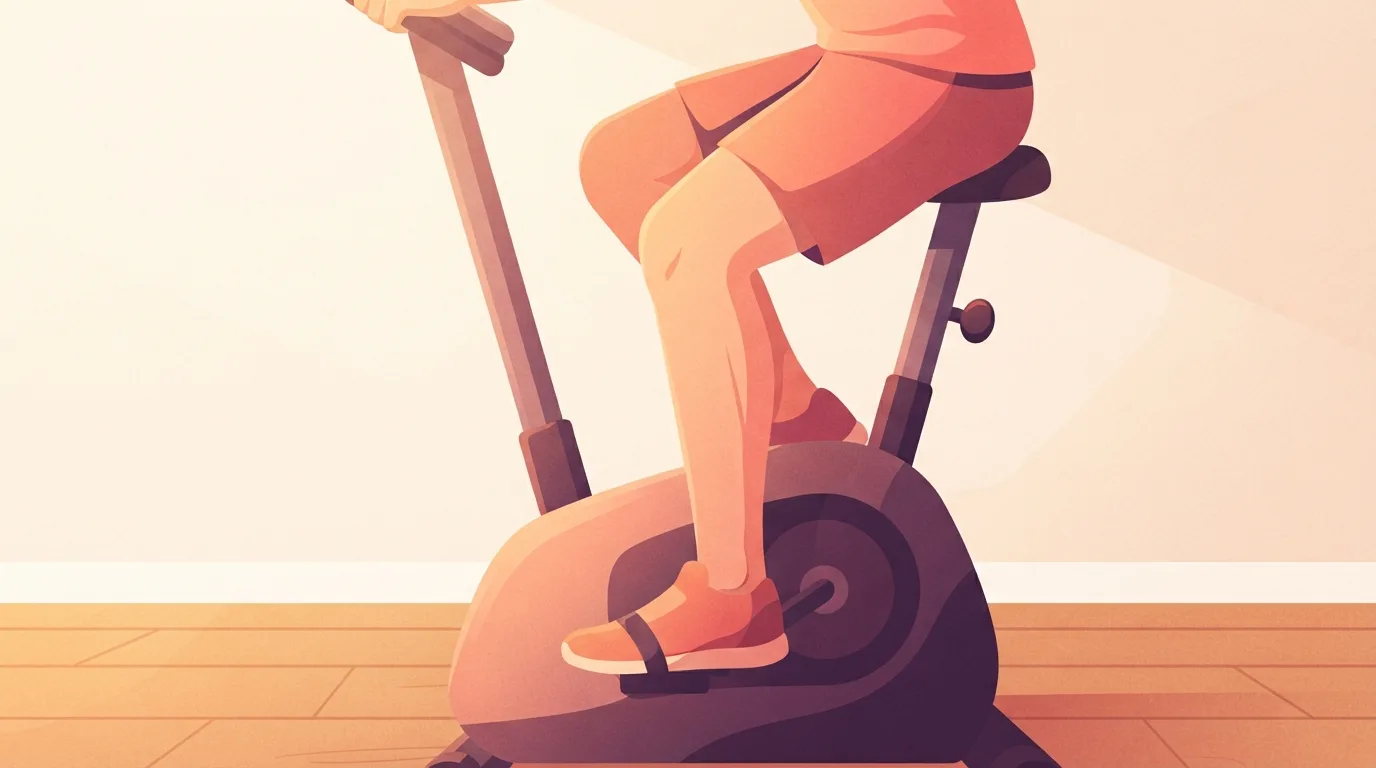
- Saddle height: standing beside the bike, set the saddle level with your hip bone. Then sit and pedal backward to the bottom of the stroke. Your knee should keep a slight bend, about 25 to 30 degrees short of straight, and your hips shouldn't rock side to side.
- Saddle position: with the pedals level, your front knee should sit roughly above the pedal axle. Slide the saddle forward or back to get there.
- Handlebars: start level with the saddle or a little higher. Only lower them if your back is comfortable after a full ride.
- Feet: put the ball of your foot over the pedal axle and snug the straps so your foot doesn't slide.
- Resistance: the numbers on a knob aren't standardized between bikes, so judge them by your RPE and cadence, not by the level someone else uses.
- Recumbent bikes: slide the seat until your knee keeps the same slight bend with the pedal at its farthest point.
A higher saddle also helps the knee in direct measurements. Kutzner and colleagues (2012) found that dropping the seat didn't raise the total force in the knee, but it did raise the backward shearing force, and the lowest loads came with a light resistance, a quick cadence and a high seat.
How Many Calories Does a Stationary Bike Burn?
A stationary bike burns roughly 120 to 450 calories in 30 minutes for most adults, depending on how hard you pedal and how much you weigh. The numbers below come from the 2024 Adult Compendium of Physical Activities (Herrmann and colleagues, 2024), the reference table researchers use to convert activities into energy cost.
| Ride | Compendium rating | 60 kg (132 lb) | 80 kg (176 lb) | 100 kg (220 lb) |
|---|---|---|---|---|
| Light, 50 watts (RPE 2 to 3) | 4.0 METs | 120 cal | 160 cal | 200 cal |
| Moderate, 90 to 100 watts (RPE 4 to 5) | 6.0 METs | 180 cal | 240 cal | 300 cal |
| Vigorous, 126 to 150 watts (RPE 6 to 7) | 8.0 METs | 240 cal | 320 cal | 400 cal |
| Indoor cycling class | 9.0 METs | 270 cal | 360 cal | 450 cal |
All figures are per 30 minutes. They're gross totals, so they include what your body would burn sitting still. For an 80 kg rider that's about 40 calories every half hour, which means a moderate 30-minute ride adds around 200 calories to the day. The RPE ranges in brackets are a rough guide for bikes with no watt reading.
Run those numbers over a week and the role of the bike gets clear. Four 40-minute moderate rides add roughly 1,050 calories for an 80 kg adult. That's meaningful, and it won't produce weight loss on its own if what you eat creeps up to match. The riding builds the deficit; the kitchen decides whether it survives.
What Cycling Trials Show About Bike Workouts and Fat Loss
Three trials ran their training entirely on stationary bikes, and together they answer the steady-or-intervals question better than any single study.
Trapp and colleagues (2008) randomly assigned 45 young women to 15 weeks of either 20-minute sprint sessions (8 seconds fast, 12 seconds easy), 40 minutes of steady cycling, or no training, three times a week. Both exercise groups got fitter, but only the sprint group significantly reduced body weight, total fat mass and trunk fat, losing about 2.5 kg of subcutaneous fat while the steady riders' fat didn't change significantly.
Heydari, Freund and Boutcher (2012) ran the same 20-minute sprint ride with 46 young men with overweight, three times a week for 12 weeks, with no change to their diet. Against the control group, the riders lost 2 kg of fat and 1.5 kg of body weight, cut visceral fat by 17 percent and added 1.1 kg of lean mass in the legs and trunk. Their waists were already measurably smaller by week six.
Keating and colleagues (2014) found the opposite in 38 inactive adults with overweight. Over 12 weeks on cycle ergometers, a continuous group that built up to 45 minutes at a moderate effort reduced total body fat by about 1 kg and trimmed fat around the middle. An interval group doing up to six 1-minute hard efforts gained the same fitness, about 22 to 24 percent more work capacity, but its body fat didn't fall. The steady group was also riding roughly twice as many minutes each week.
Read together, both styles of bike workout can work, and riding time still counts. The sprint trials used young volunteers, and the one trial in inactive adults with overweight favored the longer steady ride. So build your week on steady rides and add one hard session as a bonus, not the other way round.
The wider weight-loss evidence applies to the bike the same way it applies to anything else: a modest calorie deficit does most of the subtracting, and strength training keeps the weight you lose from coming out of your muscle. Our guide to the best workout for weight loss covers those trials and the weekly dose of cardio and lifting they support. This page sticks to what's specific to the bike.
Find out what's really holding you back
FitCraft, our mobile fitness app, pairs you with an AI coach who builds you a personalized plan around your goals, schedule, and fitness level. Every FitCraft program is designed by Domenic Angelino, MPH (Brown University) and NSCA-CSCS, with research published in the Journal of Strength and Conditioning Research and Medicine & Science in Sports & Exercise.
Take the Free Assessment Free • 2 minutes • No credit cardA 4-Week Stationary Bike Plan for Weight Loss
This plan starts where most beginners can start and ends at about two and a half hours of riding a week, with two strength days throughout. If you already ride regularly, begin at week 2.
| Week | Rides | Strength | Riding time |
|---|---|---|---|
| 1 | 3 steady rides of 25 to 30 minutes | 2 days, 2 rounds | About 85 min |
| 2 | 2 steady rides of 35 minutes, 1 interval ride (6 rounds) | 2 days, 3 rounds | About 100 min |
| 3 | 2 steady rides of 40 minutes, 1 interval ride (8 rounds), 1 seated hill ride | 2 days, 3 rounds | About 150 min |
| 4 | 2 steady rides of 45 minutes, 1 seated hill ride, 1 sprint ride with a 10-minute block | 2 days, 3 rounds, heavier dumbbells if the reps feel easy | About 150 min |
A typical week looks like this: steady ride on Monday, strength on Tuesday, the hard ride on Wednesday, rest or a 20-minute easy spin on Thursday, strength on Friday, a longer steady ride on Saturday and rest on Sunday. In weeks 3 and 4, the second hard ride goes on Saturday and the steady ride moves to Thursday.
Three rules keep the progression honest:
- Change one thing at a time: more minutes, or a harder session, never both in the same week.
- Keep hard rides (intervals, climbs, sprints) to two a week, never on back-to-back days.
- When your baseline resistance level starts to feel like RPE 3 instead of 4 to 5, move it up one level.
After week 4, lengthen the steady rides toward 45 to 60 minutes or add a short fifth ride. Riding time is the lever that moved body fat in the Keating trial, and it's the one your knees tolerate best.
Strength Days: What the Bike Doesn't Train
Pedaling works the front of your thighs and your glutes in a short, smooth arc. It barely touches your upper body, the back of your legs through a full hip hinge, or the lowering phase of a movement, and it doesn't load your bones. In a calorie deficit, the muscle you don't use is the muscle you're likeliest to lose, so two 30-minute strength sessions a week are part of the plan, not an extra.
Run these six exercises as a circuit with dumbbells and body weight, resting 60 seconds between rounds:
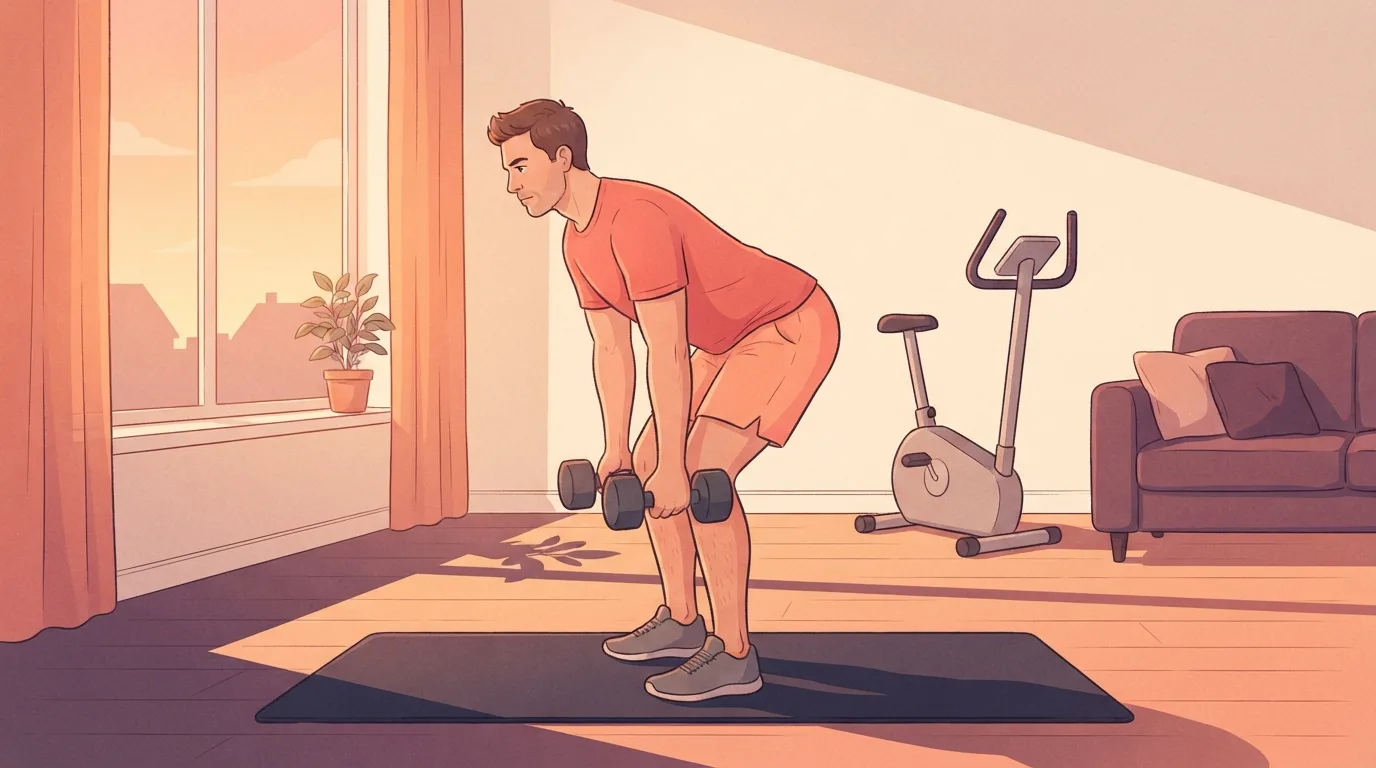
- Dumbbell Romanian deadlift, 10 reps: trains the hamstrings and glutes through the deep hip hinge that the pedal stroke never reaches.
- Push-up, 8 to 12 reps: the chest, shoulders and arms get nothing from the bike. Use a counter or sturdy bench if floor push-ups aren't there yet.
- One-arm dumbbell row, 10 reps each side: builds the upper back, which tends to round forward over the handlebars.
- Reverse lunge, 8 reps each leg: adds single-leg balance and the controlled lowering that pedaling skips.
- Dumbbell glute bridge, 12 reps: works the glutes at full hip extension, a position your hips never reach in the saddle.
- Side plank, 20 to 30 seconds each side: trains the trunk muscles that keep you steady in the saddle.
This is where an app earns its place. FitCraft's strength programs are built on dumbbells and body weight, and its 3D AI coaches demonstrate every exercise so your form holds up as the weights go up. Streaks and a workout calendar make the strength days as visible as the rides, which helps on the weeks the bike tempts you to skip them. Our roundup of the best workout apps for weight loss compares it with the alternatives.
Knee-Friendly Cardio When You Have Weight to Lose
Extra body weight makes many kinds of cardio uncomfortable, and the knees usually complain first. The bike is the exception, and there's direct measurement behind that. Kutzner and colleagues studied nine people whose knee replacements carried sensors that transmit the force inside the joint. At 60 watts and 40 rpm, peak knee force was 119 percent of body weight, lower than when the same people walked. The force rose in a straight line with the watts and fell as cadence went up.
Losing weight then pays the knees back. Messier and colleagues (2005) followed 142 older adults with overweight or obesity and knee osteoarthritis through an 18-month diet and exercise trial. Every kilogram lost was linked to about 4 kilograms less compressive force on the knee with each step. Over thousands of steps a day, that adds up quickly.
So for someone with weight to lose, the bike lets you build riding time now while your knees benefit from every pound that comes off. To keep it comfortable:
- On sore days, keep the resistance light and the cadence brisk. Light resistance at a quicker cadence gave the lowest knee forces in the Kutzner data.
- Swap climbs and sprints for steady rides whenever a knee flares.
- Choose a recumbent bike if your back, hips or balance make an upright saddle hard to sit on.
- Stop and get it checked if pain is sharp, if the knee swells, or if it hurts more the next morning.
If you have knee osteoarthritis, our review of exercise bike benefits covers the trials of stationary cycling for knee pain in detail.
How Long Should I Ride a Stationary Bike for Weight Loss?
Ride 30 to 45 minutes per session, three to five times a week, and build toward about 150 to 250 minutes of riding a week alongside your two strength days. The trials above ran three sessions a week for 12 to 15 weeks, which is a fair horizon for judging your own results. Waist measurements tend to move before the scale does: in the Heydari trial, waist size had already dropped by week six.
The same targets apply to women and men. The Trapp trial was run in young women, the Heydari trial in young men, and both groups lost fat on the same 20-minute ride.
Is 20 minutes of stationary bike a day enough?
Yes, if you do it most days. Twenty minutes daily is 140 minutes a week, close to the 150-minute floor in most activity guidelines, and a moderate 20-minute ride burns about 160 calories for an 80 kg adult. For weight loss it works best as a floor you build from, paired with a calorie deficit. And a short ride can still be a strong one: the 20-minute sprint sessions in the Trapp and Heydari trials reduced body fat on three sessions a week.
Can I Lose Belly Fat by Riding a Stationary Bike?
Yes, as part of losing fat overall. Pedaling doesn't burn belly fat first, because your body decides where fat comes off, not the exercise. But bike training does reach the belly. The Heydari riders cut visceral fat, the deeper fat around the organs, by 17 percent in 12 weeks, and the steady riders in the Keating trial lost fat from the abdominal region while the interval riders didn't.
If belly fat is your main goal and you're choosing between machines, our stationary bike vs treadmill guide compares the trials of cycling and running on abdominal fat.
The Bottom Line
A stationary bike workout for weight loss works when it's a plan rather than the same ride every night. Make steady rides the backbone, add one hard session a week, set the saddle so your knee keeps a slight bend, and give your upper body two strength days the bike can't provide. Then let 12 weeks of consistency do what one heroic session can't.
Matt lost 32 pounds in 4 months. In his words: "The real win is I actually want to work out now. That's never happened before." You're not lazy, and the bike isn't broken. It just needs a better plan.
Frequently Asked Questions
How many calories does 30 minutes on a stationary bike burn?
For an 80 kg (176 lb) adult, 30 minutes on a stationary bike burns about 160 calories at a light effort, 240 at a moderate effort and 320 at a vigorous one, using the 2024 Adult Compendium of Physical Activities. A lighter rider burns less and a heavier rider more, roughly in proportion to body weight. Those totals include the calories you'd burn sitting still.
Is a stationary bike good for weight loss?
Yes. In cycling trials, three bike sessions a week for 12 to 15 weeks reduced body fat, including visceral fat, even without a diet change. The bike works best as the cardio half of a plan that also includes two strength days and a modest calorie deficit, and its low knee load lets you build riding time while you lose weight.
What burns more fat, walking or cycling?
Minute for minute, a moderate ride burns a little more than a brisk walk, but the gap is small, and over weeks the one you repeat most often burns more fat. Our stationary bike vs treadmill guide compares the two machines in detail.
What resistance should I use on a stationary bike to lose weight?
For steady rides, set the resistance so you reach an effort of 4 to 5 out of 10 at 80 to 90 pedal revolutions per minute. If you're bouncing in the saddle at a high cadence, it's too light. If your cadence sinks below about 60, it's too heavy for anything except a short climb.
Should I ride a stationary bike every day?
Easy rides can be daily for most healthy adults, because pedaling has no impact. Keep hard sessions such as intervals, climbs and sprints to two a week with a day between them, and keep your two strength days, which the bike can't replace.
Is a recumbent bike good for weight loss?
Yes. The four workouts on this page work on a recumbent bike with the same cadence and effort targets. The backrest makes it a good choice for back pain, balance problems or a higher body weight, and a bike you're comfortable on is a bike you'll keep using.