You've probably tried a workout that promised to melt fat. Maybe it was a month of punishing classes, or a 30-day challenge from a video, or an hour on the treadmill most nights. You sweated, you were sore, and the scale barely moved. By week four it felt like proof that your body just doesn't respond.
That feeling is common, and it isn't a character flaw. Most weight-loss workouts are built around one session's calorie burn and ignore the two things that decide the result: what happens to your muscle while you eat less, and whether you're still training in month three.
So this guide answers the question the way the research does. It covers which kinds of training do what for weight loss, the eight exercises worth your time at home, a weekly plan, and honest numbers on how much and how fast exercise moves the scale.
What Is the Best Workout for Weight Loss?
The best workout for weight loss isn't one type of exercise. It's a combination, because strength training and cardio do different jobs. The clearest test is the STRRIDE AT/RT trial. Willis and colleagues (2012) randomly assigned 119 sedentary adults with overweight or obesity to 8 months of aerobic training, resistance training or both, with no diet change. Fat mass fell 1.66 kg with aerobic training, 0.26 kg with resistance training and 2.44 kg with the combination. Lean mass went the other way: up 1.09 kg with resistance training, up 0.81 kg combined, and down slightly with cardio alone.
An umbrella review backs up that split. Bellicha and colleagues (2021) pooled 12 systematic reviews covering 149 studies in adults with overweight or obesity. Exercise training cut body weight by 1.5 to 3.5 kg and fat by 1.3 to 2.6 kg, including visceral fat around the organs. Steady cardio and high-intensity intervals worked equally well when they burned the same energy, and resistance training reduced the lean mass lost during weight loss by about 0.8 kg.
| Type of training | What it does for weight loss | Weekly dose |
|---|---|---|
| Full-body strength training | Keeps muscle during a deficit, so more of the weight you lose is fat | 2 to 3 sessions |
| Steady cardio (brisk walking, cycling, hiking) | Burns the most calories you can sustain for a long time | 150 to 300 minutes |
| Intervals (HIIT) | Similar fat loss to steady cardio in less time | 0 to 2 short sessions |
| Daily walking and moving around | Adds background burn that you don't have to recover from | Most days |
| A modest calorie deficit | Does most of the subtracting; exercise decides what you lose | Every day |
The 8 Best Exercises for Weight Loss at Home
These are the best exercises to lose weight with a pair of dumbbells and your body weight. Numbers 1 to 6 are compound strength moves, which train several large muscles at once and burn more per rep than isolation work like curls. Numbers 7 and 8 are your cardio.
1. Goblet Squat
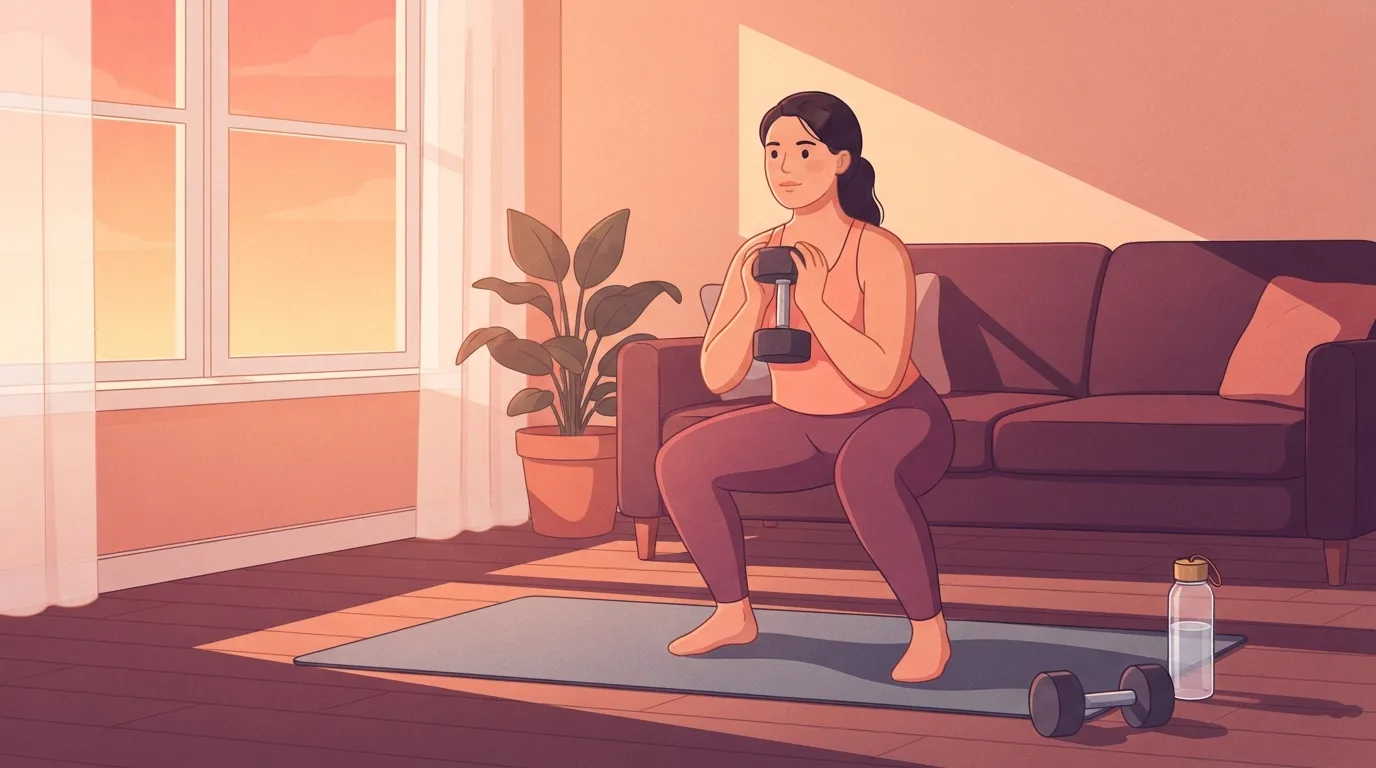
Hold one dumbbell vertically against your chest, feet a little wider than your hips, and sit down between your heels until your thighs are about parallel to the floor. Drive back up through your whole foot. Your quads and glutes are the largest muscles you own, so this is where a strength session earns most of its burn. Do 3 sets of 8 to 12 reps. If it's too hard, squat to a chair; if it's too easy, pause for two seconds at the bottom.
2. Dumbbell Romanian Deadlift
Stand tall with a dumbbell in each hand in front of your thighs. Push your hips back and let the weights slide down your legs to just below the knee, back flat and knees soft, then squeeze your glutes to stand. It trains the hamstrings, glutes and the long muscles of your back, which squats leave underworked. Do 3 sets of 10 to 12, slow on the way down.
3. Push-Up
Hands under your shoulders, body in one line from head to heels, lower your chest to a fist's height above the floor and press away. Push-ups train the chest, shoulders, triceps and the muscles that hold your trunk still. Start with your hands on a kitchen counter or a sturdy bench if floor push-ups aren't there yet, and work toward 3 sets of 8 to 15.
4. One-Arm Dumbbell Row
Put one hand and knee on a bench or chair, let a dumbbell hang from the other hand, and pull it toward your hip until your elbow passes your ribs. Lower it with control. Rows balance the push-ups and build the upper back that keeps your shoulders healthy. Do 3 sets of 10 to 12 per side.
5. Reverse Lunge
Step one foot back and lower until both knees are bent at roughly right angles, front heel planted, then push through the front foot to return. It works each leg on its own and challenges balance, which raises the effort of every rep. Start with body weight, then hold a dumbbell in each hand. Do 3 sets of 8 to 10 per leg.
6. Dumbbell Overhead Press
Stand with dumbbells at shoulder height, ribs down and glutes tight, and press them overhead until your arms are straight beside your ears. Lower to your shoulders. It trains the shoulders and triceps and makes your trunk work to keep you upright. Do 3 sets of 8 to 12, seated if your lower back complains.
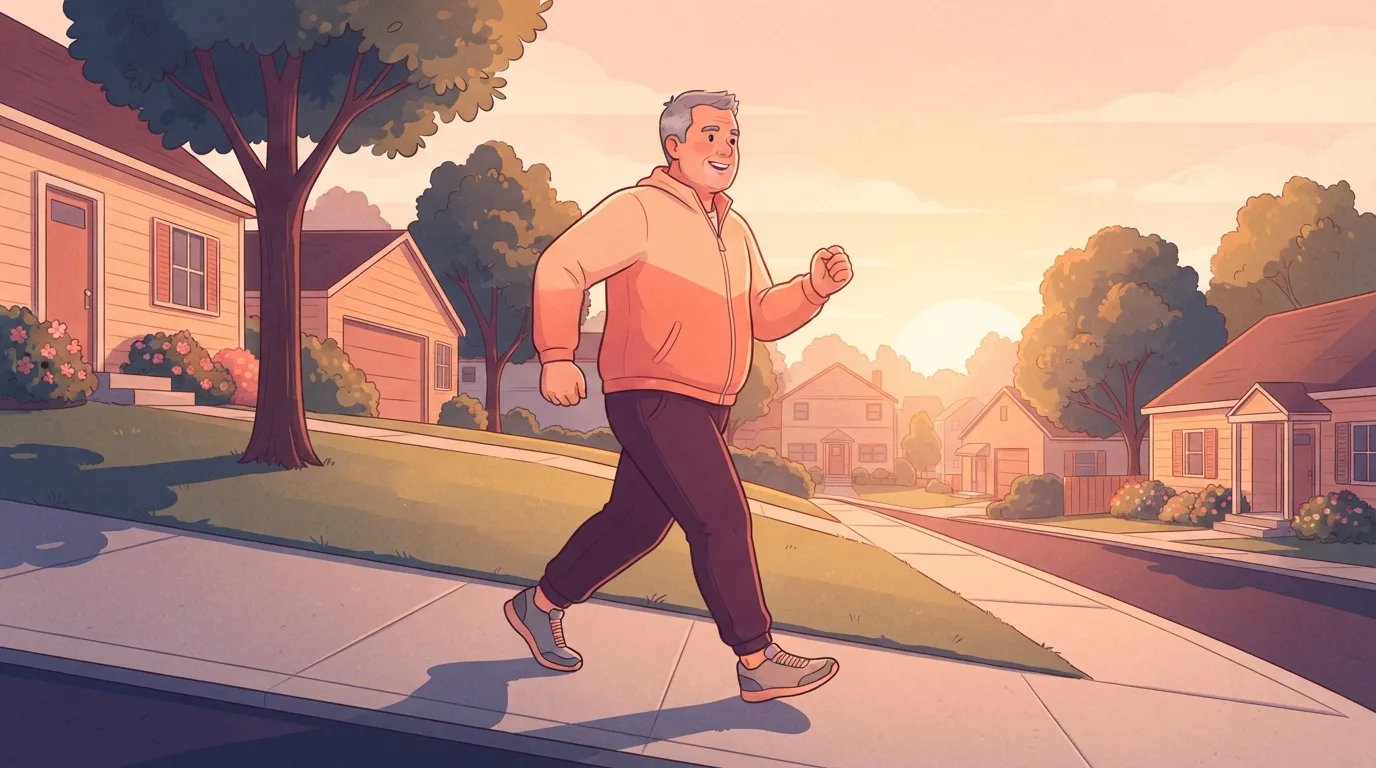
7. Brisk or Uphill Walking
Walking is the cardio most people can do every day without needing recovery, and the minutes add up. The 2024 Adult Compendium of Physical Activities (Herrmann and colleagues) rates brisk walking at 3.5 to 3.9 mph at 4.8 METs and walking up a gentle grade at 5.3, against 1 for resting quietly. For an 80 kg (176 lb) adult that's roughly 400 calories an hour on the flat. Aim for 30 to 60 minutes on most days, at a pace where you can talk but not sing.
8. Bodyweight Intervals
Intervals pack hard effort into short bouts with rests between: for example, 30 seconds of squat jumps, mountain climbers or burpees, then 30 to 60 seconds of easy marching, repeated 8 to 10 times. The Compendium rates vigorous interval work like this at 11 METs, more than double brisk walking. They're optional. One or two 20-minute sessions a week is plenty, and walking can replace them entirely if your knees or heart need a gentler plan.
Strength Training for Weight Loss: What Lifting Does and Doesn't Do
Resistance training for weight loss is the part most plans leave out, and it's the part that decides what the weight you lose is made of. When you eat less than you burn, your body takes energy from fat and from muscle. Lifting tells it to keep the muscle.
The evidence is consistent. Lopez and colleagues (2022) pooled 114 randomized trials with 4,184 participants with overweight or obesity. Resistance training combined with a calorie deficit was the most effective option they found: body fat fell by 3.8 percentage points and fat mass by 5.3 kg, while lean mass held steady. Resistance training alone, with no diet, still cut 1.0 kg of fat and added 0.8 kg of lean mass. In older adults dieting to lose weight, Sardeli and colleagues (2018) found that three weekly strength sessions prevented 93.5 percent of the lean mass the diet would otherwise have taken.
Two claims about strength exercises for weight loss get oversold, so it's worth being precise.
- Lifting doesn't supercharge your metabolism. A meta-analysis by MacKenzie-Shalders and colleagues (2020) found resistance training raised resting metabolic rate by about 96 calories a day compared with controls. That's real and useful over a year, and it's roughly one banana.
- Lifting alone is a slow way to lose weight on the scale. The ACSM position stand on physical activity and weight loss (Donnelly and colleagues, 2009) concluded that resistance training doesn't add to weight loss itself, though it may increase fat-free mass and fat loss. Muscle gained can hide fat lost, which is why a tape measure tells you more than a scale in the first months.
If you want a fat burning strength workout, the setup matters more than the exercises. The Compendium rates traditional sets of 8 to 15 reps across several exercises at 3.5 METs, and the same work done as a circuit or as paired supersets, moving straight from one exercise to the next, at 5.8. For an 80 kg adult, that's the difference between about 200 and 325 calories in a 40-minute session. The plan below uses supersets for that reason.
Find out what's really holding you back
FitCraft, our mobile fitness app, pairs you with an AI coach who builds you a personalized plan around your goals, schedule, and fitness level. Every FitCraft program is designed by Domenic Angelino, MPH (Brown University) and NSCA-CSCS, with research published in the Journal of Strength and Conditioning Research and Medicine & Science in Sports & Exercise.
Take the Free Assessment Free • 2 minutes • No credit cardCardiovascular Exercises for Weight Loss: How Much You Need
Cardio is where most of the exercise calories come from, and the dose matters more than the type. The ACSM position stand found that 150 to 250 minutes a week of moderate activity produces only modest weight loss, and that more than 250 minutes a week is linked with clinically significant loss. With a moderate diet alongside, the lower range starts to pay off too.
In practice that's about 30 to 45 minutes of brisk walking, cycling, hiking or swimming on most days. Choose the one your joints and your calendar can repeat. Our guide to cardio for fat loss goes deeper on doses, modes and how to pair them with lifting. If you're curious how far daily calorie burn can realistically be pushed, our breakdown of how to burn 1000 calories a day runs the numbers on walking, running and everyday movement.
Is High Intensity Exercise Better for Weight Loss?
It isn't better for fat loss, but it's faster per session. A meta-analysis by Wewege and colleagues (2017) compared high-intensity interval training with moderate continuous training in 13 trials of adults with overweight or obesity, averaging 10 weeks of three sessions a week. Both reduced body fat and waist size, and neither beat the other on any body composition measure. The Bellicha review reached the same verdict when the energy burned was equal.
So a high intensity workout to lose weight is a time-saver, not a shortcut. It's also harder to recover from and harder on the joints, which is why this plan caps it at two short sessions a week. If you're new to exercise, carry extra weight on your knees or have a heart condition, build a walking base first and talk to your doctor before adding sprints or jumps.
A Weekly Exercise Plan to Lose Weight
This exercise plan to lose weight runs three full-body strength sessions, three cardio days and one rest day. It takes about five hours a week. Strength days use the eight exercises above in supersets: do the two paired moves back to back, rest 60 seconds, and repeat for 3 rounds.
| Day | Session | Time |
|---|---|---|
| Monday | Strength A: goblet squat + push-up, Romanian deadlift + one-arm row, 1 minute plank | 40 minutes |
| Tuesday | Brisk walk, flat or hilly | 45 minutes |
| Wednesday | Strength B: reverse lunge + overhead press, Romanian deadlift + push-up, one-arm row | 40 minutes |
| Thursday | Bodyweight intervals (8 to 10 rounds), then an easy walk | 35 minutes |
| Friday | Strength A | 40 minutes |
| Saturday | Long walk or hike | 60 minutes |
| Sunday | Rest, or 15 minutes of gentle mobility | Optional |
On strength days, add a 15 to 20 minute walk at any time of day, such as after dinner. That brings the week to about 200 minutes of cardio.
Progress in a set order. Weeks 1 and 2, do 2 rounds and stop each set with two or three reps left in the tank. Weeks 3 and 4, do 3 rounds. After that, add reps until you reach the top of each range on every set, then pick up heavier dumbbells and drop back to the bottom of the range. Add five minutes to one walk each week until you reach 250 to 300 minutes of cardio.
Brand new to training, or short on time? Run two strength days (A and B) and walk on three others. That still covers both jobs, and you can add the third strength day once the first two feel routine.
Here's what the full week burns. Using Compendium values, an 80 kg adult spends roughly 2,400 calories across these sessions, about 450 of which they'd have burned anyway at rest. The extra 2,000 or so is a little over half a pound of fat on paper. That's why the plan runs alongside a modest food deficit rather than replacing one.
How Long Do I Need to Exercise to Lose Weight?
Per week, aim for at least 150 minutes of cardio plus two or three strength sessions, and build toward 250 minutes or more. The ACSM review found that 150 to 250 minutes gives modest weight loss on its own, and more than 250 minutes gives clinically significant loss. Per session, 30 to 45 minutes is enough for most people, and splitting cardio into two shorter walks counts the same.
Over time, expect to see the first changes in how your clothes fit after four to six weeks, and clearer scale changes after eight to twelve. If you've cut calories too, the first week usually shows a bigger drop, but most of it is water and stored carbohydrate. The steady trend that follows is the one to judge.
Can I Lose 20 lbs in 2 Months With Exercise?
Not with exercise alone. Twenty pounds in eight weeks is about 2.5 pounds a week, which would need a deficit of roughly 1,250 calories every day. In the Midwest Exercise Trial 2, Donnelly and colleagues (2013) had 141 young adults with overweight or obesity burn 400 or 600 calories per supervised session, five days a week, without dieting. After ten months they'd lost 3.9 and 5.2 kg, about 8.6 and 11.5 pounds. That's a good result, and it took ten months.
Part of the gap is that your body pushes back. Careau and colleagues (2021) analyzed energy measurements from 1,754 adults and found that about 28 percent of the calories burned through extra activity were offset by a lower basal energy expenditure, so only about 72 percent showed up as extra daily burn. Many people also end up eating a little more.
With a calorie deficit, exercise and enough protein together, losing 10 to 15 pounds in two months is realistic for many people with a lot to lose, and the first few pounds will be water. Our guide on how to lose 20 pounds sets out a full timeline for the rest.
How Do I Trigger My Body to Burn Fat?
There's no switch to flip. Your body burns fat all day, and it ends up with less stored fat when, over weeks, it uses more energy than you eat. The workout's job is to raise the energy you use and to protect the muscle you keep, not to unlock a special fat-burning state.
Two popular tricks don't change the result. Fasted cardio is one: Schoenfeld and colleagues (2014) put 20 women on the same calorie deficit with an hour of cardio three times a week, half training after an overnight fast and half after a meal. Both groups lost weight and fat, with no difference between them. The "fat-burning zone" on cardio machines is the other: easy exercise burns a higher share of fat during the session, but a harder session burns more total energy, and the 24-hour fat balance is what changes your body.
How Can I Track My Workout Progress?
Track four things, and give each a different time scale.
- Sessions done. Tick off every workout on a calendar. Consistency is the first number that predicts everything else.
- Strength. Note the dumbbell weight and reps for each exercise. If those climb, you're keeping or building muscle.
- Waist. Measure at the navel, after breathing out, every two weeks. It often shrinks while the scale stalls.
- Weight. Weigh at the same time each morning and compare weekly averages, not single days.
Writing it down helps on its own. A systematic review of 22 studies by Burke and colleagues (2011) found a consistent link between self-monitoring and weight loss, though the authors rated the evidence as weak. And because the best workout for weight loss is the one you're still doing in month three, the tools that keep you showing up count too. Gamified programs raised physical activity with a small to medium effect in a meta-analysis of 16 randomized trials and 2,407 participants (Mazeas and colleagues, 2022). Our roundup of the best workout apps for weight loss compares the options. FitCraft is one: your AI coach is a 3D character who demonstrates each exercise and says your name during the workout, and the app keeps a streak and a training calendar so missed days are easy to see.
Best Workout for Weight Loss for Women, Men and Beginners
The same plan works for everyone, because the physiology is the same. A meta-analysis by Roberts and colleagues (2020) found that women and men put through the same resistance program gained muscle and lower-body strength at similar rates, and women gained relative upper-body strength faster. Women don't need lighter "toning" routines, and lifting won't make anyone bulky by accident while eating in a deficit.
- Women: start with dumbbells you can lift 12 times with two reps to spare, and expect to move up in weight within a few weeks. Push-ups from a counter or bench are a normal starting point.
- Men: the common mistake is all lifting and no cardio, or the reverse. Keep both, and don't chase heavy singles while dieting.
- Beginners: run the two-day strength version for a month, and keep the intervals out until walking 45 minutes feels easy.
- Home or gym: at home, adjustable dumbbells are the one purchase worth making. In a gym, machines and cables can stand in for any exercise above, but the weekly structure stays the same.
The Bottom Line
The best workout for weight loss is two or three full-body strength sessions, 150 to 300 minutes of cardio, and a modest calorie deficit, repeated for months. Strength keeps your muscle, cardio adds the burn, and the deficit does most of the subtracting. None of it works if you stop in week three, so pick a version you can live with.
Jim, 26, lost 24 pounds in three months. In his words: "I kept telling myself I'd start Monday. FitCraft made me start on a Wednesday and I haven't stopped." You're not broken. You just need a plan you'll keep doing.
Frequently Asked Questions
What are the best exercises for quick weight loss?
The exercises that burn the most calories per minute are big-muscle, whole-body ones: brisk or uphill walking, running, cycling, burpees and squat jumps, plus dumbbell squats, lunges and rows done as a circuit. No exercise makes weight loss quick on its own. In trials, exercise without a diet change removes about 1.5 to 3.5 kg over several months, so pair the workouts with a modest calorie deficit.
What is the fastest weight loss exercise?
Running at 6 to 8 mph and vigorous intervals burn the most calories per minute, about 9 to 12 METs on the 2024 Compendium of Physical Activities, against about 5 for brisk walking. The fastest exercise for weight loss is still the one you can repeat most weeks, because a hard session you quit after a fortnight burns less than a walk you keep doing for a year.
Can I lose weight with exercise in 7 days at home?
You can lose a few pounds in 7 days, but most of that is water and stored carbohydrate rather than fat. A week of home workouts might burn 1,500 to 2,500 extra calories, which is under a pound of fat on paper. Use the first week to set up the habit, and judge fat loss over four to eight weeks.
Is walking or lifting weights better for weight loss?
Walking and other cardio burn more calories per hour, so they move the scale more. Lifting weights protects muscle while you diet, so more of what you lose is fat. In the STRRIDE AT/RT trial, doing both cut 2.44 kg of fat and added 0.81 kg of lean mass over 8 months, the best body composition of the three groups.
How many days a week should I work out to lose weight?
Five or six days a week works well for most people: two or three strength sessions plus three days of cardio, with walking on top. The American College of Sports Medicine links more than 250 minutes a week of moderate activity with clinically significant weight loss. Beginners can start with three days and add one every few weeks.
Do I need a gym to lose weight?
No. A pair of adjustable dumbbells, your body weight and a pair of walking shoes cover every exercise in this plan. A gym adds machines and heavier weights, which help once you're strong, but they don't make fat loss faster for a beginner. Choose the setting you'll actually use four or five times a week.