
Maybe there's a date on the calendar. A wedding, a trip, a doctor's appointment, a photo you already know you'll hate. Twenty pounds is the number that feels like it would fix it, and a month is the time you have.
You've probably tried the fast version before. The first week went brilliantly and the scale dropped six pounds. By week three you were hungry, tired and short-tempered, and the weight crept back the moment you ate normally, which left you quietly deciding you're just bad at this.
You aren't. The fast version is built to fail, because most of what it takes off is water and most of what it costs is the habit you actually needed. Below is the straight answer to the 20-pounds-in-a-month question, then a five-step plan and a 16-week schedule that gets the full 20 off and keeps it off.
How to Lose 20 Pounds in a Month
Losing 20 pounds of fat in a month isn't a realistic or safe target for most people, though the scale can show 20 pounds when about half of it is water, stored carbohydrate and food in transit. The people who see 20 pounds come off in a month without harm are usually starting very heavy and dieting under medical supervision, and even for them much of the early drop is water. Here's why, in numbers.
The arithmetic behind 20 pounds in 30 days
A pound of body fat stores roughly 3,500 calories. Twenty pounds is about 70,000 calories, and spreading that over 30 days means eating about 2,300 calories a day less than you burn. For a lot of adults, especially smaller and less active ones, that's more than their entire daily burn, which means the target can't be reached even by eating nothing. The 3,500 figure is a rough guide that overestimates longer-term loss, as our review of what a calorie deficit is explains, so the real requirement is if anything larger.
What a 20-pound month is actually made of
The clearest measurement comes from an old metabolic-ward study. Yang and Van Itallie (1976), in the Journal of Clinical Investigation, put six adults with obesity through 10-day periods on an 800-calorie mixed diet and an 800-calorie ketogenic diet and measured exactly what each day's loss was made of.
- Ketogenic diet: about 467 grams lost a day, of which 61 percent was water and 35 percent fat.
- Mixed diet: about 278 grams lost a day, of which 37 percent was water and 60 percent fat.
Do the multiplication and the fat loss was almost identical: about 163 grams a day on the ketogenic diet and 165 grams on the mixed one. The low-carb group lost about 68 percent more on the scale and the same amount of fat. Run that fat-loss rate for 30 days and you get roughly 11 pounds, and that's on 800 calories a day in people with a lot to lose. Everything a crash month adds above that is mostly water, which comes back with your first normal plate of pasta. If the scale is jumping around for that reason, our guide to how to lose water weight explains where it comes from and how fast it moves.
How long does it take to realistically lose 20 pounds?
At a sustainable pace of 0.5 to 1 percent of your body weight a week, a 160-pound person needs roughly 13 to 25 weeks, a 200-pound person 10 to 20 weeks, and a 260-pound person about 8 to 15 weeks. Heavier bodies lose more pounds per week at the same percentage, and every body slows down as it gets lighter. Why that rate is the one worth aiming for, and what the first month usually looks like on the scale, is covered in our breakdown of how much weight you can lose in a month. The rest of this guide is the plan for getting the full 20 off.
The 5-Step Plan to Lose 20 Pounds
Each step does one job, and they work together. Skip one and the others get harder.
- Set your deficit from your own maintenance calories.
- Eat protein at every meal.
- Lift two or three times a week.
- Walk daily, but let food do the subtracting.
- Protect your sleep.
Step 1: Set your deficit from your own maintenance calories
Start with your own number, not a chart. For one week, eat as you normally do, log it honestly and weigh yourself each morning. If your weight holds steady, that week's average intake is close to your maintenance. Then aim about 500 to 750 calories a day below it, which lands most people near a pound or a pound and a half of fat loss a week.
Which diet you use to create that gap matters much less than whether you can keep it. In the DIETFITS trial, Gardner and colleagues (2018) randomized 609 adults to a healthy low-fat or a healthy low-carb diet for a year. The low-fat group lost an average of 5.3 kilograms and the low-carb group 6.0, a difference that wasn't significant, and neither their genotype nor their insulin response predicted who did better on which diet.
So choose the two or three changes you'd still be willing to make in week twelve. For most people those are cutting liquid calories, planning dinners ahead, and giving the evening snack a fixed portion instead of a bag.
Step 2: Eat protein at every meal
Protein is the one macronutrient with consistent trial evidence for changing what your weight loss is made of. Wycherley and colleagues (2012) pooled 24 trials with 1,063 adults in the American Journal of Clinical Nutrition, comparing calorie-matched diets that were higher or standard in protein over about 12 weeks. The higher-protein diets produced 0.79 kilograms more weight loss and 0.87 kilograms more fat loss, kept 0.43 kilograms more fat-free mass, and limited the drop in resting energy expenditure.
Those are modest numbers per trial, and they add up over a 20-pound plan. The practical version is to build each meal around a protein you'd actually eat: eggs or Greek yogurt at breakfast, chicken, fish, tofu, lean beef or lentils at lunch and dinner, and cottage cheese or a shake if you need one more. Fill the rest of the plate with vegetables and fruit, which add volume without many calories.
Step 3: Lift two or three times a week
A calorie deficit takes muscle as well as fat unless you give your body a reason to keep it. Villareal and colleagues (2017), in the New England Journal of Medicine, put 160 adults over 65 with obesity on the same weight-loss diet and assigned them to aerobic exercise, resistance training or both. Each exercise group lost about 9 percent of body weight. Lean mass fell 5 percent in the aerobic group, against 2 percent with resistance training and 3 percent with the combination, and the combined group improved its physical performance score the most, by 21 percent.
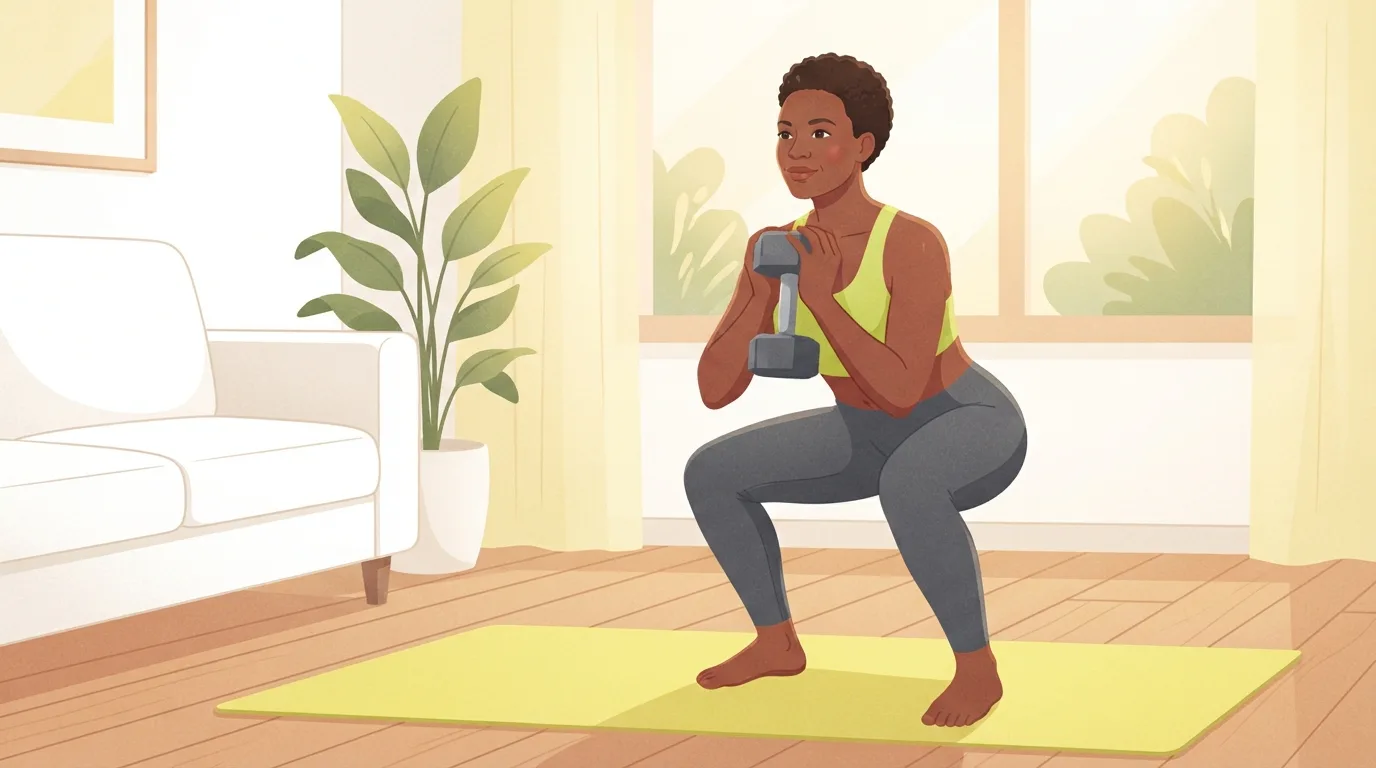
That trial was in older adults, but the principle holds at any age: lifting is what tells your body the muscle is still needed. You don't need a gym. A full-body session of five exercises covers it:
- Goblet squat with one dumbbell
- Dumbbell Romanian deadlift
- Push-up, raised on a bench or counter if needed
- One-arm dumbbell row
- Split squat or reverse lunge
Do two or three sets of 8 to 12 reps each, two or three days a week, and add a rep or a little weight when the last set feels comfortable. That's progressive overload, and it matters more than the exact exercises you pick.
Find out what's really holding you back
FitCraft, our mobile fitness app, pairs you with an AI coach who builds you a personalized plan around your goals, schedule, and fitness level. Every FitCraft program is designed by Domenic Angelino, MPH (Brown University) and NSCA-CSCS, with research published in the Journal of Strength and Conditioning Research and Medicine & Science in Sports & Exercise.
Take the Free Assessment Free • 2 minutes • No credit cardStep 4: Walk daily, but let food do the subtracting
Walking is the best support act in weight loss and a poor lead. Wilkin and colleagues (2012) measured about 89 calories for walking a mile in adults averaging 156 pounds. On that figure, walking off 20 pounds with no change in food would take around 800 miles.
Real trials come in lower still, because people tend to eat back some of what they burn. In the Midwest Exercise Trial 2, Donnelly and colleagues (2013) randomized 141 young adults with overweight or obesity to supervised sessions burning 400 or 600 calories, five days a week for ten months, or to a no-exercise control group, without asking anyone to diet. The two exercise groups lost 3.9 and 5.2 kilograms, about 8.6 and 11.5 pounds. That's a real result for ten months of hard work, and it's still well short of 20.
So walk for what it does well: 30 to 60 minutes most days adds a few hundred calories to the deficit, helps appetite and mood, and becomes the habit that keeps the weight off later. Just don't count on it to carry the plan.
Step 5: Protect your sleep
Short sleep changes what the scale takes off you. Nedeltcheva and colleagues (2010), in the Annals of Internal Medicine, ran 10 overweight adults through two 14-day stretches of the same moderate calorie deficit, once with 8.5 hours of sleep opportunity and once with 5.5. With short sleep, fat loss fell from 1.4 to 0.6 kilograms, 55 percent less, and fat-free mass loss rose from 1.5 to 2.4 kilograms. Same diet, same weight on the scale, a worse result underneath.
Aim for at least seven hours, keep a fixed wake-up time even on weekends, and stop eating two or three hours before bed if late snacking is where your deficit leaks.
A 16-Week Schedule to Lose 20 Pounds
This schedule is built for someone starting around 180 to 220 pounds. If you're lighter, stretch each phase and expect closer to 20 to 25 weeks; if you're heavier, you'll likely finish sooner.
| Weeks | What you do | What the scale usually does |
|---|---|---|
| 1 to 2 | Find maintenance, set the deficit, two strength sessions, 20 to 30 minute walks | Down 3 to 5 pounds, much of it water |
| 3 to 6 | Three strength sessions, protein at every meal, 30 to 45 minute walks | About 1 to 1.5 pounds a week |
| 7 to 10 | Re-check maintenance at about 10 pounds down, trim 100 to 200 calories if the trend has flattened, add a set | About 1 pound a week, with one flat week that's normal |
| 11 to 16 | Hold the routine, keep adding reps or weight, start planning maintenance meals | About 0.75 to 1.25 pounds a week, reaching 20 |
| 17 onward | Raise calories gradually to your new maintenance over two to four weeks, keep lifting and walking | Steady, with a small rise as glycogen refills |
Notice where the work concentrates. Weeks one and two feel dramatic and teach you very little. Weeks seven to ten decide whether the plan finishes, because that's when the early water loss is long gone and the trend is slow enough to doubt.

Why the Second 10 Pounds Comes Off Slower
A lighter body burns fewer calories, so the deficit you set in week one quietly shrinks as you lose weight. On top of that, the body adapts. The most extreme measurement comes from Fothergill and colleagues (2016), who followed 14 contestants from The Biggest Loser. They lost an average of 58.3 kilograms in 30 weeks, and their resting metabolic rate fell by 610 calories a day. Six years later they had regained about 41 kilograms, and their resting metabolism was still 704 calories a day below where it started.
A 20-pound plan is nowhere near that extreme, and a moderate pace with protein and lifting limits the adaptation. The practical lesson is to recalculate rather than panic. Around the 10-pound mark, repeat the step 1 check, adjust by 100 to 200 calories if the weekly trend has flattened for three weeks, and keep everything else the same. If you've stalled for longer than that, our guide to the weight loss plateau walks through what's usually happening and what to change first.
Keeping the 20 Pounds Off
The end of the plan is where most weight-loss stories turn, so it's worth planning for before you get there. Wing and Phelan (2005) summarized what the National Weight Control Registry has learned from people who kept weight off. Members had lost an average of 33 kilograms and kept it off for more than five years. They reported about an hour of activity a day, regular breakfasts, weighing themselves regularly, and eating much the same way on weekends as on weekdays. Roughly 20 percent of people with overweight manage to lose at least 10 percent of their body weight and keep it off for a year.
Nothing on that list is clever. It's the same five steps, run long enough that they stop feeling like a diet. That's why consistency matters more than intensity, and why the plan you can repeat beats the plan that looks best on paper.
If consistency is where you've always come undone, the tools built around it are worth a look. Our roundup of the best workout apps for weight loss compares the ones designed to keep you training through the slow middle weeks. FitCraft is one of them: an AI coach demonstrates every dumbbell and bodyweight exercise as a 3D character, adapts your workouts as you progress, and keeps a streak and a leaderboard in front of you. As Jim, 26, put it after losing 24 pounds in three months: "I kept telling myself I'd start Monday. FitCraft made me start on a Wednesday and I haven't stopped."
The Bottom Line
Twenty pounds of fat comes off in about 10 to 20 weeks for most people, not 30 days. A 20-pound month is mostly water, and the plan that actually works is five plain steps: a deficit set from your own maintenance, protein at every meal, two or three strength sessions a week, a daily walk and real sleep.
Expect a fast first two weeks, a slower middle and at least one flat week that tests you. Keep going through it. You're not bad at this; you were running a plan that was built to fail.
Frequently Asked Questions
How to lose 20 lbs in a month?
For most people, not as 20 pounds of fat. On paper a 20-pound month needs a deficit of roughly 2,300 calories a day, and Yang and Van Itallie (1976) found that even 800-calorie diets produced fat loss of only about 165 grams a day, close to 11 pounds over 30 days, with water making up the rest of any faster drop. A realistic target is 20 pounds over 10 to 20 weeks.
Is it realistic to lose 20 pounds in a month?
It's realistic on the scale for some heavier people and unrealistic as fat loss for almost everyone. A fast 20-pound month is usually about half water, glycogen and gut contents, which return when you eat normally again. People who drop that much in a month safely are generally starting very heavy and dieting under medical supervision.
How long does it take to realistically lose 20 pounds?
About 10 to 20 weeks for a 200-pound adult losing 1 to 2 pounds a week, longer for smaller people and shorter for heavier ones. At 0.5 to 1 percent of body weight a week, a 160-pound person needs roughly 13 to 25 weeks and a 260-pound person roughly 8 to 15. The second 10 pounds usually takes longer than the first.
Can you lose 20 pounds in 2 months?
Yes, if you start at roughly 230 pounds or heavier. Twenty pounds in about nine weeks is a little over 2 pounds a week, which stays within about 1 percent of body weight a week only at that size. For a 180-pound person, 8 to 15 pounds in two months is the realistic range, and pushing harder mostly costs muscle.
Can I lose 25 lbs in 3 months?
Yes, if you start at around 200 pounds or heavier. Twenty-five pounds over 13 weeks is just under 2 pounds a week, which stays within about 1 percent of body weight a week at that size. If you're lighter, it means losing faster than that, and 15 to 20 pounds in three months is the safer goal.
How much do I have to walk to lose 20 pounds?
On paper, about 800 miles with no change in food, using the roughly 89 calories per mile Wilkin and colleagues (2012) measured. In practice exercise alone works slower than that arithmetic: in Donnelly and colleagues (2013), ten months of supervised sessions burning 600 calories each, five days a week, produced about 11.5 pounds of weight loss. Walk 30 to 60 minutes a day and let the calorie deficit do most of the subtracting.
How to lose 20 pounds without working out?
It's possible, because the calorie deficit does most of the subtracting, but more of what you lose is likely to be muscle. In Villareal and colleagues (2017), dieters who only did aerobic exercise lost 5 percent of their lean mass against 2 percent for those who lifted. If time is the obstacle, two short dumbbell or bodyweight sessions a week are the minimum worth keeping.
How to lose 20 pounds for a woman?
The plan is the same, and the timeline is usually longer. A 150-pound woman losing 0.5 to 1 percent of body weight a week drops about 0.75 to 1.5 pounds weekly, so 20 pounds takes roughly 13 to 27 weeks, and a smaller body burns fewer calories, which leaves less room for a deficit. Protein at every meal, two or three strength sessions a week and patience with cycle-related water swings matter more than any diet marketed to women.