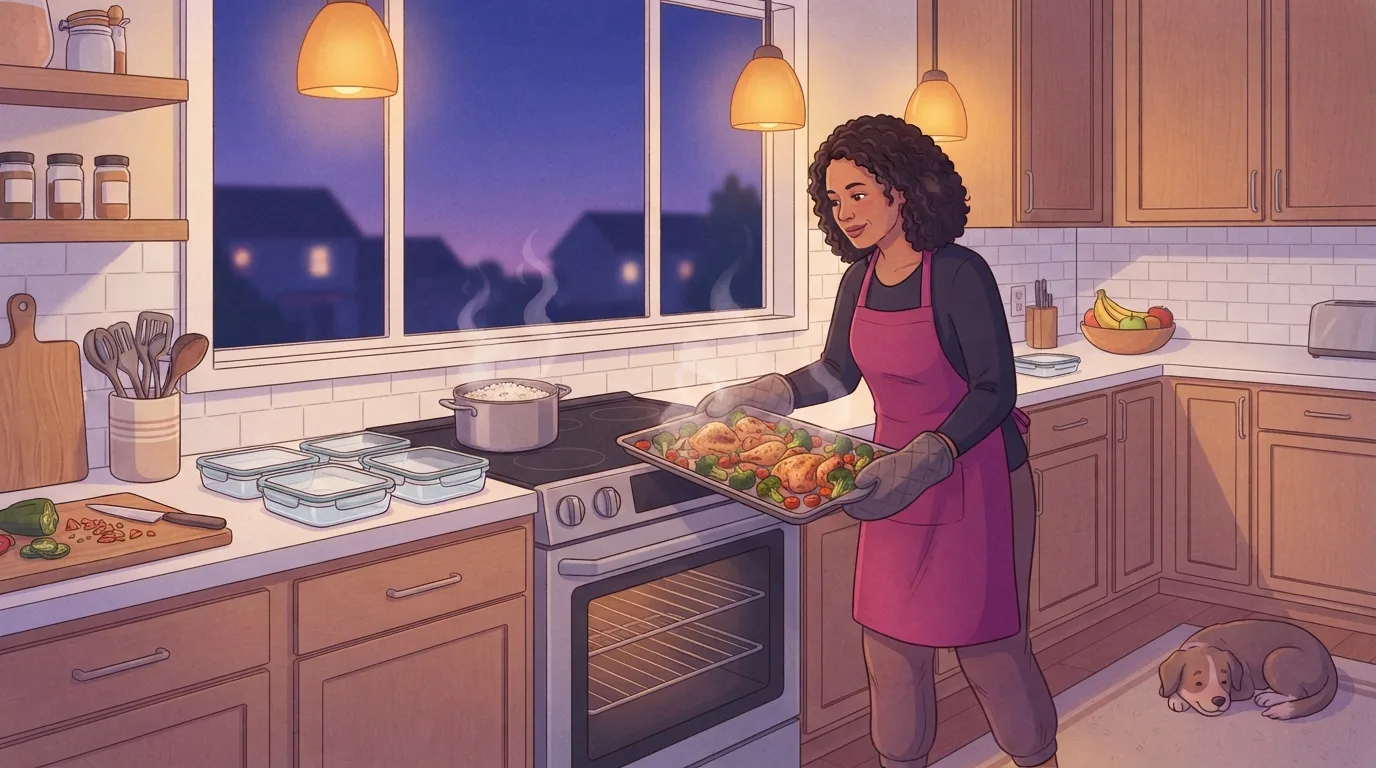
Sunday evening, you cook a pot of rice, roast a tray of chicken and line up seven containers. By Wednesday the chicken tastes like cardboard, a coworker suggests takeout, and the last two containers end up in the bin on Saturday.
After a few weeks of that, it's easy to decide meal prep isn't for you, or that you just don't have the discipline. Neither is true. Most people who give up on meal prep cooked too much of one thing for too many days.
A plan that survives the week is built differently: shorter batches, two or three meals on rotation, and portions sized to your calorie target while you're still full from lunch. Below are the five steps, the food-safety limits for each kind of food, healthy lunch meal prep ideas and dinners with the protein and calories worked out, and what the research says about why this works.
How to Meal Prep for Weight Loss in 5 Steps
- Plan three or four days of meals and the portion size for each.
- Shop from one list, organized by the sections of the store.
- Batch cook the proteins, vegetables and starches in a single session.
- Portion everything into matching containers while it's still warm.
- Store it safely, eat it in date order, and prep again midweek.
Step 1: Plan Your Meals and Your Portions
Start with your daily calorie target, because every container is a slice of it. Our macro calculator gives you a number for cutting, along with protein, carb and fat targets. As an example, a 1,800-calorie day could be three meals of about 450 calories and a 300-calorie snack.
Then build each container on the same template:
- A palm-sized portion of lean protein, about 4 ounces cooked, which usually lands at 25 to 40 grams of protein.
- Half the container of non-starchy vegetables, such as broccoli, peppers, green beans, zucchini or salad greens.
- A quarter of the container of starch, such as rice, quinoa, potatoes, pasta, beans or lentils.
- A measured amount of fat: a teaspoon or two of oil, an ounce of cheese or a little dressing.
Protein comes first for a reason. A meta-analysis of 24 trials by Wycherley and colleagues (2012) compared higher-protein and standard-protein diets with the same calories. The higher-protein versions produced 0.79 kg more weight loss and 0.87 kg more fat loss on average, and they protected 0.43 kg of lean mass that the standard diets lost.
Pick two lunches and two dinners for each batch, not one of each. Cover three or four days, not seven, for a food-safety reason explained in step 5. Breakfast can be prepped too, and five of our high protein breakfast ideas are built to be made ahead.
Step 2: Shop From One List
Write the list from your plan and group it by the sections of the store: produce, meat and fish, dairy and eggs, canned and dry goods, frozen. You'll walk the store once and skip the aisles that tempt you.
Shortcuts are fine, and they're often what keeps people prepping. Frozen vegetables are picked and frozen ripe, need no chopping, and keep for months. Canned beans, lentils and tuna are ready to use. Microwavable rice pouches and a rotisserie chicken (skin removed) can save you most of an hour.
Buy containers once and buy them in one size. Glass containers with locking lids, about 3 to 4 cups each, hold a full lunch, go from fridge to microwave, and make every portion look the same, which matters more than it sounds.
Step 3: Batch Cook in One Session
Run the oven, the stovetop and the cutting board at the same time, and a batch takes about 90 minutes.
- Oven: two sheet pans, one of protein (chicken thighs or breasts, salmon, tofu) and one of vegetables (broccoli, peppers, potatoes), both with a teaspoon or two of oil and simple seasoning.
- Stovetop: a pot of grain or lentils, plus one pot meal such as chili or soup that covers several portions by itself.
- Cutting board: raw salad vegetables, hard-cooked eggs and any sauces, kept in separate small containers so nothing goes soggy.
Cook meat to a safe internal temperature and check it with a thermometer rather than by color. The CDC's food safety steps list 165°F for all poultry, 160°F for ground meats, and 145°F for whole cuts of beef, pork and lamb followed by a 3-minute rest.
Cooking from basic ingredients also changes how much you eat. In a 4-week inpatient trial, Hall and colleagues (2019) gave 20 adults either ultra-processed or unprocessed meals matched for calories, sugar, fat, fiber and sodium, and let them eat as much as they wanted. On the ultra-processed diet they ate about 508 more calories a day and gained 0.9 kg in two weeks. On the unprocessed diet they lost 0.9 kg.
Step 4: Portion Into Containers
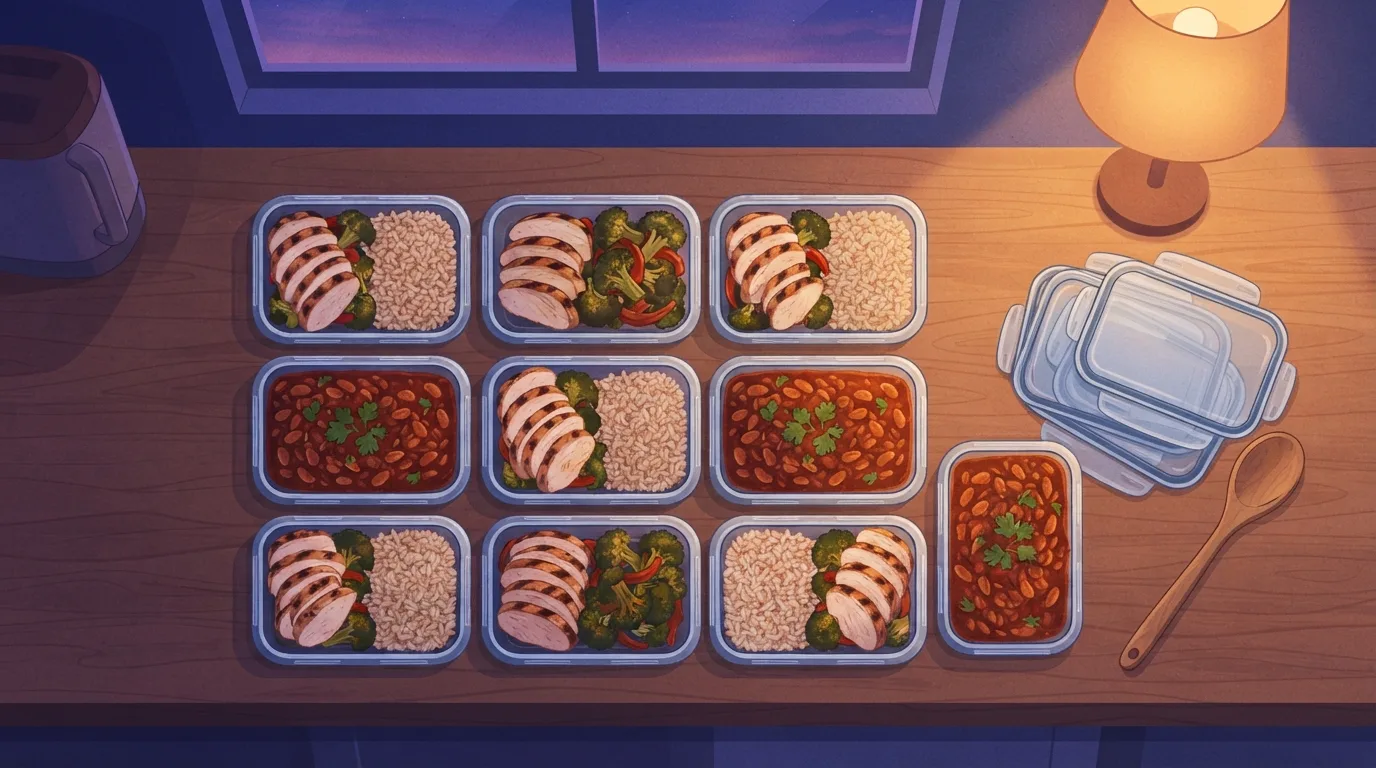
This is the step that does the most for weight loss. People eat more when they're served more, and they don't feel much fuller for it. Rolls and colleagues (2006) served 32 adults all their meals and snacks for two days at a time, at the usual size, 50% bigger or double. Bigger portions raised daily intake by 16%, about 335 calories for women and 504 for men, and doubling them raised it by 26%. Fullness ratings were no different between the 150% and 200% portions.
A container sets that portion for you. Weigh the protein and the starch with a kitchen scale for the first batch or two, then you'll be able to eyeball it. Measure the calorie-dense extras every time, because a free pour of olive oil or dressing can add 100 to 200 calories to a container without making it look any bigger.
Portion while the food is still warm and get the containers into the fridge promptly. Keep dressings and sauces in small separate cups so salads stay crisp and you control how much goes on.
Step 5: Store It Safely and Eat It in Order
The FDA's guidance on storing food safely sets the ground rules: refrigerate cooked food within two hours (one hour if the room is above 90°F), keep the fridge at or below 40°F and the freezer at 0°F, and don't pack the fridge so tightly that cold air can't circulate. Spread hot food into shallow containers so it chills faster.
The FDA's refrigerator and freezer storage chart then sets how long each food keeps:
| Prepped food | Fridge (40°F) | Freezer (0°F) |
|---|---|---|
| Cooked meat and meat dishes | 3 to 4 days | 2 to 3 months |
| Cooked poultry dishes | 3 to 4 days | 4 to 6 months |
| Cooked fish | 3 to 4 days | 4 to 6 months |
| Soups and stews | 3 to 4 days | 2 to 3 months |
| Egg, chicken or tuna salad | 3 to 5 days | Don't freeze |
| Hard-cooked eggs | 1 week | Don't freeze |
| Raw chicken parts | 1 to 2 days | 9 months |
| Raw ground meat or turkey | 1 to 2 days | 3 to 4 months |
The FDA notes that freezing at 0°F keeps food safe indefinitely, so the freezer times above are for quality, not safety. When you reheat, the CDC's guidance is to bring leftovers to 165°F all the way through.
In practice that means two short sessions instead of one long one. Prep on Sunday for Monday to Wednesday, and either freeze the Thursday and Friday portions (moving each to the fridge the night before) or run a 45-minute top-up on Wednesday evening. Write the cooking day on each lid and eat the oldest container first.
Find out what's really holding you back
FitCraft, our mobile fitness app, pairs you with an AI coach who builds you a personalized plan around your goals, schedule, and fitness level. Every FitCraft program is designed by Domenic Angelino, MPH (Brown University) and NSCA-CSCS, with research published in the Journal of Strength and Conditioning Research and Medicine & Science in Sports & Exercise.
Take the Free Assessment Free • 2 minutes • No credit cardWhat the Research Says About Meal Prep and Weight
Meal planners and home cooks eat better
The largest study is Ducrot and colleagues (2017), who asked 40,554 French adults whether they planned their meals for the next few days. The 57% who planned at least occasionally were more likely to meet national nutrition guidelines and ate a wider variety of foods. Women who planned had 21% lower odds of obesity, and men 19% lower.
Eating home-cooked food shows the same pattern. In 11,396 UK adults, Mills and colleagues (2017) found that people eating home-cooked main meals more than five times a week ate about 62 grams more fruit and 98 grams more vegetables a day than those managing fewer than three. They were also 28% less likely to have an overweight BMI and 24% less likely to have excess body fat. In a US survey of 1,319 adults, Monsivais and colleagues (2014) found that people who spent less than an hour a day on food preparation ate fast food more often and spent more on food away from home.
All three are cross-sectional, so they can't prove that planning or cooking causes the difference. People who plan meals may differ in other ways too. Treat these studies as a consistent signal, not proof.
Portion control is the active ingredient
The strongest causal evidence comes from trials that hand people their portions. Hannum and colleagues (2004) randomized 60 women with overweight or obesity to the same 1,365-calorie target for eight weeks. One group ate two packaged portion-controlled entrees a day, and the other chose their own food from the same food guide. The portion-controlled group lost 5.6 kg (6.5% of body weight) against 3.6 kg (4.2%), and more of it was fat. A meal prep container is a homemade version of that entree.
Eating the same lunch every day can help
Repetition worries people, but it may work in your favor. In Epstein and colleagues (2011), 32 women were served the same macaroni and cheese meal five times, either daily for a week or once a week for five weeks. Daily servings led to faster habituation, the gradual drop in interest that comes with repetition, and less food eaten. A rotating set of two or three meals keeps that effect without the boredom that makes people quit.
Healthy Lunch Meal Prep Ideas for Weight Loss
Each of these lunch meal prep ideas follows the container template from step 1. Protein and calories come from USDA FoodData Central and cover the listed ingredients, not salt, spices or extra sauce.
- Chicken, quinoa and broccoli bowl (44 g protein, 411 calories): 4 ounces of roasted chicken breast, half a cup of cooked quinoa, a cup of broccoli, half a red pepper and a teaspoon of olive oil.
- Turkey and black bean chili (36 g, 400 calories): 3 ounces of cooked 93% lean ground turkey, half a cup each of black beans and canned tomatoes, onion and pepper, topped with 2 tablespoons of plain Greek yogurt. It freezes well.
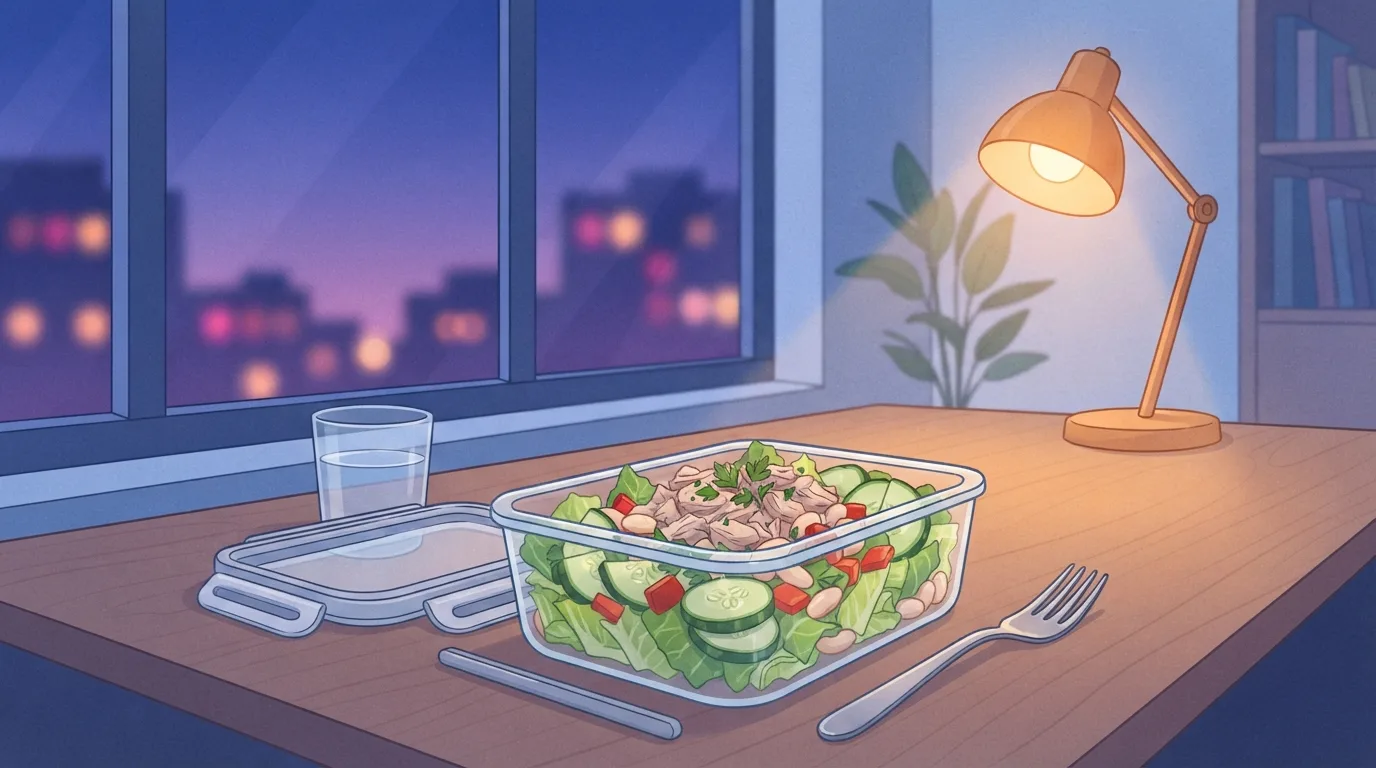
- Tuna and white bean salad (33 g, 350 calories): 4 ounces of canned light tuna, half a cup of white beans, 2 cups of romaine, cucumber, 2 teaspoons of olive oil and lemon juice, with the dressing kept separate.
- Tofu, edamame and brown rice stir-fry (36 g, 486 calories): half a cup each of firm tofu, edamame and cooked brown rice, with broccoli, red pepper and a teaspoon of oil.
- Greek chickpea and egg salad (24 g, 409 calories): two hard-cooked eggs, half a cup of chickpeas, cucumber, red pepper, an ounce of feta, romaine and a teaspoon of olive oil.
- Lentil and spinach soup (29 g, 362 calories): a cup of cooked lentils simmered with canned tomatoes, onion and spinach, finished with 85 grams of plain Greek yogurt. Soups keep 2 to 3 months in the freezer.
Dinner Meal Prep Ideas for Weight Loss
These meal prep dinners for weight loss reheat well and land between 350 and 505 calories.
- Sheet-pan salmon, potatoes and green beans (31 g protein, 454 calories): 4 ounces of salmon, about 5 ounces of potato and a cup of green beans roasted with a teaspoon of oil. Eat the salmon within 3 to 4 days.
- Turkey meatballs with marinara and zucchini (38 g, 421 calories): 4 ounces of cooked 93% lean turkey, half a cup of marinara, a cup of zucchini and half a cup of whole-wheat pasta.
- Chicken fajita bowl (47 g, 504 calories): 4 ounces of chicken breast, half a cup each of black beans and brown rice, a cup of sliced peppers, onion and a teaspoon of oil.
- Shrimp and broccoli stir-fry over brown rice (34 g, 350 calories): 4 ounces of cooked shrimp, a cup of broccoli, red pepper, half a cup of brown rice and a teaspoon of oil.
High Protein Low Fat Meal Prep
If you want high protein low fat meal prep, the protein you choose matters more than the recipe. Here's how common meal prep proteins compare per portion, from the same USDA data.
| Protein | Portion | Protein (g) | Fat (g) | Calories |
|---|---|---|---|---|
| Chicken breast, roasted | 4 oz cooked | 35.1 | 4.0 | 186 |
| Shrimp | 4 oz cooked | 27.1 | 0.3 | 112 |
| Canned light tuna in water | 4 oz drained | 22.0 | 1.1 | 97 |
| Egg whites | 6 large | 21.6 | 0.3 | 103 |
| Cod | 4 oz raw | 20.1 | 0.8 | 93 |
| Lentils | 1 cup cooked | 17.9 | 0.8 | 230 |
| Ground turkey, 93% lean | 4 oz cooked | 30.6 | 13.1 | 241 |
Shrimp, tuna, white fish and egg whites carry almost no fat. Ground turkey labeled 93% lean still has about 13 grams of fat per cooked portion, more than three times the chicken breast. The lentil soup and the shrimp stir-fry are the leanest full meals on this page, at about 6 and 7 grams of fat.
A Sample Weight Loss Meal Prep Week
Here's how two short sessions of three recipes each cover six days of lunches and dinners, keeping every container inside the 3-to-4-day window.
| Day | Lunch | Dinner |
|---|---|---|
| Sunday | Prep session 1: chicken quinoa bowls, turkey chili, sheet-pan salmon | |
| Monday | Chicken quinoa bowl | Sheet-pan salmon |
| Tuesday | Turkey chili | Sheet-pan salmon |
| Wednesday | Chicken quinoa bowl | Turkey chili |
| Wednesday evening | Prep session 2: tuna and white bean salads, lentil soup, chicken fajita bowls | |
| Thursday | Tuna and white bean salad | Chicken fajita bowl |
| Friday | Lentil soup | Chicken fajita bowl |
| Saturday | Tuna and white bean salad | Lentil soup or a meal out |
Leave one or two meals a week unplanned. A plan with room for a dinner out is one you'll still be following in a month.
Meal Prep Mistakes That Stall Weight Loss
- Prepping seven days at once. Cooked food is past its fridge window by day five, and the last containers either get thrown out or eaten when they shouldn't be.
- One recipe for every meal. Repetition helps up to a point. Two or three meals on rotation is the sweet spot.
- Unmeasured oil, cheese and dressing. They're the easiest way to turn a 400-calorie container into a 600-calorie one.
- Containers that are too small. A lunch that leaves you hungry at 3 p.m. gets topped up from a vending machine. Raise the vegetables and protein before you cut anything else.
- No plan for snacks and evenings. Prepped meals don't cover the 9 p.m. kitchen visit. Whole fruit is the easiest snack to prep, and our guide to the best fruits for weight loss covers which ones help most. If evenings are the hard part, read how to stop eating late at night.
The Bottom Line
Meal prep works for weight loss mainly because it fixes your portions before you're hungry. Plan three or four days at a time, build every container around a lean protein and a large serving of vegetables, measure the oil and the starch, store everything at 40°F or below, and eat it within 3 to 4 days.
The food side is half of the plan. The other half is training, which protects muscle while you lose fat. If that's the part that keeps slipping, our roundup of the best workout apps for weight loss compares the options. In FitCraft, a 3D AI coach shows you every move in an interactive demo and calls you by name during the workout, while your streak and the leaderboards give you a reason to show up on the days you'd rather not.
Frequently Asked Questions
What are some good meal prep ideas to lose weight?
Good meal prep ideas for weight loss pair a lean protein with vegetables and a measured starch: a chicken, quinoa and broccoli bowl, turkey and black bean chili, a tuna and white bean salad, lentil soup, or a shrimp and broccoli stir-fry over brown rice. Built from USDA FoodData Central numbers, each of these lands at roughly 350 to 420 calories with 29 to 44 grams of protein.
What is the cheapest lunch I can make?
Dried lentils and beans, eggs, canned tuna, frozen vegetables, oats and rice are among the cheapest foods that still make a filling lunch. A pot of lentil and spinach soup or bean chili makes four to six portions in one go, freezes well for up to 2 to 3 months, and usually costs less per serving than a packaged lunch.
What can I eat every day for lunch?
You can eat the same balanced lunch every day, such as a protein, a large portion of vegetables and a measured starch. Repetition may even help: in Epstein and colleagues (2011), women served the same meal daily got used to it faster and ate less of it than women served it once a week. Swap the vegetables or sauce when it starts to feel like a chore.
How long does meal prep last in the fridge?
Cooked meat, poultry, fish, soups and stews keep 3 to 4 days in a refrigerator at 40 degrees Fahrenheit or below, according to the FDA's storage chart. Hard-cooked eggs keep about a week. Prep three or four days at a time, or freeze the later portions and move each one to the fridge the night before.
How many calories should a meal prep lunch be for weight loss?
It depends on your daily target, but 350 to 500 calories suits most people eating 1,500 to 2,000 calories a day across three meals and a snack. Set your daily number first with a macro or calorie calculator, then divide it across meals so the containers match the plan.
Does meal prepping actually help you lose weight?
It helps mainly by controlling portions. In an 8-week trial, women eating two portion-controlled entrees a day lost 5.6 kilograms against 3.6 kilograms on a self-selected diet with the same calorie target (Hannum 2004). Studies of meal planners and home cooks also link them to better diets and lower odds of obesity, though those studies can't prove cause.