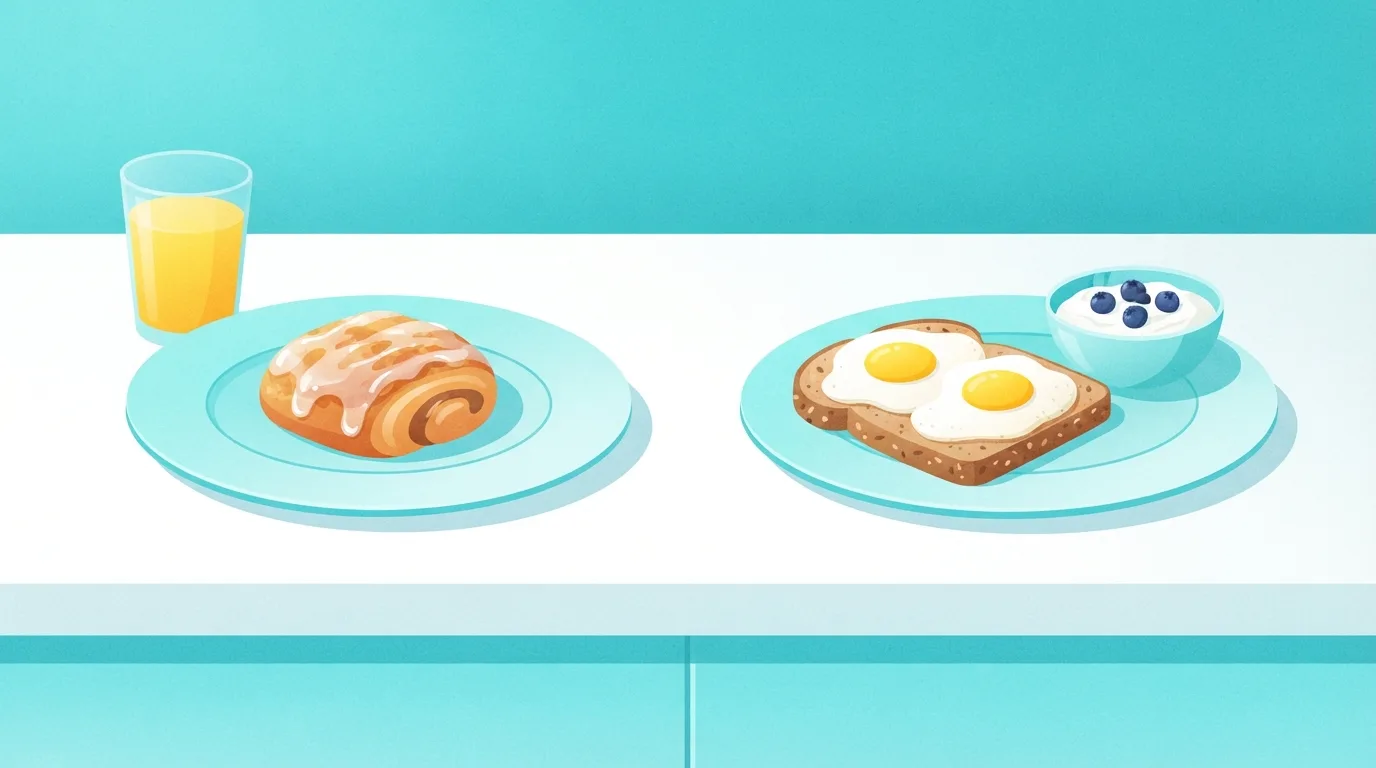
Two slices of whole-wheat toast with jam and a cup of coffee come to about 8 grams of protein, by the USDA's numbers. It feels like a reasonable breakfast. By half past ten you're looking for a snack, and lunch ends up bigger than you planned.
That pattern is frustrating, because it looks like a willpower problem. You ate breakfast. You were trying. Somehow your appetite still ran the rest of the day.
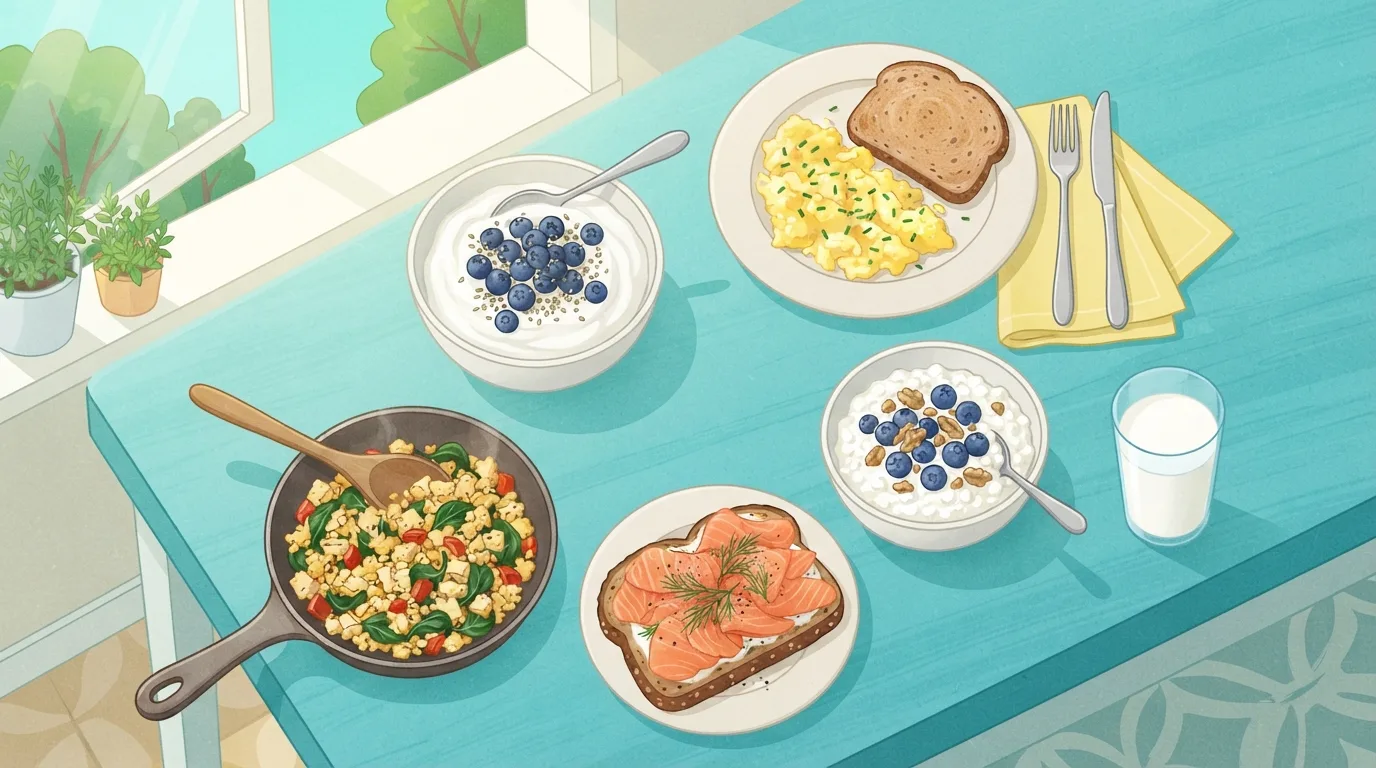
It's mostly a design problem, and it's easy to fix once you know which foods carry the grams. Below you'll find 15 high protein breakfast ideas with the protein worked out, a ranked table of breakfast foods high in protein, a simple way to hit 30 grams, and what the research says about why protein at breakfast matters.
15 High Protein Breakfast Ideas, With Grams per Serving
Every number below comes from USDA FoodData Central (the SR Legacy database), using raw weights for eggs and standard household portions for everything else. Brands differ by a gram or two, so check your labels. Calories are listed so you can match each high protein breakfast to the rest of your day.
1. Greek Yogurt Bowl With Hemp Seeds and Blueberries: 27 g
Spoon a 170-gram container of plain nonfat Greek yogurt (17.3 g of protein) into a bowl, then top it with 3 tablespoons of hulled hemp seeds (9.5 g) and half a cup of blueberries. That's about 27 grams of protein and 308 calories with no cooking. Hemp seeds are one of the few toppings that add real protein, nearly 10 grams in three spoonfuls.
2. Three-Egg Scramble With Cheddar on Toast: 29 g
Three large eggs (18.8 g) scrambled with an ounce of cheddar (6.4 g) and served with one slice of whole-wheat toast (4.0 g) come to about 29 grams of protein and 408 calories. Throw spinach, peppers or mushrooms into the pan for volume. They barely change the calories.
3. Cottage Cheese With Blueberries and Walnuts: 31 g
One cup of 1% cottage cheese holds 28 grams of protein by itself, more than four large eggs. Add half a cup of blueberries and 2 tablespoons of chopped walnuts for about 31 grams of protein and 303 calories. If the texture puts you off, blend it smooth and it eats like a thick yogurt.
4. Smoked Salmon on Whole-Wheat Toast: 24 g
Three ounces of smoked salmon (15.5 g) on two slices of whole-wheat toast (8.0 g) with a tablespoon of cream cheese gives about 24 grams of protein and 311 calories. Cucumber, capers and thin red onion add crunch for almost nothing.
5. Tofu Scramble With Spinach: 27 g
Crumble half a cup of firm tofu (21.8 g) into a pan with a teaspoon of olive oil, wilt in a cup of spinach, season with turmeric, cumin and black pepper, and serve it on one slice of whole-wheat toast. That's about 27 grams of protein and 309 calories, all from plants. Firmer tofu carries more protein per bite, so pick firm or extra-firm.
6. Greek Yogurt Overnight Oats: 29 g
The night before, stir half a cup of rolled oats, half a cup of 2% milk, a 170-gram container of plain Greek yogurt and a tablespoon of chia seeds together in a jar. In the morning you have about 29 grams of protein and 373 calories waiting in the fridge. Plain oats made with water give you only about 5 grams, so the yogurt does most of the work here.
7. Peanut Butter Banana Protein Smoothie: 38 g
Blend a cup of 2% milk (8.1 g), one scoop of whey protein powder (25 g in USDA's 32-gram reference serving), a tablespoon of peanut butter and a medium banana. You get about 38 grams of protein and 435 calories, the highest total on this list. Scoop sizes vary between brands, so read the label on yours.
8. Egg and Black Bean Breakfast Burrito: 31 g
Scramble two eggs, fold in half a cup of black beans and an ounce of cheddar, and roll it in an 8-inch flour tortilla with salsa. That's about 31 grams of protein and 529 calories. Wrapped in foil, these freeze well, so a batch on Sunday covers several weekday mornings.
9. Canadian Bacon and Egg English Muffin: 25 g
A toasted English muffin with one fried egg, two slices of Canadian bacon and a slice of cheddar is the home version of a drive-through sandwich, with about 25 grams of protein and 361 calories. Canadian bacon is unusually lean for a breakfast meat: about 4 grams of protein per slice for roughly 20 calories.
10. Egg White Omelet With Spinach and Feta: 27 g
Six large egg whites (21.6 g), a cup of spinach and an ounce of feta cooked in a teaspoon of olive oil make about 27 grams of protein for 225 calories, the lightest breakfast here. A cup of liquid egg whites from a carton does the same job without the separating.
11. Cottage Cheese Oat Pancakes: 32 g
Blend half a cup of 1% cottage cheese, two eggs and half a cup of rolled oats until smooth, then cook three or four small pancakes. They come to about 32 grams of protein and 378 calories before toppings. Berries keep them light, while syrup adds calories and no protein.
12. Egg Bites With Cottage Cheese and Ham: 25 g
Whisk two eggs with a quarter cup of 1% cottage cheese and an ounce of diced extra-lean ham, pour the mix into a greased muffin tin and bake at 350°F for about 20 minutes, until set. Three or four bites give you about 25 grams of protein and 224 calories. A tray of a dozen covers three mornings.
13. Besan Chilla With Greek Yogurt: 28 g
For an Indian-style protein rich breakfast, whisk half a cup of chickpea flour (besan) with water, chopped onion, green chili and coriander, then cook it as two thin savory pancakes. Serve them with a 170-gram bowl of plain Greek yogurt in place of regular curd. That's about 28 grams of protein and 318 calories, with the chickpea flour supplying about 10 of them.
14. Peanut Butter Toast With a Glass of Milk: 23 g
Two slices of whole-wheat toast (8.0 g) with 2 tablespoons of peanut butter (7.1 g) and a cup of 2% milk (8.1 g) add up to about 23 grams of protein. It's one of the cheapest breakfasts on this list. At 475 calories, it's also one of the heaviest, because peanut butter brings far more fat than protein.
15. Vegan Peanut Butter Overnight Oats With Soy Milk: 26 g
Soak half a cup of rolled oats in a cup of soy milk overnight, then stir in 3 tablespoons of hemp seeds and a tablespoon of peanut butter. You get about 26 grams of protein, all from plants, at 546 calories. Treat it as a big breakfast, or use half the hemp seeds on lighter days.
Breakfast Foods High in Protein: Grams per Serving
If you'd rather build your own breakfast, start from this table. It ranks common breakfast foods high in protein by grams per typical serving, using the same USDA data. The last column shows protein per 100 calories, which tells you how much protein each food gives you for its calories.
| Food | Serving | Protein (g) | Calories | Protein per 100 kcal (g) |
|---|---|---|---|---|
| Cottage cheese, 1% | 1 cup (226 g) | 28.0 | 163 | 17.2 |
| Whey protein powder | 1/3 cup (32 g) | 25.0 | 113 | 22.2 |
| Firm tofu | 1/2 cup (126 g) | 21.8 | 181 | 12.0 |
| Ham, extra lean | 3 oz (85 g) | 17.8 | 123 | 14.4 |
| Greek yogurt, plain nonfat | 1 container (170 g) | 17.3 | 100 | 17.3 |
| Smoked salmon | 3 oz (85 g) | 15.5 | 99 | 15.6 |
| Ricotta, part skim | 1/2 cup (124 g) | 14.1 | 171 | 8.3 |
| Egg whites | 3 large (99 g) | 10.8 | 51 | 21.0 |
| Chickpea flour (besan) | 1/2 cup (46 g) | 10.3 | 178 | 5.8 |
| Hemp seeds, hulled | 3 tbsp (30 g) | 9.5 | 166 | 5.7 |
| Milk, 2% | 1 cup (244 g) | 8.1 | 122 | 6.6 |
| Quinoa, cooked | 1 cup (185 g) | 8.1 | 222 | 3.7 |
| Soy milk, original | 1 cup (243 g) | 7.9 | 131 | 6.1 |
| Canadian bacon, cooked | 2 slices (28 g) | 7.8 | 40 | 19.4 |
| Black beans, cooked | 1/2 cup (86 g) | 7.6 | 114 | 6.7 |
| Peanut butter | 2 tbsp (32 g) | 7.1 | 191 | 3.7 |
| Cheddar cheese | 1 oz (28 g) | 6.5 | 114 | 5.7 |
| Egg, whole | 1 large (50 g) | 6.3 | 72 | 8.8 |
| Rolled oats, dry | 1/2 cup (41 g) | 5.3 | 153 | 3.5 |
| Whole-wheat bread | 1 slice (32 g) | 4.0 | 81 | 4.9 |
Two patterns stand out. Low-fat dairy, egg whites and lean meats give you the most protein for the calories, so they make good anchors. Nut butters, seeds and oats give the least, so they work better as boosters. Quinoa is often sold as a breakfast protein, yet a cooked cup carries about 8 grams, the same as a glass of milk.

How Do I Get 30g of Protein in My Breakfast?
Pick one anchor that supplies 15 to 28 grams, then add one or two boosters worth 4 to 10 grams each. That's the whole method.
- Anchors: a cup of 1% cottage cheese (28 g), a scoop of whey (about 25 g), half a cup of firm tofu (22 g), three large eggs (19 g), a container of plain Greek yogurt (17 g) or 3 ounces of smoked salmon (16 g).
- Boosters: 3 tablespoons of hemp seeds (10 g), a glass of milk or soy milk (8 g), 2 tablespoons of peanut butter (7 g), an ounce of cheddar (6 g), one more egg (6 g) or a slice of whole-wheat toast (4 g).
A few combinations that clear 30 grams: Greek yogurt with hemp seeds and half a cup of milk (about 31 g), a cup of cottage cheese with a slice of toast (about 32 g), or a tofu scramble on toast with a glass of soy milk (about 35 g).
Why 30? A 2015 review in the American Journal of Clinical Nutrition by Leidy and colleagues concluded that higher-protein diets, potentially with at least 25 to 30 grams per meal, improve appetite and weight management. Muscle research points the same way. Moore and colleagues (2015) pooled data on how much protein in one sitting maximally switches on muscle protein synthesis: about 0.24 grams per kilogram of body weight in younger men and 0.40 in older men. For a 175-pound person, that's roughly 19 grams at age 22 and 32 grams at age 71.
Breakfast is one meal, though, and your daily total matters more. Our guide to how much protein you need per day covers the targets by goal, and the protein calculator turns your weight and goal into a daily number you can split across meals.
Find out what's really holding you back
FitCraft, our mobile fitness app, pairs you with an AI coach who builds you a personalized plan around your goals, schedule, and fitness level. Every FitCraft program is designed by Domenic Angelino, MPH (Brown University) and NSCA-CSCS, with research published in the Journal of Strength and Conditioning Research and Medicine & Science in Sports & Exercise.
Take the Free Assessment Free • 2 minutes • No credit cardWhat the Research Says About Protein at Breakfast
A protein-rich breakfast keeps you fuller
The best-known trial comes from Leidy and colleagues (2013). Twenty teenage girls with overweight or obesity who normally skipped breakfast spent six days each eating a 350-calorie cereal breakfast with 13 grams of protein, a 350-calorie egg and beef breakfast with 35 grams, or nothing. The high-protein breakfast raised fullness more than the cereal did. Compared with skipping, it also lowered ghrelin, the main hunger hormone, raised PYY, a fullness hormone, and cut evening snacking on high-fat foods. Total daily calories didn't differ between the conditions, so the effect was on hunger and food choice, not a guaranteed calorie cut.
Adults show something similar. In Vander Wal and colleagues (2005), 30 women with overweight or obesity ate either an egg breakfast or a bagel breakfast with the same calories and weight. After the eggs they felt fuller and ate about 2,406 kilojoules at lunch instead of 3,091, roughly 575 calories instead of 739. Their intake stayed lower for the next 36 hours.
Eating breakfast alone isn't a weight-loss tool
This part gets left out of most breakfast articles. A 2019 meta-analysis in the BMJ by Sievert and colleagues pooled 13 randomized trials and found that adults assigned to eat breakfast ate about 260 more calories a day and weighed 0.44 kilograms more than those assigned to skip it. The trials were short and mostly low quality, but the message is clear enough: adding a meal you weren't eating doesn't make you lose weight.
What the meal contains seems to matter more. In a 12-week trial, Leidy and colleagues (2015) gave 57 breakfast-skipping teenagers either a 35-gram protein breakfast, a 13-gram protein breakfast or no breakfast. The high-protein group held body fat steady (down 0.4 kg) while the skippers gained 1.6 kg, and their daily intake fell by about 400 calories. The lower-protein breakfast didn't do that. One honest caveat: when the two breakfast groups were compared directly, the differences weren't statistically significant. So if you skip breakfast and your eating is under control, there's no need to start. If you do eat breakfast, make protein the center of it.
Muscle responds to protein one meal at a time
Most people eat little protein in the morning and a lot at night. Mamerow and colleagues (2014) fed eight adults the same daily protein for a week in two patterns: about 31, 30 and 33 grams at breakfast, lunch and dinner, or about 11, 16 and 63 grams. Muscle protein synthesis over 24 hours was 25% higher with the even spread. It was a small study, and later work has been mixed, which our review of protein distribution across meals covers in full.
The per-meal number isn't a hard ceiling either. Trommelen and colleagues (2023) found that 100 grams of protein after a workout produced a larger and longer muscle-building response than 25 grams, lasting more than 12 hours. A big breakfast isn't wasted. A tiny one is a missed chance.
High Protein Breakfast Ideas for Weight Loss
If you're eating in a calorie deficit, the most useful breakfasts give you plenty of protein for a modest number of calories. These five from the list above deliver the most protein per calorie:
| Breakfast | Protein (g) | Calories |
|---|---|---|
| Egg white omelet with spinach and feta | 27 | 225 |
| Egg bites with cottage cheese and ham | 25 | 224 |
| Cottage cheese with blueberries and walnuts | 31 | 303 |
| Greek yogurt bowl with hemp seeds and blueberries | 27 | 308 |
| Tofu scramble with spinach on toast | 27 | 309 |
For a low calorie high protein breakfast, keep the anchor lean (egg whites, 1% cottage cheese, nonfat Greek yogurt), add vegetables or fruit for volume, and go easy on the oil, nut butter and cheese, which add calories faster than protein. No breakfast targets belly fat specifically. Fat comes off the whole body when you hold a deficit for weeks, and a filling breakfast just makes that deficit easier to keep.
If you log your meals in a calorie-tracking app, our FitCraft vs MyFitnessPal comparison explains how a food log and a workout coach split the job, and why plenty of people use both.
Low Carb and No Carb High Protein Breakfasts
Eggs, cheese, smoked salmon, Canadian bacon and plain cottage cheese are naturally low in carbohydrate, so a low carb and high protein breakfast mostly means skipping the toast, oats and fruit. The egg white omelet above has about 4 grams of carbohydrate, and the egg bites about 3. A cup of 1% cottage cheese on its own has about 6.
A truly zero-carb breakfast is harder than it sounds. Each large egg carries a fraction of a gram, and most dairy carries a few grams per serving. Smoked salmon and other fish carry none, so salmon rolled around cream cheese and cucumber gets you close.
Vegetarian and Vegan High Protein Breakfasts
Twelve of the 15 breakfasts above are vegetarian. Only the smoked salmon toast, the Canadian bacon muffin and the egg bites with ham contain meat or fish. For a vegan breakfast, tofu scramble (27 g) and the soy milk overnight oats (26 g) are the strongest options, and swapping the Greek yogurt in the besan chilla for soy yogurt keeps it plant-based.
Plant proteins need a little more planning. A review by van Vliet and colleagues (2015) found that soy and wheat proteins produce a smaller muscle-building response than several animal proteins, mostly because they're less digestible and lower in leucine. Their suggested fixes are simple: eat a bit more plant protein, and mix sources such as soy, beans, grains and seeds in the same meal. For an Indian breakfast, besan chilla, moong dal chilla made from soaked split mung beans, and paneer bhurji all fit that approach.
High Protein Breakfast for Muscle Gain
Protein gives your muscles the raw material. Training gives them the reason to use it. A high protein breakfast for muscle gain works best on days you lift, and it matters more as you age, since the Moore data put the per-meal amount for older men at about 0.40 grams per kilogram, closer to 30 grams than 20 for most people.
The training half is where most people slip. If that's you, FitCraft's dumbbell and bodyweight programs put a 3D AI coach in your living room who demonstrates each exercise, says your name mid-workout and keeps a streak going, so the workouts you're fueling actually happen.
Make-Ahead High Protein Breakfasts
Five of these breakfasts can be made days in advance: the egg bites, the burritos, both kinds of overnight oats and the cottage cheese pancakes. Make one batch on the weekend and the weekday decision is already made. Our guide on how to meal prep for weight loss covers the full routine, including how long cooked food keeps in the fridge.
The Bottom Line
The easiest high protein breakfast ideas start with one anchor, such as eggs, Greek yogurt, cottage cheese, tofu or smoked salmon, and add a booster or two until you reach 25 to 30 grams. A breakfast like that keeps hunger quieter through the morning, and it gives your muscles a fair share of the day's protein.
Skip the idea that breakfast itself burns fat. It doesn't. Pick two or three of these that you enjoy, rotate them, and let breakfast become the one meal of the day you don't have to think about.
Frequently Asked Questions
What to add to egg bites for protein?
Cottage cheese, extra egg whites, diced extra-lean ham, Canadian bacon and shredded cheese all raise the protein in egg bites. A quarter cup of 1% cottage cheese adds about 7 grams and an ounce of extra-lean ham adds about 6, per USDA FoodData Central. Two eggs with both come to about 25 grams.
What are some healthy alternatives to yogurt for breakfast?
Cottage cheese is the closest swap, and it carries more protein: about 28 grams in a cup of 1% cottage cheese against about 17 grams in a 170-gram container of plain nonfat Greek yogurt. Eggs, a tofu scramble and part-skim ricotta also work. Plain kefir is drinkable but lower in protein, at about 9 grams per cup.
What are some ideas for a low-fat breakfast?
An egg white omelet, plain nonfat Greek yogurt with fruit, 1% cottage cheese and overnight oats made with nonfat yogurt are all low in fat and high in protein. Six large egg whites with a cup of spinach have well under 1 gram of fat before you add cheese or oil, and about 22 grams of protein.
What food is almost 100% protein?
No whole food is pure protein, but a few come close. By weight, dried egg white is about 81% protein and whey protein powder about 78%, per USDA FoodData Central. Among fresh foods, egg whites, canned light tuna and white fish such as cod get roughly 84 to 90% of their calories from protein.
What is poor man's protein?
Poor man's protein is a nickname, not a defined term, for cheap protein foods: eggs, dried beans and lentils, peanut butter, milk, canned tuna and cottage cheese are the usual examples. At breakfast, an egg and black bean burrito or peanut butter toast with a glass of milk reaches 23 to 31 grams of protein from inexpensive staples.
Is a big protein breakfast wasted on your muscles?
Probably not. The idea that muscle can only use 20 to 30 grams per meal came from short studies. Trommelen and colleagues (2023) found that 100 grams of protein after exercise produced a larger muscle-building response than 25 grams and kept it going for more than 12 hours. Your daily total matters most, so a large breakfast is fine if it fits your day.