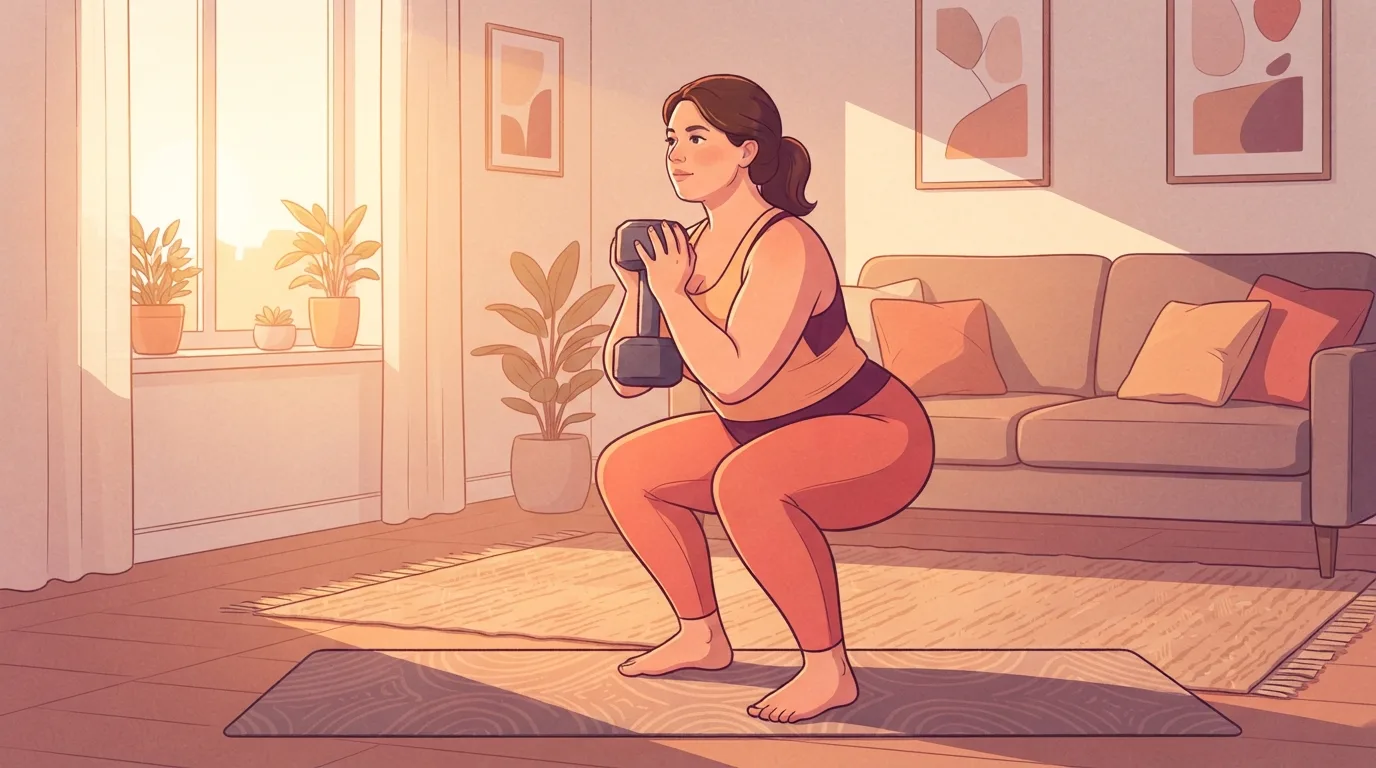
Ten pounds is the goal most people name when someone asks what they'd change. It's enough to feel when you button your jeans, and a month sounds like a fair deadline. So you search for how to lose 10 lbs in a month and find promises that range from easy to miraculous.
You may have tried a version of this already. A strict two weeks, a great first weigh-in, then a slow slide back to old meals and the old number. That pattern leaves a lot of people quietly deciding they're the problem.
They usually aren't. A 10-pound month asks for a bigger daily gap than most bodies can hold, and the first week hides that by dropping mostly water. Below you'll find the real numbers, who can lose 10 pounds in one month without harm, a 4-week plan that protects your muscle, the point where fast loss turns risky, and what to do in month 2 so the weight stays off.
Can You Lose 10 Pounds in a Month?
Yes, if you start heavy enough, and partly as water rather than fat. Ten pounds in four weeks works out to 2.5 pounds a week. For someone at 300 pounds that's a comfortable pace. For someone at 150 pounds it's well above the rate that research links with keeping muscle, so most of the answer depends on where you start.
The fundamentals don't change for a 10-pound goal: a calorie deficit you can hold, protein at every meal, strength training, daily walking and enough sleep. Our guide on how to lose 20 pounds walks through those five steps in order, and our breakdown of how much weight you can lose in a month sets out the safe rate for each starting weight. This page sticks to what's specific to 10 pounds in 4 weeks: the water share, the deficit, who it suits, the plan, the risks and month 2.
How Much of a 10-Pound Month Is Water?
More than most people expect, and nearly all of it arrives in the first week. The most precise measurement comes from Hall and colleagues (2015) in Cell Metabolism. They housed 19 adults with obesity on a metabolic ward, cut about 800 calories a day (30 percent of their intake) for six days, and measured fat loss directly from what each person ate and burned. Each person tried two versions of the cut.
- Cutting carbohydrate: 1.85 kilograms (about 4.1 pounds) came off the scale, and 245 grams of it (about half a pound) was body fat.
- Cutting fat: 1.3 kilograms (about 2.9 pounds) came off the scale, and 463 grams of it (about 1 pound) was body fat.
So between 64 and 87 percent of those first six days' loss wasn't fat. The low-carb version looked better on the scale and took off less fat that week. The rest was mostly water leaving with emptied glycogen stores, plus less food sitting in the gut.
For a 10-pound month, that usually means 2 to 4 pounds come from three sources that aren't body tissue:
- Glycogen and its water. Stored carbohydrate holds several times its weight in water, and a deficit draws part of it down in the first days.
- Salt. Cooking more of your own food usually means less sodium. Our guide to how to lose water weight covers a study in which a high-salt week held about 2.6 pounds of extra fluid.
- Food in transit. Smaller meals leave less in your digestive tract at any moment.
Put plainly, if the scale reads 10 pounds lighter on day 30, roughly 6 to 8 of those pounds are tissue, mostly fat. The 2 to 4 water pounds come back within days of eating normal carbs and salt again. That isn't a failure, and it's worth knowing before it happens.

The Deficit It Takes to Lose 10 Lbs in a Month
A pound of body fat stores roughly 3,500 calories. Ten pounds of fat is about 35,000 calories, which over 28 days is a deficit of 1,250 calories a day. Allow for the 2 to 4 pounds of water a first month usually sheds and you need 6 to 8 pounds of fat instead, or about 750 to 1,000 calories a day.
That 3,500 figure isn't the same for everyone. Hall (2008), writing in the International Journal of Obesity, showed it roughly fits people carrying more than about 30 kilograms (66 pounds) of body fat. Leaner people need fewer calories per pound lost, for an unwelcome reason: more of what they lose is lean tissue, which stores less energy than fat. If you're lean, a crash month looks easier on paper because it's eating into muscle.
Here's what the two deficits mean for what you'd actually eat, depending on how many calories you burn now.
| Your maintenance calories | Eat per day for a 1,250 deficit | Eat per day for an 875 deficit | Size of the cut |
|---|---|---|---|
| 1,900 | 650 | 1,025 | 46 to 66 percent |
| 2,300 | 1,050 | 1,425 | 38 to 54 percent |
| 2,800 | 1,550 | 1,925 | 31 to 45 percent |
| 3,300 | 2,050 | 2,425 | 27 to 38 percent |
Read it from the bottom up. A large, active person can open a 10-pound gap while eating about as much as an average adult. A smaller, less active person would have to eat around 1,000 calories or less, and anything under 800 is a very-low-calorie diet that belongs under a doctor's care. If you don't know your own maintenance number, our TDEE calculator gives an estimate in about a minute, and a week of honest food logging at a steady weight sharpens it.
For a sense of scale, the supervised trials on this page used cuts inside that table. The MATADOR trial set intake at 67 percent of maintenance, a 33 percent cut (Byrne and colleagues, 2018). The four-week protein study by Longland and colleagues (2016) used about 40 percent. Both had planned or provided food and regular check-ins, which is why the plan below leans on structure rather than willpower.
Who Losing 10 Pounds in a Month Is Realistic For
A useful ceiling is about 1 percent of your body weight a week. Above it, more of what you lose tends to be muscle, as the evidence in our month-by-month breakdown shows. Ten pounds in four weeks is 2.5 pounds a week, so here's how that rate compares with different starting weights.
| Starting weight | 10 pounds in 4 weeks, as a weekly rate | Verdict |
|---|---|---|
| 150 lb (68 kg) | 1.7 percent a week | Too fast. Aim for 5 to 6 pounds and keep the muscle. |
| 180 lb (82 kg) | 1.4 percent a week | Aggressive. The scale may show 10 thanks to water, but expect 6 to 8 of real loss. |
| 200 lb (91 kg) | 1.25 percent a week | Aggressive but often reached on the scale in a first month. |
| 250 lb (113 kg) | 1.0 percent a week | At the ceiling. Realistic with protein and lifting. |
| 300 lb (136 kg) | 0.8 percent a week | Realistic at a moderate deficit. |
| 350 lb (159 kg) | 0.7 percent a week | Comfortably realistic. |
The first-month water drop explains why people at 180 to 220 pounds often see 10 on the scale in their first 30 days even though only 6 to 8 of those pounds are tissue. It also explains why month 2 feels so slow by comparison. Men tend to lose more pounds than women for the same deficit too. Hall's 2008 analysis points to one reason: women usually carry more body fat at the same weight, and fat stores more energy per pound than lean tissue.
Find out what's really holding you back
FitCraft, our mobile fitness app, pairs you with an AI coach who builds you a personalized plan around your goals, schedule, and fitness level. Every FitCraft program is designed by Domenic Angelino, MPH (Brown University) and NSCA-CSCS, with research published in the Journal of Strength and Conditioning Research and Medicine & Science in Sports & Exercise.
Take the Free Assessment Free • 2 minutes • No credit cardA 4-Week Plan to Lose 10 Pounds
This plan is built for someone around 200 pounds or heavier who wants the fastest month that still protects muscle. If you're lighter, run the same plan and accept a smaller number. It uses dumbbells and bodyweight only, so you can do every session at home.
Set your intake once, then leave it alone
Start from your maintenance estimate and subtract 750 to 1,000 calories a day, never going below about 800 calories without medical supervision. Then hold that number for all four weeks. Recalculating after every weigh-in is how a plan turns into a guessing game. The easiest calories to remove are the ones you drink: juice, soda, sweetened coffee and alcohol add up fast and don't fill you up.
Eat at least 1.6 grams of protein per kilogram
Protein is what decides whether a fast month takes fat or muscle. In the Longland trial, 40 young men ate about 40 percent below their needs for four weeks while training six days a week with weights and intervals. The group eating 2.4 grams of protein per kilogram of body weight gained 1.2 kilograms of lean mass and lost 4.8 kilograms (about 10.6 pounds) of fat. The group eating 1.2 grams gained only 0.1 kilograms of lean mass and lost 3.5 kilograms of fat.
That's a lab result with food provided and a punishing schedule, so treat it as the best case rather than a forecast. The practical version is 1.6 grams per kilogram as a floor, which is about 145 grams a day at 200 pounds. If you have a lot to lose, work it out from your goal weight rather than your current one. Put 30 to 45 grams at each meal so no single meal has to carry the day.
Lift three times a week with dumbbells and bodyweight
Strength training matters most when the deficit is large. Bryner and colleagues (1999) put 20 adults on an 800-calorie liquid diet for 12 weeks. The group that walked, cycled or climbed stairs four hours a week lost lean body weight, falling from 51 to 47 kilograms on average. The group that lifted three days a week kept its lean body weight and its resting metabolic rate.
Alternate two full-body sessions, three days a week, so weeks 1 and 3 run A, B, A and weeks 2 and 4 run B, A, B. Rest 60 to 90 seconds between sets and stop each set with two or three good reps left.
- Workout A: goblet squat 3 x 10, push-up 3 x 8 to 12 (hands on a bench or counter if needed), one-arm dumbbell row 3 x 10 per side, glute bridge 3 x 12, plank 3 x 30 seconds.
- Workout B: reverse lunge 3 x 8 per leg, dumbbell floor press 3 x 10, dumbbell Romanian deadlift 3 x 10, standing dumbbell shoulder press 3 x 10, side plank 2 x 20 to 30 seconds per side.
Each session takes about 35 to 40 minutes. Add a rep or a little weight when the last set feels easy, which is progressive overload in its simplest form. In a deficit, holding your strength steady is already a win.
Walk every day
Add a 30 to 45 minute walk on most days, ideally after a meal. Walking won't create the deficit on its own, but it adds a steady couple of hundred calories, takes the edge off appetite for many people, and costs almost nothing in recovery, so it doesn't eat into your lifting.
Week by week
| Week | Training | Food | What the scale usually does |
|---|---|---|---|
| 1 | Workouts A, B, A and a daily 30-minute walk | Set your intake, hit your protein, cut liquid calories | Down 3 to 5 pounds, mostly water and salt |
| 2 | Workouts B, A, B and stretch walks to 40 minutes | Plan the week's meals on Sunday | Down 1 to 2 pounds, which can feel like a stall |
| 3 | Add one set to the first two exercises of each workout | Swap in high-volume foods where you're hungriest | Down 1.5 to 2 pounds |
| 4 | Hold the volume and aim for steady strength | Keep everything the same | Down 1.5 to 2 pounds, for 7 to 11 in total |
Weigh yourself each morning after the bathroom and before eating, and compare weekly averages. Week 2 is where most people decide the plan has stopped working. It hasn't: the water finished leaving, and the slower number underneath is the fat loss you were after.
A low-calorie meal plan for one day
Here's one day of eating at about 1,700 calories and 145 grams of protein, which fits a person around 200 pounds with a maintenance near 2,700. The figures are rounded from standard USDA values. Shrink the carbohydrate and fat portions if your target is lower, and keep the protein.
| Meal | What's on the plate | Calories | Protein |
|---|---|---|---|
| Breakfast | 1 cup nonfat plain Greek yogurt, 1 cup berries, 1/3 cup oats | About 320 | About 29 g |
| Lunch | 5 oz grilled chicken breast on a large salad with 1 tbsp olive oil dressing and 1/2 cup cooked quinoa | About 505 | About 50 g |
| Snack | 1 cup 2 percent cottage cheese and an apple | About 280 | About 24 g |
| Dinner | 5 oz salmon, 2 cups roasted broccoli with 1 tsp oil, 3/4 cup cooked brown rice | About 600 | About 42 g |

Where Fast Weight Loss Turns Risky
The CDC describes 1 to 2 pounds a week as the gradual pace most likely to last. A 10-pound month runs at 2.5. That's fine for some starting weights, as the table above shows, but it puts you closer to the limits below.
Gallstones
Gallstones are the best-documented physical risk of losing weight quickly. When weight drops fast, the liver releases extra cholesterol into bile and the gallbladder may not empty properly, according to the National Institute of Diabetes and Digestive and Kidney Diseases. Weinsier and colleagues (1995) pooled the prospective studies in the American Journal of Medicine and found that gallstone risk rose exponentially once weight loss passed about 1.5 kilograms (3.3 pounds) a week.
A steady 10-pound month averages 2.5 pounds a week, under that line. A crash version doesn't. Johansson and colleagues (2014) followed 3,320 matched pairs in a Swedish weight-loss program. Over a year, people who started on a 500-calorie diet had 48 gallstone cases needing hospital care against 14 among people on 1,200 to 1,500 calories, about three times the risk. The absolute risk was still low: roughly one extra case for every 92 people on the very-low-calorie diet.
Two habits lower the risk. Don't strip fat out of your diet: a meta-analysis by Stokes and colleagues (2014) found weight-loss diets with more fat produced fewer gallstones than very-low-fat ones. And don't go long stretches without eating, which NIDDK links to the same cholesterol release.
Signs to stop and call a doctor
See a doctor right away if you get pain in your upper right abdomen that lasts several hours, nausea or vomiting, fever or chills, yellowing of your skin or eyes, or tea-colored urine with light-colored stools. NIDDK lists these as signs of a gallbladder attack that needs care. Feeling faint, dizzy on standing or unable to finish workouts you could do in week 1 means the deficit is too big; eat more.
Who should skip the 10-pound target
- Anyone pregnant or breastfeeding.
- Anyone with a history of disordered eating, for whom an aggressive target can restart old patterns.
- People taking insulin or other medicines that lower blood sugar, or medicine for blood pressure, until a doctor has reviewed the plan, since a large deficit can change how much you need.
- Teenagers, who should work with a doctor rather than a calorie target.
- Anyone already at a healthy weight, for whom 10 pounds in a month would mostly cost muscle.
What to Do in Month 2
Expect month 2 to be slower. The water left in week 1, your lighter body burns a little less, and a good second month is 4 to 8 pounds for most people. That isn't a stall. It's the true rate showing through.
The encouraging news is that a strong first month is a good sign, not a trap. In the Look AHEAD trial, Unick and colleagues (2015) followed 2,290 adults with type 2 diabetes. Those who lost more than 4 percent of their weight in month 1 had 2.79 times the odds of being at least 5 percent lighter four years later than those who lost under 2 percent, and 1.77 times the odds at eight years. Nackers and colleagues (2010) found the same pattern in 262 women: the fastest first-month losers were down 10.9 kilograms at 18 months against 3.7 for the slowest, with no more regain.
For month 2, pick one of two paths:
- Keep going at a gentler deficit. Re-estimate maintenance at your new weight, eat about 500 to 750 calories below it, and keep the protein, the three workouts and the walks exactly as they were.
- Take two weeks at maintenance, then cut again. In MATADOR, 51 men with obesity either dieted continuously or alternated two-week blocks of dieting with two-week blocks at maintenance. Among those who finished, the alternating group lost 14.1 kilograms against 9.1, including 12.3 kilograms of fat against 8.0. It took longer on the calendar, but the breaks made the diet weeks count for more.
Whichever path you take, what carries month 2 is showing up for the same three workouts when the scale is quiet. If keeping that going is where you usually fall off, our roundup of the best workout apps for weight loss compares the apps designed to keep you training through slow weeks. FitCraft is one of them: your AI coach is a 3D character who demonstrates each dumbbell and bodyweight move, says your name during the workout, and adjusts your workouts as you progress, while streaks and leaderboards give a skipped session a visible cost.
The Bottom Line
Losing 10 pounds in a month is realistic from about 250 pounds and often shows up on the scale from about 200, with 2 to 4 of those pounds being water. It takes a daily deficit of roughly 750 to 1,250 calories, which some bodies can't reach without eating too little. Protect your muscle with protein and three strength sessions a week, stay above 800 calories, and treat month 2 as the real test.
You don't need a perfect month. You need one you can repeat. As Sarah, 27, put it after losing 18 pounds in three months: "First app that made exercise feel like something I chose, not forced."
Frequently Asked Questions
Can you lose 10 pounds in a month?
Yes, if you start heavy enough. Ten pounds in four weeks is 2.5 pounds a week, which stays within about 1 percent of body weight a week from roughly 250 pounds up. People between about 180 and 220 pounds often see 10 pounds come off the scale in their first month too, but 2 to 4 of those pounds are usually water, not fat.
Is it healthy to lose 10 pounds in a month?
It can be for heavier adults who eat enough protein, keep strength training and stay above about 800 calories a day. For smaller people it means a deficit large enough to cost muscle, and faster loss raises gallstone risk: Weinsier and colleagues (1995) found the risk climbs steeply above about 1.5 kilograms, or 3.3 pounds, a week. Check with your doctor first if you take medicine for diabetes or blood pressure.
How can a woman lose 10 pounds in a month?
The plan is the same, but the goal is harder for most women because they burn fewer calories and usually carry more body fat at the same weight, so the same deficit takes off fewer pounds. A 160-pound woman losing 1 percent of her weight a week drops about 6.5 pounds in four weeks. If your maintenance is under about 2,000 calories, a goal of 5 to 7 pounds in the first month is the safer target.
Can you lose 10 pounds in 2 months?
Yes, for most adults. Ten pounds in about eight and a half weeks is roughly 1.2 pounds a week, which stays within 0.5 to 1 percent of body weight a week for anyone from about 120 to 230 pounds. Heavier people usually beat that pace, and it needs a daily deficit of only about 500 to 600 calories.
How to lose 10 pounds in a day?
You can't lose 10 pounds of fat in a day, because 10 pounds of fat holds roughly 35,000 calories. A drop of a few pounds overnight is water and food leaving your gut, and it returns when you eat and drink normally. Sweat suits, saunas, laxatives and skipping fluids only remove water and can be dangerous.
What role does sleep play in weight loss?
Sleep affects how much you eat. In a randomized trial by Tasali and colleagues (2022), 80 adults with overweight who usually slept less than 6.5 hours were coached to sleep longer, gained about 1.2 hours a night and ate about 270 fewer calories a day than the control group, without being told to diet.
What is the Japanese trick to lose weight?
It usually refers to hara hachi bu, the Okinawan habit of stopping when you're about 80 percent full, which in practice means eating more slowly. In data from 59,717 Japanese adults with type 2 diabetes, Hurst and Fukuda (2018) found slow eaters had 42 percent lower odds of obesity than fast eaters. It's a useful habit for a 10-pound month, not a shortcut.