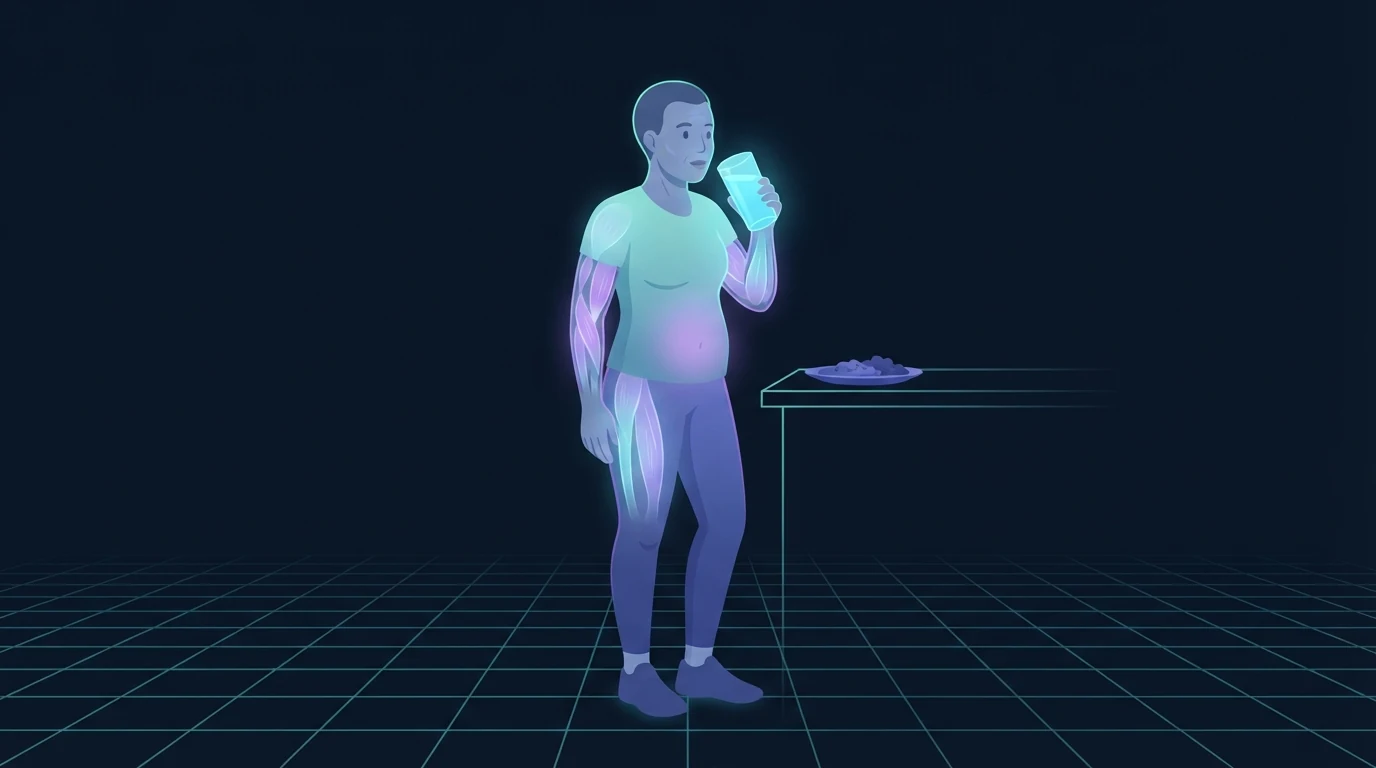
There's a specific kind of advice that survives because it costs nothing to repeat. Drink more water and the weight comes off. It sounds responsible, it's free, and nobody has ever been harmed by a glass of water. So it gets handed out forever, and every year a few million people drink 3 liters a day for a month, lose nothing, and quietly conclude they are broken.
They are not broken. The advice was oversold. Water has a small, real, well-measured place in weight loss, and it sits almost entirely on one side of the energy equation: what goes in.
Below is what the randomized trials actually found, why the premeal glass works at all, why the "cold water burns calories" claim collapsed under replication, and the one change involving water that has moved weight in trials larger than a classroom.
What the trials actually found
The premeal water trials
The study everyone quotes is Dennis and colleagues (2010) in Obesity. They took 48 adults aged 55 to 75 with a BMI between 25 and 40, put everyone on the same hypocaloric diet, and randomly assigned half of them to drink 500 mL of water before each of the three daily meals. After 12 weeks the water group had lost roughly 7 kg against about 5 kg in the control group. A 2 kg gap over three months from a habit with no cost is a genuinely good result, and it's why this single study has been the backbone of every "drink water to lose weight" article since.
The replication attempt is less famous and more useful. Parretti and colleagues (2015) ran the same idea in a harder setting: 84 adults with obesity recruited from general practices in Birmingham, England, drinking 500 mL 30 minutes before main meals for 12 weeks, with the control group asked to imagine their stomach was already full. The water group lost 1.3 kg more. Smaller, still real, still in the same direction.
Notice what both trials have in common. Neither of them is a study of water. They are studies of water added on top of a diet people were already following. Nobody drank their way to a deficit. The water made an existing deficit slightly easier to hold.
The 2024 meta-analysis that cooled things off
Then somebody added up all the trials. Chen, Khil and Keum (2024) in Nutrients pooled eight randomized controlled trials of water-intake interventions in adults with overweight or obesity. The summary results:
- Body weight: -0.33 kg across 7 trials, 95 percent CI -1.75 to 1.08. The interval crosses zero.
- BMI: -0.23 kg/m² across 4 trials, 95 percent CI -0.55 to 0.09. Also crosses zero.
- Waist circumference: 0.05 cm across 6 trials. Nothing at all.
Their conclusion, verbatim in spirit: water intake may not significantly change adiposity in people with overweight or obesity. Heterogeneity was high (I² of 78 percent for body weight), the trials were short, and the samples were small. That's a fair description of a literature where one good trial found 2 kg and several others found approximately nothing.
An earlier systematic review reached a compatible verdict. Muckelbauer and colleagues (2013) in the American Journal of Clinical Nutrition read the whole observational and experimental base and found the evidence mixed, with the clearest signal coming from studies where water replaced other drinks rather than studies where water was simply added.
That distinction is the whole article. Hold onto it.
Why a glass before a meal does anything at all
Two mechanisms get proposed. Only one of them holds up.
Gastric volume, which is real and modest
Fill your stomach with 500 mL of anything and stretch receptors report the volume upward, which nudges the meal that follows to be smaller. That's why the trials specify 30 minutes: water empties from the stomach fast, so the window where the volume signal is still doing work is short. In practice a preload trims the following meal by somewhere around 40 to 75 kilocalories in trial conditions.
Age matters here more than almost anything else. Gastric emptying slows with age, which is one reason the effect shows up cleanly in adults over 55 and gets thin in adults in their twenties. If you're 27 and the premeal glass does nothing for your appetite, that is the expected result, not a personal failure.
And 60 kilocalories is 60 kilocalories. Held for a year it's meaningful. Undone by one extra handful of something at 9pm, it is gone. If you have been holding a deficit and the scale still won't move, the arithmetic is usually somewhere else entirely, and our breakdown of why the scale stalls in a calorie deficit walks through where it hides.
Water-induced thermogenesis, which mostly did not survive
In 2003, Boschmann and colleagues reported in the Journal of Clinical Endocrinology and Metabolism that drinking 500 mL of water raised metabolic rate by 30 percent in 14 healthy adults, peaking 30 to 40 minutes in, with a total thermogenic response of about 100 kilojoules. Roughly 24 kilocalories. Even taken at face value that's a small number, but "30 percent" is a great headline and it escaped into the wild immediately.
Three years later Brown, Dulloo and Montani (2006) tried to reproduce it in the same journal and could not. Resting energy expenditure did not budge after distilled water or saline at room temperature. Water chilled to 3 degrees Celsius raised it by about 5 percent, presumably the cost of warming the water, and that's the only piece of the original claim that survived.
So the honest version: drinking cold water costs your body a handful of calories to warm up, roughly what you would spend walking to the kitchen to get it. If you're curious about the parts of daily energy expenditure that actually add up to something, NEAT is where the real variance lives, and our review of non-exercise activity thermogenesis covers a range between individuals measured in hundreds of calories a day, not dozens.
The water change that actually has evidence behind it
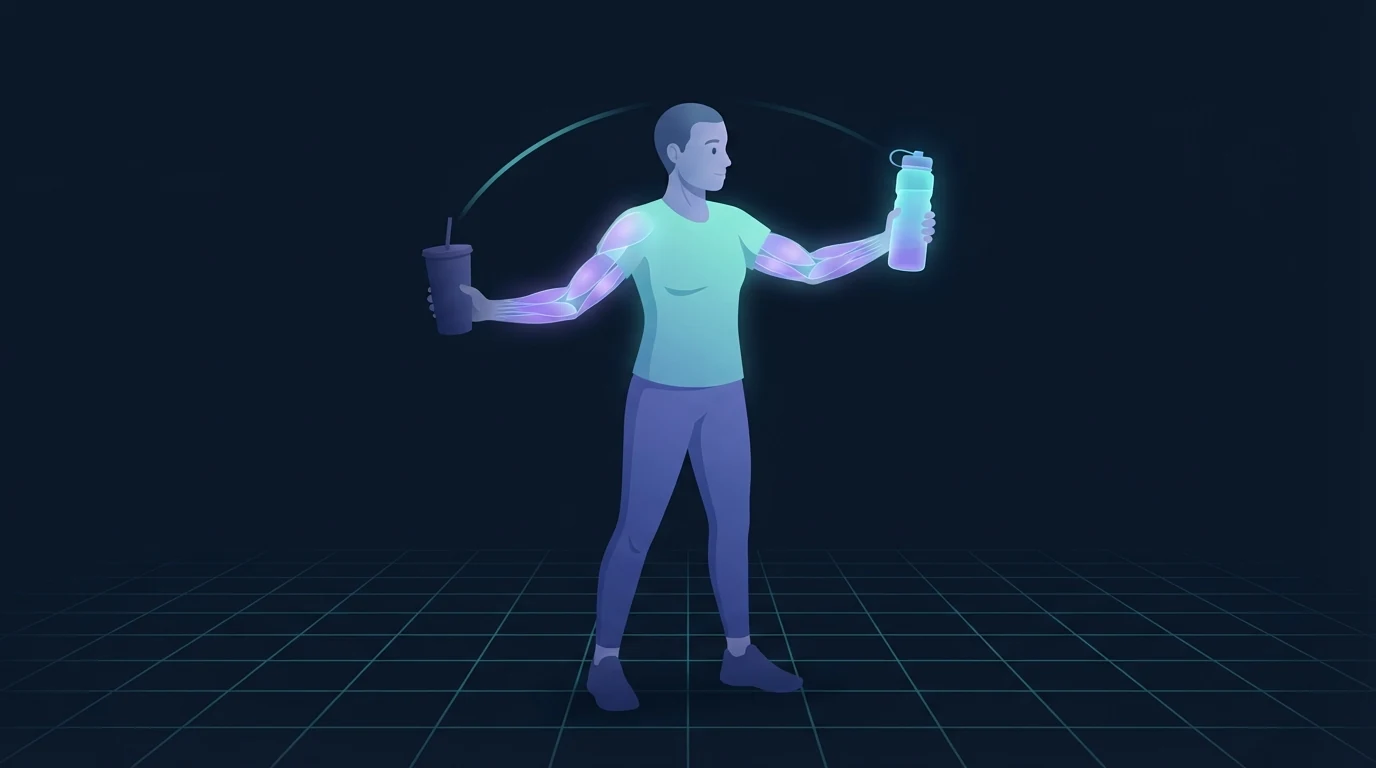
Inside the same 2024 meta-analysis that found almost nothing overall, one subgroup separated from the pack. Trials where water replaced sugar-sweetened beverages produced a weight change of -0.81 kg. Trials where water replaced artificially sweetened beverages went the other way, at +1.82 kg, which is a strange and much-argued finding that probably says more about who volunteers for those trials than about the drinks.
The CHOICE trial (Tate and colleagues, 2012) in the American Journal of Clinical Nutrition ran the replacement idea properly: 318 adults with overweight or obesity, randomized to substitute water or diet beverages for at least 200 kilocalories a day of caloric drinks, or to make dietary changes of their own choosing. At six months the raw weight differences between groups were not significant, but participants assigned to beverage replacement were twice as likely to have hit a 5 percent weight loss, and the water group improved fasting glucose and hydration relative to control.
Which makes sense, because this is the version of "drink more water" that changes intake instead of adding to it. A 500 mL bottle of regular soda is around 210 kilocalories. Two a day is 420. Swapping both for water is a bigger daily change than almost anything the premeal protocol can do, and unlike a preload it does not depend on your stomach cooperating.
Run the audit on yourself for three days. Write down everything you drink, including the oat milk in the coffee, the juice with breakfast, the beer on Friday, the sports drink after a gym session you did not really sweat in. Most people find somewhere between 150 and 600 kilocalories a day they were not counting, because liquid calories don't register as eating. That number, not your water total, is the one worth attacking.
Knowing what to do is the easy part.
FitCraft, our mobile fitness app, pairs you with an AI coach who builds you a personalized plan around your goals, schedule, and fitness level. Every FitCraft program is designed by Domenic Angelino, MPH (Brown University) and NSCA-CSCS, with research published in the Journal of Strength and Conditioning Research and Medicine & Science in Sports & Exercise.
Take the Free Assessment Free • 2 minutes • No credit cardHow much water you actually need
The National Academies set an adequate intake for total water at about 3.7 liters a day for men and 2.7 liters for women, and that figure includes water arriving inside food, which is roughly a fifth of the total for most people. So the fluid part lands near 3.0 liters for men and 2.2 for women, on average, in a temperate climate, for someone not training hard.
Those are population averages, not targets you owe anyone. Body size, sweat rate, climate, altitude, caffeine, salt intake and training load all move the real number, sometimes by a liter or more in a day. The mechanism that handles all of that automatically is thirst, and it's very good at its job in healthy adults under about 65.
The eight-glasses rule, incidentally, has no research behind it. Valtin (2002) went looking for the source in the American Journal of Physiology and traced it to a 1945 Food and Nutrition Board note recommending about 1 mL of water per kilocalorie of food, immediately followed by a sentence saying most of that quantity is already present in prepared foods. The second sentence got dropped somewhere in the retelling and the first became a rule.
Practical targets that survive contact with real life:
- Drink to thirst, and keep a bottle within reach. Availability drives intake more than intention does.
- Add 500 to 750 mL around a hard or hot session. More if you're a heavy salty sweater and the session runs long.
- Use urine color as a rough check, not a scoreboard. Pale straw is fine. Clear all day mostly means you are over-drinking.
- Put 500 mL in front of your two biggest meals if you want the preload effect. That is where the trials found it.
- Stop chasing a liter target if it's making you miserable. Adherence to the diet matters vastly more than the water number.
Is it thirst or is it hunger?
The internet is confident that most hunger is really thirst in disguise. The research is not. McKiernan, Houchins and Mattes (2008) in Physiology and Behavior tracked thirst, hunger, drinking and eating in free-living adults and found the two signals were rarely confused with each other. Hunger tracked eating closely. Thirst preceded drinking on a minority of occasions, because most drinking in modern life is habitual or social rather than thirst-driven.
Which leaves the advice in a funny place. Drinking a glass of water before you decide whether to eat is still a reasonable five-minute delay tactic, and the delay itself does some work. Just don't build a story where your appetite is a hydration error. Most of the time you're hungry because you're hungry, and the fix is a meal with enough protein and volume in it rather than another glass. Our piece on post-workout hunger goes through the appetite side properly, including why the hungriest days often follow the hardest sessions.
What this means for you
Here is the version to actually run. Stop treating water as an intervention and start treating it as the default drink. Everything caloric you currently sip becomes a decision instead of a habit, and water is what fills the gap. That change alone outweighs every preload protocol in the literature for most people.
Then, if you want the small extra: 500 mL about half an hour before your two largest meals. It is free, the evidence is real if modest, and older adults get the most from it. Keep a bottle on your desk because proximity beats willpower. And let thirst set the total, because your kidneys are better at fluid balance than any app.
What water cannot do is create a deficit, protect muscle, or decide what you eat. Those come from the food and the training, and the training is where consistency usually breaks first. If you want a plan that does not fall apart in week three, our roundup of the best workout apps for weight loss compares what each one actually does to keep people showing up, and our review of what really moves metabolic rate covers the levers that dwarf a glass of cold water.
Frequently Asked Questions
Does drinking water help you lose weight?
A little, and almost entirely by displacing calories rather than by burning them. Dennis et al. (2010) gave 48 adults aged 55 to 75 a reduced-calorie diet and had half of them drink 500 mL of water before each meal; after 12 weeks the water group had lost about 2 kg more. Parretti et al. (2015) repeated the idea in 84 primary-care patients with obesity and found 1.3 kg more. But Chen, Khil and Keum (2024) pooled eight randomized trials and the summary effect was only -0.33 kg, with a confidence interval that crossed zero. Water is a useful habit, not a fat-loss mechanism.
How much water should I drink to lose weight?
There's no weight-loss dose of water. The National Academies set an adequate total water intake of about 3.7 liters a day for men and 2.7 liters for women, and roughly a fifth of that arrives in food, so most adults land around 2.5 to 3 liters of fluid. The trials that showed an effect used 500 mL about 30 minutes before each main meal, which is the only protocol with randomized support. Drinking far past thirst does nothing extra, and Valtin (2002) found no evidence behind the eight-glasses rule at all.
Does drinking cold water burn more calories?
Barely. Boschmann et al. (2003) reported that 500 mL of water raised metabolic rate by 30 percent, which became the internet's favorite water statistic. Brown, Dulloo and Montani (2006) could not replicate it: room-temperature water changed resting energy expenditure not at all, and water chilled to 3 degrees Celsius raised it by roughly 5 percent. Even the generous reading of the original study is about 20 to 25 kilocalories per 500 mL, which is a few minutes of walking. Cold water is fine. It is not a fat burner.
Does drinking water before a meal really make you eat less?
In older adults, yes, and by less than you would guess. Preloading 500 mL of water 30 minutes before a meal typically trims that meal by roughly 40 to 75 kilocalories in trial conditions, because the stomach empties water quickly and the volume signal fades. The effect is consistently weaker in adults under about 35, whose gastric emptying is faster. It's also easy to undo: if you eat 60 fewer calories at lunch and 200 more at 9pm, the water did nothing.
Can drinking water reduce belly fat?
No. Chen, Khil and Keum (2024) measured waist circumference across six randomized trials and found a summary change of 0.05 cm, which is nothing. Nobody can direct fat loss to a body region by choosing a drink, a food or an exercise. Waist measurements fall when total body fat falls, and total body fat falls when you hold a calorie deficit over weeks. Water helps that deficit only to the extent that it replaces something caloric you were drinking before.
Am I actually thirsty or hungry?
Usually hungry, despite the popular advice. McKiernan, Houchins and Mattes (2008) tracked thirst, hunger, drinking and eating in free-living adults and found the two sensations were rarely confused; thirst preceded drinking on a small minority of occasions and hunger tracked eating far more tightly. Drinking a glass of water before you decide is still a cheap test and costs you nothing. Just don't expect it to explain away a genuine appetite, because most of the time the appetite is real.
Can you drink too much water?
Yes. Drinking well past thirst over a short window can dilute blood sodium and cause exercise-associated hyponatremia, which is rare but genuinely dangerous and has killed marathon runners and military recruits. Healthy kidneys clear roughly 0.8 to 1.0 liters an hour, so trouble starts when intake outruns that for hours. In practice: drink to thirst, add a little around hard or hot sessions, and treat any water target above about 4 liters a day as a reason to talk to a clinician rather than a badge.