
You finish a session feeling great and weirdly not hungry at all. An hour later you're standing in front of the fridge eating cereal out of the box. If that sequence feels familiar, nothing has gone wrong with you. You've just experienced the two halves of the same physiological event, and most people only ever hear about the first half.
The fitness internet loves the line that "exercise suppresses appetite." It's true, and it's true for about an hour. The energy cost of the session lasts considerably longer than that, and your body is very good at noticing.
Below is what the appetite research actually shows: what happens hormonally during a workout, why the hunger arrives late, why cardio and lifting produce different versions of it, the four things that turn ordinary post-workout hunger into a problem, and how to eat around training so that hunger does not quietly undo a deficit you worked for.
What actually happens to your appetite during a workout
Appetite is not one signal. It's a conversation between the gut, the brain and body tissue, and exercise interrupts that conversation in a fairly specific way.
The ghrelin dip is real, and it is short
Ghrelin is the only circulating hormone known to actively stimulate hunger, and the biologically active form is acylated ghrelin. Broom, Stensel, Bishop, Burns and Miyashita (2007) put nine men through two 9-hour trial days in the Journal of Applied Physiology, one with a 60-minute run and one without. Plasma acylated ghrelin and subjective hunger were both lower on the exercise day across the first 3 hours and across the full 9 hours.
The hormone picture is broader than ghrelin alone. Schubert, Sabapathy, Leveritt and Desbrow (2014) pooled the acute exercise literature in Sports Medicine and found the same direction everywhere: acylated ghrelin falls, while peptide YY, GLP-1 and pancreatic polypeptide all rise. Those three are satiety peptides. So a hard session briefly pushes every relevant lever toward "not hungry".
And then it stops. The suppression tracks closely with the exercise bout itself, which is why the effect has been nicknamed exercise-induced anorexia rather than exercise-induced appetite loss. It's a state, not a change.
Intensity flips the switch, not duration
A long easy walk will not do this. A hard interval session will. McCarthy, Tucker and Hazell (2024) reviewed the candidate mechanisms in Physiological Reports and concluded that blood lactate has the most empirical support. In one of the studies they cite, raising blood lactate with sodium bicarbonate produced roughly 30 percent lower acylated ghrelin than placebo at the same workload. Interleukin-6 and GDF-15 have been proposed too, but the evidence for both is still inconsistent.
The practical reading: the harder the session, the deeper the dip, and the more energy you've spent for appetite to come looking for later. Intensity buys you a quieter hour and a louder afternoon.
So why does the hunger show up anyway?
Because suppression and expenditure run on different clocks. A 45-minute session might cost 300 to 600 calories depending on your size and the work you did. It also drains muscle glycogen, the stored carbohydrate your muscles run on. Both of those are real debts. The hormonal brake that holds appetite down is temporary; the debt is not.
There's a second layer. Blundell, Gibbons, Caudwell, Finlayson and Hopkins (2015) separate appetite control in Obesity Reviews into tonic signals, which come from body tissue and metabolism and are relatively stable across days, and episodic signals, which come from eating and fluctuate through the day. Exercise sharpens the episodic system while raising the tonic drive to eat, because a bigger, more active body genuinely needs more fuel. Those two effects point in opposite directions, which is why the research reads as contradictory until you separate the timescales.
The acute trials and the 12-week trials disagree, and both are right
Look at a single session and the news is good. Schubert, Desbrow, Sabapathy and Leveritt (2013) pooled 29 studies and 51 trials in Appetite and found a trivial effect of exercise on absolute energy intake afterwards (effect size 0.14) and a large effect on relative energy intake (effect size -1.35). Translated: on the day of the workout, most people don't eat noticeably more, so the session leaves a genuine net deficit.
Look at 12 weeks and the average hides the story. King, Hopkins, Caudwell, Stubbs and Blundell (2008) supervised 35 adults with overweight or obesity through five exercise sessions a week for 12 weeks in the International Journal of Obesity. Mean weight loss was 3.7 kg, which sounds tidy until you see the range: from a 14.7 kg loss to a 1.7 kg gain. Splitting the group by whether actual loss matched predicted loss, the compensators averaged 1.5 kg and the non-compensators averaged 6.3 kg. Same prescription. Four times the result.
That variability is the real answer to "does post-workout hunger cancel out my workout". On average, no. For a meaningful minority of people, yes, and the difference shows up at the table rather than in the gym. If your scale has stalled despite training consistently, our breakdown of why you might not be losing weight in a calorie deficit walks through the six usual causes in order of frequency.
One more wrinkle worth knowing. Beaulieu, Hopkins, Blundell and Finlayson (2016) reviewed 28 studies in Sports Medicine and found that physically active people are not less hungry than inactive people. What they are is better calibrated: active people adjusted their later intake more accurately after a high-energy preload. Intake across activity levels followed a J-shaped curve, with both the very sedentary and the very active eating more than the moderately active middle. Training does not turn appetite off. It makes appetite better at matching what you actually ate.
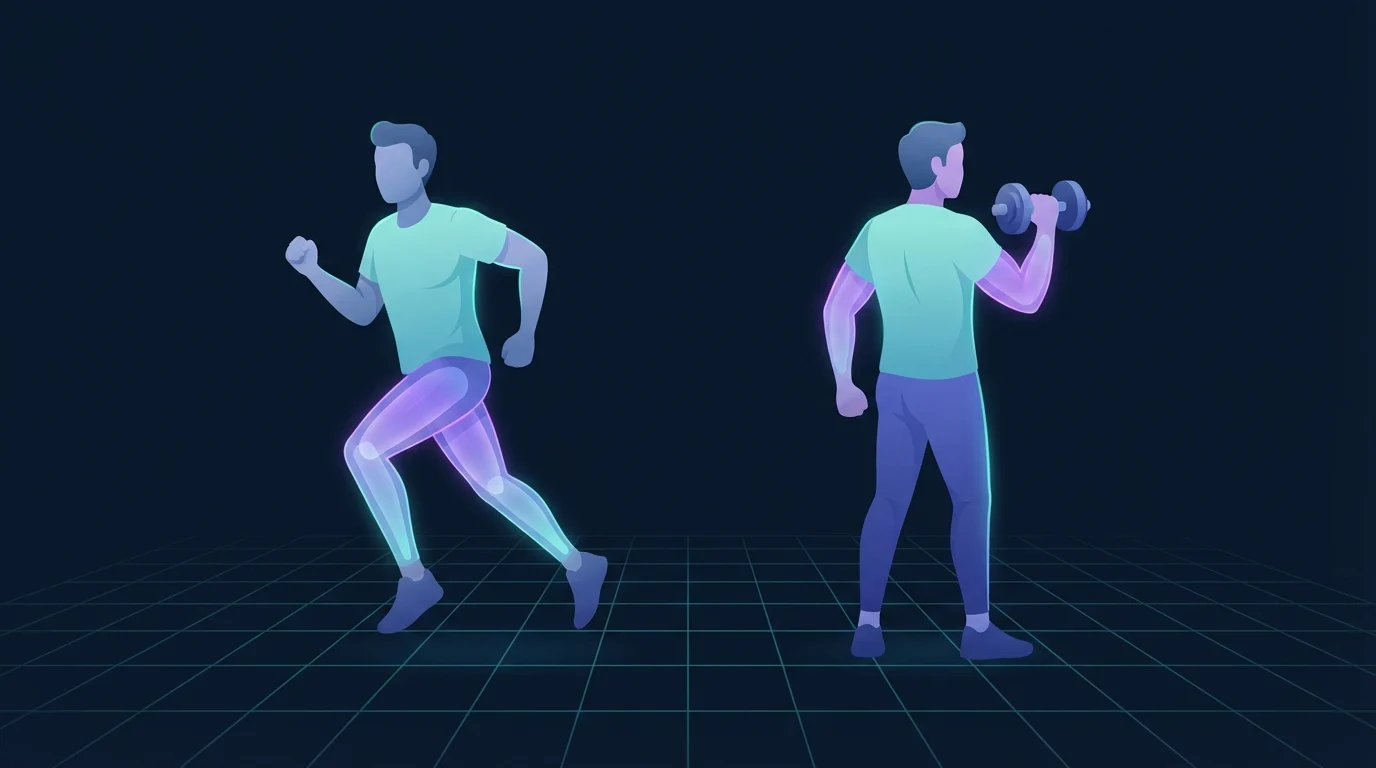
Why cardio and lifting make you hungry in different ways
This is the head-to-head study people ask for. Broom, Batterham, King and Stensel (2009) ran 11 healthy men through three conditions in the American Journal of Physiology: a 90-minute free-weight session, a 60-minute run, and an 8-hour control day. Hunger and acylated ghrelin were suppressed during both types of exercise. PYY told a different story. Its 8-hour area under the curve was 1750 pg/mL after running versus 1381 after lifting and 1411 on the control day. Only the run raised it.
So the aerobic session produced more satiety signalling. That's the opposite of what most people expect, given that cardio has the folk reputation for making you ravenous. The resolution is that hormones are not the whole ledger. The run also cost more energy, and energy cost is what appetite eventually settles up on.
Actual eating behaviour bears this out, and not flatteringly for either mode. Laan, Leidy, Lim and Campbell (2010) gave 19 young active adults an ad libitum pasta meal 30 minutes after a 35-minute aerobic session, a 35-minute resistance session, or a sedentary control, in Applied Physiology, Nutrition, and Metabolism. Hunger fell transiently after the aerobic session and was unchanged after the resistance session. Meal energy intake was 14 to 18 percent higher after both types of exercise than after sitting still.
Read that twice. Reported hunger dropped, and they ate more anyway. The hormonal brake and the fork are not as tightly coupled as we would like.
Practical version:
- Cardio tends to produce a deeper, more clearly signalled suppression during the session, followed by hunger proportional to how much energy it cost. A 60-minute run leaves a bigger hole than a 30-minute one, and appetite is fairly good at sensing the difference over a day or two.
- Lifting tends to produce less hormonal suppression but also a smaller energy deficit per session. The hunger it drives is more often about the repair bill than the session bill, which is why it frequently lands the next day.
- Both can produce more eating at the very next meal than a rest day would, whatever the hunger ratings say.
Knowing what to do is the easy part.
FitCraft, our mobile fitness app, pairs you with an AI coach who builds you a personalized plan around your goals, schedule, and fitness level. Every FitCraft program is designed by Domenic Angelino, MPH (Brown University) and NSCA-CSCS, with research published in the Journal of Strength and Conditioning Research and Medicine & Science in Sports & Exercise.
Take the Free Assessment Free • 2 minutes • No credit cardFour things that turn normal hunger into a problem
Some post-workout hunger is just the bill arriving. When it feels unmanageable rather than normal, one of these four is almost always involved, and they stack.
1. You are under-fuelling the whole day, not just the session
The single most common pattern behind "I'm starving after every workout" is a day that looks like coffee, a small lunch, a 6 pm training session and then dinner. That isn't a post-workout hunger problem. That's eight waking hours of low energy availability with a workout dropped into the end of it, and the hunger would have arrived at 7 pm regardless.
Training amplifies whatever the rest of the day already did. If you finish sessions genuinely light-headed or shaky, or you can't get through the last third of a workout you could complete a month ago, those are under-fuelling signals rather than discipline signals. Our guide on what to eat before a workout covers the timing and the portion sizes that keep a session fuelled without sitting heavy.
2. Your protein is too low
Protein is the most satiating macronutrient per calorie, and it has a threshold. Leidy and colleagues (2015) reviewed the acute feeding trials in the American Journal of Clinical Nutrition and noted that none of the studies using less than 25 grams of protein produced a satiety effect at all. Below roughly 25 grams per meal, you're not getting the fullness benefit you think you are.
For the daily total, Morton and colleagues (2018) pooled 49 studies and 1,863 participants in the British Journal of Sports Medicine and found that gains in fat-free mass stopped improving beyond about 1.62 grams per kilogram of body weight per day. That number is a training target, not a satiety target, but it's a sensible ceiling to aim at while dieting because it protects muscle at the same time. Our protein calculator will do the arithmetic for your body weight and goal.
3. You slept badly
Short sleep does to ghrelin what exercise does in reverse. Spiegel, Tasali, Penev and Van Cauter (2004) put 12 healthy young men through two days of 4 hours in bed and two days of 10 hours in bed, in the Annals of Internal Medicine. On the short-sleep condition, leptin fell 18 percent, ghrelin rose 28 percent, and self-rated hunger rose 24 percent. Their food preferences shifted too, toward sweets, starches and salty snacks, and away from fruit, vegetables and dairy.
That's two nights. Not two months. If you're training hard on six hours of sleep and wondering why you can't stop eating in the evening, you have found a large part of your answer. Exercise itself helps here: our review of exercise and sleep research covers how much training moves sleep quality and in which direction.
4. Your deficit is too aggressive
A calorie deficit produces hunger by design. A steep one produces hunger that outlasts the diet. Sumithran and colleagues (2011) tracked 50 adults through a 10-week very-low-energy diet in the New England Journal of Medicine. Mean loss was 13.5 kg. At the 62-week follow-up, ghrelin was still elevated, leptin still suppressed, and subjective hunger still higher than at baseline, a full year after the aggressive phase ended.
A 20 to 25 percent deficit below maintenance is a pace most people can hold while training. A 40 percent deficit plus five hard sessions a week is a recipe for exactly the post-workout hunger this article is about. And if the scale is going the other way while you train, that's usually water and glycogen rather than fat: our post on why you might be gaining weight while working out covers the short-term mechanics.
How to eat around training so hunger does not undo the deficit
None of this requires timing your meals to the minute. It requires the day to have enough food in it, arranged so the hungry parts are covered.
Before the session
- Eat a real meal 2 to 3 hours before, or a smaller snack 30 to 60 minutes before if that's the window you have. Carbohydrate plus some protein. Training fasted is fine if you like it, but understand that you're moving the hunger rather than removing it.
- Do not train at the end of a long fast by accident. An 8 pm session after a 1 pm lunch is a choice; make it deliberately or fix it.
- Drink water. Mild dehydration is routinely mistaken for hunger, and you're about to lose more fluid.
After the session
- Build the meal around 25 to 40 grams of protein. That's a chicken breast, a large can of tuna, 200 g of Greek yogurt plus a scoop of whey, or 1.5 cups of cottage cheese. Below 25 grams you lose most of the satiety effect.
- Include carbohydrate, not just protein. Muscle glycogen is what you actually depleted. Rice, potatoes, oats, fruit and bread all refill it. A protein-only post-workout meal is the fastest route to being hungry again at 9 pm.
- Add volume. Vegetables, salad, soup, fruit. High-fibre, high-water foods let you land a large, satisfying plate inside a moderate calorie number.
- Have it decided in advance. The hour after training is the worst possible time to make a food decision from scratch. Post-workout hunger does not make people eat badly. Unplanned post-workout hunger does.
The rest of the day
Spread protein across three or four meals rather than loading it at dinner, keep the deficit moderate, and treat the day after a hard session as a normal eating day rather than a compensating one. If you want a training plan built to the number of days you'll realistically train, rather than a plan that quietly assumes unlimited recovery capacity, our roundup of the best workout apps for weight loss compares the tools that handle diet and training together against the ones that only do one side.
The post-workout hunger checklist
Run this in order the next time a session leaves you ravenous. The first "no" is usually the culprit.
| Check | What good looks like | If not |
|---|---|---|
| Did you eat within 3 hours before training? | A meal or a real snack, carbohydrate plus protein | Move a meal earlier rather than eating more later |
| Is daily protein near 1.6 g per kg of body weight? | Roughly 110 g at 70 kg, 130 g at 80 kg | Add 25 to 40 g to the meal after training first |
| Did the post-workout meal include carbohydrate? | Rice, oats, potato, bread or fruit alongside the protein | Add a carbohydrate source before adding more protein |
| Did you sleep 7 hours or more? | 7 to 9 hours, consistent timing | Expect roughly 25 percent more hunger and plan for it |
| Is the deficit 20 to 25 percent below maintenance? | About 400 to 600 kcal per day for most adults | Shrink the deficit before you add more training |
| Are you drinking enough water? | Pale urine, no headache after sessions | Drink 500 ml and wait 15 minutes before eating |
| Is the hunger at the meal, or all evening? | Concentrated at meals | All-evening grazing usually means the daily total is too low |
What this means for you
Post-workout hunger is not a sign that your program is wrong or that your body is fighting you. It's an accurate report on energy availability delivered on a short delay. Treating it as a character flaw is the single fastest way to turn it into a binge, because the plan becomes "resist" instead of "feed".
The version of this that works looks boring from the outside. You eat before you train. You have the post-workout meal decided before the session starts, and it has protein and carbohydrate in it. You sleep. You keep the deficit at a size you could hold for three months rather than three weeks. Hunger still shows up, because you're still spending energy, but it arrives at a meal you already planned instead of at the fridge door.
And when hunger and the scale disagree, believe the scale's weekly average. As the year-long follow-up in Sumithran's work makes clear, appetite signals can stay elevated long after the fat loss has happened. Hunger tells you about fuel. It does not tell you about fat.

Frequently Asked Questions
Why am I so hungry after working out?
Because the appetite suppression that exercise produces is short and the energy cost of the session is not. Hard exercise lowers acylated ghrelin, the only hormone known to stimulate hunger, and raises the satiety peptides PYY and GLP-1. Broom, Stensel, Bishop, Burns and Miyashita (2007) measured that suppression across a 60-minute run in the Journal of Applied Physiology. It fades within roughly an hour of finishing. What does not fade is the 300 to 600 calories you just spent, plus the muscle glycogen you used. Once the hormonal brake lifts, normal appetite regulation starts asking for that energy back. Add a skipped pre-workout meal, protein below your target, or a short night of sleep and the hunger arrives loud.
Is it normal to be starving the day after a workout?
Yes, and it's more common than being starving right after. The acute appetite studies mostly stop measuring a few hours after the session, so the day-after hunger sits in a blind spot. Two things are happening. Muscle glycogen you emptied is being refilled, which shows up as a genuine pull toward carbohydrate. And the tissue you damaged is being repaired, which costs energy for 24 to 48 hours. If a hard session reliably makes you ravenous the next day, treat that day as a normal eating day rather than a compensating one: hit your protein target, eat carbohydrate around the next session, and don't try to claw back the calories.
Should I eat if I am hungry after a workout?
Eat, and eat something with protein in it. Post-workout hunger is a signal about energy availability, not a test of willpower. The risk isn't eating at all. It's eating unplanned, because unplanned post-workout eating skews toward fast carbohydrate and fat and lands well above what the session cost. A meal built around 25 to 40 grams of protein plus carbohydrate and some fibre does two jobs at once: Leidy and colleagues (2015) found the satiety effect of a meal only appears above roughly 25 grams of protein, and the protein is what the training adaptation needs anyway.
Why am I hungrier after cardio than after lifting?
Mostly because a typical cardio session costs more energy than a typical lifting session, and partly because the hormonal responses differ. Broom, Batterham, King and Stensel (2009) put 11 men through a 90-minute weights session, a 60-minute run and a control day. Hunger and acylated ghrelin dropped during both bouts, but PYY, a satiety peptide, only rose meaningfully with the run (8-hour area under the curve 1750 pg/mL for running versus 1381 for resistance training and 1411 for control). So running produced more short-term satiety signalling, then more hunger later, because it also cost more energy. Lifting produces less of a hormonal brake and less of a deficit.
Does being hungry after a workout mean I am burning fat?
No. Hunger tracks energy availability in the short term, not fat loss. You can be ravenous in a calorie surplus and completely unbothered in a deficit. The clearest evidence that hunger is a poor fat-loss gauge comes from Sumithran and colleagues (2011) in the New England Journal of Medicine: a year after losing 13.5 kg, participants still had elevated ghrelin and elevated subjective hunger compared with baseline, well after the active weight loss had stopped. Use waist measurements, a weekly weight average and how your clothes fit. Hunger tells you about fuel, not about fat.
How do I stop feeling so hungry after exercise?
Work through four levers in order. First, eat before you train, or at least earlier in the day; most crushing post-workout hunger is a whole-day under-fuelling problem wearing a workout costume. Second, get daily protein to roughly 1.6 grams per kilogram of body weight, the point where the benefit plateaus in the Morton et al. (2018) meta-analysis, and put 25 to 40 grams of it in the post-workout meal. Third, sleep 7 hours or more: two nights at 4 hours raised ghrelin 28 percent and hunger 24 percent in Spiegel et al. (2004). Fourth, check the size of your deficit; 20 to 25 percent below maintenance is usually sustainable and 40 percent usually isn't.
Can post-workout hunger cancel out my workout?
It can, for some people, over weeks rather than hours. In the short term the meta-analytic picture is reassuring: Schubert, Desbrow, Sabapathy and Leveritt (2013) pooled 51 trials and found a trivial effect of exercise on absolute energy intake and a large effect on relative energy intake, meaning the session usually produces a real net deficit that day. Over 12 weeks the picture splits. King and colleagues (2008) supervised 35 adults through five exercise sessions a week and saw weight change range from a 14.7 kg loss to a 1.7 kg gain, with compensators averaging 1.5 kg of loss versus 6.3 kg for non-compensators. Same training, opposite outcome, and the difference was mostly what happened at the table.