About 70 million Americans have chronic sleep problems. The default solution for most of them is medication, and the sleep aid market is projected to hit $112 billion by 2030. But a growing body of randomized controlled trial evidence points to something cheaper, safer, and more durable: exercise.
That's not a wellness platitude. It's what 86 RCTs, involving over 7,000 participants, actually found when researchers pooled the data and ran a network meta-analysis. And the results weren't subtle.
Here's what the research says about how exercise affects sleep, how much you need, what type works best, and where the evidence runs out.
The Landmark Study: 86 RCTs, 7,276 Participants
In 2024, Li et al. published a network meta-analysis in Frontiers in Psychology that pulled together 86 randomized controlled trials and 7,276 participants. They compared six types of exercise interventions against inactive controls: aerobic exercise (37 studies), traditional Chinese exercises like tai chi (25 studies), yoga (18 studies), combined aerobic and resistance training (14 studies), resistance training alone (7 studies), and Pilates (5 studies).
The results were clear across the board. Aerobic exercise, traditional Chinese exercises, and combined training all produced significant improvements in sleep quality compared to controls. Both moderate-intensity and high-intensity interventions showed meaningful benefits. This wasn't a marginal effect buried in statistical noise. The improvements held up across different populations, different exercise types, and different study designs.
Citation: Li L, Wang C, Wang D, et al. Optimal exercise dose and type for improving sleep quality: a systematic review and network meta-analysis of RCTs. Front Psychol. 2024;15:1466277.
The Optimal Dose: How Much Exercise Improves Sleep?
One of the most useful questions this body of research answers is: how much exercise do you actually need?
Xie et al. (2024) tackled this directly in Preventive Medicine, analyzing 51 RCTs with 5,890 participants. They identified the optimum dose as approximately 440 METs-min per week, which produced a meaningful effect (Hedges' g = -0.85). To put that in practical terms, 440 METs-min per week is roughly equivalent to 150 minutes of moderate-intensity exercise, like brisk walking, cycling, or light resistance training spread across the week.
That lines up almost exactly with the WHO physical activity guidelines, which recommend 150 to 300 minutes of moderate aerobic activity per week. The sleep research suggests you don't need to train like an athlete. You need to move consistently at a moderate effort level.
Frequency matters too. Research on exercise frequency and sleep quality consistently finds that exercising at least 4 times per week produces greater sleep improvements than 2 to 3 sessions. This makes intuitive sense: sleep is a daily process, and the physiological mechanisms that exercise triggers (body temperature regulation, cortisol cycling, adenosine accumulation) work best when they're activated regularly.
Citation: Xie W, Lu D, Liu S, Li J, Li R. The optimal exercise intervention for sleep quality in adults: a systematic review and network meta-analysis. Prev Med. 2024;183:107955.
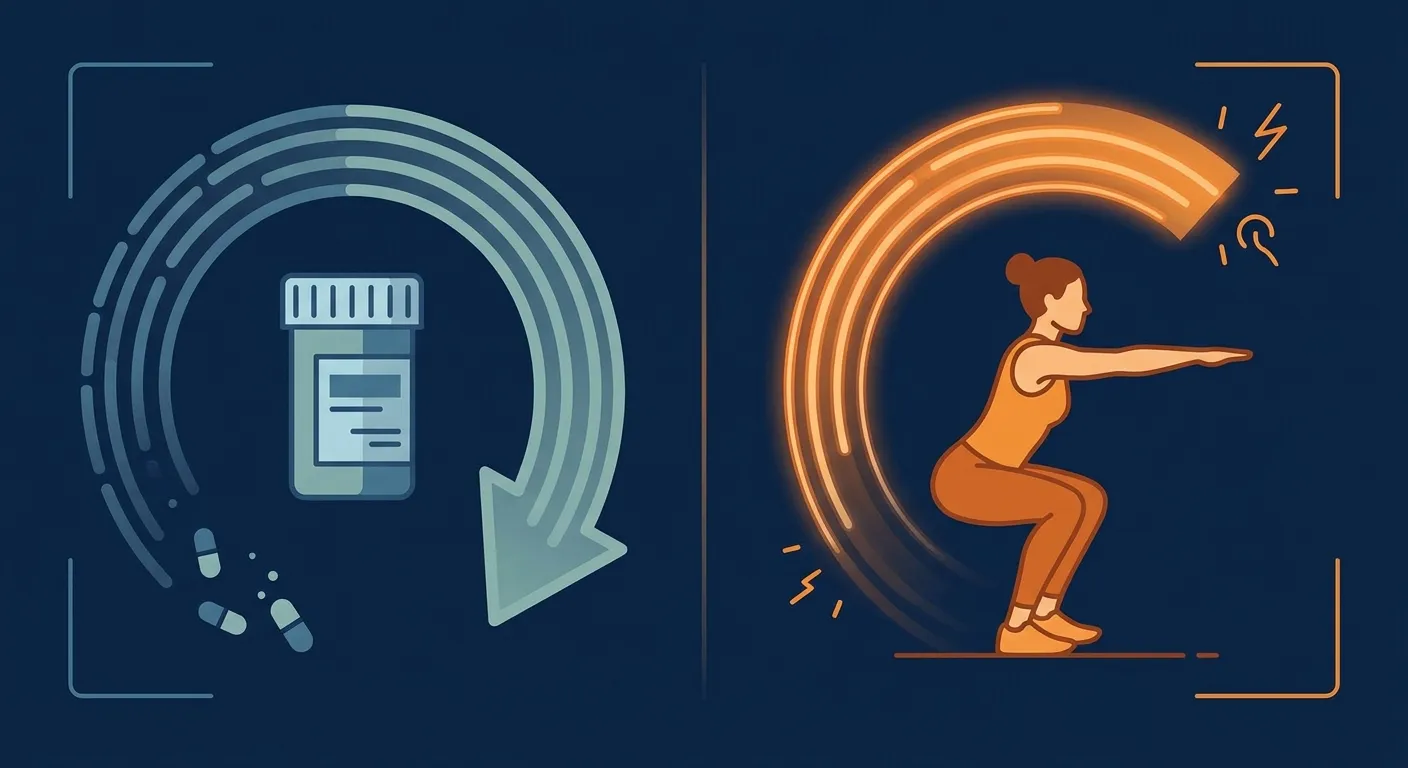
What Makes Exercise Better Than Sleep Medication?
Sleep medications work. Nobody disputes that. Benzodiazepines, Z-drugs (like zolpidem), and newer dual orexin receptor antagonists all reduce sleep onset latency and increase total sleep time in the short term. The problem isn't that they're ineffective. The problem is everything else about them.
The Dependency Trap
Most sleep medications carry dependency risks. Benzodiazepines are well-documented for producing tolerance (you need higher doses over time for the same effect) and withdrawal symptoms (rebound insomnia that's often worse than the original problem). Even newer Z-drugs, originally marketed as non-habit-forming, have shown similar patterns in long-term follow-up studies.
Exercise has the opposite trajectory. It tends to get more effective over time as your body adapts and your circadian rhythm stabilizes. There's no tolerance, no withdrawal, and no rebound insomnia when you stop for a few days.
Side Effects vs. Side Benefits
Sleep medications come with cognitive impairment, daytime drowsiness, fall risk (especially in older adults), and potential interactions with other drugs. Exercise comes with reduced cardiovascular risk, improved mood, better metabolic health, stronger bones, and a lower risk of about a dozen chronic diseases. The side effect profile of regular exercise is basically a list of things you'd want anyway.
Long-Term Durability
Kredlow et al.'s 2015 meta-analysis in the Journal of Behavioral Medicine analyzed 66 studies and found that regular exercise produces moderate beneficial effects on overall sleep quality, with improvements in sleep onset latency, total sleep time, and sleep efficiency. These effects held across both acute bouts (a single workout improving that night's sleep) and chronic programs (sustained exercise habits improving sleep over weeks and months).
Cognitive behavioral therapy for insomnia (CBT-I) research tells a related story. Meta-analyses show that CBT-I (a non-pharmacological approach that shares some behavioral overlap with exercise habits) outperforms medication in the long term, while medication often produces rebound insomnia when discontinued. Exercise functions through a similar non-pharmacological pathway: it changes the underlying biology rather than masking the symptom.
Citation: Kredlow MA, Capozzoli MC, Hearon BA, Calkins AW, Otto MW. The effects of physical activity on sleep: a meta-analytic review. J Behav Med. 2015;38(3):427-449.
How Exercise Improves Sleep: The Biology
Exercise doesn't just tire you out. The relationship between physical activity and sleep involves at least four distinct biological mechanisms, each of which has been studied independently.
Body Temperature Regulation
Exercise raises core body temperature by 1 to 2 degrees Celsius. The subsequent drop in temperature over the following hours mimics the natural thermoregulatory decline that signals sleep onset to the brain. This is one reason workout timing matters for some people: exercising 4 to 6 hours before bedtime may amplify this cooling effect right when you want to fall asleep. A warm bath 1 to 2 hours before bed works through the same temperature drop, and it's one of the ten methods in our guide on how to fall asleep faster.
Circadian Rhythm Synchronization
Regular exercise helps anchor your circadian clock. Morning or afternoon exercise reinforces the light-dark cycle and stabilizes the timing of melatonin release. For people with irregular sleep schedules (shift workers, students, remote workers with no fixed routine), exercise can serve as a secondary zeitgeber, or time-giver, that keeps the internal clock aligned. If you work overnight schedules, our night shift workout guide covers how to time training around a flipped sleep window.
Stress Hormone Regulation
Chronic stress elevates evening cortisol levels, which directly interferes with sleep onset. Regular exercise lowers baseline cortisol over time and improves the cortisol awakening response, creating a steeper cortisol curve: high in the morning (which promotes alertness) and low at night (which permits sleep). This is related to the dopamine and neurochemical effects of exercise that influence mood and motivation throughout the day.
Adenosine Accumulation
Physical activity increases adenosine levels in the brain. Adenosine is the molecule that builds "sleep pressure" throughout the day. (Caffeine works by blocking adenosine receptors, which is why coffee fights sleepiness.) Exercise accelerates adenosine buildup, making the drive to sleep stronger and more consistent by evening.
Enjoying the article?
Start a new fitness routine today, written by me and coached by the AI I designed.
Take the Free Assessment Free • 2 minutes • No credit cardThe 81-Trial Confirmation
If one network meta-analysis is compelling, two is hard to argue with. Zhou and colleagues published a paired and network meta-analysis in Sleep Medicine that pooled 81 randomized controlled trials with 6,193 participants drawn from the general, non-athlete population.
Their findings confirmed what the smaller meta-analyses suggested: exercise reliably improves both subjective sleep quality (how you feel about your sleep) and objective sleep efficiency (the share of time in bed actually spent asleep). Pooled across trials, exercise cut PSQI scores by 1.77 points (95% CI 1.25 to 2.28) and raised sleep efficiency by 4.81 percentage points (95% CI 2.89 to 6.73). Ranking the modalities, mind-body exercise came out best for subjective sleep quality and aerobic exercise came out best for sleep efficiency.
Twenty-three of the 81 trials reported objective sleep efficiency, and exercise produced a statistically significant improvement there too, consistent with the subjective outcomes. That's important because subjective sleep measures can be influenced by expectation effects. When objective data confirms the subjective findings, the result is much harder to dismiss. The review also found that longer programs produced larger sleep gains, and that the size of the benefit tapered with increasing age.
Citation: Zhou X, Kong Y, Yu B, Shi S, He H. Effects of exercise on sleep quality in general population: Meta-analysis and systematic review. Sleep Med. 2025;125:1-13.

What Type of Exercise Works Best for Sleep?
The short answer: most types work. The longer answer involves some useful distinctions.
The Li et al. (2024) network meta-analysis compared six exercise modalities head-to-head and found aerobic exercise had the most evidence behind it (37 of 86 studies used aerobic interventions). Combined aerobic-plus-resistance training and yoga also showed strong effects. Resistance training alone had fewer studies (7) but still produced meaningful improvements.
Moderate-intensity exercise appears to hit the sweet spot for sleep. High-intensity training also works, but it can temporarily elevate cortisol and core body temperature, which may disrupt sleep if done too close to bedtime. For people whose primary goal is better sleep rather than athletic performance, moderate-intensity options like brisk walking, cycling, yoga, or bodyweight strength training are probably the safest bet.
The practical takeaway is familiar but true: the best exercise for sleep is the one you'll actually do four or more times per week. A yoga routine you stick with will outperform a HIIT program you abandon after two weeks.
Medical Disclaimer: What Exercise Cannot Replace
Important: Exercise is a powerful tool for improving general sleep quality, but it is not a substitute for medical treatment of diagnosed sleep disorders. Conditions like obstructive sleep apnea, narcolepsy, restless leg syndrome, and severe chronic insomnia require evaluation and treatment by a healthcare provider. If you are currently taking prescribed sleep medication, do not stop or reduce your dosage without consulting your doctor. The research reviewed here applies to general sleep quality in otherwise healthy adults, not to clinical sleep pathology.
This distinction matters more than most health content acknowledges. Sleep apnea affects an estimated 30 million Americans, and exercise alone will not resolve an obstructed airway. Chronic insomnia with psychiatric comorbidities often requires a combination of CBT-I, medication, and behavioral intervention. Exercise can be a valuable part of a comprehensive treatment plan for these conditions, but it should complement professional care, not replace it.
Honest Limitations of the Research
We wouldn't be doing this research justice if we only reported the headline findings. Here's what the evidence doesn't tell us yet.
Most Studies Use Self-Reported Sleep Measures
The vast majority of RCTs in these meta-analyses used the Pittsburgh Sleep Quality Index (PSQI) or similar self-report questionnaires. Only a small subset used polysomnography or actigraphy for objective measurement. Self-reported sleep is useful but imperfect: people are notoriously inaccurate at estimating how long it takes them to fall asleep and how often they wake up. The Zhou et al. review did find that the 23 trials with objective sleep-efficiency data confirmed the subjective results, which is reassuring, but we need more objective measurement.
Trial Duration Is Limited
Most exercise-and-sleep RCTs run for 8 to 16 weeks. We have very little randomized evidence on whether the sleep benefits of exercise persist beyond a year. Observational studies suggest they do, but observational data can't establish causation the way RCTs can. Longer trials with follow-up assessments would strengthen the evidence considerably.
Publication Bias Likely Inflates Effect Sizes
Studies that find exercise improves sleep are more likely to get published than studies that find no effect. This publication bias is a known problem in exercise science research. While both meta-analyses attempted to assess publication bias using funnel plots and statistical tests, some inflation of the pooled effect is probable.
Population Generalizability
Most participants in these trials were healthy adults without diagnosed sleep disorders. The findings may not generalize directly to people with clinical insomnia, sleep apnea, or other specific conditions. Exercise may still help these populations (and smaller studies suggest it does), but the large meta-analytic evidence applies primarily to general sleep quality in people who don't sleep great but don't have a clinical diagnosis.
How This Connects to Recovery Research
Sleep is the foundation of exercise recovery. You can't separate the two. The research on recovery techniques across 99 studies consistently shows that sleep quality mediates how well your body repairs and adapts after training. Improving your sleep through exercise creates a positive feedback loop: better sleep leads to better recovery, which leads to better workouts, which leads to better sleep.
This is also why overtraining can wreck your sleep. When exercise volume exceeds your recovery capacity, cortisol stays elevated, sleep quality drops, and the positive cycle reverses. The optimal approach is consistent, moderate exercise that your body can recover from, not chronic overreaching that undermines the sleep benefits you're trying to build.
How FitCraft Applies This Research
FitCraft was built around the principle that consistent, adaptive exercise produces compounding benefits, and sleep is one of the biggest. Here's how the app connects to this research specifically:
- Adaptive workout intensity keeps you in the moderate-effort zone that research links to the best sleep outcomes. FitCraft's AI trainer Ty adjusts difficulty based on your actual progress, so you're never doing too much or too little.
- Workout variety across modalities matches the meta-analytic finding that aerobic, resistance, and yoga-style training all improve sleep. FitCraft programs span yoga, mobility, strength (bodyweight, dumbbells, resistance bands), cardio, and dynamic movement.
- Gamification and streaks solve the consistency problem that makes or breaks sleep benefits. The research is unambiguous that exercising 4+ times per week works better than sporadic sessions. FitCraft's XP system, leveling, collectible cards, and calendar rewards use variable reinforcement to keep you showing up.
- Session length flexibility means you can fit a workout into 15 or 45 minutes depending on your day. Since the evidence shows 150 minutes per week of moderate activity is the target, shorter sessions done more frequently can be just as effective as longer ones done less often.
We're not claiming FitCraft is a sleep intervention. We're saying that the exercise habit it helps you build is one of the most evidence-backed tools available for improving sleep, and the app is designed around the specific dose and consistency patterns that the research identifies as effective.
Frequently Asked Questions
Does exercise actually improve sleep quality?
Yes. A 2024 network meta-analysis of 86 RCTs involving 7,276 participants found that exercise significantly improves sleep quality across multiple modalities. Aerobic exercise, resistance training, yoga, and combined programs all outperformed inactive controls. A separate network meta-analysis in Sleep Medicine pooled 81 trials with 6,193 participants and confirmed these findings, showing significant improvements in both subjective sleep quality and objective sleep efficiency.
How much exercise do you need for better sleep?
Research suggests the optimal dose is around 440 METs-min per week, which translates to roughly 150 minutes of moderate-intensity exercise. Exercising at least 4 times per week appears to be more effective for sleep than lower frequencies. Even modest amounts help, but consistency matters more than individual session length.
Is exercise better than sleep medication?
For most people with general sleep difficulties, exercise produces comparable or better long-term results without the side effects, dependency risks, or tolerance issues associated with sleep medications. However, exercise is not a replacement for medical treatment of diagnosed sleep disorders like sleep apnea or severe chronic insomnia. Always consult a healthcare provider before changing any prescribed sleep medication.
What type of exercise is best for improving sleep?
The 2024 network meta-analysis found that aerobic exercise, yoga, and combined aerobic-plus-resistance training all produce significant sleep improvements. Moderate-intensity exercise appears most effective for sleep quality. The best type is the one you will actually do consistently, since adherence predicts outcomes more strongly than any single exercise modality.
Does the time of day you exercise affect sleep?
Research shows exercising earlier in the day may produce slightly better sleep outcomes than late-night sessions, but the differences are modest. The old advice to avoid all evening exercise has been largely debunked by recent studies. Finishing a workout at least 1 to 2 hours before bedtime is generally sufficient. The most important factor is simply exercising regularly, regardless of timing.