
Maybe your watch has a 1,000-calorie goal ring, or you saw a video promising a 1000 calorie workout in an hour. You tried it, finished soaked and shaking, and checked the scale two days later. Nothing much had changed, and the next session felt even harder to start.
That frustration makes sense. Calorie numbers get thrown around as if every one of them were exact and every workout were the same. They aren't, and a target this big turns into punishment fast when it's built on the wrong math.
So here's how to burn 1000 calories a day in a way that holds up: what your body already burns, how long each kind of exercise takes, a realistic day that gets there, and what that much activity will and won't do to your weight.
Total Burn vs Active Burn: Which 1,000 Calories Do You Mean?
Your body burns calories in three ways. Your resting metabolism, or BMR, keeps your organs running and is the biggest share for almost everyone. Digesting food takes roughly a tenth of what you eat. The rest is movement, both planned exercise and everything else you do on your feet.
Resting burn alone clears 1,000 calories for any adult. The Mifflin-St Jeor equation (Mifflin and colleagues, 1990), built from measurements in 498 healthy adults, puts a 35-year-old woman of 70 kg and 165 cm at about 1,400 calories a day at rest, and a 35-year-old man of 90 kg and 178 cm at about 1,850. Add digestion and ordinary moving around and most adults burn 1,800 to 3,000 calories a day in total.
So when people search for how to burn 1,000 calories a day, they almost always mean 1,000 active calories: the exercise and movement on top of that baseline. That's what the "active calories" figure on a watch is trying to measure, and it's what the rest of this guide is about.
How Many Calories Can I Burn by Exercising for an Hour?
The standard way to estimate it uses METs, the energy cost of an activity as a multiple of resting. The 2024 Adult Compendium of Physical Activities (Herrmann and colleagues) lists values for 1,114 activities, most of them measured in the lab. The formula is simple: calories per hour = METs × body weight in kg × 1.05.
| Activity | METs | Calories per hour at 70 kg (154 lb) | Calories per hour at 90 kg (198 lb) | Time to burn 1,000 at 70 kg | Time to burn 1,000 at 90 kg |
|---|---|---|---|---|---|
| Weight training, sets of 8 to 15 reps | 3.5 | 257 | 331 | 3 h 53 min | 3 h 01 min |
| Brisk walking, 3.5 to 3.9 mph | 4.8 | 353 | 454 | 2 h 50 min | 2 h 12 min |
| Walking uphill, 1 to 5% grade | 5.3 | 390 | 501 | 2 h 34 min | 2 h 00 min |
| Bodyweight circuit training | 6.0 | 441 | 567 | 2 h 16 min | 1 h 46 min |
| Stationary cycling, general | 6.8 | 500 | 643 | 2 h 00 min | 1 h 33 min |
| Vigorous calisthenics (burpees, jumping jacks, push-ups) | 7.5 | 551 | 709 | 1 h 49 min | 1 h 25 min |
| Elliptical, vigorous | 9.0 | 662 | 851 | 1 h 31 min | 1 h 11 min |
| Running, 6 mph | 9.3 | 684 | 879 | 1 h 28 min | 1 h 08 min |
| Running, 7 mph | 11.0 | 809 | 1,040 | 1 h 14 min | 58 min |
Two things stand out. Body weight matters as much as the activity, because moving a heavier body costs more. And only running at a fairly fast pace gets a heavier adult to 1,000 calories inside an hour. For everyone else, burning 1,000 calories through exercise alone means 1.5 to 3 hours.
These are gross figures, so they include the roughly 70 to 95 calories an hour your body burns at rest anyway. Subtract that and the extra burn is a little lower.
What exercises burn the most calories?
Per minute, the winners are running, fast cycling, hard rowing, jumping rope and vigorous intervals, all around 9 to 14 METs on the Compendium. Per day, the winner is whatever you can keep doing for longest, which is usually walking. Interval training is time-efficient but doesn't unlock extra burn: Skelly and colleagues (2014) measured 24-hour oxygen consumption and found that an interval session and a longer moderate session produced similar totals for the day.
How to Burn 1000 Calories a Day: A Realistic Day
The plan that works for most people doesn't put 1,000 calories into one session. It spreads them over the day, so no single block is brutal and you can do it again tomorrow. Here's what that looks like for an 80 kg (176 lb) adult, counting only the calories above resting.
| When | What | Time | Extra calories |
|---|---|---|---|
| Morning | Brisk walk | 45 minutes | About 240 |
| Midday or evening | Bodyweight or dumbbell circuit at home | 40 minutes | About 280 |
| After lunch | Brisk walk | 20 minutes | About 105 |
| After dinner | Brisk walk | 30 minutes | About 160 |
| Through the day | Housework, yard work, carrying groceries, cooking | 60 minutes | About 195 |
| Total | About 3 hours 15 minutes | About 980 |
Lighter people need a little more time and heavier people a little less. To set it up:
- Find your starting point. Note how many minutes you walk and train on a normal day before changing anything.
- Add walking first. Put in one 20 to 30 minute walk a day for the first week or two, then a second.
- Add the workout. Start with three 30-minute circuits a week and build toward 40 minutes most days.
- Move more between sessions. Do chores in one active block, take calls walking, and carry things rather than wheeling them.
- Raise it slowly. Add roughly 15 to 20 minutes of activity a day each week, so a 1,000-calorie day arrives in a month or two rather than on Monday.
If the day's main goal is weight loss, the strength part matters as much as the burn. Our guide to the best workout for weight loss lays out a full week of dumbbell, bodyweight and walking sessions built around keeping your muscle.
The 1000 Calorie Workout: How Long It Really Takes
Plenty of videos promise to burn 1000 calories in one workout. For most people, a single 60-minute session of strength and intervals burns 450 to 700 calories. The people who reach 1,000 in an hour tend to be heavier, fit and working near their limit the whole time.
Here's a 90-minute burn 1000 calories workout built from dumbbells and body weight, with honest numbers for an 80 kg adult:
- Warm-up, 10 minutes: easy walk or marching in place, then arm circles and bodyweight squats. About 50 calories.
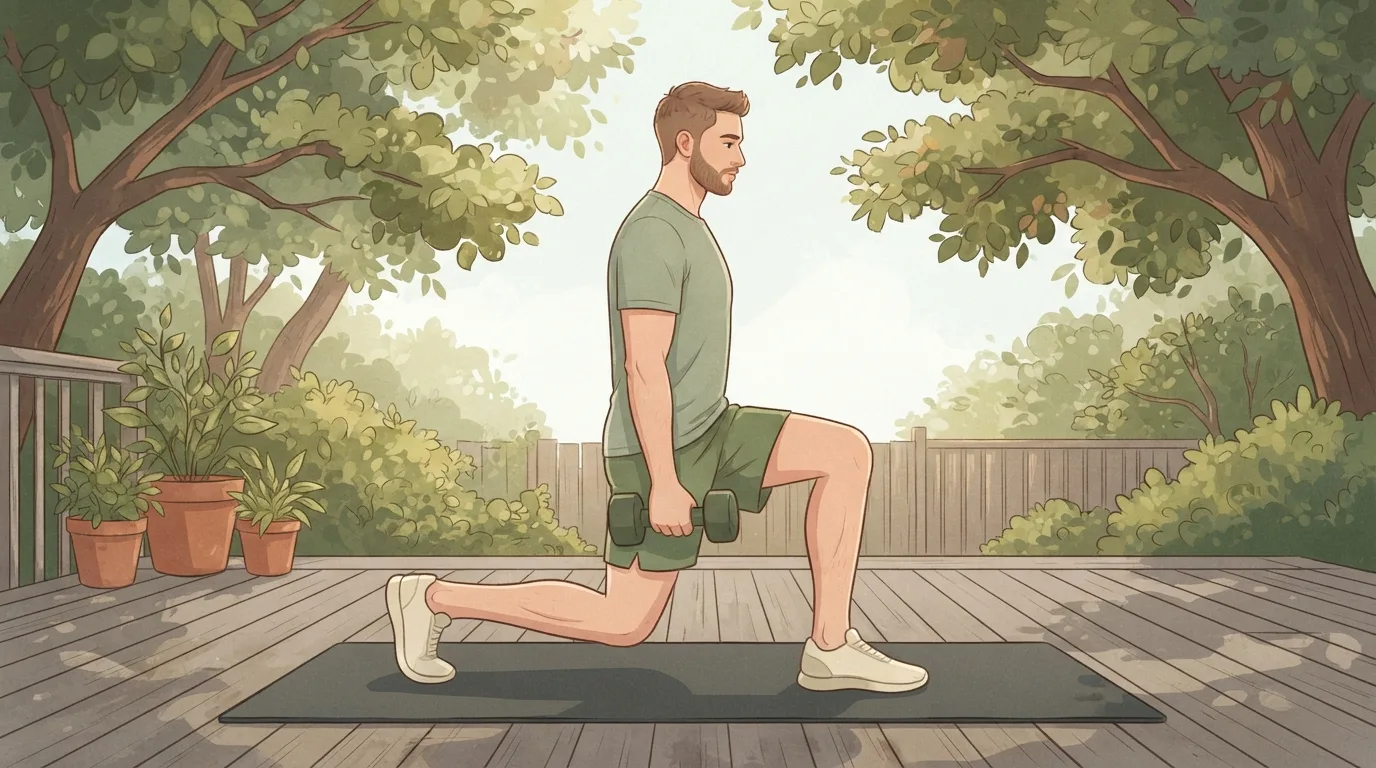
- Strength circuit, 35 minutes: goblet squats, push-ups, one-arm dumbbell rows, reverse lunges, overhead presses and Romanian deadlifts, 10 to 12 reps each, moving straight from one to the next, 3 rounds. About 295 calories.
- Intervals, 15 minutes: 30 seconds each of squat jumps, mountain climbers and burpees, then 60 seconds of marching, repeated. About 145 calories.
- Brisk walk, 30 minutes: outside or on a treadmill. About 200 calories.
That's about 700 calories in 90 minutes, which is a big session. To reach 1,000 in one go, you'd need to stretch the walk to well over an hour. That's why the realistic version of a 1000 calorie workout is a 1000-calorie day: one session plus walks, as in the table above.
If you'd rather not plan circuits yourself, a home workout app that needs no equipment can run them for you. In FitCraft, a 3D AI coach demonstrates each exercise, says your name as you work, and the app keeps your streak going so the second and third weeks happen too.
Can I Burn 1000 Calories a Day by Walking?
Yes, if you have the time. Wilkin and colleagues (2012) measured 30 adults averaging 71 kg walking and running a mile, and walking cost about 89 calories. At that rate, 1,000 calories is about 11 miles for a 155-pound walker and closer to 9 miles at 200 pounds. At a brisk pace that's 2 to 3 hours.
In steps, that's roughly 18,000 to 26,000 a day, depending on your weight and pace. Our breakdown of how many calories 10,000 steps burn puts an ordinary 10,000 at about 400 calories for a 150-pound adult and 530 at 200 pounds, with brisk steps costing about a third more each.
How many steps should you take a day to lose 2 pounds a week?
On the old 3,500-calorie rule, 2 pounds a week needs a deficit of about 1,000 calories a day. Getting all of that from walking would mean something like 25,000 to 35,000 steps on top of what you already take, because only the burn above resting counts toward a deficit. Almost nobody can sustain that, and the body claws some of it back, as the next sections explain. A steadier target is 8,000 to 12,000 steps a day plus eating about 300 to 500 fewer calories, which tends to land nearer 1 pound a week.
Find out what's really holding you back
FitCraft, our mobile fitness app, pairs you with an AI coach who builds you a personalized plan around your goals, schedule, and fitness level. Every FitCraft program is designed by Domenic Angelino, MPH (Brown University) and NSCA-CSCS, with research published in the Journal of Strength and Conditioning Research and Medicine & Science in Sports & Exercise.
Take the Free Assessment Free • 2 minutes • No credit cardNEAT: The Calories You Burn Outside Your Workouts
Everything you do that isn't sleeping, eating or formal exercise is called NEAT, short for non-exercise activity thermogenesis. It's the walking to the car, the standing, the cleaning and the fidgeting, and it varies a lot between people.
Two classic studies show how much. Levine and colleagues (1999) overfed 16 adults by 1,000 calories a day for 8 weeks. Two-thirds of the rise in their daily burn came from NEAT, and differences in NEAT explained a tenfold difference in how much fat they gained. In a follow-up, Levine and colleagues (2005) tracked 20 sedentary adults' posture every half-second for 10 days. The participants with obesity sat about 2 hours longer each day, and the authors estimated that moving like their lean peers could burn about 350 more calories a day.
That 350 is a third of the 1,000-calorie target without a single workout. The Compendium rates general house cleaning at 3.3 METs, carrying groceries at 3.5 and cooking while moving around at 2.3 to 3.5, all well above sitting. Walking meetings, a few minutes of walking every hour, parking at the far end of the lot and doing chores in one long active block all count. Standing still adds very little compared with walking.
If I Burn 1,000 Calories a Day, How Much Weight Will I Lose?
Less than the 2 pounds a week the arithmetic promises. Burning 1,000 extra calories a day is 7,000 a week, which the 3,500-calorie rule turns into 2 pounds. Real bodies don't follow that rule, for four reasons.
- Your basal burn drops a little. Careau and colleagues (2021) analyzed energy measurements from 1,754 adults and found that about 28 percent of the calories burned through extra activity were offset by lower basal energy expenditure. Only about 72 percent showed up as extra burn for the day.
- Total burn levels off at high activity. Pontzer and colleagues (2016) measured 332 adults in five countries and found that total daily energy expenditure rose with activity at low levels, then plateaued among the most active.
- Weight change slows as you go. Hall and colleagues (2011) modeled adult metabolism and found that body weight responds to a change in energy balance slowly, with a half-time of about a year, because a smaller body burns less.
- Appetite often rises. Many people eat back part of what they burn without noticing.
The real-world numbers show the gap. In the Midwest Exercise Trial 2, Donnelly and colleagues (2013) had 141 young adults with overweight or obesity burn 600 calories per supervised session, five days a week, for ten months, without dieting. On the 3,500-calorie rule that's well over 30 pounds. The group lost 5.2 kg, about 11.5 pounds. Scaled up to 1,000 calories every day, that suggests something like half a pound to a pound a week from exercise alone, more if you also eat a little less. Our guide to cardio for fat loss covers why the scale lags the work and how to plan around it.
How Do I Calculate My Calorie Burn?
Use the MET formula above with your own weight: calories per hour = METs × kg × 1.05. For a 75 kg adult doing 50 minutes of stationary cycling at 6.8 METs, that's 6.8 × 75 × 1.05 × 50/60, or about 446 calories. Our calories burned calculator does the same sum for dozens of activities.
Treat a fitness watch as a rough guide, not a ledger. Shcherbina and colleagues (2017) tested seven wrist-worn devices against lab measurements in 60 adults. Heart rate was mostly accurate, but no device estimated energy expenditure with an error below 20 percent, and walking produced the largest errors. A watch that says 1,000 active calories may mean 800 or 1,200.
Is Burning 1000 Calories a Day Safe?
For a healthy adult who builds up to it, a high-activity day made mostly of walking and moderate training is safe. Problems come from three directions.
- Jumping in too fast. Gabbett's review in the British Journal of Sports Medicine (2016) concluded that rapid spikes in training load drive a large share of non-contact soft-tissue injuries, while well-built-up training protects against them. Going from 20 minutes of activity a day to 3 hours in a week is exactly that kind of spike. If a big new workout leaves you with severe muscle pain, swelling or dark, cola-colored urine, get medical care the same day.
- Not eating enough for the work. The 2023 IOC consensus statement on Relative Energy Deficiency in Sport (Mountjoy and colleagues) describes the health and performance damage that follows when food intake doesn't cover the energy spent exercising, in men as well as women. Warning signs include constant fatigue, frequent illness, missed periods, low mood, bone stress injuries and workouts that keep getting worse.
- Stacking a big burn on a crash diet. Eating 1,000 calories a day is a different thing entirely. That's a very aggressive diet for almost any adult, and intakes that low belong under medical supervision. Combining one with a 1,000-calorie burn creates a deficit few bodies can sustain, and more of what's lost tends to be water and muscle.
A safer frame for weight loss is a daily deficit of about 500 calories, split between a little less food and a little more movement. That tends to produce about a pound a week that you can keep up for months.

How Much Is 1000 Calories?
In food, 1,000 calories is about half the 2,000-calorie reference on US nutrition labels. It's roughly nine or ten medium bananas, eight tablespoons of olive oil, or one large restaurant burger with fries. In body fat, it's much less than people expect: about 0.29 pounds, or 130 grams, on the 3,500-calories-per-pound rule. That's why one big workout never shows up as fat loss the next morning, and why a run of steady weeks does.
The Bottom Line
Burning 1,000 extra calories a day is possible for most healthy adults, but it takes about 1.5 to 3 hours of movement, and the realistic version is a full active day rather than one heroic workout. Build it from walks, a 40-minute home circuit and more time on your feet, raise it over several weeks, and eat enough to recover. The scale will move more slowly than the math, and that's normal.
Sarah, 27, lost 18 pounds in three months. In her words: "First app that made exercise feel like something I chose, not forced." The day you can repeat beats the day that wrecks you.
Frequently Asked Questions
How long do you have to walk to burn 1000 calories?
Most adults need about 2 to 3 hours of brisk walking to burn 1000 calories. On the 2024 Compendium of Physical Activities, brisk walking at 3.5 to 3.9 mph takes about 2 hours 50 minutes at 70 kg (154 lb) and about 2 hours 12 minutes at 90 kg (198 lb). That's roughly 9 to 11 miles.
Can you burn 1000 calories in 30 minutes?
No. Burning 1000 calories in 30 minutes means about 33 calories a minute, which takes close to 7 liters of oxygen a minute. That's near the highest oxygen uptake ever measured in elite rowers and skiers, and far beyond what anyone can hold for half an hour. A hard 30-minute session burns about 250 to 500 calories for most adults.
How many push ups does it take to burn 1000 calories?
Roughly 2,000 to 3,000 push-ups for a 70 kg (154 lb) adult. Vigorous calisthenics burn about 9 calories a minute at that weight, and a steady pace of 20 to 30 push-ups a minute works out to around 0.3 to 0.5 calories each. Nobody should try it: push-ups build strength, and walking burns calories.
How many calories do 10,000 steps actually burn?
About 300 to 700 calories for most adults, depending mostly on body weight and pace. At an ordinary 3 mph pace that's roughly 400 calories at 150 pounds and 530 at 200 pounds. About a quarter of it is resting burn you'd spend sitting down anyway.
How to burn 1600 calories a day?
If you mean total daily burn, most adults already burn 1,600 calories or more just by living, because resting metabolism alone is about 1,400 to 1,850 calories for typical adults. If you mean 1,600 active calories, that's endurance-athlete territory: about 2 hours of running at 6 mph or 4 hours of brisk walking for an 80 kg (176 lb) adult.
Is it bad to burn 1000 calories a day?
Not if you build up to it over weeks and eat enough to recover. It becomes risky when it's a sudden jump from little activity, when most of it is high-intensity work, or when it's paired with a crash diet. Persistent fatigue, frequent illness, missed periods or new aches that don't settle are signs to cut back and see a doctor.