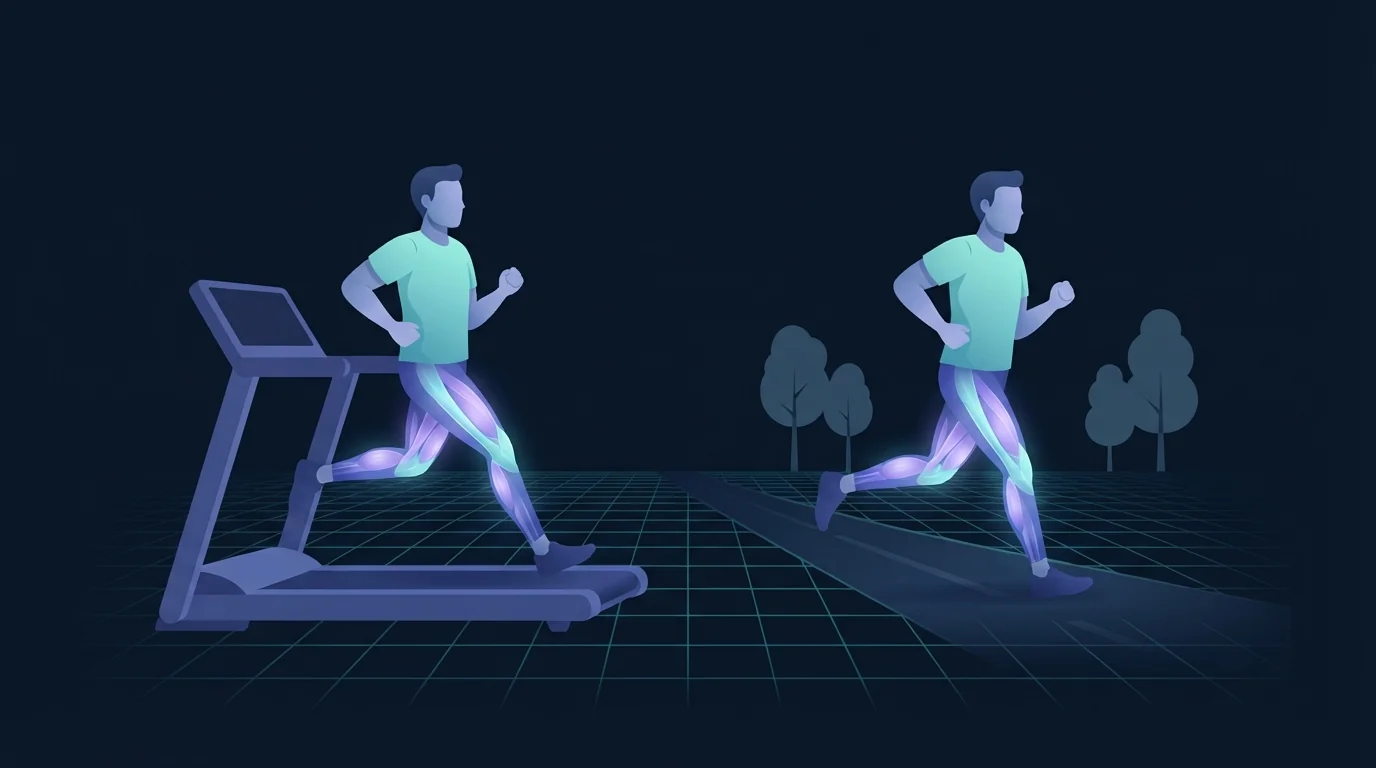
Every runner eventually ends up in this argument, usually in January. One camp says the treadmill is cheating because the belt does the work. The other says the treadmill is harder because there's nowhere to hide and no scenery to distract you. Both camps are describing something real, and neither is describing energy cost.
Here's the useful framing. The two are close enough on oxygen consumption that you should pick between them on other grounds entirely: what you're training for, what your joints will tolerate, what the weather is doing, and which one you'll actually finish. The evidence on each of those is better than the argument usually gets.
Treadmill vs Outside Running at a Glance
| Treadmill | Outside | |
|---|---|---|
| Energy cost | Matches the road at a 1% grade | The reference point |
| Air resistance | None, and the cost rises with the square of wind speed outdoors | Real, and the reason a headwind ruins a pace |
| Perceived effort | Higher at faster submaximal speeds | Lower at the same oxygen cost |
| Endurance performance | Worse on the belt (SMD -0.50) | Better in matched time trials |
| Footstrike | Flatter foot, more knee flexion through stance | More toe-up at contact, more vertical travel |
| Surface | Uniform, cushioned, predictable | Camber, kerbs, gravel, ice, potholes |
| Pacing control | Exact, set by the machine | A skill you have to build |
| Best for | Precise intervals, bad weather, coming back from injury | Race-specific fitness, long runs, the part of running people like |
The 1 Percent Rule and Where It Came From
The most durable finding in this whole comparison is nearly thirty years old. Jones and Doust (1996), in the Journal of Sports Sciences, had nine trained male runners complete six-minute bouts at six velocities from 2.92 to 5.0 metres per second, repeated across treadmill grades of 0, 1, 2 and 3 percent and once outdoors on a level road. They were looking for the grade at which treadmill oxygen uptake matched road oxygen uptake.
The answer came out speed-dependent, which is the part everyone forgets. At the two slowest velocities, road running was not significantly different from 0 or 1 percent on the belt. At 3.75 m/s, road matched 1 percent and differed from 0, 2 and 3 percent. At 4.17 and 4.58 m/s, road matched 1 or 2 percent and was significantly harder than 0 percent. The authors concluded that 1 percent equalises the energetic cost of treadmill and outdoor running across that range.
Translate that into paces you recognise. Below roughly 8 minutes per mile the flat belt is honest enough that the incline is mostly ritual. Above it, 1 percent is a real correction and the difference is on the order of 9 to 15 seconds per kilometre. If your treadmill pace looks suspiciously good compared with your road pace, the grade is usually the explanation.
The mechanism is mostly air. Pugh (1970), in the Journal of Physiology, measured oxygen intake in seven athletes on a track and four on a treadmill, then blew wind at a treadmill runner at varying velocities to isolate the cost of moving air out of the way. The extra oxygen cost rose with the square of wind velocity, which is why a 10 mph headwind is far worse than twice as bad as a 5 mph one. Indoors you're not pushing any air, so you get that energy back.
Why the Treadmill Feels Harder Than the Numbers Say
This is where the internet argument becomes tractable. Miller and colleagues (2019) pooled 34 crossover studies in Sports Medicine, all of them running the same participants on a motorised treadmill and overground. Their findings, in order of how much they explain:
- Oxygen cost barely differs. At submaximal speeds on a level belt the mean difference was -0.55 mL/kg/min, and at maximal intensity 0.78 mL/kg/min. The engine is doing the same work.
- Heart rate and perceived exertion split by speed. Both ran higher on the treadmill at faster submaximal speeds and lower at slower ones. So the "treadmill feels harder" complaint is real, and it belongs to tempo pace rather than easy pace.
- Blood lactate is consistently lower on the belt. Mean difference of -1.26 mmol/L at 0 percent grade and -0.52 at 1 percent. Lower lactate with the same oxygen cost and higher perceived effort is an odd combination, and it's why indoor effort is hard to translate directly.
- Endurance performance is worse indoors. Standardised mean difference of -0.50. Put a runner on a belt for a time trial and they do less than they would on a road. Sprint performance showed no significant difference and varied a lot.
Heat explains a good share of this. Without a headwind, the convective cooling that a road run gives you for free disappears, so core temperature and skin blood flow climb faster, and rising perceived effort follows. The rest is psychological: a fixed belt, a fixed view, and no landmarks to break the distance into pieces. If your head is what quits before your legs do, our piece on running longer mentally is aimed at exactly that.
Find out what's really holding you back
FitCraft, our mobile fitness app, pairs you with an AI coach who builds you a personalized plan around your goals, schedule, and fitness level. Every FitCraft program is designed by Domenic Angelino, MPH (Brown University) and NSCA-CSCS, with research published in the Journal of Strength and Conditioning Research and Medicine & Science in Sports & Exercise.
Take the Free Assessment Free • 2 minutes • No credit card
Biomechanics and Joint Loading
Van Hooren and colleagues (2020) ran the biomechanical half of the same question in Sports Medicine, pooling 33 crossover studies and 494 participants. Their overall conclusion was that spatiotemporal, kinematic, kinetic, muscle activity and muscle-tendon outcomes were largely comparable between the belt and the ground. The exceptions were specific and worth knowing:
- Sagittal foot-ground angle at footstrike was 9.8 degrees smaller on the treadmill (95% CI -13.1 to -6.6), meaning a flatter foot at contact.
- Knee flexion range from footstrike to peak stance was 6.3 degrees greater on the belt (95% CI 4.5 to 8.2).
- Vertical displacement of the centre of mass was 1.5 cm less on the treadmill.
- Ground contact time was 5.0 ms longer, and peak propulsive force 0.04 body weights lower.
Read that honestly. It doesn't say the treadmill is safer for your knees. It says the landing pattern shifts a little, the body travels up and down a little less, and you push off a little less hard because the belt is already moving under you. Nobody has run a prospective trial randomising runners to belt or road and counting injuries, so anyone who tells you one is definitively safer is extrapolating.
What the surface genuinely buys you is uniformity. A road has camber that loads one leg differently from the other, kerbs, gravel, black ice and potholes. A belt has none of that, which is why the treadmill is the standard tool for rebuilding volume after an injury. It's also the reason step-rate work is easy to do indoors: the pace is fixed, so you can change cadence without accidentally changing speed. The evidence on why that matters is in our review of the running cadence research.
Does Treadmill Training Transfer?
Partially, and the honest answer needs a caveat about study size. Singh and colleagues (2022) randomised 28 recreationally active young men into outdoor or treadmill running for six weeks, three sessions a week at 60 to 80 percent of predicted maximum heart rate, and published the results in PeerJ. The outdoor group improved more on the 50 metre sprint (3.0 versus 0.9 percent), the 1,600 metre run (8.3 versus 2.8 percent) and the standing long jump (12.4 versus 5.6 percent). Both groups cut body fat similarly, but the treadmill group lost leg skeletal muscle mass while the outdoor group held onto it.
That's a pilot study with 14 people per arm, so treat the effect sizes as a direction rather than a settled number. The direction is consistent with the propulsion data: a belt that moves under you asks for less push-off, and less push-off over six weeks is less stimulus for the muscles that produce it. If your goal is a road race, some of your running needs to happen on a road.
The aerobic side transfers fine. Cardiorespiratory fitness doesn't care much where the oxygen is consumed, and the 2011 ACSM position stand makes no distinction between indoor and outdoor modes when prescribing weekly volume. It's the skills that are surface-specific: pacing yourself without a display, cornering, running a camber, and the neuromuscular work of pushing off ground that doesn't move.
Weather, Safety and the Sessions That Actually Happen
The best session is the one you do, which sounds like a platitude until you count the weeks a bad forecast has cost you. A realistic split looks like this.
Take the treadmill when: there's ice or standing water on your route, lightning is forecast, it's dark and your route has no lighting or pavement, the air quality index is elevated, the heat index is dangerous, someone is asleep in the house and you can't leave, or you're rebuilding volume after an injury and want to be able to stop without a two-mile walk home.
Go outside when: you're inside about eight weeks of a road race, the run is long and you'd lose your mind indoors, you need to practise pacing without a machine setting it, or the weather is simply good and running outdoors is the reason you started. Cold is a smaller obstacle than most people assume, and our guide on dressing for cold runs covers the layering that makes a winter run pleasant rather than heroic.
One safety note specific to the belt: clip the safety key to your shirt every time, and step onto the side rails before making a large speed change. A treadmill does not stop because you stopped.

How to Run Your Key Sessions on Each
Most training weeks can use both without any conversion headaches, as long as you match the session to the surface that suits it.
| Session | Better surface | Why |
|---|---|---|
| Easy run | Either | At easy paces the 1% correction is close to noise. Pick whichever gets you out the door. |
| Tempo run | Treadmill | The belt holds the pace exactly, which is the hardest part of a tempo to self-manage. |
| VO2 max intervals | Either | Indoors the recoveries are strict. Outdoors the top end is easier to reach. |
| Hill work | Treadmill for repeatability, outside for the downhill | A belt gives you the exact same gradient every rep. It cannot give you the eccentric descent. |
| Long run | Outside | Pacing drift, fuelling, camber and boredom are all part of the adaptation. |
| Return from injury | Treadmill | Uniform surface, controlled volume, and you can stop mid-session. |
If you're using the belt for the controlled sessions, it's worth getting the structure right: our guides to the tempo run and to hill sprints both translate onto a treadmill with almost no modification, and how to increase stamina covers how the easy and hard sessions should sit in the same week. If the treadmill isn't the machine you want at all, we compared it against the low-impact alternative in elliptical vs treadmill.
Who Should Choose Which
Choose the treadmill if
- You're coming back from injury and need a uniform surface with a stop button.
- Your week collapses whenever the weather does, and a missed run turns into a missed month.
- You run in the dark, near traffic, or somewhere you would rather not run alone.
- Your sessions are mostly tempo and interval work, where exact pacing matters more than terrain.
- Heat, cold or air quality where you live regularly makes outdoor running unwise.
Choose outside if
- You have a road race booked and want the fitness to transfer fully.
- Your long run is over an hour, and staring at a wall for that long is what actually ends your training block.
- You want to build pacing as a skill rather than borrow it from a machine.
- You're chasing push-off power and leg strength alongside aerobic fitness.
- You started running for the part that happens outdoors, which is a completely legitimate reason.
Most people aren't one or the other. The runners who keep running usually have both available and stop treating the choice as a moral question.
The Bottom Line
Treadmill vs outside running is a specificity question. One percent of grade closes the oxygen gap, so the belt isn't cheating. What the belt does not give you is air resistance, uneven ground, cornering, the full push-off, and the skill of pacing yourself. What it does give you is exact pacing, a uniform surface, and a session that happens in February.
Practical rule: if you're training for a road race, put your long run and at least one quality session outside. Everything else can live indoors. If you're running for fitness and health, the belt and the road are close enough that the right answer is whichever one you'll still be doing in twelve weeks.
Katie put the same idea more simply: "I've tried everything. This is the first time I've stuck with something past two weeks." She didn't find the optimal surface. She found a version of running that survived her actual life, which is the variable both sides of this argument keep skipping past. If keeping the habit is the part that keeps breaking, our roundup of the best fitness apps for staying consistent compares how the main options handle streaks and scheduling.
Frequently Asked Questions
Is running on a treadmill easier than running outside?
Slightly, at faster paces, and the gap is smaller than runners think. Jones and Doust showed in 1996 that a 1 percent treadmill grade matches the oxygen cost of level road running at speeds from 2.92 to 5.0 metres per second, which is roughly 9 to 15 seconds per kilometre of help on a flat belt. Below about 8 minutes per mile the difference is small enough to ignore.
Should I set the treadmill to 1 percent incline?
If you run faster than about 7 minutes per mile, yes. The 1996 Jones and Doust study found road running matched 0 or 1 percent grade at the two slowest speeds tested but needed 1 to 2 percent at 4.17 metres per second and above. For an easy jog, 0 percent is honest and 1 percent just makes an easy run less easy.
Why does the treadmill feel harder than running outside?
Because perception and physiology come apart indoors. A 2019 meta-analysis of 34 crossover studies found heart rate and perceived exertion were higher on a treadmill at faster submaximal speeds, blood lactate was consistently lower, and endurance performance was worse on the belt (SMD -0.50). Heat build-up without a headwind, fixed pacing and no changing scenery all push perceived effort up while the oxygen cost stays about the same.
Is treadmill running better for your joints?
The belt is a softer and more uniform surface, but the biomechanics are close enough that no study has shown a real injury-rate advantage either way. A 2020 meta-analysis of 33 studies and 494 participants found treadmill running produced a 9.8 degree smaller foot-ground angle at footstrike, 6.3 degrees more knee flexion range during stance and 1.5 cm less vertical displacement, while concluding most outcomes were largely comparable.
Does treadmill training transfer to outdoor races?
The aerobic work transfers well. The specific skills of pacing yourself, handling camber and cornering, and pushing off an unyielding surface do not. A six-week pilot study randomised 28 recreationally active young men to outdoor or treadmill running and found the outdoor group improved more on the 1,600 metre run (8.3 versus 2.8 percent) and the standing long jump, so race-specific work belongs outside when you can get there.
When is the treadmill the better choice?
Ice, lightning, extreme heat, darkness with no lit route, air quality alerts, a newborn asleep upstairs, and any session where holding an exact pace matters more than the scenery. The treadmill is also the safer place to build volume when you're coming back from injury, because the surface is uniform and you can stop mid-session without a walk home.