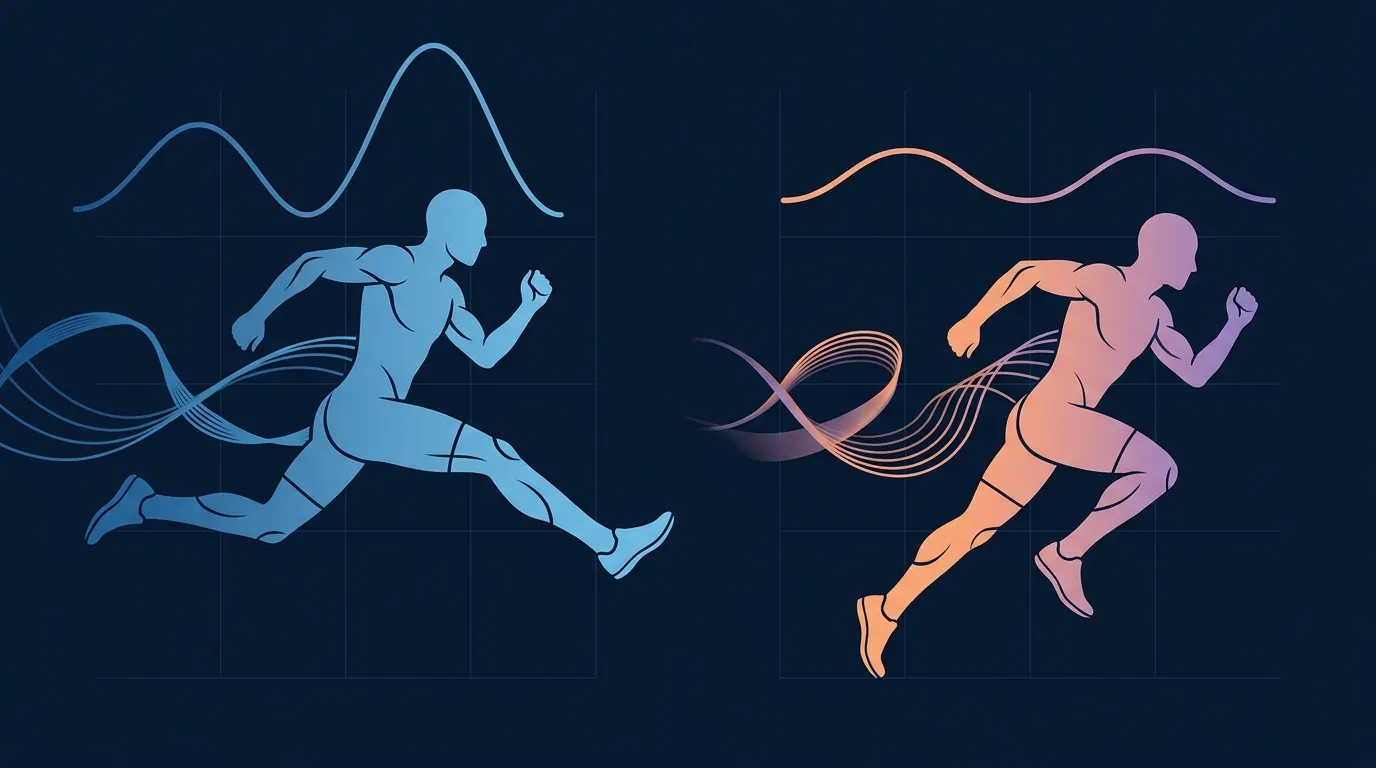
Ask any runner what their cadence should be and half of them will tell you 180. That number has been passed hand to hand at running clinics, marathon expos, and podcast interviews since coach Jack Daniels counted steps at the 1984 Los Angeles Olympics and noticed the fastest athletes were running at 180 steps per minute or higher.
The 180 number is not wrong. It just is not what runners think it is. It described a specific sample of elite distance runners at race pace on a specific day. It was never a prescription for a 42-year-old jogging a 10-minute mile on a Saturday morning.
The actual peer-reviewed research on cadence is more precise, and more useful. Here is what it says, what it does not, and how to change your step rate if you decide to.
The Research: What Studies Show
Heiderscheit et al. (2011): The Foundational Step-Rate Study
This is the paper every subsequent cadence study builds on. Heiderscheit and colleagues at the University of Wisconsin recruited 45 healthy recreational runners (mean age 32.7 years) and ran them on an instrumented treadmill at a constant speed under five step-rate conditions: preferred cadence, plus or minus 5%, and plus or minus 10%. They captured three-dimensional joint kinematics and inverse-dynamic joint kinetics for each condition.
The findings were clean. Less mechanical energy was absorbed at the knee during the +5% and +10% conditions. At +10%, knee energy absorption dropped by roughly 34% compared with preferred cadence. Hip energy absorption also dropped significantly at +10%. Peak knee flexion angle fell from 46.3° at preferred to 42.8° at +10% (p<0.01). Vertical center-of-mass excursion fell from 8.7 cm to 7.3 cm. Step length and braking impulse also decreased.
The authors' conclusion has become the modern default guidance for gait retraining: "subtle increases in step rate can substantially reduce the loading to the hip and knee joints during running and may prove beneficial in the prevention and treatment of common running-related injuries."
Citation: Heiderscheit BC, Chumanov ES, Michalski MP, Wille CM, Ryan MB. Effects of step rate manipulation on joint mechanics during running. Med Sci Sports Exerc. 2011;43(2):296-302.
Schubert, Kempf, and Heiderscheit (2014): The Systematic Review
Three years after the foundational trial, Schubert and colleagues pooled the accumulated evidence on stride frequency and running mechanics into a systematic review. They searched PubMed, CINAHL Plus, SPORTDiscus, PEDro, and Cochrane in 2012 and included 10 studies that manipulated stride frequency or length and measured biomechanical outcomes.
Across the pooled trials, higher stride rate consistently reduced peak vertical ground reaction force, center-of-mass vertical excursion, and mechanical energy absorbed at the hip, knee, and ankle (all p<0.01). Reduced stride rate produced the opposite. Every joint absorbed more energy when preferred stride frequency was cut by 10%.
One practical note from the review: the minimum change in step frequency required to produce a consistent biomechanical shift was 10% in most studies, though some measurable effects showed up at 5%. That is the origin of the 5-to-10-percent-above-preferred rule that gait clinicians still use. A treadmill is the easiest place to make that change, because the speed stays fixed while your step rate moves, and we cover the rest of how a belt changes your stride separately.
Citation: Schubert AG, Kempf J, Heiderscheit BC. Influence of stride frequency and length on running mechanics: a systematic review. Sports Health. 2014;6(3):210-217.
Anderson et al. (2022): The Meta-Analysis
A decade after Heiderscheit, Anderson and colleagues published a systematic review and meta-analysis in Sports Medicine - Open that pulled together 37 studies covering injury, performance, and biomechanics outcomes of step-rate manipulation.
The biomechanical picture held up. Strong evidence supported reduced peak knee flexion angle with increased step rate. Moderate evidence supported reduced step length, reduced peak hip adduction, and reduced peak knee extensor moment.
The clinical picture was narrower. The two injury studies included in the review both showed that increasing step rate improved pain and function in recreational runners with patellofemoral pain at 4 and 12 weeks. The five performance studies were more mixed. Higher step rates were associated with higher perceived exertion, awkwardness, and metabolic energy consumption, at least in the short term. The authors flagged this honestly: "at present there is insufficient evidence to conclusively determine the effects of altering running step rate on injury and performance." Biomechanics is settled. Everything downstream of biomechanics still needs longer trials.
Citation: Anderson LM, Martin JF, Barton CJ, Bonanno DR. What is the Effect of Changing Running Step Rate on Injury, Performance and Biomechanics? A Systematic Review and Meta-analysis. Sports Med Open. 2022;8:112.
Bramah et al. (2019): 10% Step Rate in Patellofemoral Pain
The clinical case study most often cited in gait-retraining programs. Bramah and colleagues recruited 12 runners diagnosed with patellofemoral pain who had frontal-plane hip or pelvis kinematics one standard deviation above a healthy reference database. Participants completed a supervised gait-retraining program aimed at a 10% increase in step rate, with feedback delivered through a metronome and real-time visual cadence cues.
Outcomes were measured at baseline, 4 weeks, and 3 months. Average pain dropped by 2.1 points on a 10-point scale (Cohen's d = 1.7). Worst pain dropped by 3.9 points (d = 2.0). Both are large effect sizes and both were sustained at 3 months. Peak knee flexion decreased by 3.7° (d = 0.78) and peak hip internal rotation decreased by 5.1° (d = 0.96), matching the kinematic pattern Heiderscheit's team had predicted.
This is a small, uncontrolled case series, which limits how much weight it carries. But it is one of the few studies to track cadence retraining across months of running life rather than a single treadmill session. And the effect sizes are large enough that the direction of effect is hard to dismiss.
Citation: Bramah C, Preece SJ, Gill N, Herrington L. A 10% Increase in Step Rate Improves Running Kinematics and Clinical Outcomes in Runners With Patellofemoral Pain at 4 Weeks and 3 Months. Am J Sports Med. 2019;47(14):3406-3413.
van Oeveren et al. (2017): The Economic Optimum
Not every cadence study is about injury. van Oeveren and colleagues at the Vrije Universiteit Amsterdam asked a different question: what stride frequency minimizes metabolic energy cost, and does it match what runners actually pick? They tested 12 inexperienced runners across a range of speeds and calculated the optimal stride frequency at each pace.
The optimum sat around 83 strides per minute (roughly 166 steps per minute counting both feet). Self-selected stride frequency was consistently 2 to 6 percent below the optimum. Previous work with experienced runners has shown they land closer to their individual optima. So inexperienced runners tend to over-stride and under-cadence relative to their most economical gait. Experienced runners drift toward it naturally with training volume.
The practical implication is meaningful: a beginner running at their preferred cadence is probably not running at their economic best. A 5 to 10 percent bump nudges most people toward their true optimum, not away from it. The perceived awkwardness during retraining reflects habituation, not a real efficiency loss.
Citation: van Oeveren BT, de Ruiter CJ, Beek PJ, van Dieën JH. Optimal stride frequencies in running at different speeds. PLoS ONE. 2017;12(10):e0184273.
Why This Matters for Your Fitness
Recreational runners get hurt a lot. Published estimates put annual running-injury incidence somewhere between 20 and 80 percent depending on how you count, with knee injuries the most common category. If a small, cheap, gear-free change to gait can reduce joint loading by a third, that is meaningful. It is one of the few interventions in running where the biomechanics are well characterized, the mechanism is intuitive, and the risk of trying it is low.
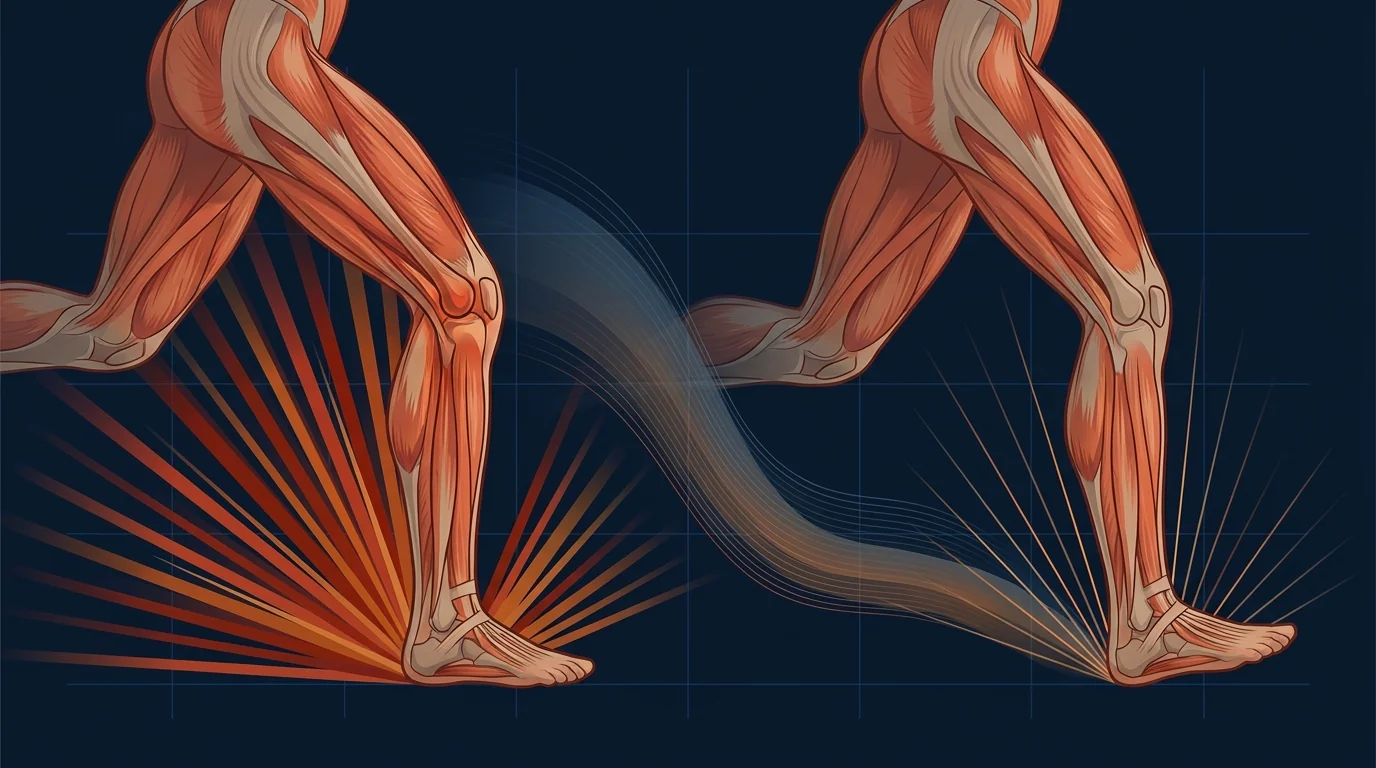
The catch is that cadence works through overstride. Most runners with a low preferred cadence overstride, meaning their foot lands well ahead of their center of mass with the knee extended. That posture drives most of the braking force and most of the peak knee load. Shortening the step by picking up the cadence pulls the foot landing back under the body, which reduces braking impulse and knee overshoot. That is the mechanism the whole cadence literature keeps pointing at.
The catch to the catch is that overstride is not the only injury driver. Weak hip abductors, poor calf strength, sudden mileage jumps, worn-out shoes, and load spikes all matter too. Cadence is one variable in a system. Bumping cadence by 8% will not fix a knee that hurts because the runner tripled weekly mileage last week or has never trained hip stability. This is why the joint-pain fitness guide and the strength-training injury-prevention research both emphasize a stack of interventions rather than any single fix.
The honest framing: cadence retraining is a well-supported, low-cost tool for one specific problem (knee-dominant load in runners who overstride). It is not the answer to running injury in general. It sits next to hip strength work, shoe rotation, gradual mileage progression, and structured recovery, not above them. If the target is a time rather than a pain-free knee, the levers that move the clock sit elsewhere: our guide to running a faster mile covers the interval, tempo and strength work that actually changes the number.
How to Apply This in Practice
If you want to try increasing your cadence, the protocol is straightforward:
- Measure your current cadence first. Run at your normal easy pace for at least a mile. Count the number of times one foot lands over 30 seconds and multiply by 4 to get steps per minute for both feet. Most GPS watches (Garmin, COROS, Apple Watch, Polar) report cadence automatically. Do not use race pace. Cadence naturally rises with speed, so a single number only makes sense relative to a specific effort.
- Set a target 5 to 10 percent above your current number. If you currently run at 158, aim for 166 to 174. If you currently run at 170, aim for 179 to 187. Do not force yourself to 180 if your current is 150. That is a 20% jump and Heiderscheit's data does not support it.
- Use a metronome or a music playlist at the target BPM. Metronome apps (free) let you set the exact BPM. Spotify and Apple Music both index songs by BPM. Running to an audible beat is the single most effective way to hold a new cadence.
- Retrain gradually over 4 to 6 weeks. Do not rip your cadence up on your longest run. Bramah's supervised protocol used graded exposure with feedback. A reasonable amateur version: do 5 minutes at the new cadence in the middle of easy runs for the first week, build to 15 minutes by week 3, and by week 6 the new cadence should feel like your default.
- Expect it to feel awkward for the first 2 to 3 weeks. Higher perceived exertion is normal during retraining and it fades. The metabolic-cost bump reported by Anderson et al. (2022) is short-term. van Oeveren's data suggests that once the new gait pattern habituates, most runners land closer to their economic optimum than they were before.
- Do not chase 180 for its own sake. Personalize the target to your current cadence, height, and pace. Tall runners with long legs often top out around 165 to 170 at easy pace. Short runners can comfortably sit at 180+. Neither is wrong.
For runners with active patellofemoral pain, the Bramah 2019 protocol is a reasonable model, but the case for supervision is stronger. A physical therapist or gait clinician can identify whether cadence is actually the right lever for your specific pain pattern before you commit 6 weeks to the change.
Get an evidence-based plan built for you
FitCraft, our mobile fitness app, pairs you with an AI coach who builds you a personalized plan around your goals, schedule, and fitness level. Every FitCraft program is designed by Domenic Angelino, MPH (Brown University) and NSCA-CSCS, with research published in the Journal of Strength and Conditioning Research and Medicine & Science in Sports & Exercise.
Take the Free Assessment Free • 2 minutes • No credit cardCommon Misconceptions
Misconception: "180 SPM is the ideal cadence for every runner"
It is not. The 180 number came from Jack Daniels counting elite distance runners at the 1984 Olympics. Those athletes were tall, fast, and racing. The peer-reviewed literature since then has looked at recreational runners across heights, paces, and training histories, and the modal preferred cadence sits closer to 160 to 170 at easy pace. Tall runners with long legs run naturally lower. Short runners run naturally higher. Faster runners run higher regardless of height. There is no single ideal number. The evidence-backed rule is a relative one: aim 5 to 10 percent above your own preferred, not at a fixed target lifted from a different population.
Misconception: "Higher cadence means shorter, choppier steps and slower running"
Only if you keep the same pace. Cadence and stride length trade off against each other at any given speed. If you speed up, both cadence and stride length usually rise together. The Heiderscheit protocol held speed constant and manipulated cadence, so the increase in cadence necessarily meant a decrease in stride length. In real training, if you bump cadence and keep effort constant, pace usually stays the same because stride length adjusts. If you bump cadence and hold stride length, pace goes up. Cadence retraining is not a slowdown.
Misconception: "Cadence retraining will fix any running injury"
No. The strongest evidence is for patellofemoral pain specifically, where overstride and high knee loading are the mechanism of injury. Cadence changes have less support for Achilles tendinopathy, plantar fasciitis, hip flexor issues, or IT band pain, all of which have different mechanical drivers. And Anderson et al. (2022) explicitly noted that for general injury prevention in pain-free runners, the evidence is not yet strong enough for confident conclusions. Cadence is a tool for a specific problem, not a fix-all.
What the Research Suggests Going Forward
Three things are reasonably settled. Higher step rate reduces peak vertical ground reaction force, joint loading at the hip and knee, and vertical bounce (Heiderscheit 2011, Schubert 2014, Anderson 2022). Increasing step rate by 10% in runners with patellofemoral pain produces clinically meaningful pain reductions sustained over months (Bramah 2019). And most inexperienced runners self-select cadences slightly below their economic optimum, so a 5 to 10 percent bump usually moves them closer to it, not further away (van Oeveren 2017).
What is less settled is whether cadence retraining meaningfully reduces injury risk in healthy, pain-free runners over the long term. The trial data does not yet exist. It is a plausible protective mechanism, but plausibility is not the same as demonstrated benefit. If you have no pain and no injury history, changing your cadence for prophylactic reasons is a reasonable idea backed by mechanism but not by long-term trial data.
What is also less settled is the durability of the cadence change itself. Metronome-cued retraining works over 4 to 6 weeks. Whether the new cadence sticks 6 or 12 months out, without ongoing feedback, has not been well studied. In clinical practice, some runners hold the new pattern and some drift back. The runners who hold it tend to also change something upstream (hip strength work, shoe rotation, cueing during long runs) rather than relying on cadence alone.
For most readers, the takeaway is small and boring in the good way. Measure your cadence. If it is under 165 at easy pace and you carry knee pain or a knee-injury history, bump it 5 to 10 percent over a month with a metronome. Watch what happens. If you have no pain and your body feels good, running at your natural cadence is fine.
Honest Limitations
The strongest cadence data comes from single-session treadmill studies. Heiderscheit 2011, Schubert 2014, and much of the biomechanics literature measured what happens over 5 minutes at a new cadence, not what happens over a training year. The one study that tracked outcomes at 3 months (Bramah 2019) is a case series of 12 runners with no control group. The evidence base is directionally consistent and mechanistically clean, but the number of properly randomized, long-duration cadence trials is small.
The population is also narrow. Most cadence research has been done on healthy young recreational runners between 20 and 40 years old. Data on older runners, novice runners, and runners with complex injury histories is thin. The van Oeveren 2017 finding that inexperienced runners under-cadence relative to optimum is suggestive but based on a small mixed-sex sample.
Finally, cadence interacts with other variables. Shoe drop, surface (treadmill vs road vs trail), fatigue late in a long run, hydration, and pace all shift preferred cadence within an individual. A single measurement at one pace on one day is a snapshot, not a diagnosis. Runners tracking cadence seriously should measure it across several runs at their normal easy pace before setting a retraining target.
For related running-mechanics content on this site, the first-time running tips guide covers stride and posture for beginners, the run-walk method covers Jeff Galloway's structured pacing approach, and is running every day bad unpacks the recovery side that cadence work sits inside.
References
- Heiderscheit BC, Chumanov ES, Michalski MP, Wille CM, Ryan MB. "Effects of step rate manipulation on joint mechanics during running." Medicine & Science in Sports & Exercise 43.2 (2011): 296-302. doi:10.1249/MSS.0b013e3181ebedf4
- Schubert AG, Kempf J, Heiderscheit BC. "Influence of stride frequency and length on running mechanics: a systematic review." Sports Health 6.3 (2014): 210-217. doi:10.1177/1941738113508544
- Anderson LM, Martin JF, Barton CJ, Bonanno DR. "What is the Effect of Changing Running Step Rate on Injury, Performance and Biomechanics? A Systematic Review and Meta-analysis." Sports Medicine - Open 8 (2022): 112. doi:10.1186/s40798-022-00504-0
- Bramah C, Preece SJ, Gill N, Herrington L. "A 10% Increase in Step Rate Improves Running Kinematics and Clinical Outcomes in Runners With Patellofemoral Pain at 4 Weeks and 3 Months." American Journal of Sports Medicine 47.14 (2019): 3406-3413. doi:10.1177/0363546519879693
- van Oeveren BT, de Ruiter CJ, Beek PJ, van Dieën JH. "Optimal stride frequencies in running at different speeds." PLoS ONE 12.10 (2017): e0184273. doi:10.1371/journal.pone.0184273
Frequently Asked Questions
Is 180 steps per minute really the ideal running cadence?
No, 180 SPM is not a universal target. The number came from coach Jack Daniels' observation that elite distance runners at the 1984 Olympics ran at 180 or higher, but that was a description of a small, fast, elite sample, not a prescription for everyone. Peer-reviewed data since then puts most recreational runners in a 150 to 175 range depending on height, leg length, and pace. What the research does support is that increasing your own preferred cadence by roughly 5 to 10 percent lowers joint loading and can reduce running injury risk in specific populations. That is a personalized target, not a fixed number.
Does increasing running cadence reduce injury risk?
The evidence is strongest for one specific injury: patellofemoral pain (runner's knee). Bramah et al. (2019) had 12 runners with patellofemoral pain increase step rate by 10 percent through gait retraining and found clinically meaningful pain reductions at 4 weeks and 3 months, with large effect sizes for both average and worst pain. Anderson et al. (2022) pooled 37 studies and reported that increasing step rate improved pain and function for recreational runners with patellofemoral pain. For general injury prevention in pain-free runners, the evidence is weaker but the direction is consistent.
How much should I increase my running cadence?
5 to 10 percent above your current preferred cadence is the range with the best evidence. Heiderscheit et al. (2011) showed a 5 percent increase reduced knee energy absorption by about 20 percent, and a 10 percent increase reduced it by about 34 percent. Going higher than 10 percent produced diminishing returns and higher perceived exertion. Measure your current cadence over a mile at easy pace, then aim for a step rate 5 to 10 percent higher. A metronome app or a music playlist at the target beats-per-minute helps you hold it.
Does higher cadence make running less economical?
Slightly, in the short term. Anderson et al. (2022) reported that increasing step rate is associated with higher perceived exertion, awkwardness, and metabolic energy consumption. van Oeveren et al. (2017) found that inexperienced runners self-select stride frequencies 2 to 6 percent below their calculated economic optimum. So a 5 to 10 percent bump above preferred cadence may feel harder at first but often lands within your true optimum. The awkwardness fades over 4 to 6 weeks as the new gait pattern habituates.
How do I measure my running cadence?
Count the number of times one foot hits the ground over 30 seconds, then multiply by 4. That gives you steps per minute for both feet combined. Most GPS watches (Garmin, COROS, Apple Watch, Polar) report cadence automatically during a run. Do it at your normal easy-run pace, not at race pace. Cadence naturally rises with speed, so a single number only makes sense relative to a specific effort.
Does FitCraft have a running program?
FitCraft programs cover yoga, mobility, strength (dumbbells, resistance bands, bodyweight), and cardio. The free FitCraft assessment builds a personalized program around your goals, schedule, and fitness level, and an AI coach demonstrates every exercise through interactive 3D models. If running is a goal, the strength and mobility programming pairs well with an outdoor run schedule. For a full running plan, see our run-walk method and first-time running tips for structured progressions.