
Maybe you caught your reflection in a shop window mid-run, or a friend filmed you at a race and you winced at the replay. Your feet looked heavy, your arms flailed, and you looked nothing like the runners in the ads.
So you searched for fixes and found twenty of them. Land on your forefoot. Lean forward. Hit 180 steps a minute. Keep your elbows at 90 degrees. Trying all of them at once turns every run into a test you're failing, and it's no surprise that most people give up on form work within a week.
You don't need a new stride. Most runners need two or three changes, made one at a time, and the evidence says which ones matter. A lot of the rest improves on its own with consistent running. When Moore, Jones and Dixon (2012) followed 10 beginner women through a 10-week running program in Medicine & Science in Sports & Exercise, their running economy improved by about 8 percent as their gait changed on its own.
The 7 Fixes at a Glance, Ranked by Evidence
| Rank | Fix | What to do | How strong the evidence is |
|---|---|---|---|
| 1 | Stop overstriding | Let your foot land closer to under your knee | Strong: lab studies and race-performance data |
| 2 | Raise a low cadence | Take steps 5 to 10 percent quicker at the same pace | Strong for knee and hip loading |
| 3 | Land softly | Make your footsteps quieter | One large randomized trial in novices |
| 4 | Run tall | Lean slightly from the ankles, never the waist | Mixed: helps knee load, too much may cost speed |
| 5 | Swing your arms | Relaxed, forward and back | Lab data on energy cost |
| 6 | Practice with drills and strides | Short focused blocks, then stop thinking about it | Coaching practice, little direct trial evidence |
| 7 | Build strength | Hips, calves and trunk, twice a week | Strong for injury risk, weak for changing your stride alone |
One popular fix is missing from the list on purpose: changing your foot strike. The section on it below explains why.
Good Running Form vs Bad: What Actually Matters
The best evidence on which parts of technique matter comes from Folland and colleagues (2017), in Medicine & Science in Sports & Exercise. They filmed 97 endurance runners, 47 of them women, in 3D on a treadmill and measured how much energy each one used. Three features explained 39 percent of the differences in energy cost: less up-and-down bounce of the pelvis while the foot is on the ground, a less deeply bent knee during contact, and less braking at each landing.
Four features explained 31 percent of the differences in race times: less braking, a more vertical shin at touchdown, a shorter share of each stride spent on the ground, and a more upright trunk. These are correlations, not proof that changing one feature will speed you up. Still, they point at the same short list. Bad running form is mostly braking and bouncing. The rest is personal style.
| Body part | Usually fine | Worth fixing |
|---|---|---|
| Foot landing | Close to under the knee, whatever part touches first | Well ahead of the knee on a straight leg |
| Bounce | A small rise and fall | A big up-and-down with each step |
| Sound | Quiet footsteps | Loud slapping or thudding |
| Trunk | Tall, with a slight lean from the ankles | Bent at the waist or leaning back |
| Shoulders and arms | Low, loose, swinging forward and back | Hunched toward the ears or held still |
| Head | Level, eyes on the path ahead | Chin up or eyes on your feet |
How Do I Know If I Have Poor Running Form?
Film yourself. Prop your phone at hip height beside a flat path or a treadmill, run past it at your normal easy pace for 20 seconds, then repeat with the camera behind you. Play it back in slow motion and pause at the moment each foot touches down.
- From the side: Is your foot landing well in front of your knee? Is your shin angled forward or close to vertical? Do your head and hips bounce a lot?
- From behind: Does one hip drop sharply when the opposite foot lands? Do your arms swing across your body?
- Without a camera: Listen to your footsteps. Loud, heavy landings usually mean you're braking. Pain that keeps returning in the same knee, shin or foot is another sign worth taking to a physical therapist.
Pick the single biggest problem you see and work on that one for a few weeks. For most runners it's the first one on the list.
1. Stop Overstriding
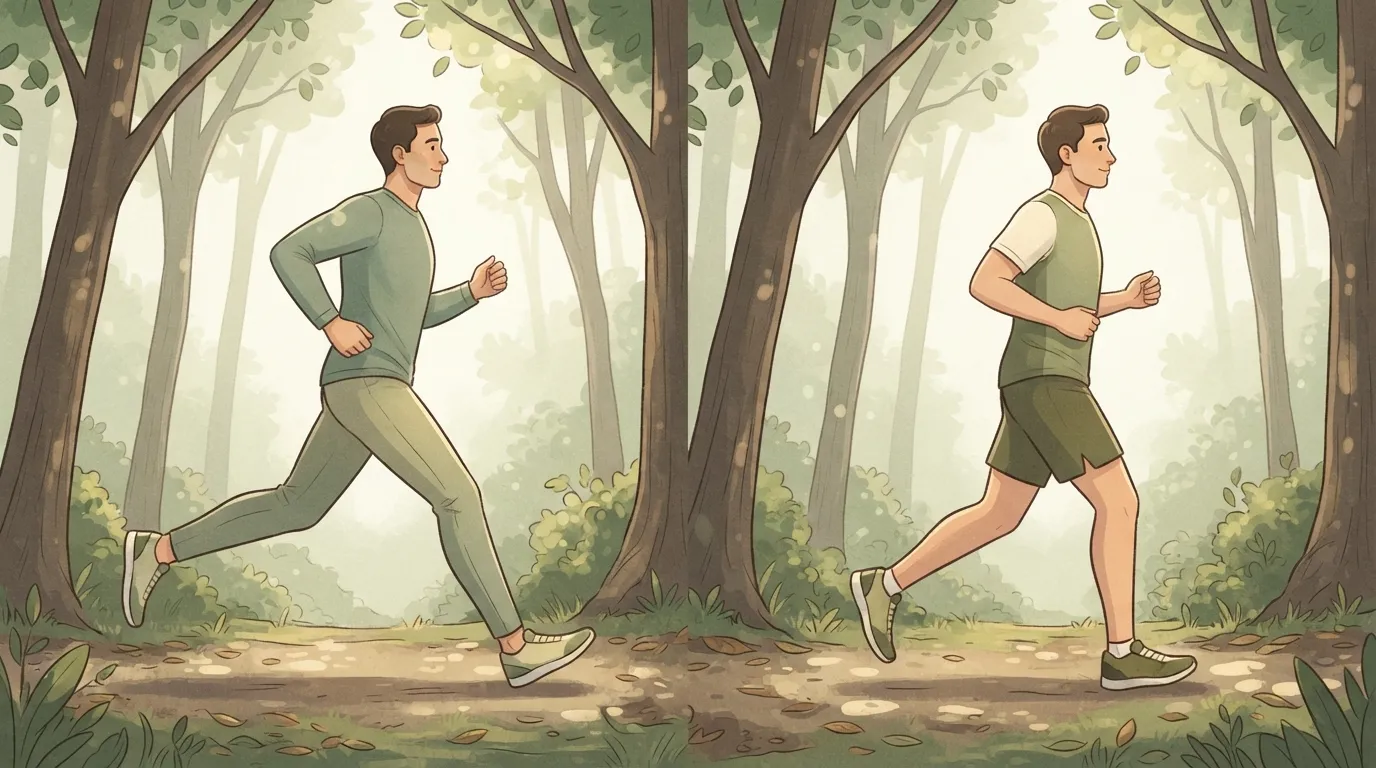
Overstriding means your foot lands well in front of your body, usually on a straight leg. Each landing then acts like a brake you have to push through on the next step.
Lieberman and colleagues (2015), in the Journal of Experimental Biology, measured 14 runners at a range of step rates. The farther in front of the hip the foot landed, the bigger the braking force. The farther in front of the knee it landed, the bigger the impact peak. The authors recommended landing "with a relatively vertical tibia," which means your shin should be close to upright when your foot touches down.
Don't try to fix it by reaching your foot back or shuffling. Two cues work better:
- "Put your foot down under you." Think about where the foot lands, not how long the step is.
- Take quicker steps. A slightly faster step rate shortens the reach in front of you without any other change, which is why fix number 2 usually solves fix number 1.
2. Nudge a Low Cadence Up 5 to 10 Percent
Cadence is how many steps you take per minute. Raising it a little at the same pace is the most practical way to stop overstriding, because quicker steps leave less time to reach forward. The trials behind the 5 to 10 percent range, the step-count test and a metronome plan for changing it are in our review of the running cadence research, so they aren't repeated here. Two points matter for this list: change it only if yours is on the low side, and add 5 percent at a time rather than chasing a fixed number.
3. Land Softly
Soft landings are the one form change with a large injury trial behind them. Chan and colleagues (2018), in the American Journal of Sports Medicine, randomized 320 novice runners. One group of 166 got 2 weeks of treadmill retraining with real-time visual feedback on their impact loading, while 154 controls ran for the same time without feedback. The retrained group lowered their impact loading. Over the next 12 months, 16 percent of them got injured, compared with 38 percent of the control group, a 62 percent lower risk.
You probably don't have a treadmill that measures impact. The closest cue you can use anywhere is sound: run so your footsteps are quieter. That cue is a practical stand-in, not the exact method the trial tested, so build it in gradually with a few 3-minute quiet-feet blocks during easy runs.
4. Run Tall, With a Slight Lean From the Ankles
Posture advice pulls in two directions, and the research explains why. Teng and Powers (2014), in the Journal of Orthopaedic & Sports Physical Therapy, had 24 recreational runners run with their usual posture, a more upright trunk and a more forward-leaning one. Their usual lean averaged about 7 degrees, and leaning to about 14 degrees reduced stress on the joint behind the kneecap. Runners who naturally leaned more had lower knee stress.
But in the Folland data, a more upright trunk went with faster race times. So the useful version is simple. Run tall, as if a string pulls the top of your head up. If you want a lean, let it come from your ankles as one straight line, never from bending at the waist. If the front of your knee hurts on runs, a little more lean is worth trying with a physical therapist's input.
- Head: level, with your eyes on the path several strides ahead.
- Shoulders: low and loose. Shake them out every mile or so.
- Hips: stay tall over your feet instead of sinking back as you land.
Relaxed shoulders and a tall trunk also leave your ribs free to move. Our guide on how to breathe while running covers the breathing side.
Find out what's really holding you back
FitCraft, our mobile fitness app, pairs you with an AI coach who builds you a personalized plan around your goals, schedule, and fitness level. Every FitCraft program is designed by Domenic Angelino, MPH (Brown University) and NSCA-CSCS, with research published in the Journal of Strength and Conditioning Research and Medicine & Science in Sports & Exercise.
Take the Free Assessment Free • 2 minutes • No credit card5. Let Your Arms Swing
Your arms balance the twisting of your legs. Arellano and Kram (2014), in the Journal of Experimental Biology, had runners run normally and then with their arms held still in three positions. Compared with a normal swing, running cost about 3 percent more energy with the hands held behind the back, 9 percent more with the arms folded across the chest and 13 percent more with the hands on the head. Without an arm swing, the shoulders and pelvis rotated more to counter the legs.
So don't hold your arms still or pump them hard. Bend your elbows to roughly a right angle, keep your hands loose, and let the swing come from your shoulders, forward and back. A little crossing in front of your body is normal. Big sideways swings usually mean your shoulders are tense.
Should You Change Your Foot Strike?
Probably not, and that's the most useful thing on this page if you've been forcing yourself onto your toes. Heel striking is how most people run. Larson and colleagues (2011), in the Journal of Sports Sciences, filmed 936 runners at the 10 km point of a road race. They found 88.9 percent landed heel first, 3.4 percent midfoot and 1.8 percent forefoot. At the 32 km point of the marathon, even more runners had switched to a heel strike, and foot strike pattern wasn't related to finishing times.
Switching doesn't seem to pay either. Anderson and colleagues (2020) pooled 53 studies in Sports Medicine. They found no study that followed runners forward in time to compare injuries by strike pattern. Habitual heel strikers and habitual midfoot or forefoot strikers were equally economical, and imposing a forefoot strike on heel strikers made them less economical in the short term. A forefoot landing did lower impact loading rates and stress behind the kneecap, but it raised the load on the ankle and calf. The authors concluded that changing strike pattern "cannot be recommended" for an uninjured heel striker.
The fix that matters is where your foot lands, not which part lands first. A heel strike close to under your knee is fine. If a clinician suggests a forefoot strike for a specific knee problem, make the switch over weeks, not days, because your calves and Achilles tendons need time to adapt to the extra load.
6. Running Form Drills That Transfer
Drills are coaching tradition more than tested science, so keep them short and close to real running. Do them after a 10-minute easy warm-up, twice a week:
- A-march, then A-skip: 2 sets of 20 meters each. Lift one knee to hip height and drive the foot down under your hip, so you rehearse a landing under your body.
- High knees: 2 sets of 15 seconds with quick, light contacts.
- Runner's stance hold: stand on one leg with the other knee lifted in front and your arms in running position. Hold 30 seconds per side, staying tall without letting the standing hip drop.
- Strides: 4 to 6 relaxed accelerations of about 20 seconds, building to a fast but smooth pace, with a full walk back. Strides are where drills turn into running.
Then stop thinking about your form. Schücker and colleagues (2009), in the Journal of Sports Sciences, found trained runners used more oxygen when they focused on their running movement or their breathing than when they focused on their surroundings. Practice a cue in short blocks of a few minutes, then let your attention go back to the road. That's how a cue becomes automatic.
7. Strength Work That Supports Your Running Form
Strength training won't rewrite your stride by itself. Willy and Davis (2011), in the Journal of Orthopaedic & Sports Physical Therapy, gave 20 female runners whose hips collapsed inward when running a 6-week hip strengthening program, including single-leg squat practice. Their hip strength rose and their single-leg squats improved, but their running mechanics didn't change. Strength builds capacity, and only running practice turns it into a new running pattern.
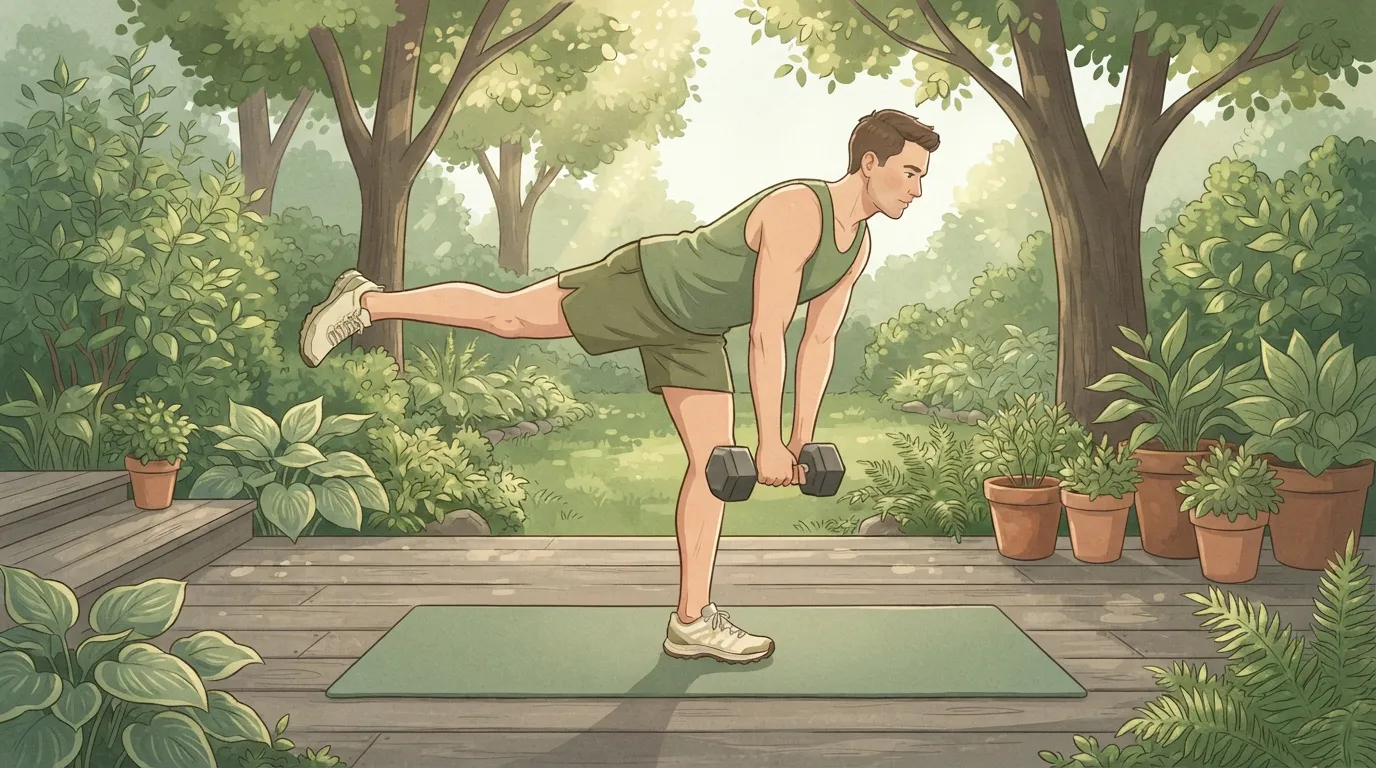
Strength still earns its place. Across 25 trials and 26,610 people in many sports, Lauersen and colleagues (2014), in the British Journal of Sports Medicine, found strength training programs cut sports injuries to about a third. Strong hips, calves and trunk also make good form easier to hold late in a run. These running posture exercises use dumbbells and bodyweight, twice a week on non-consecutive days:
| Exercise | Sets and reps | What it supports |
|---|---|---|
| Single-leg deadlift with a dumbbell | 3 x 8 per side | Hip control on one leg, hamstrings and glutes |
| Split squats holding dumbbells | 3 x 8 to 10 per side | Quads and glutes through a running-like stance |
| Calf raises, slow on the way down | 3 x 12 to 15, then single-leg | Calves and Achilles, the main push-off muscles |
| Glute bridges | 3 x 12, then single-leg | Hip extension for a tall stance |
| Side planks | 3 x 20 to 30 seconds per side | Keeping the pelvis level when one foot lands |
Add load when the last two reps of every set feel easy. FitCraft's strength workouts are built on dumbbells and bodyweight, an AI coach demonstrates each exercise on an interactive 3D model you can pinch and zoom, and the workouts adjust as you progress. If you'd like these sessions planned for you, a dumbbell workout app keeps them on the calendar, and streaks reward the weeks you don't skip.
A 4-Week Plan to Improve Your Running Form
| Week | Running | Strength |
|---|---|---|
| 1 | Film yourself and pick one fix. On 2 easy runs, practice it in 3 blocks of 3 minutes. | 2 sessions from the table |
| 2 | Same fix in 3 blocks of 5 minutes. Add drills before one run. | 2 sessions |
| 3 | Drills and 4 strides before two runs. Use the cue only when you notice yourself slipping. | 2 sessions, a little heavier |
| 4 | Film yourself again and compare. Keep the fix if it stuck, or move on to the next one. | 2 sessions |
Keep the rest of your running easy and unchanged. One cue at a time is the whole method.
Running Form in a Marathon: What Changes When You're Tired
Form fades as you tire. In the Larson race data, more runners had switched to heel striking by 32 km than at 10 km. Late in a long race, steps get heavier, the trunk folds and the arms tighten. That's normal, and it's the stretch where your strength work and a few seconds of "run tall, quiet feet" pay off.
Pacing matters as much as drills here. A first half run too fast leaves you running the last miles on tired legs with your worst form. Our guide to negative split running shows how to pace a race so you still have your form, and your speed, in the second half.
The Bottom Line
To improve running form, stop overstriding first, using quicker steps and a landing under your knee. Then land softly, run tall and let your arms swing. Leave your foot strike alone unless a clinician gives you a reason to change it. Build strength twice a week, and practice one cue at a time in short blocks.
Your stride doesn't need to look like an elite runner's. It needs to waste less energy and keep you running week after week, and small, steady changes get you there.
Frequently Asked Questions
Is heel striking bad for you?
Heel striking isn't bad by itself. About 89 percent of recreational runners land heel first, and a 53-study review found no prospective evidence that switching to a forefoot strike prevents injury, no gain in running economy, and more load on the ankle and calf. The problem is overstriding, where the heel lands far in front of the knee. A heel strike close to under your body is fine.
Do running posture correctors work?
There's no good evidence that wearing a posture corrector improves running form. Running posture comes from the muscles that hold your trunk and pelvis steady with every step, so side planks, single-leg work and a simple run-tall cue do more than a brace. If your posture collapses late in runs, that usually points to fatigue or pacing rather than a strap you're missing.
Are fast runners born or made?
Both. Genes influence how high your aerobic ceiling can go and how strongly you respond to training, but almost everyone gets much faster with consistent running, and form improves with practice too. In one study, beginner runners became about 8 percent more economical in 10 weeks as their gait changed on its own. Talent sets the top end, and training decides how close you get.
How long does it take to improve running form?
A single change, such as a slightly quicker step or a softer landing, usually takes 2 to 6 weeks of short, regular practice before it feels automatic. A 2-week retraining program was enough to change landing mechanics in one trial, and most cadence retraining protocols run 4 to 6 weeks. Broader improvements in economy build over months of consistent running.
What is the best running form for beginners?
For beginners, the best running form is relaxed and simple: run tall, take quick light steps that land close to under your body, keep your shoulders loose and let your arms swing forward and back. Run easy enough to talk. Don't copy elite runners or force a forefoot strike, because a lot of your form will improve on its own as you run consistently.