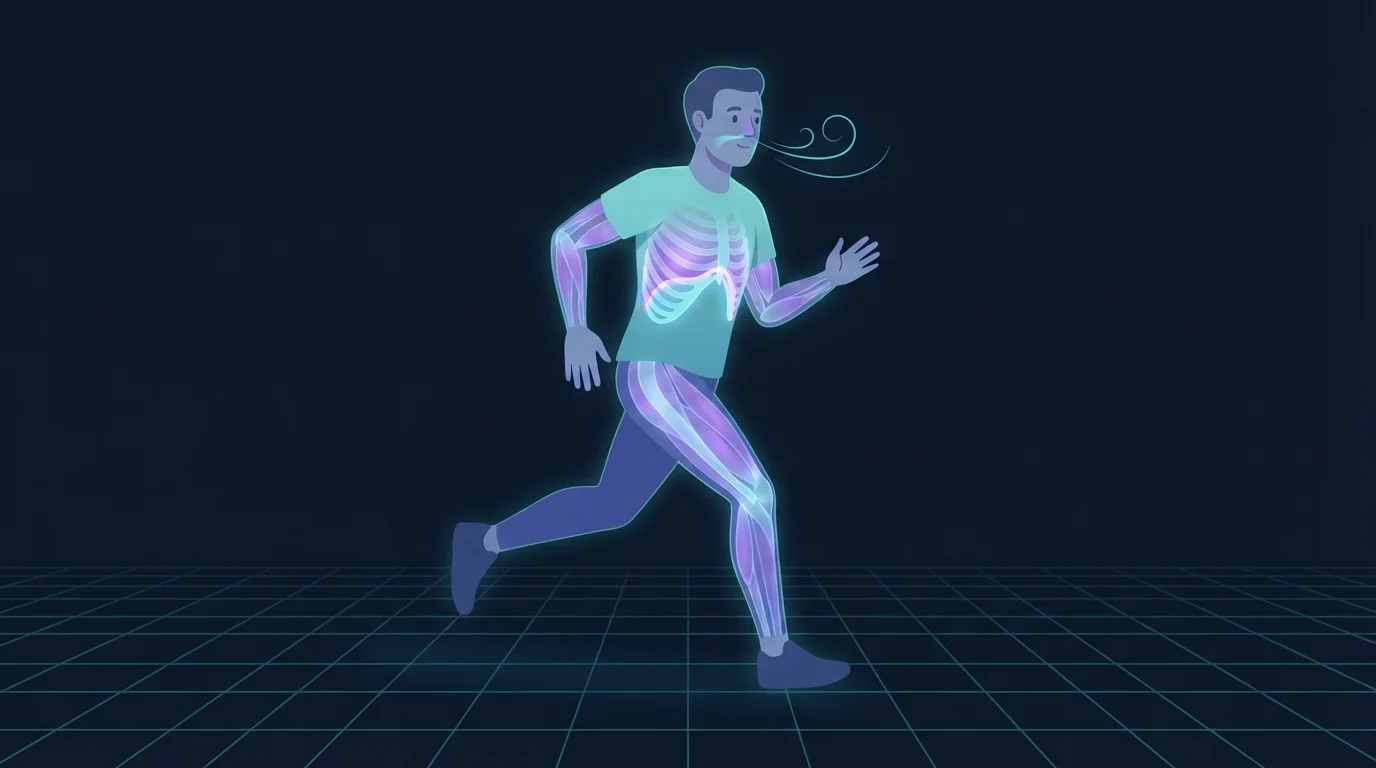
You get about four hundred metres in and your breathing falls apart. It turns fast and shallow, you can hear yourself, and somewhere in the back of your head a voice starts asking whether you're built for this. Then a stitch arrives under the ribs and settles the argument.
That experience is close to universal among new runners, and it gets blamed on the wrong thing constantly. People go looking for a breathing technique because breathing is the part they can feel. It's loud, it's frightening, and it feels like the thing that's failing.
Usually it isn't. Breathlessness is a symptom of running faster than your aerobic system can currently support, and no pattern of inhales fixes a pace problem. That said, a small number of breathing habits do change how a run feels, and a couple of the most repeated rules online have nothing behind them. Sorting the two is what this guide is for.
Why Your Breathing Feels Like the Limiter
The urge to breathe isn't driven by a shortage of oxygen. It's driven mostly by carbon dioxide. As you work harder your muscles produce more of it, the blood turns more acidic, and receptors in your brainstem and arteries push ventilation up hard to clear it. That signal arrives long before any oxygen problem does, which is why you can feel desperate for air while your blood oxygen saturation sits at a perfectly ordinary number.
So the panic is real and the alarm is honest. It's just reporting on pace, not on your lungs. In healthy adults without respiratory disease, the lungs are rarely the limiting factor in running. The heart's ability to deliver blood and the muscles' ability to use oxygen give out first, which is the whole subject of our guide on how to increase stamina.
What breathing technique can do is lower the cost of moving that air. Ventilation uses muscle and burns energy, and a shallow, high-rate pattern wastes a bigger share of every breath on dead space in the airways that never reaches the alveoli. Deeper and slower moves more usable air for the same effort. That's the entire mechanism. It's smaller than the internet suggests, and it's also real.
Nose or Mouth: What the Evidence Actually Says
This is the question everyone asks first, and the honest answer is that both work, with a mild edge to the nose at intensities where the nose can keep up.
What the nasal breathing trials show
The most directly relevant study is a crossover trial by Dallam and colleagues (2018) in the International Journal of Kinesiology and Sports Science. Ten recreational runners who had already spent an extended period training with nasal-only breathing completed a maximal graded exercise test and a steady-state trial at 85 percent of their maximum running velocity, once breathing nasally and once orally. VO2 max, time to exhaustion and peak lactate came out the same in both conditions. During the hard steady-state trial, though, nasal breathing produced significantly better running economy and lower ventilatory equivalents for both oxygen and carbon dioxide. In plain terms, those runners moved less air to do the same work.
Two caveats keep that finding honest. The sample was ten people who had already adapted to nasal breathing over months, so it doesn't tell you what happens if you clamp your mouth shut tomorrow. And the ceiling didn't move. If your goal is a faster 5K, nothing here says nose breathing will deliver it.
The broader case for the nose is mechanical rather than metabolic. It filters, warms and humidifies incoming air, which matters in cold or dusty conditions, and it produces nitric oxide in the sinuses, which mildly improves the match between blood flow and ventilation in the lungs. Our review of the nasal breathing research works through the full evidence base, including where the popular claims outrun the data.
The rule that actually works on a run
Let intensity decide. At an easy conversational pace, breathe in through your nose and out through your mouth. It paces the inhale, it forces you to run slower than your ego wants, and it's comfortable. Once the effort passes the point where the nose can supply enough air, open your mouth and stop thinking about it. Fighting for air through a straw at threshold pace isn't discipline. It's a handicap.
Nasal resistance makes up roughly half of your total airway resistance at rest, and it simply isn't built for the ventilation rates of hard running. Holding nasal-only breathing at a hard effort raises the work of breathing, which is the opposite of the point.
Find out what's really holding you back
FitCraft, our mobile fitness app, pairs you with an AI coach who builds you a personalized plan around your goals, schedule, and fitness level. Every FitCraft program is designed by Domenic Angelino, MPH (Brown University) and NSCA-CSCS, with research published in the Journal of Strength and Conditioning Research and Medicine & Science in Sports & Exercise.
Take the Free Assessment Free • 2 minutes • No credit card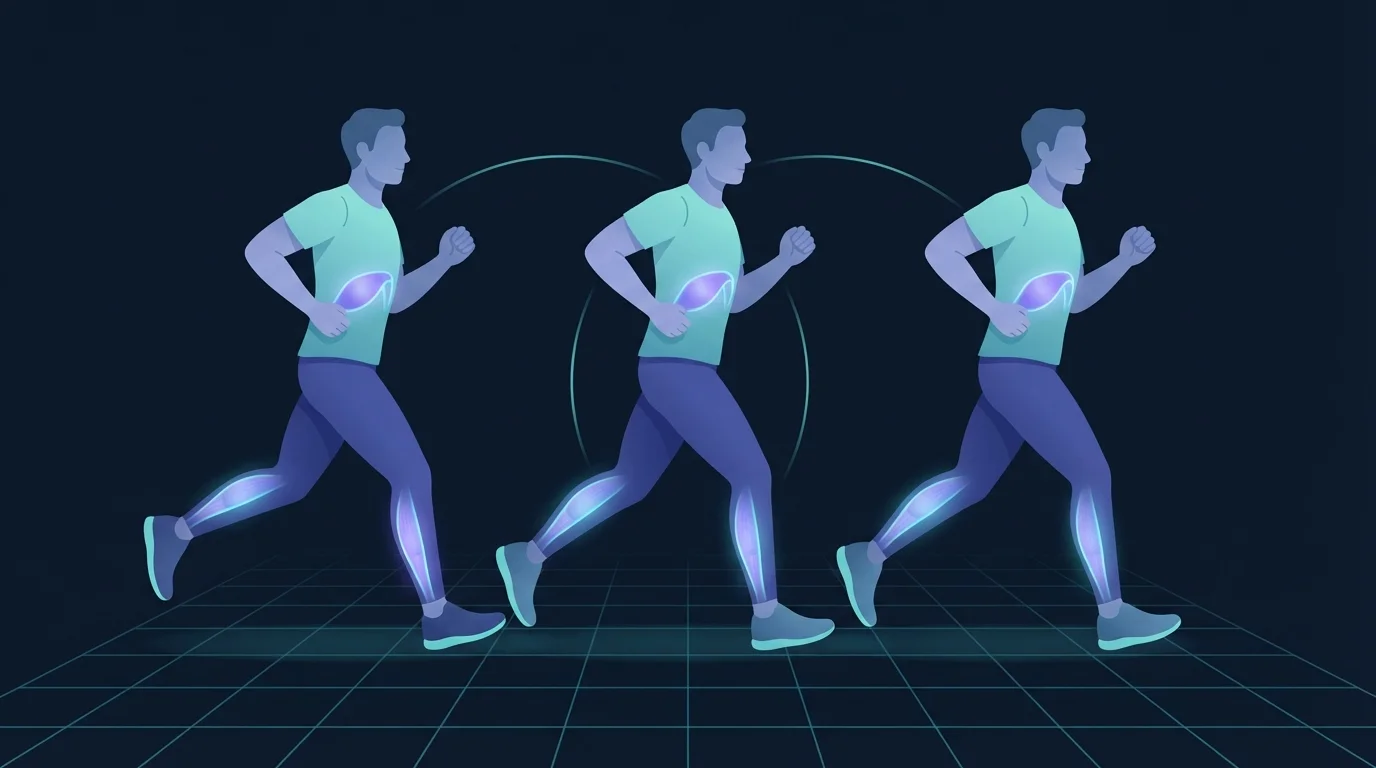
Rhythmic Breathing Patterns: 3:2, 2:2, and What the Research Supports
Rhythmic breathing means tying your breath to your footfalls on a fixed count. Inhale for three steps, exhale for two, and you have a 3:2 pattern. Inhale two, exhale two, and you have 2:2. Coaches teach these constantly, and they're genuinely useful. They're also wrapped in a claim that isn't supported.
What the coupling research shows
Humans synchronise breathing to stride without being told to. Bramble and Carrier (1983), writing in Science, documented phase locking between limb and respiratory frequency in running humans and recorded several stable patterns (4:1, 3:1, 2:1, 1:1, 5:2 and 3:2), with 2:1 clearly favoured. Quadrupeds lock at a rigid 1:1. Humans are unusual in having options, which is part of why we're good at endurance running.
The mechanism turns out to be partly mechanical. Daley, Bramble and Carrier (2013) measured 14 runners and found that the impact of each footstrike drives measurable airflow on its own, accounting for roughly 10 to 12 percent of total ventilation. Breaths that began during a mechanically helpful phase of the step cycle completed about twice as fast as breaths fighting against it. Runners drift toward patterns that keep stepping and breathing out of conflict, which is exactly what you'd expect if the coupling exists to spare the respiratory muscles.
What the research does not show
The popular version of rhythmic breathing goes further. It says an odd ratio like 3:2 is superior because it alternates which foot lands at the start of each exhale, and that this protects you from side stitches and one-sided injuries, on the theory that the diaphragm is relaxed and the core less stable at the moment of exhalation. It's a tidy story. No controlled trial has tested it, and neither the coupling literature nor the side-stitch literature supports it as stated.
Use the ratios, then. Just use them for the reason that holds up. Counting a 3:2 rhythm forces a slower breathing rate and a longer exhale, and it gives your mind something to hold onto instead of the panic. It's a pacing tool and a focus tool. Treat any injury-prevention promise attached to it as marketing.
How to Breathe at Different Intensities
Breathing is the most reliable intensity gauge you own, and it needs no device. The talk test works because comfortable speech becomes impossible right around the ventilatory threshold. Reviewing the evidence, Reed and Pipe (2014) concluded that in both healthy adults and patients with cardiovascular disease, comfortable speech is likely possible below the ventilatory or lactate threshold and not likely possible above it. That makes your own voice a decent proxy for a lab test.
| Effort | Speech test | Breathing pattern | Rhythm |
|---|---|---|---|
| Easy (most of your running) | Full sentences, comfortably | Nose in, mouth out | 3:3 or 3:2 |
| Steady | A sentence with one pause | Nose and mouth in, mouth out | 3:2 |
| Threshold | Short phrases only | Mouth dominant, deliberate exhale | 2:2 |
| Hard intervals | One or two words | Mouth wide open, no restriction | 2:1, or whatever happens |
Two things are worth noticing in that table. Most of your running should sit in the top row, in the zone 2 range where breathing stays quiet and conversational. And in the bottom row, the correct technique is basically to stop managing it. During hard intervals your job is to move air, rebuild the rhythm during the easy segment, and get on with the next rep.

Diaphragmatic Breathing Drills That Transfer to Running
Belly breathing isn't a trick. It's the default pattern your body uses at rest, and stress, sitting and shallow habits gradually hand the job over to the neck and upper chest. Getting it back makes each breath move more air for less muscular effort, which is worth having 40 minutes into a run. Our review of the diaphragmatic breathing research covers what it does and doesn't do beyond sport.
Three drills, in the order you should learn them.
- Two-hand lying drill (5 minutes, daily). Lie on your back, knees bent, one hand flat on your chest and one on your belly. Breathe in through your nose for four seconds and let the lower hand rise first. Breathe out through pursed lips for six seconds. The top hand should barely move. If it leads, you've found your problem.
- Seated 4-6 breathing (3 minutes, before a run). Same count, sitting upright, hands off. The longer exhale is the active ingredient. It empties the lungs properly, which is what leaves room for the next breath. Incomplete exhaling is why people feel like they can't get air in.
- Standing brace-and-breathe (30 seconds at a time, during easy runs). While running easy, gently draw the lower abdomen in to about 20 percent of maximum and keep breathing into the belly around that tension. Hold 30 seconds, release, repeat four times. This is the bridge from the floor to the road, and it doubles as side-stitch insurance.
If you want more than drills, the version with real trial evidence is inspiratory muscle training, which loads the breathing muscles directly using a handheld resistance device. A meta-analysis of 21 studies by HajGhanbari and colleagues (2013) in the Journal of Strength and Conditioning Research found consistent improvements in inspiratory strength, inspiratory endurance and maximal voluntary ventilation, with performance benefits in some athlete groups. Our page on inspiratory muscle training has the dosing and the caveats.
You can rehearse all of this without leaving the house. A low-stakes indoor session like running in place lets you practise a rhythm with no traffic, hills or pace pressure in the way.
Side Stitches: Why They Happen and How to Stop One
The side stitch has a formal name, exercise-related transient abdominal pain, and a surprising amount of research behind it. Surveying 965 athletes across six sports, Morton and Callister (2000) found 69 percent of runners had experienced it in the previous year. Swimming was worse at 75 percent, cycling far better at 32 percent. That pattern points at repetitive torso movement rather than at breathing technique.
Their later review in Sports Medicine (Morton and Callister, 2015) narrowed the likely mechanism to irritation of the parietal peritoneum, the membrane lining the abdominal cavity, rather than the old diaphragm-cramp story. The strongest and most repeatable trigger in the literature is drinking a large volume of fluid shortly before exercise, especially a concentrated carbohydrate drink. Younger athletes get stitches more often than older ones, and the link to fitness level is weak.
There's also a role for the deep abdominal wall. Mole, Bird and Fell (2014) reported that participants with stronger trunk muscles and a larger resting transversus abdominis experienced less exercise-related abdominal pain, and that training the muscle with ultrasound biofeedback carried over into upright loaded tasks. That's the evidence behind the brace-and-breathe drill above.
What to do when one arrives, in order:
- Slow to a walk. Running through it usually extends it.
- Press two or three fingers firmly into the painful spot and hold.
- Exhale hard through pursed lips, longer than feels natural, three or four times.
- Raise the arm on the painful side overhead and lean gently away to lengthen that flank.
- Restart easy once the pain drops below about a 2 out of 10.
To stop them recurring: leave two to three hours between a full meal and a run, keep pre-run fluid to small sips rather than a large volume, dilute sugary sports drinks, and spend a few weeks building the deep core. Posture helps too. A slumped upper back restricts the lower ribs and makes a proper diaphragm breath harder to take.
A Two-Week Breathing Practice Plan
Breathing habits change the way any motor skill changes: short daily reps, low stress, then gradual exposure to real conditions. Two weeks is enough to make the pattern automatic at easy paces.
| Days | Session | Breathing focus |
|---|---|---|
| 1-2 | No running. Five minutes of the two-hand lying drill, twice a day. | Lower hand leads. In for 4, out for 6. |
| 3-4 | 20 to 25 minutes easy, walk breaks allowed. | Nose in, mouth out, the whole way. Slow down whenever the nose can't keep up. |
| 5-7 | 25 to 30 minutes easy, plus 3 minutes of seated 4-6 breathing first. | Count a 3:2 rhythm for the middle 10 minutes, then let it go. |
| 8-10 | 30 minutes easy with the last 5 minutes at a steady effort. | Shift from 3:2 to 2:2 as effort rises, then shift back down during the cool-down. |
| 11-12 | 25 minutes easy with 4 rounds of standing brace-and-breathe. | Belly stays engaged at about 20 percent while the breath keeps moving. |
| 13-14 | 30 to 35 minutes easy with 4 x 1 minute hard, 2 minutes easy between. | Let breathing go wherever it wants during the hard minute. Rebuild the rhythm within 30 seconds after. |
Run everything except the hard minutes at an effort where you could speak a full sentence. If the plan feels too easy, that's the plan working. Pace is the lever you're deliberately not pulling for two weeks. Holding yourself to an easy effort is harder than it sounds, which is why our roundup of the best fitness apps for beginners weighs how each one handles easy-effort progression.
What Most Runners Get Wrong
Treating technique as a substitute for fitness. If you're gasping in the first five minutes, you're running too fast for your current aerobic base. No ratio fixes that, and chasing one wastes the months that would have fixed it. Slow down and add time.
Inhaling more instead of exhaling more. Air hunger makes people gulp bigger inhales on top of lungs that never emptied, which makes it worse. Lengthen the exhale first and the inhale takes care of itself.
Holding nasal-only breathing past its usefulness. Nasal breathing is comfortable and efficient at easy paces and becomes a restriction at hard ones. There's no prize for finishing an interval session with your mouth closed.
Breathing with the shoulders. Watch a tired runner and you'll see the shoulders climbing toward the ears. That's the accessory muscles taking over from the diaphragm, and it's expensive. Drop the shoulders, run tall, and let the lower ribs expand sideways.
Ignoring cadence. Breath rhythm sits on top of stride rhythm, so a very slow, over-striding cadence makes a comfortable pattern hard to find. Our review of the running cadence research covers what steps per minute actually change and what they don't.
The Bottom Line
Breathe through your nose when it's easy and through your mouth when it isn't, and spend your attention on the exhale rather than the inhale. Pick a rhythm if counting helps you hold an honest easy pace, and drop it the moment it becomes one more thing to worry about. Do five minutes of belly breathing on the floor most days for a couple of weeks and it starts showing up on the road by itself.
The thing nobody tells beginners is that breathing gets easier mostly as a side effect. Six to eight weeks of consistent easy running will do more for how your breathing feels than any technique in this article, because the same pace will simply demand less air. You're not short of lung capacity and you weren't built wrong. You just haven't asked your aerobic system for much lately. If the part that quits first is your head rather than your legs, our guide on running longer mentally is the next one to read.
Frequently Asked Questions
Should you breathe through your nose or your mouth while running?
Use whatever moves enough air. At easy paces nose breathing is comfortable and slightly more economical; above roughly a conversational effort the nose becomes a bottleneck and the mouth has to open. A 2018 crossover trial in ten recreational runners found no difference in VO2 max or time to exhaustion between nasal-only and oral breathing, but better running economy and lower ventilation per litre of oxygen during nasal breathing at 85 percent of maximum speed. Nothing in that data says an open mouth is a mistake.
What is the best breathing pattern for running?
A 3:2 pattern, inhaling over three footfalls and exhaling over two, is a useful teaching tool for easy running, and 2:2 or 2:1 suits harder efforts. Runners naturally lock breath to stride anyway, usually near 2:1, so the pattern is mostly a way to slow yourself down and stop shallow panting. The claim that an odd-numbered ratio prevents injury by alternating which foot lands on the exhale has no trial evidence behind it.
Why do I get out of breath so fast when I run?
Almost always because the pace is too fast for your current aerobic fitness, not because you're breathing wrong. Breathlessness is the feedback your body gives when carbon dioxide production outruns clearance, and the fix is slowing down until you can speak a full sentence. Beginners who add walk breaks and hold a conversational effort for six to eight weeks stop feeling breathless at paces that used to wreck them.
How do I stop a side stitch while running?
Slow to a walk, press two fingers into the painful spot, and do several deliberate long exhales with pursed lips while lengthening your torso. Side stitch, formally exercise-related transient abdominal pain, was reported by 69 percent of runners in the past year in a survey of 965 athletes. Eating or drinking a large volume within two hours of running is the most consistently reported trigger, so shift fuelling earlier.
Does diaphragmatic breathing actually help runners?
It helps the way good posture helps: it makes each breath cheaper rather than adding a new energy system. Breathing driven by the diaphragm moves more air per breath at a lower rate than shallow upper-chest breathing, which lowers the perceived cost of a given pace. Formal inspiratory muscle training is the version with trial support, and a 2013 meta-analysis of 21 studies found respiratory muscle training improved inspiratory strength, endurance and sport performance in some athlete groups.
Should I breathe in through my nose and out through my mouth when running?
That combination works well for easy running and is the easiest rhythm to learn, because the nose paces the inhale and the mouth lets you empty the lungs quickly. As intensity rises, switch to taking air in through both nose and mouth. The one habit worth keeping at every pace is a full, slightly longer exhale, since incomplete exhales are what leave you feeling like you cannot get a breath in.