
Your run was going fine. Then, fifteen minutes in, a pain lands just under your ribs, sharp enough that you grab your side and slow to a shuffle. A few minutes later it's gone, and you're left wondering what you did wrong.
A runner stitch can make you doubt yourself. Maybe you're not fit enough, or not built for running, or everyone else has some trick you missed. Side stitches while running are also strangely random: some days nothing, other days a stitch in your side every time you pick up the pace.
The good news is that fitness level and body type barely predicted who got stitches in the largest surveys. What you eat and drink before a run, how often you train, your posture and the strength of your trunk do, and you can change all four.
What Is a Running Stitch?
A running stitch is a localized pain in the side of the abdomen that comes on during exercise and fades when you stop. Researchers call it exercise-related transient abdominal pain, or ETAP. Most of what we know about it comes from a series of studies by the Australian researchers Morton and Callister.
Their first big survey, Morton and Callister (2000) in Medicine & Science in Sports & Exercise, asked 965 regular athletes from six sports to describe it. Most people pointed to the same kind of pain:
- Where: 78% felt it on the right or left side of the middle abdomen, at or just below the lower ribs.
- How it feels: 79% called it well localized, something you can point to with one finger. Mild stitches felt cramping, aching or pulling. Severe ones felt sharp or stabbing.
- Shoulder tip pain: 14% also felt pain at the tip of the shoulder, which matters for the cause below.
How Common Are Side Stitches?
Very common, and running is one of the worst offenders. In the same survey, the share of athletes who'd had a stitch in the past year was:
| Sport | Had a stitch in the past year |
|---|---|
| Swimming | 75% |
| Running | 69% |
| Horse riding | 62% |
| Aerobics | 52% |
| Basketball | 47% |
| Cycling | 32% |
The pattern points at sports that move the torso over and over, either up and down or by twisting. After adjusting for age and other factors, Morton and Callister (2002) found stitches were 10.5 times more common in running than in cycling.
Race-day numbers tell the same story. At the 14 km Sydney City to Surf run, Morton, Richards and Callister (2005) surveyed 848 finishers. 27% got a stitch during the event: 30% of runners and 16% of walkers. Of those who got one, 42% said it hurt their performance.
And it isn't only a beginner problem. In a 2022 survey of 168 adults running at least 10 miles a week, Wynne and Wilson found 39.9% had a stitch at least once in the past month. Those runners tended to be younger and less experienced.
What Causes a Side Stitch When Running?
Nobody has proven what causes a side stitch. In their 2015 review in Sports Medicine, Morton and Callister list seven theories and conclude that one fits the evidence best, while saying more research is needed. What makes this topic interesting is that several of the popular explanations have actually been tested.
| Theory | The idea | What testing found |
|---|---|---|
| Diaphragm cramp | The breathing muscle runs short of blood and spasms | Breathing capacity was unchanged during a stitch (2006) |
| Abdominal muscle cramp | A stomach muscle cramps like a calf does | Muscle activity at the painful spot was no higher than background noise (2008) |
| Organ ligaments | A full stomach tugs on the ligaments that hold organs to the diaphragm | Fits the drink studies, but landing harder on each step didn't make the pain worse (1999) |
| Gut blood flow or bloating | The gut runs short of blood or gets stretched | Pain tracked bloating, but juice caused extra pain beyond it (2004), and blood flow changes didn't fit the 1999 results |
| Artery compression | A ligament squeezes the main artery to the gut | A rare, real cause of stitch-like pain that won't go away (case report, 2016) |
| Spinal nerves | Irritated nerves from the mid-back refer pain to the abdomen | People with a rounded upper back are more prone (2010) |
| Abdominal lining | The lining of the abdominal wall gets irritated by friction | Best explains the sharp, pointable pain and the shoulder tip pain (2015 review) |
The Diaphragm and Muscle-Cramp Theories Didn't Hold Up
The most repeated explanation online is a tired or cramping diaphragm. Morton and Callister (2006), in the International Journal of Sports Physiology and Performance, tested it directly. They had 28 stitch-prone people run on a treadmill and measured their breathing with a flow-volume test. Fourteen developed a stitch and did the test while it hurt. Their ability to breathe in was essentially unchanged, and breathing out dipped only slightly, about the same as in the people with no pain. A cramping diaphragm should have shown up there.
The muscle-cramp idea fared worse. Morton and Callister (2008), in the Journal of Science and Medicine in Sport, recorded electrical muscle activity right over the painful spot in 14 people with a stitch. During the pain it read 0.20 microvolts, indistinguishable from background noise. A full contraction of the same muscles read 17.5 microvolts. A cramp is a muscle firing hard, and these muscles weren't firing at all.
The Leading Theory: An Irritated Abdominal Lining
The parietal peritoneum is a thin membrane that lines the inside of the abdominal wall and the underside of the diaphragm. Unlike the organs, it has pain nerves that pinpoint exactly where something hurts, which matches the one-finger pain most people describe. The part under the diaphragm is supplied by the phrenic nerve, and pain from that area is felt at the tip of the shoulder, which would explain the 14% with shoulder pain. The idea is that a full stomach and constant jolting or twisting increase friction against this lining until it complains. It would also explain why posture matters and why swimmers, whose torsos rotate with every stroke, are so prone.
One more correlate surprised the researchers. In the Wynne and Wilson survey, runners who got stitches scored higher on anxiety and stress scales, even after accounting for age and running experience. That's an association, not proof that stress causes stitches, but it fits a wider pattern of stress affecting the gut during exercise.

How to Prevent Side Stitches When Running
Prevention works better than any mid-run trick, and most of it costs nothing. The 2015 review lists the commonly suggested strategies: avoid large amounts of food and drink for at least 2 hours before exercise, improve posture, and support the abdomen with core strength or a broad supportive belt. The studies behind them add useful detail.
1. Leave 2 Hours After a Real Meal
At the City to Surf run, runners who had eaten a large amount of food relative to their body weight 1 to 2 hours before the start were more likely to get a stitch. The nutritional content of that meal made no difference. So it's the size and timing that count, not whether you had oatmeal or eggs. If you run early, a small snack like a slice of toast is a safer bet than a full breakfast.
2. Drink Small Amounts of Plain Fluids
Volume matters. Plunkett and Hopkins (1999), in Medicine & Science in Sports & Exercise, had 10 young men drink 14 mL per kilogram of body weight, about a liter for a 70 kg person, before five hard 5-minute treadmill bouts. Stitches came on with every drink they tested, plain water included, and were less intense in the sessions with no drink.
What you drink matters too. Morton, Aragón-Vargas and Callister (2004), in the International Journal of Sport Nutrition and Exercise Metabolism, ran 40 stitch-prone people through four treadmill sessions:
| Drink | Sugar content | Concentration (mosmol/L) | Result |
|---|---|---|---|
| No fluid | None | None | Baseline |
| Flavored water | None | 48 | No worse than no fluid |
| Sports drink | 6% carbohydrate | 295 | No worse than flavored water |
| Reconstituted orange juice | 10.4% carbohydrate | 489 | Significantly more stitch pain and bloating than all the others |
Even after accounting for the bloating, the juice still caused more pain, so stomach weight alone doesn't explain it. The practical rule: skip juice, soda and other sugary, concentrated drinks shortly before and during a run. If you need fluid, take small sips of water or a standard-strength sports drink.
Find out what's really holding you back
FitCraft, our mobile fitness app, pairs you with an AI coach who builds you a personalized plan around your goals, schedule, and fitness level. Every FitCraft program is designed by Domenic Angelino, MPH (Brown University) and NSCA-CSCS, with research published in the Journal of Strength and Conditioning Research and Medicine & Science in Sports & Exercise.
Take the Free Assessment Free • 2 minutes • No credit card3. Breathe Deeper and Steadier
Shallow, panicky chest breathing is common when a run gets hard, and deep, rhythmic belly breathing is the usual advice for stitch-prone runners. No trial has tested breathing patterns as stitch prevention, and the popular idea that odd breathing ratios like 3:2 protect you hasn't been tested either. Deeper breathing is still a sensible habit for comfort and pacing. Our guide to how to breathe while running has the drills.
4. Strengthen Your Trunk
Mole, Bird and Fell (2014), in the Journal of Science and Medicine in Sport, tested trunk strength in 50 runners and measured the deepest stomach muscle, the transversus abdominis, by ultrasound. Runners who never got stitches had stronger trunk muscles than those who got them every week or every year, and they had a thicker transversus abdominis at rest. It's an observational study, so it can't prove that core training prevents stitches, but the routine further down is cheap insurance.
5. Work on Your Upper-Back Posture
In Morton and Callister's (2010) study of 159 active young adults, those with a rounded upper back (kyphosis) were more likely to get stitches, and the degree of curve in the upper and lower back affected how bad the pain was. Body type showed no link at all. Upper-back mobility and strength work is a reasonable step if you sit hunched most of the day. Our guide to exercises for posture covers what helps.
6. Run More Often and Build Intensity Gradually
In the 2002 survey, training status didn't change how likely or how severe stitches were, but people who trained more often got them less often. Stitches also became less common with age. Regular, frequent running and a gradual start to each run, rather than going hard from the first minute, is a sensible combination.
How to Get Rid of a Side Stitch While Running
The 2015 review calls the evidence on relief techniques equivocal, and that's fair. Only one lab study has tested mid-run maneuvers directly. In the second part of the Plunkett and Hopkins study, seven people ran after drinking flat cola, and three things relieved their stitches within seconds:
- bending forward while tightening the stomach muscles
- tightening a belt around the waist
- breathing through pursed lips while keeping the lungs fuller than usual
Trying to relax the stomach muscles did little, and neither did landing harder on each step. Here's a sequence built around those findings:
- Slow down or walk. Lowering the intensity is the most reliable fix, and stopping almost always ends a stitch.
- Press into the spot. Push two or three fingers firmly into the painful area.
- Bend forward slightly and brace. Tighten your stomach muscles as if someone were about to poke you, and hold for a few breaths.
- Breathe out through pursed lips. Take a deep breath, then let it out slowly through pursed lips, without emptying your lungs all the way.
- Restart gently. Once the pain fades, ease back to an easy pace for a few minutes before you pick it up again.
Two other tips are popular but untested: reaching the arm on the painful side overhead, and timing your exhale so it lands when the foot on the opposite side strikes the ground. They're harmless, so try them if they help you.
Left Side vs Right Side Stitch
A stitch can sit on either side. At the City to Surf run, the most common site was the right side of the middle abdomen (46%), followed by the left (23%). In the 2002 survey, younger athletes were more likely than older ones to feel it on the left. The side doesn't change the cause or the fix. What matters is whether the pain behaves like a stitch: it comes with exercise and fades within minutes of slowing down.
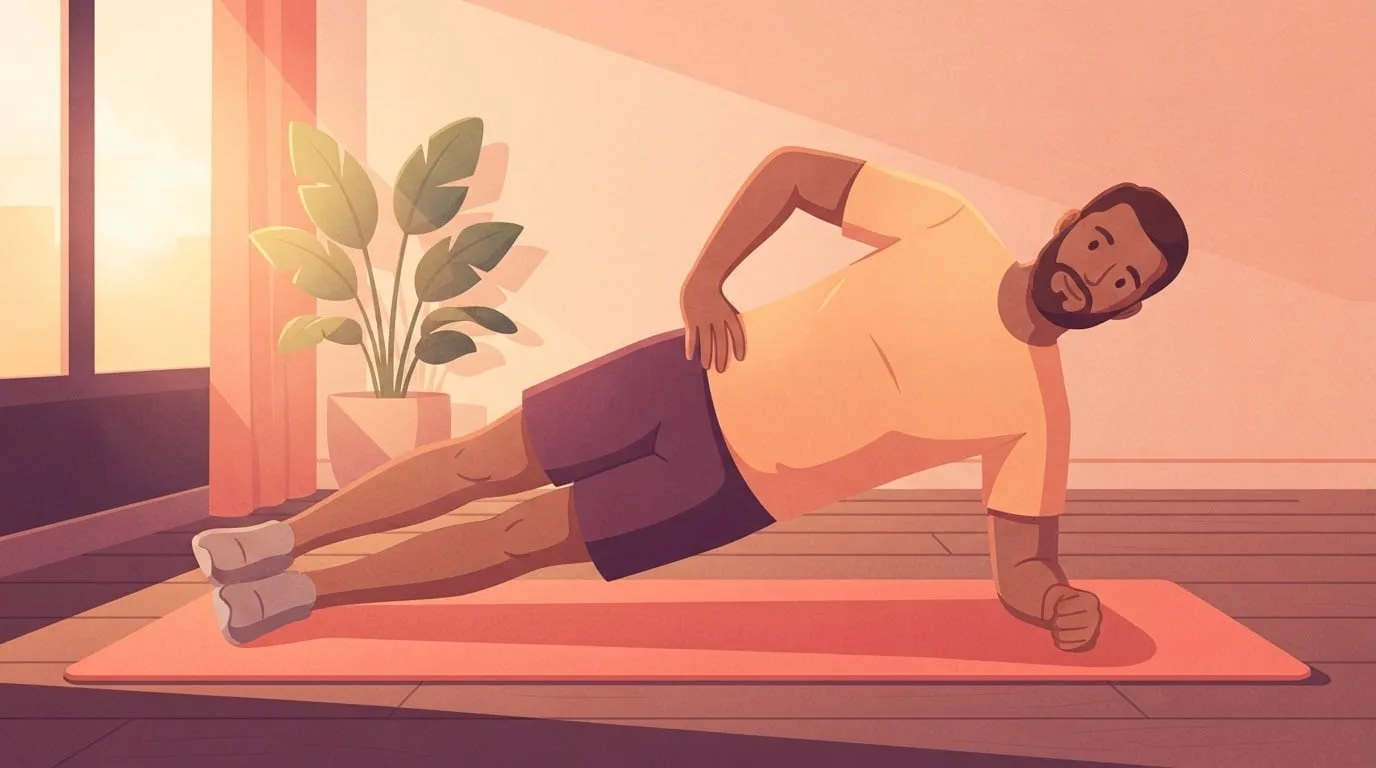
A 10-Minute Core Routine for Runners Who Get Stitches
This routine follows the Mole study's focus on the deep stomach muscles and adds upper-back work for the posture finding. Do it two or three times a week, on easy days or after a run. Go through the list twice:
- Dead bugs: 8 slow reps per side, lower back pressed to the floor.
- Side planks: 20 to 40 seconds per side, body in one straight line.
- Bird dogs: 8 reps per side, pausing for two seconds with the arm and opposite leg reaching long.
- Forearm plank: 30 to 45 seconds, ribs pulled down and glutes tight.
- Prone Y raises: 10 reps lying face down, lifting the arms in a Y shape to work the upper back.
For more options and how to progress them, see our guide to core stability exercises. If you'd rather have the routine planned for you, a bodyweight workout app for home can take that off your plate. In FitCraft, an AI coach demonstrates each exercise on an interactive 3D model and says your name during the workout, the workouts adjust as you progress, and streaks keep two short sessions a week from slipping.
Side Stitch That Won't Go Away: When It Isn't a Stitch
A real stitch is transient. It comes on with exercise, eases when you slow down and is usually gone within a few minutes of stopping. Pain that doesn't follow that pattern needs a different explanation, and some of those need a doctor.
See a doctor promptly if your side pain:
- lasts or gets worse after you've stopped exercising
- shows up at rest, without exercise, or wakes you at night
- comes with fever, vomiting, blood in your stool or urine, or black stool
- comes with a bulge or swelling in your abdomen or groin
- started after a fall, a collision or a hit during sport
- sits low on the right side and keeps getting worse
- happens during pregnancy
Call emergency services if abdominal or shoulder pain comes with chest pain or pressure, pain spreading to the arm, jaw or back, shortness of breath, sweating, dizziness or fainting. Shoulder tip pain can be part of an ordinary stitch, but not alongside those symptoms.
Stitches that keep coming back on every run despite good meal timing and training deserve a check-up too. Rare structural problems can mimic them. Haskins, Harr and Brody (2016) described an 18-year-old field hockey player whose year of exercise-related abdominal pain didn't respond to the usual prevention. The pain turned out to be median arcuate ligament syndrome, where a ligament presses on the main artery to the gut, and it resolved after surgery.
Not every running stomach ache is a stitch, either. A dull, spreading cramp with nausea or a sudden need for the bathroom points to the gut itself, usually reduced blood flow or food that hasn't cleared your stomach. Our post on why your stomach hurts when you run sorts out those causes and how to fix each one.
The Bottom Line
A side stitch when running is a sharp, one-sided pain under the ribs that fades when you ease off. The best-supported cause is an irritated abdominal lining, and tests have ruled against the diaphragm-cramp and muscle-cramp explanations. To stop one, slow down, press on the spot, bend forward while bracing your stomach and breathe out through pursed lips. To prevent the next, leave 2 hours after a meal, skip juice before and during runs, run often and build trunk strength.
A stitch isn't a sign you're not cut out for running. It's a timing and training problem, and those are fixable.
Frequently Asked Questions
What causes a side stitch?
Nobody knows for certain, but the best-supported explanation is irritation of the parietal peritoneum, the sensitive lining of the abdominal wall. Direct tests have argued against the two popular explanations: breathing capacity is unchanged during a stitch, so a cramping diaphragm is unlikely, and muscle activity at the painful spot is no higher than background noise, so it isn't an ordinary muscle cramp. Large meals, big drinks and concentrated drinks before exercise make stitches more likely.
Why do I get side cramps when I run?
Running is one of the sports most likely to cause side cramps because it jolts and rotates the torso with every stride. In a survey of 965 athletes, 69% of runners had a stitch in the past year against 32% of cyclists. The most common triggers are eating or drinking a lot within 2 hours of a run and drinking juice or other concentrated drinks. Younger and less experienced runners get them more often.
What causes a stitch in your side after eating?
Exercising soon after eating is the best-known trigger for a stitch. In a 14 km community run, runners who ate a large amount of food relative to their body weight 1 to 2 hours before the start were more likely to get one, while the type of food made no difference. Leave at least 2 hours after a normal meal, and keep anything closer to the run small.
What causes a stitch when not exercising?
A side stitch is by definition tied to exercise, so a stitch-like pain at rest has a different cause. Trapped gas, constipation or a strained muscle are common harmless reasons, but side pain without exercise can also come from the gallbladder, appendix, kidneys or bowel. If the pain is severe, keeps coming back or comes with fever, vomiting or blood, see a doctor.
Is a side stitch dangerous?
A side stitch itself isn't dangerous. It's uncomfortable, it can slow you down, and in one race 42% of the people who got one said it hurt their performance, but it fades once you ease off. Pain that lasts after you stop, or comes with chest pain, breathlessness, dizziness, fever or vomiting, isn't a stitch and needs medical attention.
Do side stitches go away as you get fitter?
Partly. Fitness level made no difference to how likely or how severe stitches were in a survey of 965 athletes, but people who trained more often got them less often. Stitches also become less common with age. Regular running, sensible meal timing and stronger trunk muscles together give the best odds.