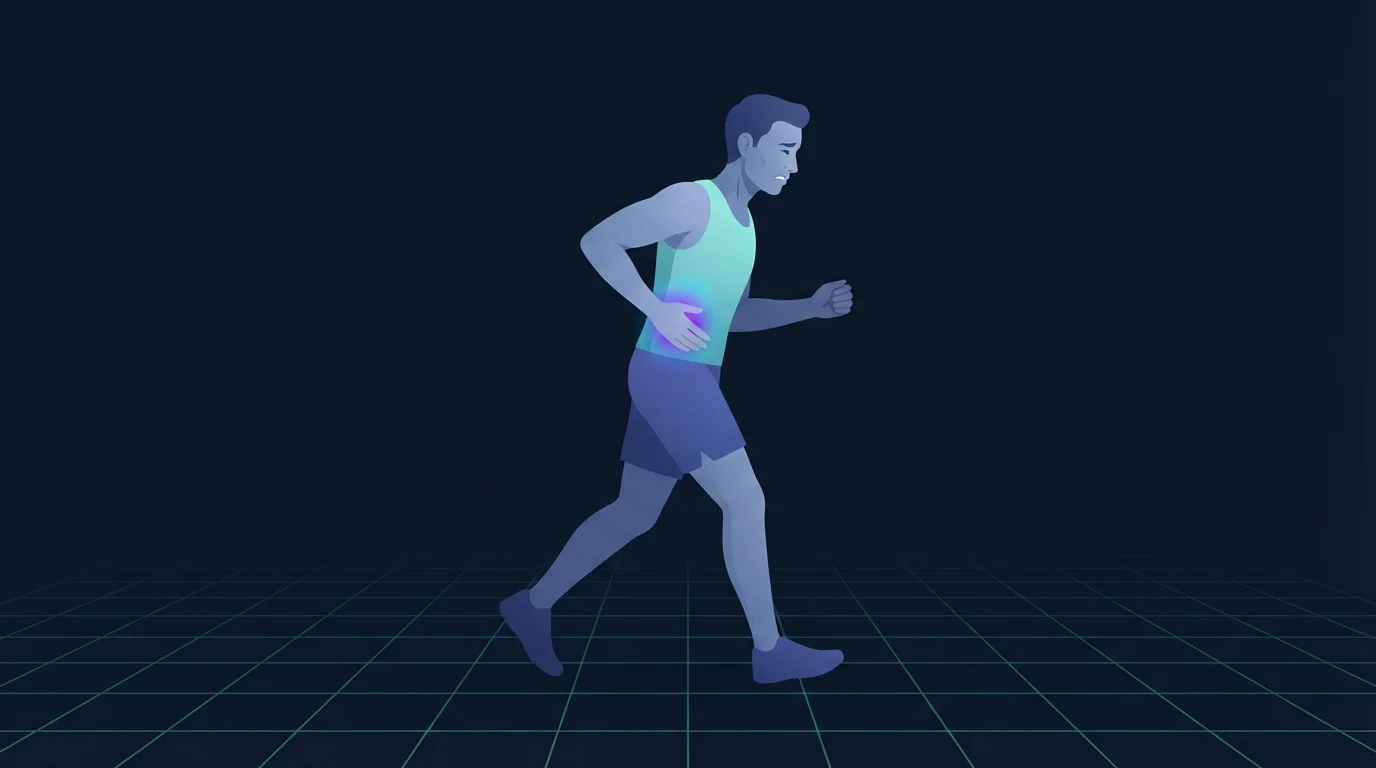
The question gets asked as if there were one answer. There isn't. "My stomach hurts when I run" covers a sharp jab under the ribcage that vanishes the second you walk, a heavy churn that arrives forty minutes in and makes you plan bathroom stops, a bloated ache from a breakfast that never left, and a burning that started the week a runner began taking a painkiller before long sessions. Those have almost nothing in common except the word stomach.
They are also extremely common. de Oliveira, Burini and Jeukendrup (2014) in Sports Medicine put the prevalence of gastrointestinal complaints among endurance athletes at 30 to 50 percent, and Costa and colleagues (2017) in Alimentary Pharmacology and Therapeutics gave the whole family a name, exercise-induced gastrointestinal syndrome, precisely because the pattern is predictable enough to be a syndrome rather than bad luck.
So the useful move is not another list of running nutrition tips. It's sorting which of the four you actually have, because the fix for one of them makes another one worse.
Four Pains, Four Different Fixes
Start here. Read down the middle column and find the row that sounds like your run.
| Where | What it feels like | When it starts | Usually |
|---|---|---|---|
| Just under the ribs, one side, a spot you can point at | Sharp, stabbing or cramping, sometimes with a shoulder-tip ache on the same side | Mid-run, often as pace picks up; gone within a minute or two of slowing | Side stitch (exercise-related transient abdominal pain) |
| Low and central, hard to localize | Dull, spreading cramp, often with nausea, gurgling or an urgent need for a bathroom | Builds gradually, typically after 30 to 60 minutes of hard effort | Splanchnic blood flow shift and slowed gut motility |
| High, just below the breastbone | Heavy, full, sloshing; worse on downhills and when you bend | Early, and it maps onto how recently and how much you ate | A meal that has not cleared the stomach |
| Diffuse, with burning or unusual persistence after the run | Burning ache, sometimes lingering into the evening | Appeared around the time a pre-run painkiller became routine | Anti-inflammatory on top of exercise-induced gut stress |
Two of those rows overlap in practice, because a big meal makes the blood flow problem worse. But the sharp under-the-ribs one is genuinely its own thing, with its own literature and its own fixes, and it is the one people most often try to solve with a diet change that was never going to work.
The Side Stitch, and Why It Is Not Your Diaphragm
The side stitch is the most common running stomach pain and one of the best-described. Morton and Callister (2015), writing in Sports Medicine, pulled together two decades of work on it under the clinical name exercise-related transient abdominal pain. Their survey of 965 participants across six sports found 61 percent had experienced it in the previous year, and the sport breakdown is the most interesting part: swimming 75 percent, running 69 percent, horse riding 62 percent, group fitness classes 52 percent, basketball 47 percent, cycling 32 percent.
Look at what the top of that list has in common. Swimming, running and horse riding all involve repetitive torso movement with the trunk relatively extended. Cycling, where you sit flexed forward and the torso barely moves, sits at the bottom. That pattern is the biggest clue to the mechanism, and it rules out most of the popular explanations.
What it is not
- Not a diaphragm cramp. Electromyography during an actual episode shows no elevated muscle activity in the area. A cramp without muscle activity isn't a cramp.
- Not diaphragm ischemia. Lung function testing during episodes shows no compromise, which it would if the breathing muscle were starved of blood.
- Not gas, and not the liver or spleen bouncing on their ligaments. These are the two folk explanations. Neither predicts the sport pattern, and neither explains why the pain is so precisely localized.
What it probably is
Morton and Callister land on irritation of the parietal peritoneum. The peritoneum is a two-layer membrane: the visceral layer wraps the organs, the parietal layer lines the inside of the abdominal wall and the underside of the diaphragm, and a thin film of fluid sits between them so they glide. The visceral layer has poor, vague pain sensation, which is why organ pain is hard to localize. The parietal layer is richly innervated by somatic nerves, which produce exactly the sharp, well-localized, pointable pain a stitch produces. It also explains the referred shoulder-tip ache some runners get on the same side, because the parietal peritoneum under the diaphragm shares nerve supply with the shoulder region.
The proposed trigger is friction between those two layers, made worse by a stomach that is distended by recent food or drink, and by repetitive extension and rotation of the torso. That single picture accounts for the sport rankings, the localization, the referred pain, the food and drink findings below, and the fact that it disappears as soon as you stop moving.
What Makes a Stitch More Likely
This is where the research gets specific enough to act on, and where it contradicts the advice most runners get.
What you drink matters more than what you eat. In the experimental work Morton and Callister review, drinking before exercise clearly raised the risk, and concentrated drinks were worst: 83 percent of participants developed the pain after a hypertonic solution compared with 70 percent in the other two trial conditions. The provocative effect was not simply a function of added stomach weight, which points at the fluid's concentration rather than its mass.
Meal composition does not predict it. This is the finding that surprises people. Carbohydrate, fat and protein content of the pre-exercise meal showed no relationship with the pain. Volume and timing did. Guidance in the review is to avoid large volumes of food and fluid for at least two hours beforehand, and three to four hours for people who get stitches easily. If you have been swapping oatmeal for toast for months trying to fix a stitch, that's why it never worked.
Posture matters, body size does not. Participants with more pronounced thoracic kyphosis, the rounded upper-back posture, were more susceptible, and the degree of kyphosis and lordosis influenced how severe the pain was. Body mass index and somatotype showed no relationship at all. The stitch isn't a fitness problem or a body composition problem. It's partly a spinal-posture and trunk-control problem, which is the one thing on this list you can train.
It fades with age. Seventy-seven percent of active people under 20 reported experiencing it, against only 40 percent of those over 40. If you got stitches constantly as a teenager and rarely do now, that's the normal trajectory rather than a sign you finally cracked it.
Knowing what to do is the easy part.
FitCraft, our mobile fitness app, pairs you with an AI coach who builds you a personalized plan around your goals, schedule, and fitness level. Every FitCraft program is designed by Domenic Angelino, MPH (Brown University) and NSCA-CSCS, with research published in the Journal of Strength and Conditioning Research and Medicine & Science in Sports & Exercise.
Take the Free Assessment Free • 2 minutes • No credit card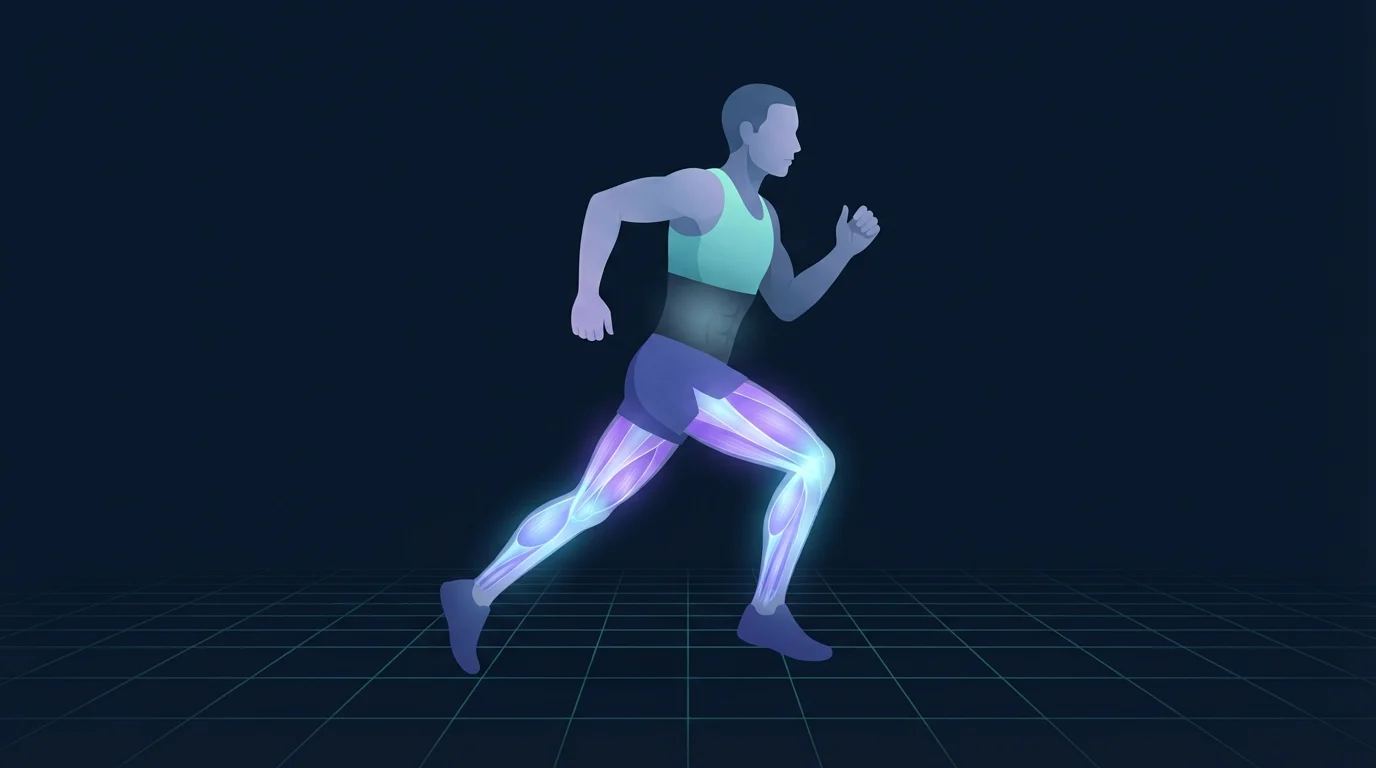
The Dull Cramp Is a Blood Supply Problem
The second pain is a different animal. It builds rather than stabs, it sits low and central, it resists being pointed at, and it often travels with nausea, gurgling or urgency.
van Wijck and colleagues (2011), in PLoS ONE, measured exactly what happens. Healthy men cycled for 60 minutes at 70 percent of maximum workload capacity while the researchers tracked gut perfusion with gastric tonometry and sampled blood every 10 minutes. Perfusion to the gut dropped sharply inside the first 10 minutes. Intestinal fatty acid binding protein, a marker released when intestinal cells are damaged, rose from 309 to 615 picograms per millilitre, roughly a doubling. Small intestinal permeability increased measurably.
Then two things happened that are worth sitting with.
First, everything recovered fast. The injury marker fell steeply within 10 minutes of stopping and was back at baseline in about 50 minutes, and gut perfusion normalized on a similar clock. This is a transient, self-repairing stress, not accumulating harm.
Second, and this is the part that reframes the whole question, those men had no symptoms. Measurable intestinal cell injury, measurable permeability change, zero complaints. Which means pain is not a damage meter. You can have the injury without the pain, and, as the stitch shows, you can have severe pain with no injury at all. Treat the pain as information about what your gut is dealing with on that particular day, not as an alarm about what it is losing.
Running makes this version worse than other modalities because it adds mechanical agitation to the blood flow shift. Peters and colleagues (1999) surveyed 606 well-trained endurance athletes in the American Journal of Gastroenterology and found lower gastrointestinal symptoms in 71 percent of runners against 64 percent of cyclists. The triathlete data makes the comparison cleanest of all, because the same people did both on the same day: 79 percent reported symptoms during the run leg versus 45 percent during the bike leg.
If your version of this is urgency and a bathroom search rather than pain, that is a related but distinct problem with its own set of levers, and our post on preventing runner's trots works through them in order. If the dominant sensation is queasiness, our post on why you feel sick after working out covers the nausea side. For the longer view of how training changes the gut over months rather than minutes, our review of exercise and gut health is the background piece.
Two Things You Swallowed That Make It Worse
Beyond the meal itself, two swallowed inputs turn a manageable situation into a painful one.
Concentrated drinks
A strongly concentrated sports drink, a gel taken without water, or a large sugary drink shortly before a run all raise the osmolality of what is sitting in your stomach. That slows gastric emptying, keeps the stomach distended, and in the stitch literature specifically it was the hypertonic condition that produced pain in 83 percent of participants. Dilute the drink, or take the carbohydrate with enough plain water that it is not sitting there as syrup.
Anti-inflammatories
This one is worth taking seriously because the pre-run ibuprofen habit is common in recreational distance running. van Wijck and colleagues (2012) in Medicine and Science in Sports and Exercise tested nine trained men across four conditions: ibuprofen then cycling, cycling alone, ibuprofen at rest, and rest alone. Peak intestinal injury marker came in at 875 picograms per millilitre for ibuprofen plus cycling, against 474 for cycling alone, 507 for ibuprofen at rest and 352 for rest with nothing. Gut permeability was worst in the same arm.
The drug and the exercise each stress the gut barrier, and together they stack. If you are taking a painkiller before long runs and your stomach has recently started hurting on them, that's the first variable to remove, and it costs you nothing to test. If you need anti-inflammatories often enough that dropping them is a problem, that is a conversation with a clinician about the underlying issue rather than a running nutrition question.
Fixing It, in the Order That Works
Change one thing at a time and give each change three runs before you judge it. Changing five variables at once teaches you nothing.
- Move the meal. Two hours minimum between a normal meal and a hard run, three to four if you are stitch-prone. This single change resolves more cases than everything below it combined, and it costs nothing.
- Thin what you drink. Plain water in the hour before. If you use a sports drink or a gel, dilute it or chase it with water. Small sips rather than a large volume in one go.
- Drop the pre-run painkiller. Not the post-run one, the pre-run one. Three runs without it tells you whether it was the cause.
- Train the trunk and the posture. This is the stitch-specific lever, and it follows straight from the kyphosis finding. Direct work on the deep trunk muscles and thoracic extension gives the abdominal wall a more stable platform during the repetitive torso movement running demands. Our guide to core stability exercises covers the movements worth using, and it is a slow fix, measured in weeks.
- Sort the breathing. Shallow, rapid chest breathing keeps the diaphragm in a small range and increases the torso movement the mechanism depends on. Deeper, more rhythmic breathing is a reasonable preventive, and it is the main in-session tool once a stitch arrives. Our guide to how to breathe while running covers the pattern.
- Train the gut, do not starve it. The last resort for most runners is to stop eating and drinking on long runs, which fixes the symptom and wrecks the fuelling. Jeukendrup (2017) in Sports Medicine describes the alternative: the gut is adaptable, its transport proteins respond to what you regularly ask them to handle, and progressively practicing carbohydrate and fluid intake during training raises tolerance and reduces distress on race day. Start with small amounts on easy long runs and build over weeks.
Once a stitch has actually arrived mid-run, the in-session sequence is short: slow down, press firmly into the painful spot, lean slightly toward that side, and breathe deeply, exhaling as the foot on the painful side lands. Stopping is the most reliable relief of all, which is not useful in a race but is worth knowing on a training run.
When the Pain Is Not About Running
Everything above describes pain that belongs to the run: it arrives during effort and it leaves when the effort stops. A different pattern deserves a different response, and running is not the explanation for any of these.
- Pain that persists for hours after you finish, or that shows up at rest and at night.
- Blood in stool, black stool, or repeated vomiting.
- Pain with fever, or pain that keeps localizing to the lower right abdomen.
- Unintended weight loss, or a change in bowel habit that has lasted weeks.
- Pain that has steadily worsened run over run rather than varying with what you ate and how hard you went.
- Any chest pressure, jaw or arm pain, or breathlessness disproportionate to the effort, which needs urgent assessment rather than a running fix.
Celiac disease, inflammatory bowel disease, gallstones, reflux disease, hernias and irritable bowel syndrome all turn up in runners at roughly the rate they turn up in everyone else, and running just happens to be when a person notices. A pattern that does not fit the four rows in the table above is worth a doctor's time.
What Changes When You Get This Right
The practical cost of running stomach pain is rarely the pain itself. It's what the pain does to the plan. You stop eating before runs, so the long runs get worse. You keep the pace easy to avoid triggering it, so the hard sessions quietly disappear. You skip the run you were dreading, then skip the next one. Six weeks later the training block is gone and the reason is a symptom that would have taken three runs to diagnose.
That's worth naming because it is the real mechanism by which this derails people. If the gut is the reason your consistency keeps breaking, the fix is partly medical and partly structural: have a plan that survives a bad gut week and gives you something to do on the days the run is not happening. Our roundup of the best fitness apps for consistency covers the tools built around staying on the plan rather than optimising any one session.
And the diagnosis itself is usually quick. Most runners who work through the list in order find their answer in the first two steps, because most running stomach pain is a stitch made worse by a meal or a drink that was too close and too concentrated. That's a boring answer to a question that feels alarming, which is generally a good sign.
Frequently Asked Questions
Why does my stomach hurt when I run?
Four causes account for almost all of it, and where the pain sits tells you which one you have. A sharp, well-localized pain just under the ribs that starts mid-run and eases when you slow down is a side stitch, which researchers call exercise-related transient abdominal pain. A dull, spreading cramp with nausea or urgency is your gut running short on blood while the legs take priority. A heavy ache high in the abdomen usually means the last meal has not cleared the stomach. And a burning ache that showed up the same week you started taking a painkiller before long runs is probably the painkiller. Each one has a different fix, so identifying which you have matters more than any general advice about running nutrition.
How do you get rid of a side stitch while running?
Slow down first, because reducing intensity is the single most reliable thing short of stopping. While you do that, press your fingers firmly into the painful spot and lean the torso slightly toward that side, then take a few deliberately deep breaths, exhaling hard as the foot on the painful side strikes the ground. Morton and Callister's review of exercise-related transient abdominal pain lists deep breathing, direct pressure and reduced intensity as the practical in-session strategies. Most stitches release within a minute or two of doing all three together, and you can usually pick the pace back up afterwards.
How long before a run should I eat?
Leave at least two hours between a normal meal and a hard run, and three to four if you get stitches easily. For the side stitch specifically the evidence points at volume and concentration rather than food type: Morton and Callister found that the macronutrient makeup of a pre-exercise meal did not predict the pain, while drinking a concentrated beverage beforehand did, with 83 percent of participants developing pain after a hypertonic drink. So a small, low-volume snack with plain water 60 to 90 minutes out is usually safe, while a large meal or a strong sports drink 30 minutes out is the combination that reliably causes trouble.
Why does my stomach hurt when I run but not when I cycle?
Running adds mechanical jostling on top of the blood flow shift, and the data reflects that. Peters and colleagues surveyed 606 endurance athletes and found lower gastrointestinal symptoms in 71 percent of runners against 64 percent of cyclists, and triathletes reported symptoms in 79 percent of cases during the run compared with 45 percent during the bike leg. The same athletes, the same day, roughly the same effort, and the run produced almost twice the trouble. Side stitch prevalence splits the same way: 69 percent of runners versus 32 percent of cyclists in Morton and Callister's survey, because the torso movement is what irritates the membrane involved.
Does stomach pain while running mean I am damaging my gut?
Pain and damage are not the same signal, and the research shows they come apart in both directions. van Wijck and colleagues had healthy men cycle for an hour at 70 percent of maximum workload and measured a roughly two-fold rise in a marker of intestinal cell injury and a measurable increase in gut permeability, yet those men reported no symptoms at all. The markers fell back toward baseline within about 50 minutes of stopping. So a hard session can produce transient, self-repairing gut stress with no pain, and a side stitch can produce severe pain with no tissue injury. Persistent pain that outlasts the run is the version worth investigating.
How do you prevent runner's trots?
Runner's trots is the lower-gut version of this problem, urgency and diarrhea rather than pain, and it responds to a different set of levers: what you ate in the 24 hours before the run, fiber and fat timing, fermentable carbohydrate load, and gut training on long runs. Our dedicated post on preventing runner's trots works through those layers in order. If your main complaint is a sharp pain under the ribs rather than a dash for a bathroom, you have a side stitch instead, and food composition is not the variable to chase.
Should I take ibuprofen before a long run?
No, and this is one of the clearer findings in the area. van Wijck and colleagues tested nine trained men across four conditions and found that ibuprofen taken before cycling pushed a marker of small intestinal injury to 875 pg/mL, against 474 for cycling alone, 507 for ibuprofen at rest and 352 for rest with nothing. Gut permeability was worst in the same arm. Taking an anti-inflammatory before a hard endurance session stacks a drug effect on top of the blood flow effect the exercise already causes. If pain relief is genuinely needed, take it afterwards, and talk to a clinician if you need it often.