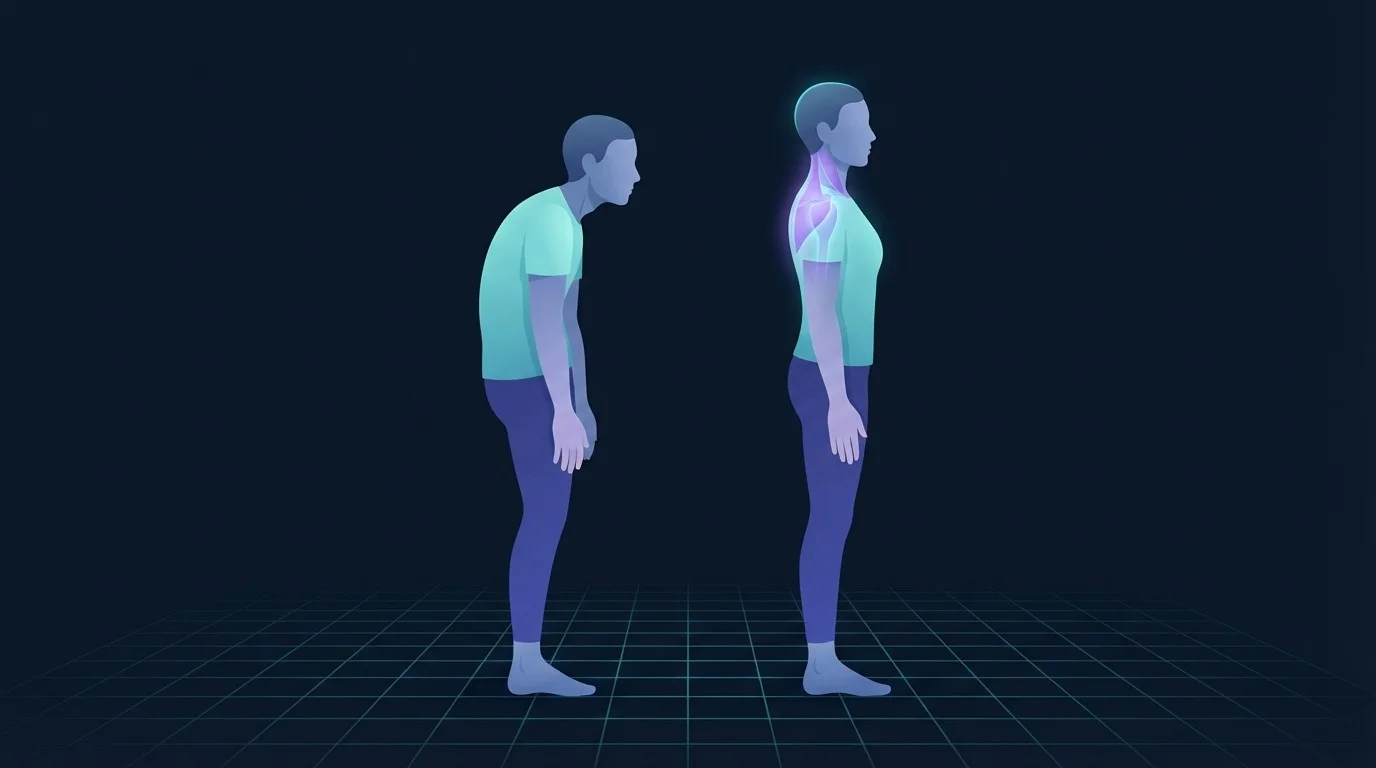
Exercises for posture work on the measurement and only sometimes on the symptom. Strengthening the deep neck flexors, the mid and lower trapezius and the muscles that extend the mid back reliably shifts head and shoulder position in controlled trials, usually within 8 to 12 weeks. The claim that straightening you out will fix your back pain is a different claim, and it holds up far less well. Do the routine because stronger, more mobile shoulders and a mid back that still extends are worth having on their own.
You are probably here because a photo caught you off guard, or because your neck aches by 4pm, or because someone told you that your rounded shoulders explain everything that hurts. That last one is worth interrogating. The exercises below are good exercises. The story usually attached to them is oversold, and knowing the difference saves you from quitting when the pain does not vanish in week two.
What Do Exercises for Posture Actually Change?
Posture research runs on a few specific numbers. Craniovertebral angle is the angle between a horizontal line through the seventh cervical vertebra and a line from that point to the ear; a smaller angle means the head sits further forward. Cobb angle measures the curve of the thoracic spine on a lateral radiograph. Rounded shoulder angle tracks how far the shoulder sits ahead of the trunk. These are the outcomes trials move, and they do move.
A systematic review and meta-analysis in the Journal of Manipulative and Physiological Therapeutics (Sheikhhoseini et al., 2018) pooled 7 randomized clinical trials covering 627 participants with forward head posture. Exercise training produced a pooled odds ratio of 6.7 for craniovertebral angle change and 0.3 for pain, which the authors graded as strong evidence for the posture change and moderate evidence for the pain improvement. Cranial angle did not budge. The authors were careful to say that the relationship between forward head posture and pain, and between improvements in each, is still unsettled.
A larger and more recent analysis reached the same place. Sepehri et al. (2024), published in BMC Musculoskeletal Disorders, pooled 22 studies of people with upper crossed syndrome, the tight-chest, weak-upper-back pattern most posture programs target. Therapeutic exercise significantly improved forward head angle, rounded shoulder angle and thoracic kyphosis angle. Strength work, stretching, shoulder specific drills and comprehensive programs that hit everything all produced improvements, which is a useful finding: no single magic exercise carried the effect.
The most demanding evidence comes from older adults. In the SHEAF trial (Katzman et al., 2017) in Osteoporosis International, 99 community-dwelling adults aged 60 to 88 with at least 40 degrees of kyphosis were randomized to six months of supervised spine strengthening and posture training, three one-hour sessions a week, or to health education. The exercise group improved their radiographic Cobb angle by 3.0 degrees relative to controls. Participants also reported better self-image and satisfaction with their appearance.
Three degrees over six months of supervised training is a real result and a small one. That is the honest scale of what posture exercise does to a spine that has already changed shape. Here is how the main claims sort out. The strength side of that picture moves faster than the angles do, which is why our guide to neck strengthening exercises treats posture change as the side effect rather than the goal. The shoulder girdle is the one place where the numbers come out bigger, which our review of upper cross syndrome research goes through study by study.
| Common claim | What the evidence supports | Key source |
|---|---|---|
| Exercise can improve forward head posture | Supported. Large pooled change in craniovertebral angle across 7 trials | Sheikhhoseini et al., 2018 (627 participants) |
| Exercise can reduce rounded shoulders and kyphosis | Supported. Significant improvement in all three upper-body posture angles | Sepehri et al., 2024 (22 studies) |
| Bad posture causes back pain | Not supported. 41 systematic reviews produced no consensus on causality | Swain et al., 2020 (umbrella review) |
| Slouched sitting causes neck pain | Not supported. Four distinct posture clusters, no difference in neck pain | Richards et al., 2016 (1,108 adolescents) |
| Rounded upper back causes shoulder pain | Not supported. Moderate evidence of no kyphosis difference between groups | Barrett et al., 2016 (10 studies) |
| Neck and shoulder strengthening reduces neck pain | Supported at low certainty. Pain and disability both fell versus control | Jones et al., 2024 (8 randomized trials) |
Does Bad Posture Cause Pain?
This is where the industry oversells, so it's worth being blunt. The strongest evidence says posture is a weak and inconsistent predictor of musculoskeletal pain. If back pain is what sent you looking at your posture in the first place, our guide to the best exercises for lower back pain covers what the evidence supports treating instead.
Swain and colleagues (2020) ran an umbrella review in the Journal of Biomechanics, screening 4,285 publications and including 41 systematic reviews on spinal posture, physical exposure and low back pain. They appraised each against the Bradford Hill criteria for causality. Both positive and null associations turned up across prolonged standing, sitting, bending, twisting and awkward postures. Meta-analyses tended to find an association; reviews restricted to prospective studies did not. Their conclusion: association exists in places, causality is not established.
The adolescent data is starker. Richards et al. (2016), in Physical Therapy, photographed 1,108 seventeen-year-olds in sitting and used cluster analysis to sort them into four sagittal neck postures: upright, intermediate, slumped thorax with forward head, and erect thorax with forward head. The clusters differed by sex, weight and height. The slumped group had higher odds of depression. There was no significant difference in the odds of neck pain or headache across the four clusters. The authors wrote that this challenges widely held beliefs.
Shoulders tell the same story. Barrett et al. (2016) reviewed 10 studies in Manual Therapy and found a moderate level of evidence of no significant difference in thoracic kyphosis between people with and without shoulder pain. They did find strong evidence that maximum shoulder range of motion is greater in an erect posture than a slouched one, but that was measured within single sessions, so it says more about what position you should press from than about what shape your spine should be.
The one place the picture tilts is adult neck posture. Mahmoud et al. (2019), in Current Reviews in Musculoskeletal Medicine, pooled 15 cross-sectional studies and found adults with neck pain did have more forward head posture than asymptomatic adults, with correlations to pain intensity and disability. In adolescents, that association disappeared. Age was the confounder. Cross-sectional data also cannot tell you which came first: the posture, or the pain that changed how someone holds their head.
So why do the routine? Because the exercises are worth doing on their own terms. Jones, Jadhakhan and Falla (2024) pooled 8 randomized trials in Applied Ergonomics and found that strengthening the neck, shoulder and scapular muscles significantly reduced neck pain intensity and disability in office workers with chronic neck pain, though they rated the certainty of that evidence as low because all eight trials carried a high risk of bias. Strength helps. The mechanism is probably capacity and tolerance rather than alignment. Same exercises either way.
Find out what's really holding you back
FitCraft, our mobile fitness app, pairs you with an AI coach who builds you a personalized plan around your goals, schedule, and fitness level. Every FitCraft program is designed by Domenic Angelino, MPH (Brown University) and NSCA-CSCS, with research published in the Journal of Strength and Conditioning Research and Medicine & Science in Sports & Exercise.
Take the Free Assessment Free • 2 minutes • No credit cardWhich Exercises for Posture Are Worth Your Time?
Every trial that moved a posture angle did some version of three things: strengthen the muscles that hold the head and shoulder blades back, restore extension to a mid back that has stopped extending, and lengthen the front of the chest and hips. Six movements cover all three. None of them needs equipment beyond a wall, a floor and, if you want it, one light resistance band. For the shoulder half of that specifically, our guide on how to fix rounded shoulders turns those three jobs into eight exercises and a four-week plan.
| Exercise | What it trains | Dose | Cue that makes it work |
|---|---|---|---|
| Chin tuck | Deep neck flexors, the endurance muscles that hold the head back | 10 reps, 5 second holds | Slide the head straight back, don't tip the chin down |
| Wall slide | Lower trapezius and serratus, shoulder blade upward rotation | 2 sets of 8 | Keep wrists, elbows and low back touching the wall the whole way |
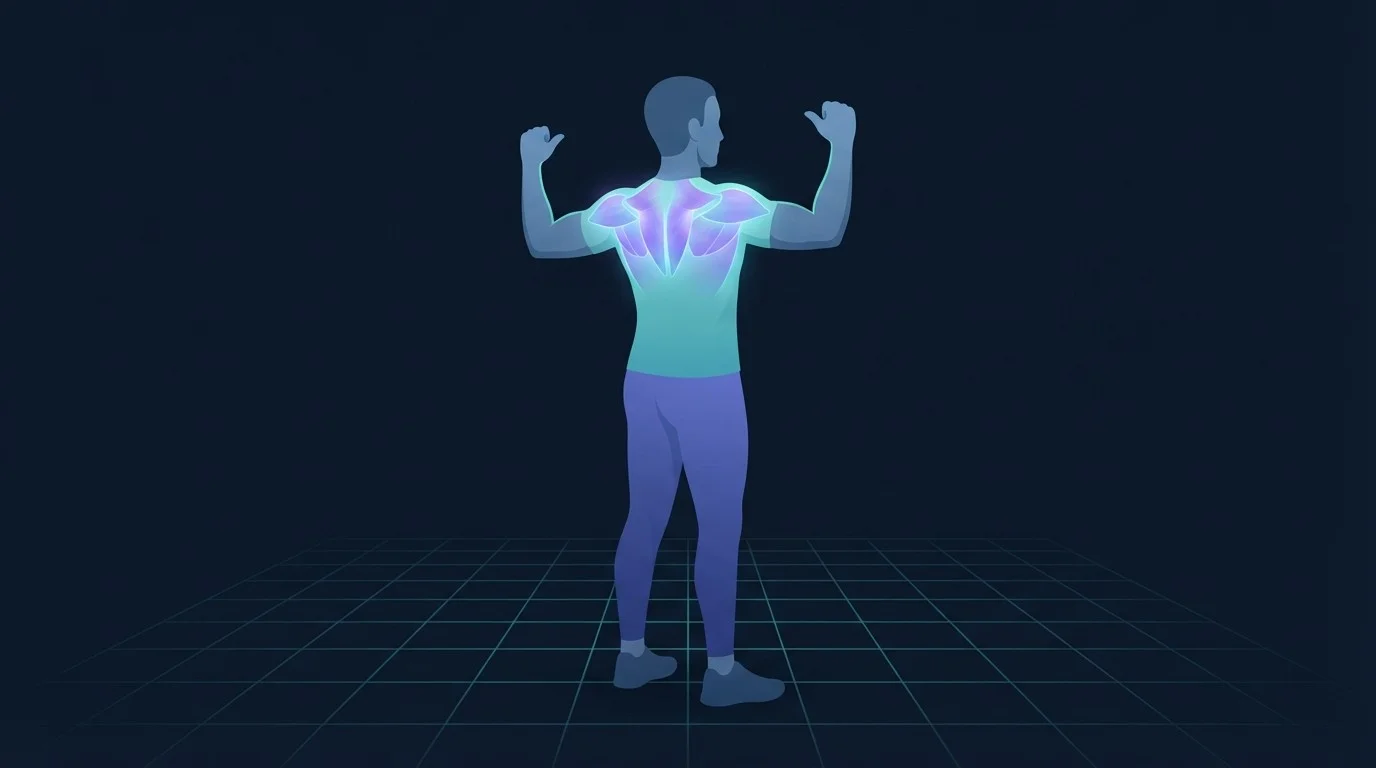
| Band pull-apart | Rear deltoids, rhomboids, mid trapezius | 2 sets of 15 | Lead with the hands, finish with the shoulder blades, not the elbows |
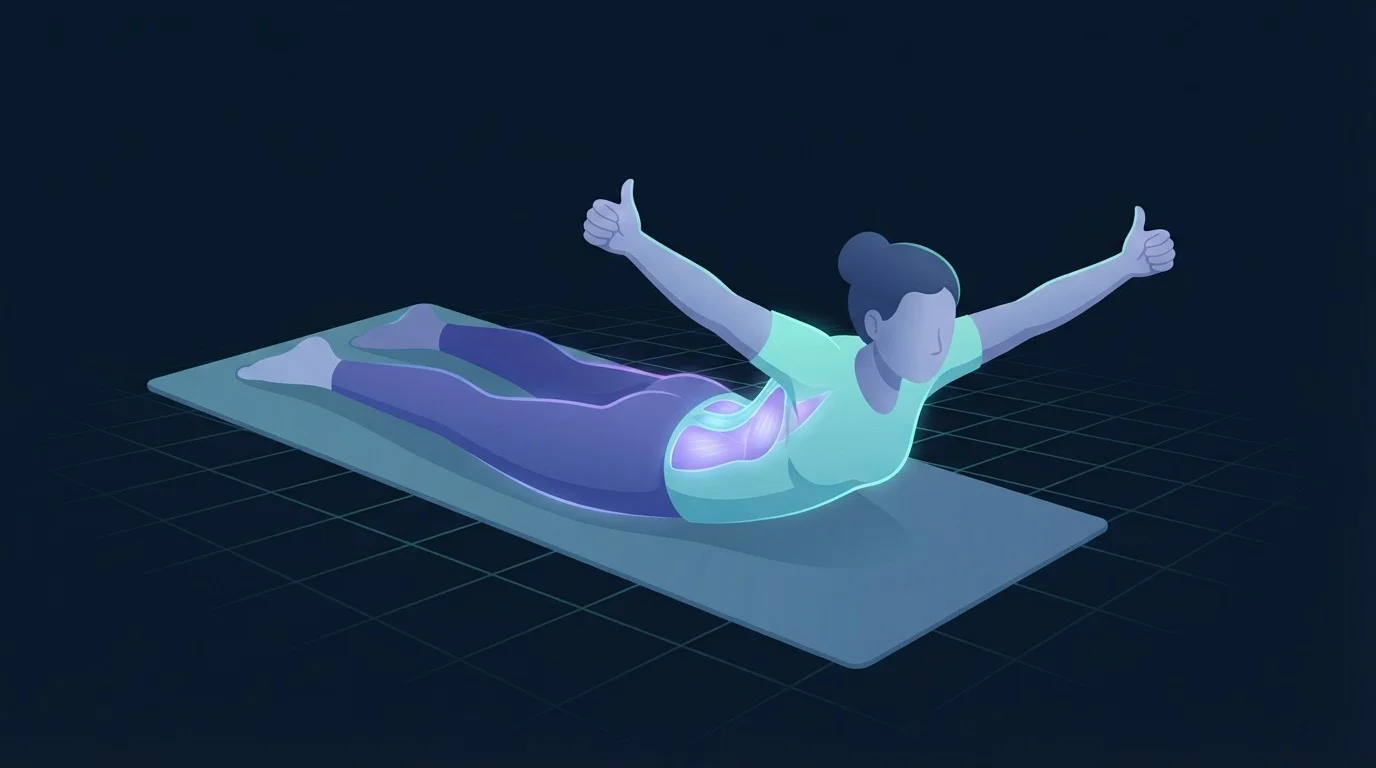
| Prone Y raise | Lower trapezius, the most commonly underworked link | 2 sets of 10 | Thumbs up, lift from the shoulder blade, keep the neck long |
| Thoracic extension over a rolled towel | Mid back extension range | 5 slow breaths per spinal level | Ribs down, extend over the roll rather than arching the low back |
| Half kneeling hip flexor stretch | Hip flexors and the front of the trunk | 2 x 30 seconds per side | Tuck the pelvis first, then shift forward one inch |
That's roughly ten minutes. Add bird dogs if you want a trunk endurance component, which is a reasonable addition given how much of the low back literature points toward capacity rather than shape. The wall slide and the chin tuck are both isometric at the end range, which is where the endurance deficit usually lives.
None of this needs a gym. If you want a plan that programs these alongside real strength work, our roundup of the best no-equipment workout apps covers which options hold up when all you have is floor space and a band.
How Often Should You Do a Posture Routine?
Match the dose to what the trials used. The interventions that produced measurable angle changes were not casual. Katzman's older adults trained three hours a week under supervision for six months. The forward head posture trials in the 2018 meta-analysis typically ran four to twelve weeks of near-daily corrective work.
For a healthy adult who sits for a living, this is a workable version:
| Phase | Frequency | Session length | What changes |
|---|---|---|---|
| Weeks 1 to 4 | 5 days a week | 10 minutes | Learn the positions. Endurance in the neck and mid back climbs fast |
| Weeks 5 to 12 | 4 days a week | 10 to 12 minutes | Add load and reps. This is where the angle changes show up |
| Month 4 onward | 2 to 3 days a week | 8 minutes, or folded into warm-ups | Maintenance. Rowing and pulling in a regular strength plan covers most of it |
The maintenance row matters. Once you're training regularly, horizontal rows, face pulls and overhead work do most of what a dedicated posture routine does, which is why the long-term answer to posture is usually a strength program rather than a corrective one. If sticking with a plan is the hard part for you, that's a different problem and we wrote about it in consistency beats intensity.
Do Posture Correctors, Standing Desks and Ergonomic Chairs Fix Posture?
Short answers: a brace is a reminder, a standing desk changes which position you are stuck in, and a chair cannot make you strong.
Posture braces
Wearing one gives you a tactile cue to pull your shoulders back, and some people genuinely like that for a few weeks while they build the habit. The problem is that a brace does the holding for you, and the deficit in most people is endurance in the muscles that should be doing the holding. Nothing in the brace literature approaches the evidence base behind the exercise trials above. Use it as a nudge if you want. Do the strengthening regardless.
Standing desks and chairs
The Swain umbrella review looked at prolonged standing and prolonged sitting and found the same mixed, non-causal picture for both. Standing all day is not a solution to sitting all day. What helps is variety: changing position every 30 to 45 minutes, walking to refill water, taking calls on your feet. Short movement breaks scattered across the day, sometimes called exercise snacks, are far easier to sustain than a promise to sit correctly for eight hours.
Screen height
This one is cheap and worth doing. If your monitor sits low, your head goes forward for eight hours a day, and no ten-minute routine competes with that much time. Raise the top of the screen to roughly eye level. Then stop optimizing your furniture and go do the exercises. And if your arms still won't reach cleanly overhead once the strength work is in, the limit is range rather than posture: our shoulder mobility exercises guide has the floor test for that.
What Results Should You Expect, and When?
Weeks 1 to 2: You'll feel more upright for an hour or two after each session and then drift back. That's a motor control effect, not a structural one. It's also the point where most people conclude it worked, or that it didn't, and both conclusions are premature.
Weeks 3 to 6: Endurance changes. Holding a chin tuck for five seconds stops being hard. The mid back gets noticeably less stiff first thing in the morning. Neck ache in the second half of the workday often eases here, which lines up with the Jones et al. finding on strengthening and neck pain in office workers.
Weeks 8 to 12: This is where the trials measured their angle changes. If someone photographs you from the side, this is when the difference starts showing up rather than felt. Expect a shift, not a transformation.
Month 6 and beyond: Katzman's supervised six-month program produced a 3 degree Cobb angle change in adults over 60 with established kyphosis. Younger spines with less structural change tend to move more, but the message holds. Posture responds slowly, and it responds to load and repetition rather than to reminders.
The honest verdict: exercises for posture reliably improve the angles researchers measure, and they reliably improve strength and endurance in the neck, shoulder blades and mid back. They are not a treatment for back pain, because the link between posture and pain is weak enough that 41 systematic reviews could not agree it exists. Do the routine to be stronger and to move better. If it also makes your neck feel better by week six, and it often does, that is the strength doing the work.
Can an App Help You Stick With a Posture Routine?
The failure mode for posture work is never the exercise selection. It's that a ten-minute routine with no visible short-term payoff is the easiest thing in your week to skip, and the angle changes only arrive after two months of not skipping it. The same is true of trunk work, which is why our guide to core stability exercises dose them as short repeated holds you can actually keep doing rather than one long plank you dread.
That's a consistency problem, and consistency responds to design. A 2022 meta-analysis of 16 randomized trials and 2,407 participants in the Journal of Medical Internet Research (Mazeas et al.) found gamified interventions increased physical activity with a small-to-medium effect and outperformed non-gamified programs, not just waiting lists.
FitCraft programs yoga, mobility and strength work as one plan rather than as separate apps you have to coordinate, and every exercise has an interactive 3D demo with pinch-and-zoom camera control, which matters for movements like the prone Y raise where the difference between doing it right and doing it wrong is a shoulder blade you cannot see from the front. Workouts adapt as your progress logs, and calendar tracking, XP and collectible cards are there to make showing up on week seven feel like something other than an obligation.
Frequently Asked Questions
Do exercises for posture actually work?
Yes, for the thing they are measured on. A 2018 meta-analysis of 7 randomized trials and 627 participants found that corrective exercise produced a large improvement in craniovertebral angle, the standard measure of forward head posture, and a moderate improvement in neck pain. A 2024 meta-analysis of 22 studies found the same pattern for rounded shoulders and thoracic kyphosis. What exercise does not do is guarantee that changing your alignment will change how you feel, because posture and pain are only loosely linked.
How long does it take to improve posture with exercise?
Most trials that measured a real change in posture angles ran between 6 and 12 weeks of training two to four times a week. The largest older-adult trial, a 6 month randomized controlled trial of supervised spine strengthening three times a week, moved the Cobb angle of kyphosis by 3 degrees compared with controls. Expect to feel more upright within 2 to 3 weeks, and expect measurable angle changes closer to the 8 to 12 week mark.
Does bad posture cause back and neck pain?
Not reliably. An umbrella review of 41 systematic reviews concluded there is no consensus that spinal posture or physical exposure causes low back pain. A study of 1,108 seventeen-year-olds found four distinct sitting posture clusters with no difference in neck pain or headache between them. Adults with neck pain do show slightly more forward head posture than pain-free adults, but the relationship is weak and does not prove one causes the other. Train for strength and movement variety rather than chasing a perfect line.
What are the best exercises for posture?
The exercises with the most supporting evidence strengthen the muscles that hold the head, shoulder blades and upper back in position, and restore extension to a stiff mid back. A short list that covers all three: chin tucks for the deep neck flexors, wall slides or scapular squeezes for the mid and lower trapezius, band pull-aparts for the rear shoulders, prone Y raises for the lower trapezius, a thoracic extension over a rolled towel, and a half kneeling hip flexor stretch. Ten minutes of that, four to five days a week, is a complete routine.
Do posture correctors and braces work?
A brace gives you a tactile reminder while you wear it, and some people find that useful for a few weeks. What it does not do is build the strength and endurance that hold a position when the brace comes off, and no posture brace has evidence behind it that matches the exercise trials. Use one as a cue if you like it, but do the strengthening work either way.
Is a standing desk better for posture than sitting?
A standing desk changes which position you are stuck in, not whether you are stuck. The useful part of a sit-stand setup is that it makes changing position easy, and changing position often is the part that helps. Set your screen at eye height, get up every 30 to 45 minutes, and treat the desk as a way to add movement rather than as a treatment on its own.
Can I fix rounded shoulders at home without equipment?
Yes. Wall slides, scapular squeezes, prone Y and T raises, and thoracic extensions all need nothing but floor and wall space, and a light resistance band covers everything else for a few dollars. The 2024 meta-analysis on upper crossed syndrome found that strength work, stretching, shoulder focused drills and comprehensive programs all improved rounded shoulder and kyphosis angles, so the specific tool matters far less than doing the work consistently.