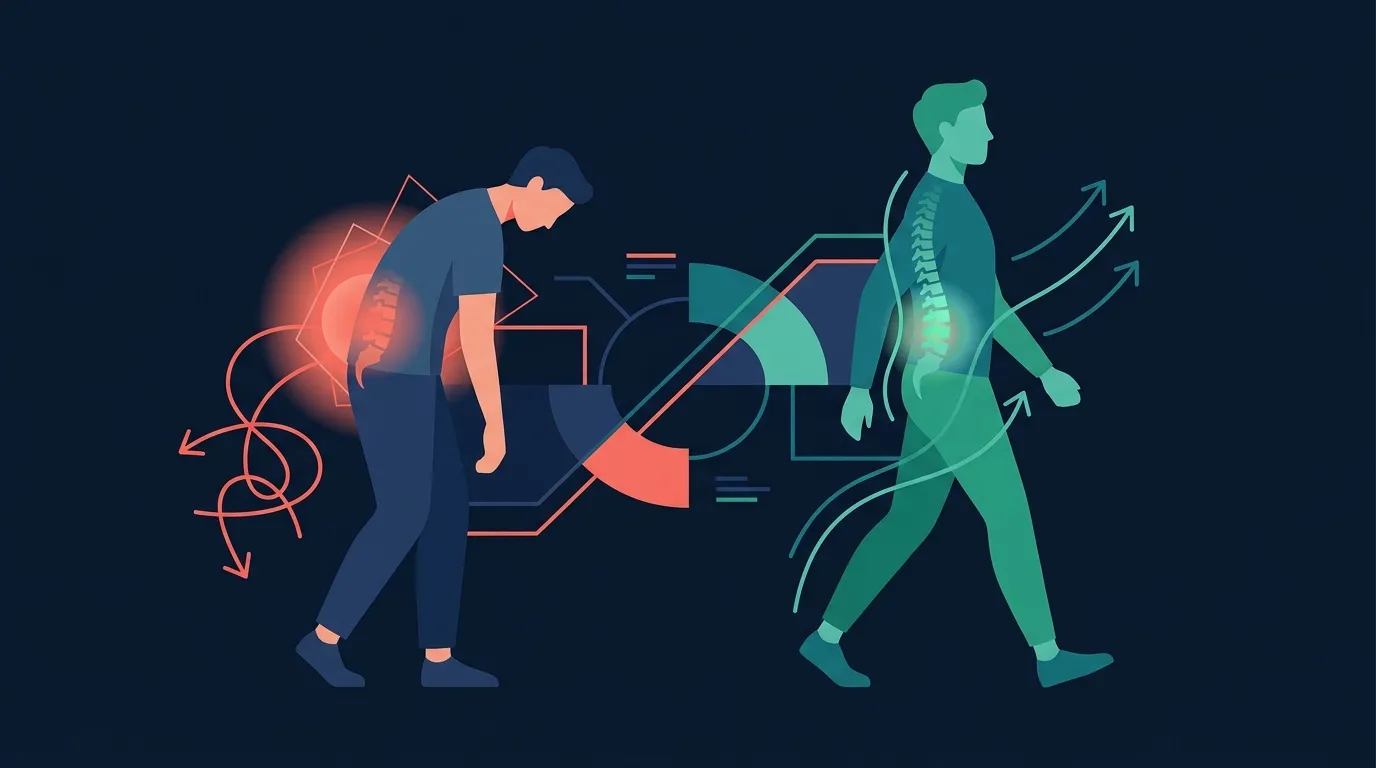
Ask ten people with back pain what they've been told to do, and you'll get ten different answers. Rest. Get an MRI. See a chiropractor. Do core work. Do yoga. Do McKenzie extensions. Take an anti-inflammatory. Get an injection. Try Pilates. Buy a standing desk. Some of that advice is useful. Most of it is a mix of outdated convention and personal anecdote. The actual clinical evidence has become far cleaner in the last decade, and it says something specific. The step-by-step version of that approach, with the extension progression and its stop rules, is in our guide to McKenzie exercises.
Exercise works. Almost any structured exercise, done consistently, at a reasonable dose. And when researchers do head-to-head trials trying to prove one mode is best, the honest result is that they land in roughly the same place. That is not a disappointment. It is liberating. It means you are not gated on finding the "right" program. You are gated on picking one and sticking with it.
This article walks through the evidence base: the global scale of the problem, the Cochrane review that anchors treatment recommendations, the practice guideline that changed clinical care, the specific-modality trials, and the prevention data. If you have low back pain right now, or you are trying to keep it from coming back, this is the research to weigh.
The Research: What Studies Show
Foster 2018: How Big Is the Problem, Really?
The scale-setting paper is the Lancet Low Back Pain series, led by Foster, Anema, Cherkin, and colleagues (2018). Using Global Burden of Disease data, the team estimated that roughly 540 million people worldwide are experiencing low back pain at any given moment, and that it has been the number one cause of years lived with disability globally for more than a decade. Most people will have at least one episode in their life. Most episodes settle within 6 weeks. But recurrence is the norm, and a significant minority progress to persistent pain that reshapes their working life, sleep, and mood.
The series also documented what the authors called an "evidence-practice mismatch." Clinical guidelines already recommended reassurance, activity, and exercise as first-line care. Actual practice heavily favored imaging, opioids, injections, and surgery, especially in high-income countries. The gap was, and largely still is, expensive and harmful. Bed rest and passive care do not just fail to help. They can prolong the very disability the patient came in trying to solve.
So the frame the modern research is working inside is this. Back pain is common, mostly not dangerous, and the treatments that consistently help are the ones that get you moving again. Skip the ones that don't. Passive treatments sit beside that answer rather than replacing it, which is why our review of cupping therapy benefits lands on loading for anything lasting and cups only for the comfort.
Hayden 2021: The 249-Trial Cochrane Review
The definitive treatment-side synthesis is Hayden, Ellis, Ogilvie, Malmivaara, and van Tulder (2021), published in the Cochrane Database of Systematic Reviews. The team pooled 249 randomized trials involving 24,486 adults with chronic low back pain. 203 of those trials (19,633 participants) contributed to the meta-analysis proper.
Across trials that compared any form of structured exercise to no treatment, usual care, or a placebo intervention, exercise produced a mean pain reduction of about 15 points on a 0 to 100 pain scale (95 percent confidence interval -18.3 to -12.2). Function scores improved by a similar magnitude. Certainty of evidence was rated moderate. That is a clinically meaningful effect. For a person sitting at a 60/100 pain rating, dropping to 45/100 is the difference between skipping walks and taking them, between reaching for a heating pad by 3 pm and getting through the workday without one.
The review also stratified by exercise type. Pilates, motor control (core stability), aerobic exercise, and mixed programs all outperformed no-treatment control. Once head-to-head comparisons were run against other active exercise, the differences between modes shrank sharply. Nothing lapped the field. That is the second big finding buried inside a 200-plus-trial review. The winning variable is that exercise is happening. The winning specific mode is whichever one the person will actually do.
Qaseem 2017: The Guideline That Changed the Care Model
The American College of Physicians clinical practice guideline (Qaseem, Wilt, McLean, and Forciea, 2017) in Annals of Internal Medicine was the moment U.S. primary care got a formal push toward the evidence base. For chronic low back pain, the ACP issued a strong recommendation, based on moderate-quality evidence, that clinicians first select non-pharmacologic therapy: exercise, multidisciplinary rehabilitation, acupuncture, mindfulness-based stress reduction, tai chi, yoga, motor control exercise, progressive relaxation, cognitive behavioral therapy, or spinal manipulation.
Drugs came second in the recommendation order. Opioids were pushed into a weak, last-resort category for the small subgroup where prior therapy has failed and benefits are judged to outweigh risks. For acute and subacute low back pain, the guideline was even more direct: use superficial heat, massage, acupuncture, or spinal manipulation, and if pharmacologic treatment is needed, use NSAIDs or skeletal muscle relaxants. Not opioids. Not scans.
This was a substantive shift, and the practical takeaway for a person reading this is simple. A clinician who reaches for imaging, opioids, or surgery on a first visit for uncomplicated back pain is not following current guidelines. A clinician who asks about your activity, your fear of movement, and your interest in an exercise plan is.
Saragiotto 2016: Is "Core Stability" Actually Special?
For years, the physiotherapy world sold motor control exercise (transversus abdominis activation, multifidus recruitment, "core stability") as fundamentally different from general strength or aerobic training. The Cochrane review by Saragiotto, Maher, Yamato, and colleagues (2016) pooled 29 randomized trials with 2,431 participants to test that claim directly.
Motor control exercise clearly beat minimal intervention or no treatment: pain and disability both improved at 3 to 12 months. But once it went head-to-head with other active exercise, general exercise, or manual therapy, the differences collapsed. At 3 to 12 months of follow-up, motor control training produced similar pain and disability outcomes to other forms of exercise. The review authors concluded that motor control exercise is a reasonable option but should not be prioritized over other forms of exercise the patient prefers or has better access to.
That is a large deal in clinical translation. It reframes the "you need to strengthen your core" advice from a mechanical necessity to a menu choice. Core work counts. So does walking. So does Pilates, yoga, a strength program, or a general aerobic routine. Pick one you will keep doing. That is now defensible from the Cochrane literature. If core work is the menu item you want to pick, our guide to core stability exercises covers the anti-movement model, the McGill big three and how to dose them.
Steffens 2016: The Prevention Story
The prevention-side anchor is Steffens, Maher, Pereira, and colleagues (2016), published in JAMA Internal Medicine. The team pooled 21 randomized trials with 30,850 participants and asked a direct question: what interventions actually reduce the risk of a future low back pain episode?
Exercise plus education cut the relative risk of a new low back pain episode by 45 percent (RR 0.55, 95 percent CI 0.41 to 0.74). Exercise alone still cut it by 35 percent (RR 0.65, 95 percent CI 0.50 to 0.86). Education alone, back belts, ergonomic modifications, and shoe insoles produced no statistically significant protective effect. That is a clean, actionable result. The workplace back-safety poster, the lumbar support cushion, the pricey ergonomic chair. On the trial evidence, none of those move the needle. Regular exercise does.
The trial protocols ranged widely, from 2 sessions per week of general strength or aerobic training to blended programs of strength, flexibility, and coordination. The common thread was consistent activity for at least 8 weeks. Not intensity. Not equipment. Just showing up, 2 to 3 times a week.
Why This Matters for Your Fitness
If you have low back pain right now, three things follow from the evidence. First, moving is safer than resting, once serious pathology has been ruled out (which for most adults with mechanical back pain is quickly). Second, the "right" exercise is the one you will actually keep doing. Walking counts. Yoga counts. Pilates counts. A general strength program counts. Motor control drills count. All of them cluster in the same effectiveness band at 3 months. Third, the dose is 2 to 3 sessions per week for at least 8 weeks. That is not a lot. But it is a threshold, and quitting at week 3 because you don't feel dramatically better is the most common self-inflicted failure.
If your back is currently fine, the Steffens (2016) prevention data is the piece to hold onto. A relative risk reduction of 45 percent for exercise plus education is a bigger effect than most drug interventions in cardiovascular medicine. And unlike a drug, it comes with side effects that are all wanted: better sleep, better mood, better function, lower all-cause mortality. Skipping exercise is the actual risk. Doing it is the mitigation.
For desk workers, prolonged sitting is a related but separable risk. Our writeup on exercises for desk workers covers the specific movement snacks that help. The joint pain fitness guide is the closest sibling for anyone dealing with more general joint discomfort alongside back symptoms, and yoga and mobility at home is a practical starting point for the flexibility-plus-strength blend that the trial evidence favors. On the research side, our exercise for knee osteoarthritis research tracks a parallel story: chronic joint pain of many kinds responds to graded activity better than to rest, and the mechanism (deconditioning worsens pain sensitization; loading normalizes it) is largely shared.
Get an evidence-based plan built for you
FitCraft, our mobile fitness app, pairs you with an AI coach who builds you a personalized plan around your goals, schedule, and fitness level. Every FitCraft program is designed by Domenic Angelino, MPH (Brown University) and NSCA-CSCS, with research published in the Journal of Strength and Conditioning Research and Medicine & Science in Sports & Exercise.
Take the Free Assessment Free • 2 minutes • No credit card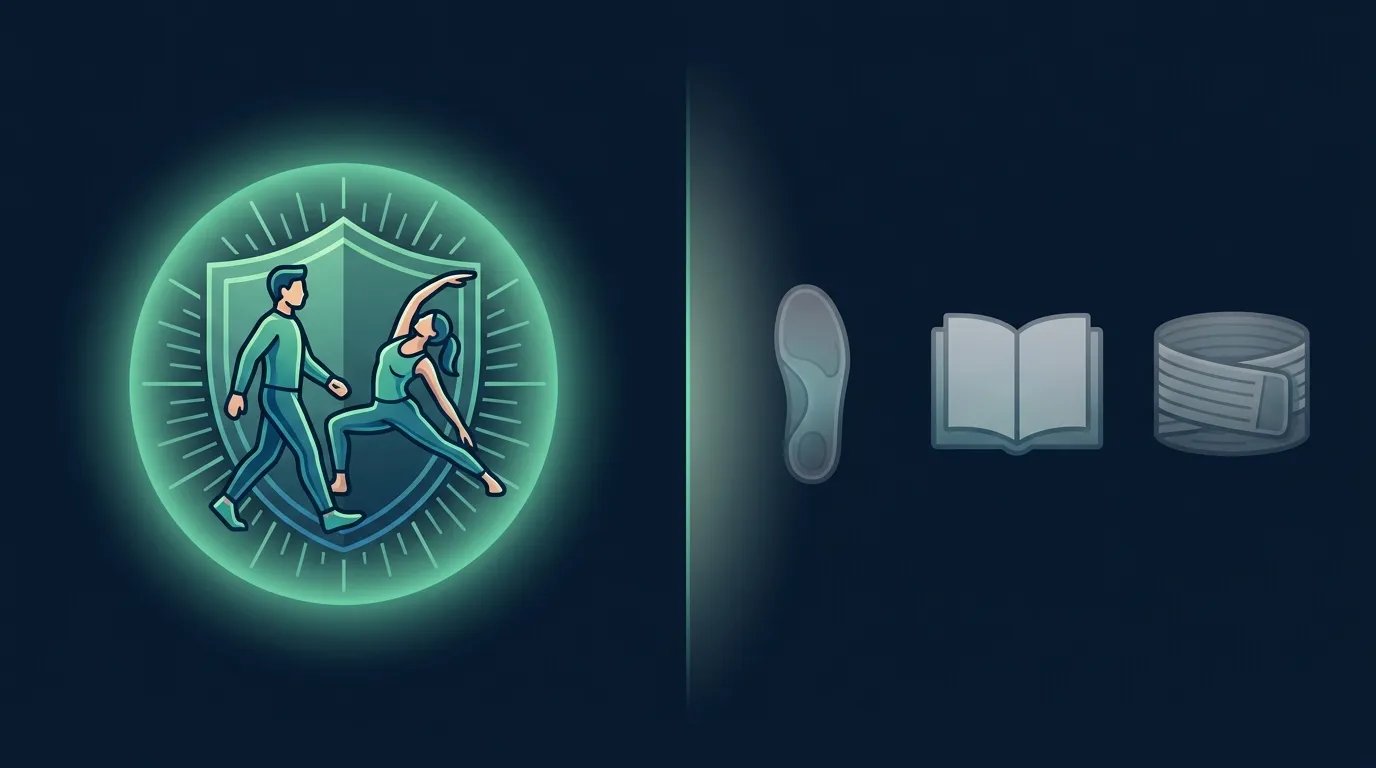
How to Apply This in Practice
The trial protocols pooled by Hayden (2021), Saragiotto (2016), and Steffens (2016) converge on a recipe that is far less exotic than the marketing around back rehab suggests. Here is the practical translation: If you want that recipe written out as exercises, sets and weeks, our guide to the best exercises for lower back pain turns these same trials into a four-week routine you can run at home.
- Frequency: 2 to 3 sessions per week. This is the dose most trials used and the dose that consistently produced results. More is fine. Less usually is not.
- Duration: 20 to 40 minutes per session. The pooled trial average sits in this range. Long-duration protocols did not consistently outperform shorter ones.
- Length: at least 8 weeks. This is the minimum time frame across most trials that showed meaningful pain and function improvements. Effects typically emerge in weeks 3 to 6. Judging the program in week 2 is judging it before adaptation has had a chance.
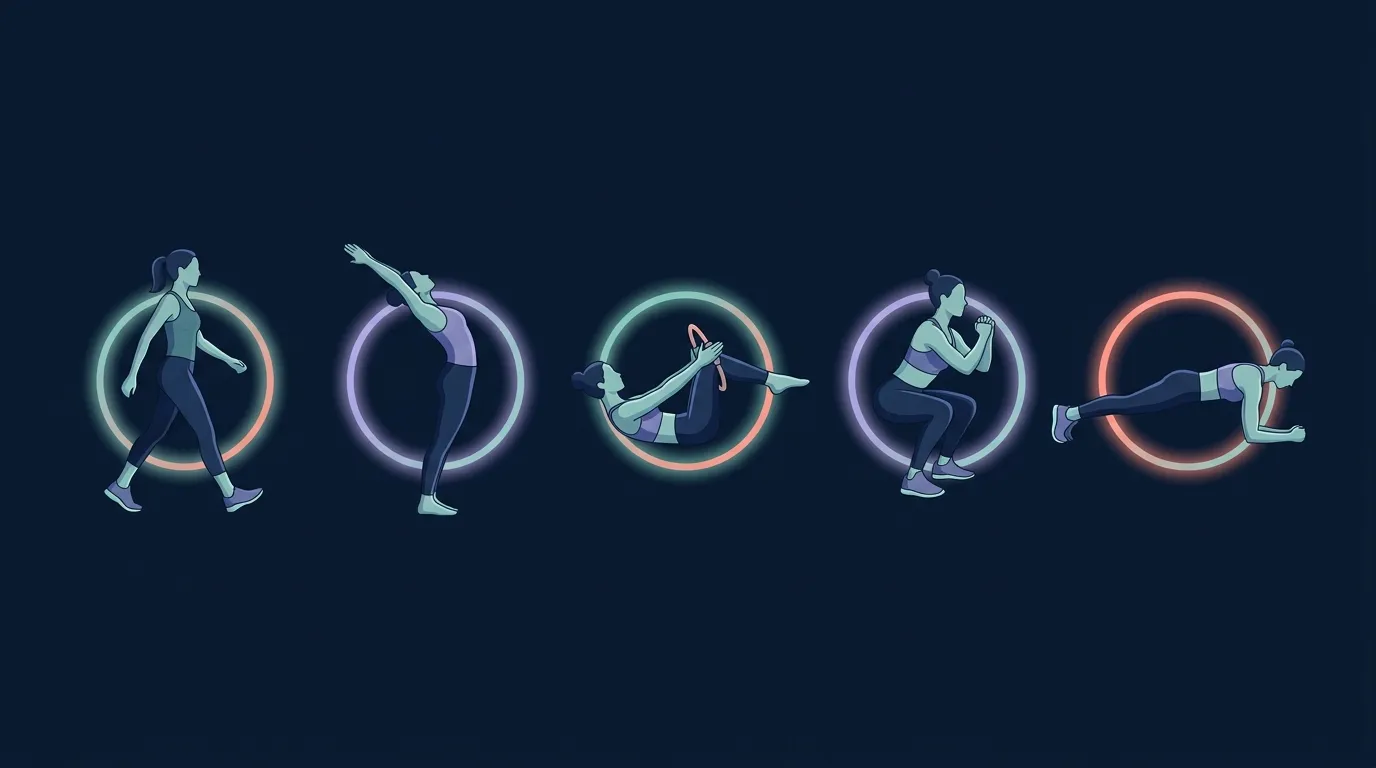
- Modality: your choice, within reason. Walking, Pilates, yoga, general strength, aerobic training, motor control drills, and directional-preference programs all cluster at similar effectiveness levels. Pick the one your calendar and preferences will actually support.
- Intensity: moderate. The pooled protocols were rarely maximal-effort. Aim for something you can sustain: a walk brisk enough to break a light sweat, resistance exercise at loads that leave 2 to 3 reps in reserve, yoga that challenges without straining. Avoid protocols that provoke sharp pain during or the day after.
- Add education. Steffens (2016) showed exercise plus education outperformed exercise alone (45 percent vs 35 percent risk reduction). "Education" here means understanding that hurt does not equal harm, that most back pain is not caused by structural damage on imaging, and that graded activity is safe and beneficial. Reading this article is a small dose of that education.
- Do NOT prioritize the equipment. The prevention data specifically found that back belts, ergonomic aids, and shoe insoles did not reduce risk. Do not spend money on hardware when you could spend the time on a walk or a beginner yoga class instead.
A reasonable 8-week starter that maps onto the trial protocols: 3 walks per week (25 to 40 minutes, brisk pace), 2 short strength sessions per week (bodyweight squats, hip hinges, rows with a band, planks or side planks, 2 to 3 sets of 8 to 12 reps), and 1 mobility session per week (10 to 20 minutes of hip and thoracic mobility work, or a beginner yoga class). Adjust for your baseline. Progress by adding 5 minutes to the walks or 1 rep per set every couple of weeks. Reassess pain and function at week 8. That's it. That's the program.
Individual Variation: Who Responds How
People with Chronic Non-Specific Low Back Pain
This is the population most of the trials enrolled. It's back pain that has been present for more than 3 months without a specific identified cause (no fracture, no radicular signs, no serious systemic disease). Response to exercise is reliable but gradual, with meaningful pain and function gains typically showing up in weeks 4 to 8, and continuing to accrue over 12 to 24 weeks. This is the group with the strongest evidence base and the most predictable response.
People with Acute Low Back Pain (Under 6 Weeks)
Acute flares usually settle on their own within 4 to 6 weeks regardless of intervention. The Foster (2018) series and the Qaseem (2017) guideline both recommend staying as active as pain allows, using heat or NSAIDs for symptom relief, and returning to normal activity rather than resting. Formal exercise programs are not usually needed in the first 2 to 3 weeks. Once the initial pain settles, layering in a maintenance exercise routine is where the prevention benefit lives.
People with Radiculopathy or Nerve Symptoms
Pain that radiates below the knee, numbness, weakness, or altered reflexes point to nerve involvement (sciatica, radiculopathy). This population needs a medical evaluation before starting a general exercise program. Once cleared, exercise still helps, but the protocol usually starts with directional preference work (McKenzie-style extensions or flexions depending on which movement centralizes the symptom) under professional guidance before progressing to general programming. Buttock pain that builds after fifteen or twenty minutes of sitting and eases when you stand is a different picture again, and our guide to the piriformis stretch covers how to separate deep gluteal irritation from a nerve root, and how contested that diagnosis still is.
People Over 60
The Hayden (2021) pool included older adults, and the pattern of benefit held. Age is not a contraindication to exercise for back pain. It is a reason to start gently, prioritize balance and coordination work, and monitor for the medication interactions and comorbidities that are more common in this group. Our strength training after 60 research covers the broader picture for aging adults, including the specific role resistance training plays in preserving spine-supporting muscle mass.
People with Fear-Avoidance
Some of the strongest predictors of chronic back pain becoming persistent are psychological, not structural: catastrophizing pain, believing movement will cause harm, and avoiding activity as a result. This is the population that benefits most from the "movement is safe" education component and often does best in a supervised setting where a clinician can coach graded exposure. If you notice yourself flinching from movements you used to do casually, that is a signal to add education and coaching, not just more exercise.
Common Misconceptions
Misconception 1: "You need to strengthen your core to fix your back."
Core training helps back pain. It does not have a special claim beyond that. Saragiotto (2016) tested motor control exercise (the technical version of "core stability") in 29 trials and found it beat doing nothing but did not beat other exercise at 3 to 12 months. Walking, yoga, Pilates, and general strength all produce similar back-pain outcomes at follow-up. The core specifically is not a mechanical weak point most people need to target with special drills. Move consistently, in almost any structured way, and the core adapts along with everything else.
Misconception 2: "Rest is the safest first move when your back hurts."
The trials say the opposite. Prolonged bed rest worsens deconditioning, prolongs fear of movement, and delays return to normal function. The Qaseem (2017) ACP guideline and the Foster (2018) Lancet series both advise staying as active as pain allows and returning to normal activity as soon as possible. A day or two of relative rest during an acute flare is fine. Beyond that, movement is medicine.
Misconception 3: "I need an MRI first to know what's wrong."
Imaging for uncomplicated low back pain is not recommended in current guidelines. Most adults over 40 will have some degree of disc degeneration, bulging, or facet arthrosis visible on MRI regardless of whether they have symptoms. The finding is often not the cause. Imaging early can trigger a cascade of "you have degeneration" framing that increases fear-avoidance and does not change conservative treatment. Guidelines reserve imaging for cases with red flags (progressive neurological deficit, cauda equina signs, suspected fracture or cancer) or when a specific intervention (surgery, targeted injection) is being seriously considered.
Misconception 4: "Exercise will make my pain worse."
Graded, sub-maximal exercise typically reduces chronic low back pain rather than aggravating it. The 15-point pain reduction pooled by Hayden (2021) came from exercise programs, not from rest. A brief post-exercise increase in soreness in the first 1 to 2 weeks is common and does not indicate harm. Sharp, unfamiliar pain during a specific movement is a signal to modify that movement, not a signal to stop exercising entirely. The distinction between hurt (a symptom) and harm (tissue damage) is central to modern back pain rehab.
Misconception 5: "There's a perfect program for back pain if I can just find it."
There isn't. The head-to-head trials that have looked for a superior modality have not found one. Pilates, yoga, aerobic training, resistance training, motor control work, tai chi, and general exercise cluster in the same effectiveness range at 3 to 12 months when dose is matched. The variable that separates responders from non-responders is not program design. It is program adherence. This is why the framing that "the best exercise is the one you'll do" is not a cliche. It is the empirical conclusion of a very large trial literature.
What the Research Suggests Going Forward
The state of the evidence is clear enough to make firm practical recommendations. Exercise, at moderate dose, done consistently for at least 8 weeks, in almost any structured modality, produces meaningful reductions in chronic low back pain and disability. The gains are similar across modes. The gains do not require heavy loads, specialized equipment, or gym access. And on the prevention side, exercise plus a small amount of education cuts the risk of a new back pain episode by about 45 percent. That is a bigger effect than most pharmaceutical interventions in primary care.
What is still open:
- Whether specific psychological screening (fear-avoidance, catastrophizing) before starting exercise materially improves outcomes, or whether it mainly matters in the subgroup with high fear-avoidance scores.
- The optimal integration of exercise with brief CBT or mindfulness-based interventions. Trials of blended programs look promising but the specific dose of each component is under-studied.
- Long-term retention. Most trials follow participants for 3 to 12 months. Whether the benefits persist at 5 or 10 years without continued exercise is not well characterized.
- The role of graded exposure specifically for people with high fear of movement, versus a simpler "do any exercise you like" approach. Both work; whether one is systematically better for high-fear subgroups is still being debated.
- Digital delivery. Whether app-guided or telehealth-delivered exercise programs match supervised in-person programs is being actively tested. Early results suggest yes for motivated adults, less clear for people with high fear-avoidance or complex comorbidities.
The practical bottom line for someone reading this and trying to decide what to do: pick a modality you can see yourself doing 2 to 3 times a week for the next 8 weeks. Do that. Reassess. The specific program is negotiable. The consistency is not. And if your pain includes red-flag features (progressive weakness, saddle numbness, loss of bladder or bowel control, unexplained weight loss, night pain, or a history of cancer), see a clinician first. Everything above assumes uncomplicated mechanical back pain, which is the vast majority of cases but not all of them.
This is a good example of why consistency beats intensity as a training principle in general. And it is why the standard advice to "just move more" is not the empty platitude it sometimes sounds like. In back pain specifically, that advice happens to be exactly what the 249-trial Cochrane review says.
References
- Hayden JA, Ellis J, Ogilvie R, Malmivaara A, van Tulder MW. "Exercise therapy for chronic low back pain." Cochrane Database Syst Rev. 2021;9(9):CD009790. doi:10.1002/14651858.CD009790.pub2
- Foster NE, Anema JR, Cherkin D, Chou R, Cohen SP, Gross DP, et al. "Prevention and treatment of low back pain: evidence, challenges, and promising directions." Lancet. 2018;391(10137):2368-2383. PMID: 29573872
- Qaseem A, Wilt TJ, McLean RM, Forciea MA. "Noninvasive treatments for acute, subacute, and chronic low back pain: A clinical practice guideline from the American College of Physicians." Ann Intern Med. 2017;166(7):514-530. doi:10.7326/M16-2367
- Saragiotto BT, Maher CG, Yamato TP, Costa LOP, Menezes Costa LC, Ostelo RWJG, Macedo LG. "Motor control exercise for chronic non-specific low-back pain." Cochrane Database Syst Rev. 2016;(1):CD012004. doi:10.1002/14651858.CD012004
- Steffens D, Maher CG, Pereira LSM, Stevens ML, Oliveira VC, Chapple M, Teixeira-Salmela LF, Hancock MJ. "Prevention of low back pain: A systematic review and meta-analysis." JAMA Intern Med. 2016;176(2):199-208. doi:10.1001/jamainternmed.2015.7431
Frequently Asked Questions
Does exercise actually help chronic lower back pain?
Yes, and the evidence base is one of the strongest in musculoskeletal medicine. Hayden and colleagues (2021, Cochrane Database of Systematic Reviews) pooled 249 randomized trials with 24,486 adults with chronic low back pain. Across the trials that compared exercise to no treatment, usual care, or placebo, exercise produced a mean pain reduction of about 15 points on a 0 to 100 scale (95 percent confidence interval -18.3 to -12.2), rated moderate-certainty evidence. Function scores improved by a similar magnitude. The American College of Physicians clinical guideline (Qaseem et al. 2017, Annals of Internal Medicine) issued a strong recommendation, based on moderate-quality evidence, that clinicians select non-pharmacologic therapies including exercise before prescribing drugs for chronic low back pain.
Which type of exercise works best for lower back pain?
The honest answer from the trial evidence is that no single mode of exercise is clearly superior to others for chronic low back pain. Saragiotto and colleagues (2016, Cochrane Database of Systematic Reviews) pooled 29 trials with 2,431 participants and found that motor control exercise (the specific "core stability" approach popularized by physiotherapy) reduced pain and disability more than minimal intervention, but produced similar results to other forms of exercise at 3 to 12 months of follow-up. That means walking, Pilates, yoga, general strength training, aerobic training, and directional-preference programs all show comparable benefits when they are done consistently. Choose the mode you will actually keep doing. The dose matters more than the label.
Can exercise prevent lower back pain from coming back?
Yes, and this is one of the cleanest findings in the whole literature. Steffens and colleagues (2016, JAMA Internal Medicine) pooled 21 randomized trials with 30,850 participants and reported that exercise combined with education reduced the risk of a new low back pain episode by 45 percent (relative risk 0.55, 95 percent confidence interval 0.41 to 0.74). Exercise alone still reduced the risk by 35 percent (RR 0.65, 95 percent CI 0.50 to 0.86). Education alone, back belts, ergonomic modifications, and shoe insoles did not produce a statistically significant protective effect. The signal is exercise. Everything else without exercise underperformed.
Should I rest my back when it hurts, or keep moving?
Modern guidelines have largely reversed the old bed-rest advice. The Foster et al. (2018) Lancet series and the American College of Physicians guideline (Qaseem 2017) both recommend that people with acute or chronic low back pain remain as active as their pain allows and return to normal activity as soon as possible. Prolonged bed rest is now considered harmful because it accelerates deconditioning, worsens fear-avoidance behavior, and delays recovery. A short period (one to two days) of relative rest during an acute flare is fine. After that, gentle walking, hip and thoracic mobility work, and light aerobic activity are the recommended starting point, with progression back to strength and general exercise as symptoms settle.
How much exercise do I need to see a benefit for my back?
The trials pooled in Hayden (2021) used a wide range of doses, from 2 supervised sessions per week to 5, over 4 to 24 weeks. The dose that consistently produced meaningful improvements was on the order of 2 to 3 sessions per week for at least 8 weeks. That matches the ACP recommendation and matches what the 45 percent risk-reduction prevention trials in Steffens (2016) delivered. The practical translation: 20 to 40 minutes of exercise, 2 to 3 times per week, for at least 2 months, is the floor. Effects typically show up in weeks 3 to 6, not the first week. The mistake most people make is quitting before the adaptation window closes.