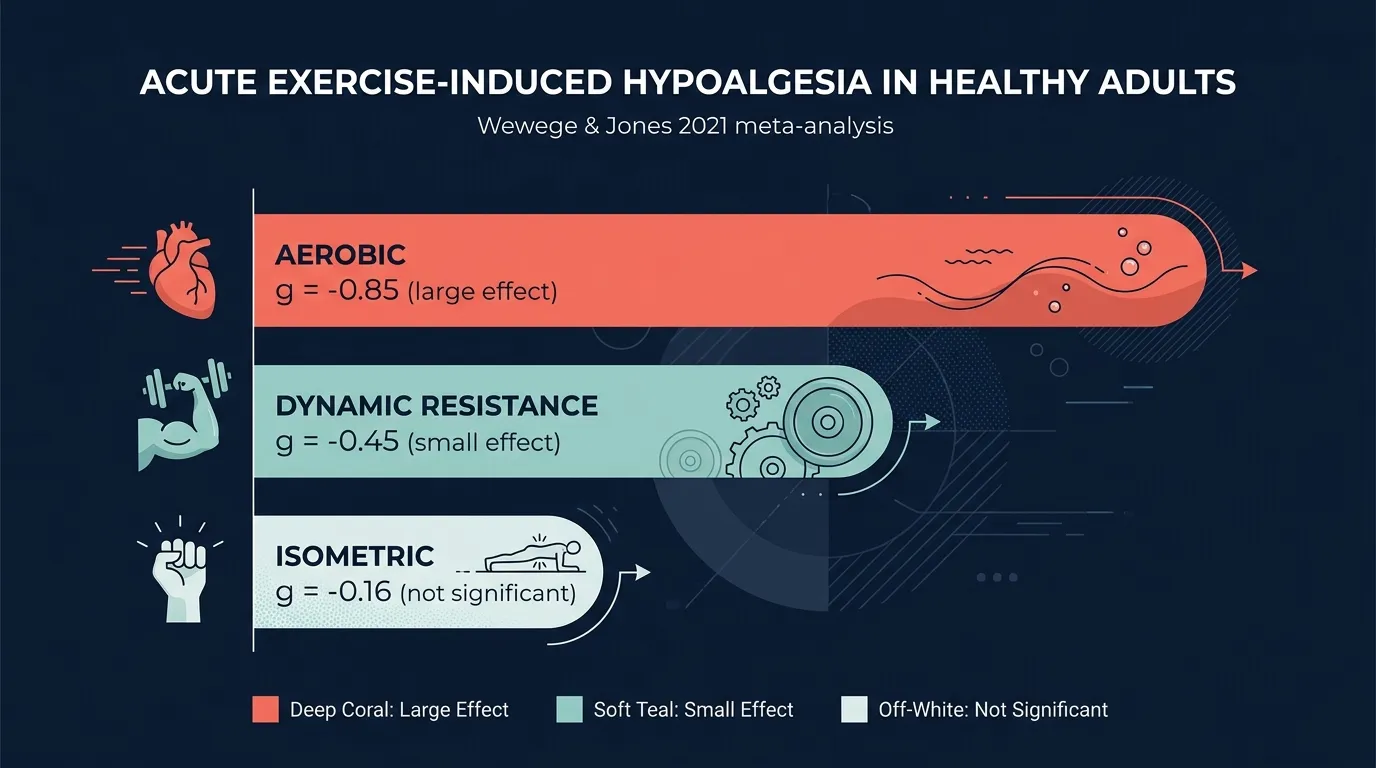
Here's a number worth sitting with: g = -0.85.
That's the standardized effect size Michael Wewege and Matthew Jones calculated in 2021 after pooling seven randomized trials of aerobic exercise in healthy adults. Big by any standard. Bigger than the average effect of most non-drug pain interventions. And the intervention is one thing you already do, or could start doing, this afternoon.
The phenomenon has a name. Exercise-induced hypoalgesia, or EIH. It describes a real, reproducible, short-lived reduction in pain sensitivity that shows up after a single bout of exercise. Not a placebo. Not a coping strategy. A measurable shift in how your nervous system reports pain, one you can trigger on purpose.
But this is a research page, not a hype page. So let's do the full picture. What EIH is, how strong the effect is, how long it lasts, why it looks different in chronic pain populations, and what four meta-analyses agree on. Also where the story gets murky, because it does.
The Research: What the Meta-Analyses Show
Naugle et al. (2012): The Foundational Meta-Analysis
Kelly Naugle, Roger Fillingim, and Joseph Riley at the University of Florida ran the first big meta-analytic pool of the acute EIH literature. Published in The Journal of Pain, they synthesized studies that measured experimentally induced pain (things like pressure algometry and heat pain thresholds) before and after a single bout of exercise.
Their headline finding: all three exercise types they analyzed reduced pain perception in healthy participants.
- Aerobic exercise: moderate effect on pain threshold (d = 0.41) and pain intensity (d = 0.59)
- Isometric exercise: large effect on pain threshold (d = 1.02) and pain intensity (d = 0.72)
- Dynamic resistance exercise: large effect on pain threshold (d = 0.83) and pain intensity (d = 0.75)
The pattern that emerged: whatever your preferred modality, if you exercised hard enough, your pain sensitivity dropped for a window afterward. The paper became the anchor citation for a decade of follow-up work.
Citation: Naugle KM, Fillingim RB, Riley JL 3rd. A meta-analytic review of the hypoalgesic effects of exercise. J Pain. 2012;13(12):1139-1150.
Wewege and Jones (2021): The Updated Meta-Analysis
Nine years after Naugle, Michael Wewege and Matthew Jones at UNSW Sydney re-ran the analysis with tighter inclusion criteria and studies published through 2020. Same question, better methods, more data. Published in The Journal of Pain.
In healthy adults:
- Aerobic exercise: large hypoalgesic effect, g = -0.85 (7 studies, 236 participants)
- Dynamic resistance: small but significant effect, g = -0.45 (2 studies, 23 participants)
- Isometric exercise: no significant acute effect, g = -0.16 (3 studies, 177 participants)
Notice the isometric result inverted the Naugle finding. That's not a scandal, it's the story of a maturing field. Better-controlled studies and tighter test-retest protocols narrowed the isometric effect. Aerobic held up strong. Resistance sat in the middle.
The chronic-pain side of the same paper was thinner. Only three isometric studies met inclusion criteria in chronic musculoskeletal pain (114 participants), and the pooled effect was not statistically significant (g = -0.41, wide confidence interval). Not enough aerobic or resistance trials were available in chronic pain to pool. Which brings us to the third study on the list.
Citation: Wewege MA, Jones MD. Exercise-Induced Hypoalgesia in Healthy Individuals and People With Chronic Musculoskeletal Pain: A Systematic Review and Meta-Analysis. J Pain. 2021;22(1):21-31.
Rice, Nijs, Kosek et al. (2019): The State-of-the-Art Review
David Rice, Jo Nijs, Eva Kosek, and colleagues, a heavyweight panel of pain researchers from Auckland, Brussels, and Karolinska, wrote the field's synthesis paper on EIH in chronic pain. Also in The Journal of Pain. This one is a narrative review rather than a meta-analysis, but it's the paper that shaped how clinicians think about EIH.
The core finding: EIH is often preserved in chronic pain, but it's variable, and a nontrivial subset of patients show blunted or paradoxically increased pain after acute exercise.
Populations where EIH tends to be reduced or absent include:
- Fibromyalgia, where central sensitization is a defining feature
- Chronic whiplash-associated disorders
- Some chronic low back pain subgroups, especially those with high pain catastrophizing
- Chronic fatigue syndrome / ME, where post-exertional malaise can involve pain worsening
The authors also flagged that response varies by exercise intensity and modality. Lower-intensity aerobic often works when higher-intensity work provokes flares. Isometric holds at submaximal loads (often used in tendinopathy rehab) tend to be well-tolerated.
Their practical takeaway: exercise remains the most evidence-backed non-drug tool for chronic pain, but the "prescription" needs to be individualized. The one-size protocol that works for healthy adults will not always work for someone whose nervous system is already dysregulated.
Citation: Rice D, Nijs J, Kosek E, Wideman T, Hasenbring MI, Koltyn K, Graven-Nielsen T, Polli A. Exercise-Induced Hypoalgesia in Pain-Free and Chronic Pain Populations: State of the Art and Future Directions. J Pain. 2019;20(11):1249-1266.
Polaski et al. (2019): The Dose-Response Question
If exercise reduces chronic pain, how much do you need? Anna Polaski and colleagues at Duquesne pooled 75 studies covering eight chronic pain conditions (fibromyalgia, osteoarthritis, low back pain, neck pain, rheumatoid arthritis, intermittent claudication, spinal cord injury, and patellofemoral pain) and tried to model the dose-response curve.
What they found:
- 69 of 75 studies showed positive benefit from exercise for chronic pain
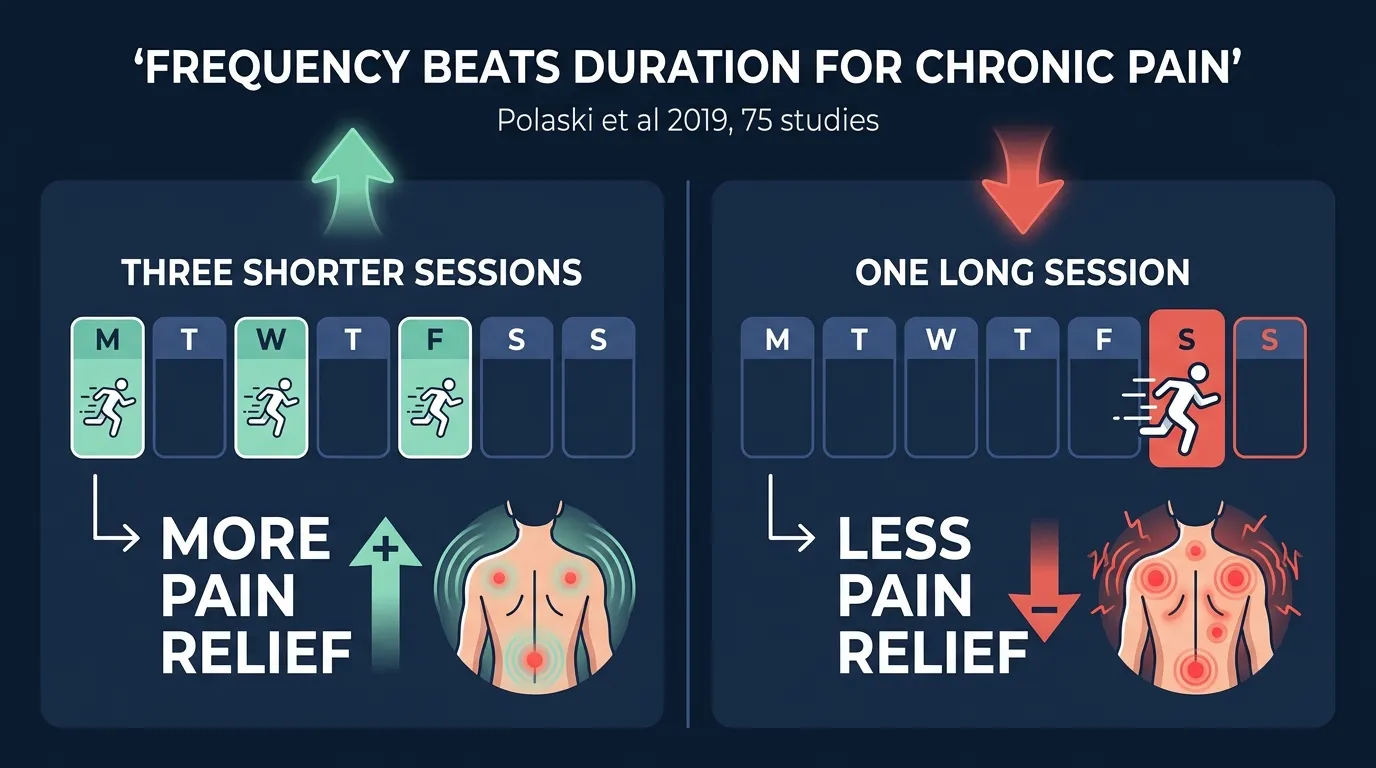
- Exercise frequency per week was the strongest positive predictor of pain relief
- Longer session duration and longer total program duration did not add proportionate benefit in their multivariate model
- For neck pain specifically, longer intervention duration correlated strongly with better outcomes (R = 0.86, p = 0.006)
Translation: for chronic pain, showing up often beats grinding longer per session. Three moderate 30-minute sessions per week appears to do more than one heroic 90-minute session, even at matched weekly volume.
The authors caveated that individual studies varied enormously in exercise prescription and outcome measures, so their dose-response conclusions are estimates, not prescriptions. But the frequency finding held up across the eight pain conditions studied.
Citation: Polaski AM, Phelps AL, Kostek MC, Szucs KA, Kolber BJ. Exercise-induced hypoalgesia: A meta-analysis of exercise dosing for the treatment of chronic pain. PLoS One. 2019;14(1):e0210418.
How Exercise Actually Reduces Pain: The Mechanisms
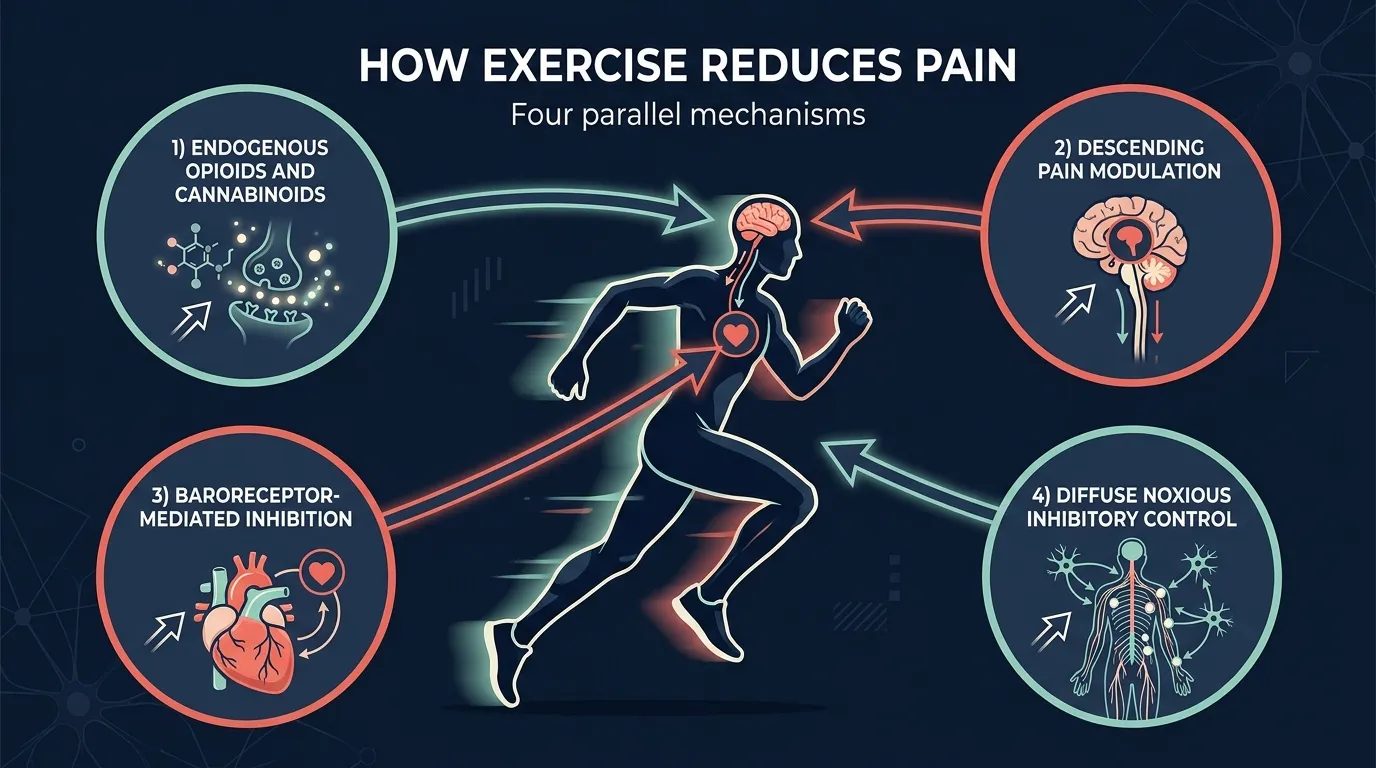
EIH is not one thing. It's a convergence of several parallel systems, each firing at once during and after exercise. The Rice, Nijs, Kosek review lays out the main candidates, and human research has confirmed roles for most of them.
Endogenous Opioids and Endocannabinoids
The most-cited mechanism, and the one runners' hazy vocabulary of "endorphins" gestures at. Exercise increases circulating beta-endorphin and other endogenous opioid peptides. It also elevates anandamide and other endocannabinoids, the same signaling molecules cannabis binds to. When researchers block the opioid receptors with naloxone before exercise, the hypoalgesic effect gets partially attenuated in some studies, confirming the pathway is doing real work.
Descending Pain Modulation
Your brainstem contains a pain-inhibitory network centered on the periaqueductal gray. Exercise activates this network, which then sends inhibitory signals down the spinal cord that dampen incoming pain signals before they even reach conscious perception. This is the same top-down pain suppression that lets soldiers not feel wounds until the battle ends.
Baroreceptor-Mediated Inhibition
Exercise raises blood pressure. Stretch receptors in the carotid sinus (the baroreceptors) detect the pressure and send signals to the brainstem that, incidentally, also inhibit pain processing. This is why isometric contractions of large muscles (which spike blood pressure quickly) sometimes produce disproportionate acute pain relief.
Conditioned Pain Modulation and Diffuse Noxious Inhibitory Control
There's a general principle in pain neuroscience called conditioned pain modulation. When you apply one painful stimulus, it dampens the perception of another. Exercise is itself a mildly noxious stimulus (muscle burn, effort discomfort), which activates the same inhibitory system and reduces pain sensitivity elsewhere in the body. This is one reason lower-body cycling can reduce upper-body pain sensitivity, and vice versa.
Get an evidence-based plan built for you
FitCraft, our mobile fitness app, pairs you with an AI coach who builds you a personalized plan around your goals, schedule, and fitness level. Every FitCraft program is designed by Domenic Angelino, MPH (Brown University) and NSCA-CSCS, with research published in the Journal of Strength and Conditioning Research and Medicine & Science in Sports & Exercise.
Take the Free Assessment Free • 2 minutes • No credit cardHow to Actually Use This: A Practical Read
The research points to a few practical patterns. Nothing here is a prescription (talk to your clinician for that, especially if you have a chronic pain condition). But here's what the evidence supports.
For general soreness and mild recurring pain in healthy adults: a moderate-to-vigorous aerobic session of 20 to 40 minutes gets you the acute EIH window. Effect is largest right after exercise and fades over the next 30 minutes or so. Not a magic solution, but a real one, and free.
For chronic pain conditions: start lower than you think you need. Rice and colleagues emphasize that vigorous prescriptions can provoke flares in central sensitization conditions. A short walk at conversational pace is a legitimate starting dose. Frequency matters more than intensity or duration according to Polaski. Three shorter sessions per week beat one long weekend session.
For tendinopathy and specific joint pain: isometric holds at submaximal loads have their own line of evidence in physical therapy contexts. Not covered fully by the EIH literature above, but often used clinically for acute pain relief in tendon issues.
Consistency window: the acute EIH effect is transient. Building durable pain reduction requires repeated sessions across 8 to 12 weeks at minimum. That's the window most successful chronic-pain trials used. Two weeks of solid exercise followed by a two-week gap will not stack.
Common Misconceptions
Misconception: "Endorphins are the whole story"
Reality: partial. Endogenous opioids are one of at least four systems involved. Naloxone blockade only partially reduces EIH, meaning most of the effect comes from non-opioid pathways (endocannabinoids, descending modulation, baroreceptor activation). If you took an opioid antagonist and exercised, you'd still get some pain relief. The "runner's high" is real, but the pain-relief part is a team sport.
Misconception: "If exercise hurts more than it helps, I must be doing it wrong"
Reality: not necessarily. Rice et al. (2019) documented that a meaningful subset of people with chronic pain (especially fibromyalgia, chronic whiplash, and CFS/ME) show blunted or paradoxically increased pain after acute exercise. That is a nervous-system response, not a character flaw. The clinical answer is usually to reduce intensity, shorten duration, and build up gradually rather than pushing through. This is a good time to talk to a physical therapist or pain specialist.
Misconception: "You have to work out hard to get pain relief"
Reality: intensity helps in healthy adults, but not necessarily in chronic pain. The Wewege and Jones meta-analysis found larger effects at higher intensity in pain-free populations. But in chronic pain, moderate-intensity exercise sustained over weeks and months tends to outperform bursts of vigorous work. Polaski's dose-response analysis specifically found frequency, not intensity, was the top predictor of pain reduction across 75 chronic-pain trials.
Misconception: "Exercise can replace pain medication"
Reality: no, and this framing is dangerous. Exercise is a strong adjunct. It has real, measurable effects on pain sensitivity and on long-term pain outcomes. It does not replace prescribed medication, physical therapy, or medical evaluation. If you're on medication for a chronic pain condition, do not adjust or stop it based on an exercise routine. Talk to your prescriber. Exercise almost always works better alongside a proper treatment plan than in place of it.
What the Research Suggests Going Forward
The "does acute exercise reduce pain sensitivity in healthy adults" question is settled. The answer is yes, with moderate-to-large effect sizes depending on modality.
The "does long-term exercise training reduce chronic pain" question is also mostly settled. Yes, across most conditions studied, with clinically meaningful effect sizes. Polaski's 75-study analysis and dozens of individual-condition meta-analyses converge here.
What's still being worked out:
Who does not respond, and why. The individual-difference question is huge. Some people with fibromyalgia get major relief from exercise. Some get worse. Predicting which is still poor. Central sensitization biomarkers, pain catastrophizing scores, and prior activity history all seem to matter, but there's no clean prediction rule yet.
Optimal dose per condition. Polaski's frequency finding held across conditions, but the ideal frequency, session duration, and modality mix for, say, chronic low back pain vs. osteoarthritis vs. fibromyalgia is still being untangled. The field will look better in ten years.
How EIH interacts with mood and sleep. Pain, depression, anxiety, and poor sleep form a tight loop. Exercise reduces all four. Whether the pain reduction is primarily direct (EIH mechanisms) or downstream of mood and sleep improvement is still an open question.
The honest summary: exercise is the single best-studied non-drug tool for pain, and the effect sizes are competitive with a lot of pharmaceutical options. It just requires consistency, and consistency is exactly what most people fail at. Which is the actual problem worth solving.
References
- Naugle KM, Fillingim RB, Riley JL 3rd. "A meta-analytic review of the hypoalgesic effects of exercise." The Journal of Pain 13.12 (2012): 1139-1150. doi:10.1016/j.jpain.2012.09.006
- Wewege MA, Jones MD. "Exercise-Induced Hypoalgesia in Healthy Individuals and People With Chronic Musculoskeletal Pain: A Systematic Review and Meta-Analysis." The Journal of Pain 22.1 (2021): 21-31. doi:10.1016/j.jpain.2020.04.003
- Rice D, Nijs J, Kosek E, Wideman T, Hasenbring MI, Koltyn K, Graven-Nielsen T, Polli A. "Exercise-Induced Hypoalgesia in Pain-Free and Chronic Pain Populations: State of the Art and Future Directions." The Journal of Pain 20.11 (2019): 1249-1266. doi:10.1016/j.jpain.2019.03.005
- Polaski AM, Phelps AL, Kostek MC, Szucs KA, Kolber BJ. "Exercise-induced hypoalgesia: A meta-analysis of exercise dosing for the treatment of chronic pain." PLoS One 14.1 (2019): e0210418. doi:10.1371/journal.pone.0210418
Frequently Asked Questions
What is exercise-induced hypoalgesia?
Exercise-induced hypoalgesia (EIH) is a transient reduction in pain perception that occurs during and immediately after a single bout of exercise. Naugle et al. (2012) pooled the healthy-participant literature and found aerobic exercise, isometric exercise, and dynamic resistance exercise all reduced experimentally induced pain, with effect sizes ranging from moderate to large depending on modality and pain test.
How long does exercise-induced pain relief last?
In healthy adults, EIH typically lasts from a few minutes up to roughly 30 minutes after exercise ends. The effect is short-lived because it reflects acute pain-system modulation, not structural change. Building durable pain reduction requires repeated exercise sessions over weeks, which is why exercise therapy programs for chronic pain typically run 8 to 12 weeks minimum.
Does exercise work for chronic pain?
Yes, but the acute response is more variable than in healthy adults. Rice, Nijs, Kosek and colleagues (2019) reviewed the state of the field and reported that some people with chronic pain show normal EIH, some show blunted EIH, and a smaller subset actually experience increased pain after acute exercise. Regular training over weeks and months still delivers meaningful long-term pain reduction across most chronic pain conditions, including fibromyalgia, osteoarthritis, and low back pain.
What type of exercise is best for pain relief?
In pain-free adults, Wewege and Jones (2021) found aerobic exercise produced the largest acute hypoalgesic effect (g=-0.85), followed by dynamic resistance (g=-0.45). Isometric holds did not produce a significant acute effect in their meta-analysis, though they remain useful in specific rehab contexts. For long-term chronic pain management, Polaski et al. (2019) found that exercise frequency per week was the strongest predictor of pain reduction across 75 studies covering eight chronic pain conditions.
How does exercise reduce pain biologically?
Several parallel mechanisms are involved. Exercise activates the endogenous opioid system and the endocannabinoid system. It stimulates descending pain modulation from the periaqueductal gray in the brainstem. It temporarily elevates blood pressure, which engages baroreceptor-mediated pain inhibition. And it produces a general "diffuse noxious inhibitory control" response where one sensory input dampens the perception of another. The combined effect is a real, measurable reduction in how much pain the nervous system reports.