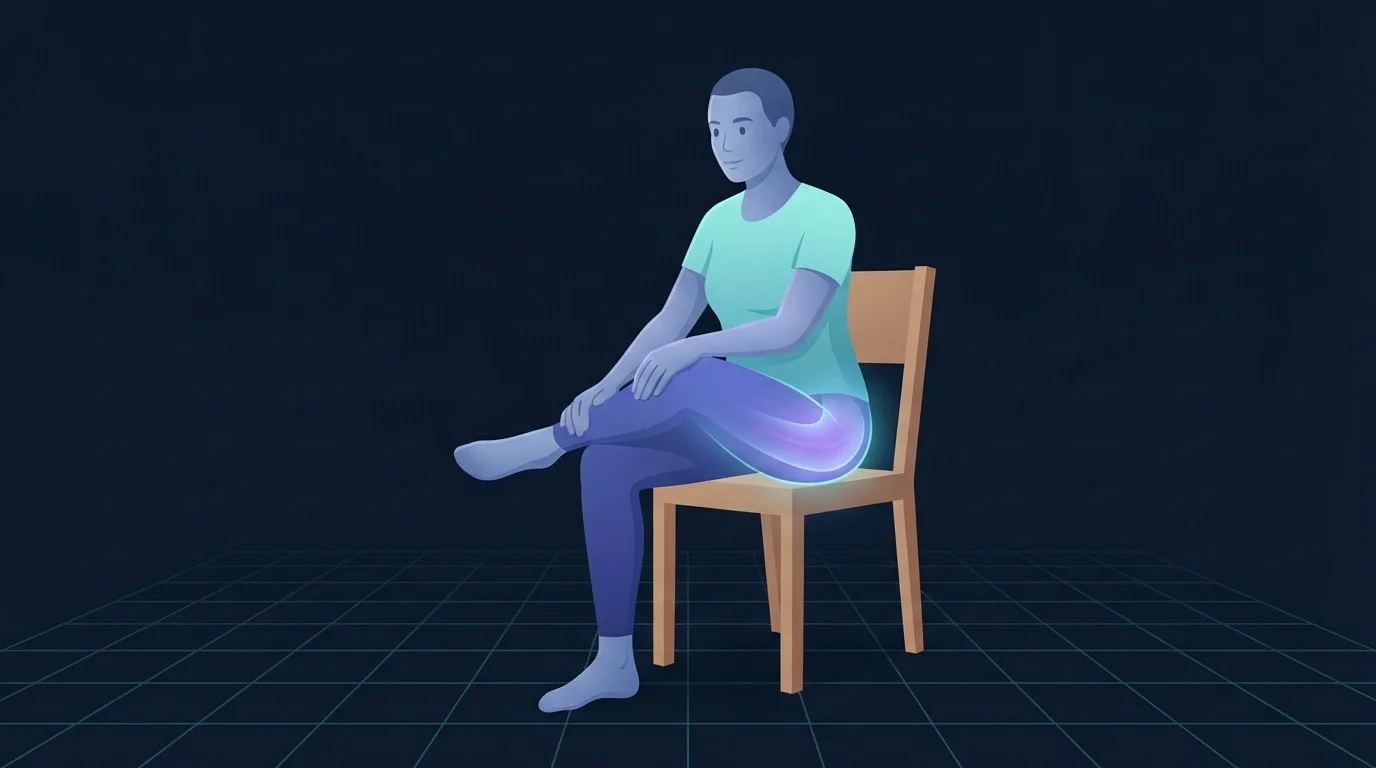
It starts as a small ache deep in one side of your backside, usually after a long drive or a long meeting. Then it starts arriving earlier. Sitting on a hard chair becomes a negotiation, you catch yourself leaning onto one cheek, and some days a thin line of discomfort runs down the back of the thigh like a rumour of sciatica.
Search for it and you'll find a hundred versions of the same figure-4 stretch, all promising relief, none of them explaining why the position is shaped that way or what to do when it stops working after ten minutes. That is the frustrating part. The stretch usually does help. It just doesn't hold, and nobody tells you what the missing half is.
Here is the missing half, along with an honest account of how shaky the underlying diagnosis actually is.
What the Piriformis Actually Does
The piriformis is a flat, pear-shaped muscle that runs from the front of the sacrum, through the greater sciatic notch, to the top of the thigh bone. It sits underneath the gluteus maximus, in company with five other small deep rotators. The sciatic nerve, the thickest nerve in your body, passes through the same crowded corridor.
Its job changes depending on where your hip already is, and that detail explains every stretch position on this page. With the hip extended, as in standing, the piriformis rotates the thigh outward. Once the hip is flexed past about 90 degrees, its line of pull shifts and it starts acting as an internal rotator instead. Michel and colleagues (2013), writing in Annals of Physical and Rehabilitation Medicine, use exactly this reversal to explain why the clinical tests look the way they do: with the hip flexed, you stretch the piriformis by rotating the leg outward, and with the hip extended you stretch it by rotating inward.
It also abducts the flexed hip and helps steady the head of the femur. That last function is the one that matters for treatment, because a muscle doing overtime as a stabiliser behaves very differently from a muscle that's simply short.
Piriformis Syndrome Versus Sciatica From the Spine
Most sciatic-type leg pain comes from the lumbar spine, where a disc bulge or a narrowed canal irritates a nerve root before it ever reaches the buttock. How common sciatica is at all depends entirely on how you define it: a review by Konstantinou and Dunn (2008) in Spine found published prevalence estimates ranging from 1.2 percent to 43 percent, almost all of that spread caused by inconsistent definitions rather than different populations.
Piriformis syndrome is the label for sciatic pain generated outside the spine, where the nerve is irritated in the deep gluteal space. And this is where you should hold your certainty loosely, because three separate lines of evidence say the picture is murkier than the internet suggests.
First, the diagnostic criteria are unsettled. Hopayian and Danielyan (2018) reviewed the clinical features and found the condition clusters around four things: buttock pain, pain made worse by sitting, tenderness near the greater sciatic notch, and pain on any manoeuvre that puts the piriformis under tension. Useful. But their conclusion is blunt about the rest: many physical tests have been described, the accuracy of those tests cannot be concluded from the studies to date, and the prevalence of the condition among people with low back pain and sciatica is still unknown because the larger studies carry a high risk of bias.
Second, the anatomy story is weaker than it sounds. You have probably read that the sciatic nerve sometimes runs through the piriformis instead of under it, and that this variation causes the syndrome. The variation is real and common. Smoll (2010) pooled 18 studies and 6,062 cadavers and put its prevalence at 16.9 percent. The catch is the comparison: in surgical case series of patients actually operated on for piriformis syndrome, the same anomaly showed up in 16.2 percent, a difference that was not statistically significant. If the variation were driving the condition, you would expect it to be enriched in the patients. It isn't.
Third, the field has partly moved on. A systematic review by Kizaki and colleagues (2020) pooling 853 patients found that clinicians lack confidence diagnosing this presentation precisely because the definition is ambiguous, and proposed deep gluteal syndrome as the broader and more defensible term: a non-discogenic sciatic nerve disorder involving entrapment somewhere in the deep gluteal space, of which the piriformis is one possible culprit among several.
None of that means your buttock hurts for no reason. It means the treatment should be aimed at the hip's mechanics rather than at one muscle you've decided is the villain.
| Feature | More typical of deep gluteal or piriformis pain | More typical of spine-driven sciatica |
|---|---|---|
| Where it starts | Deep in one buttock, sometimes spreading to the back of the thigh | Low back or buttock, with a clearer band running past the knee |
| Sitting | Worse after 15 to 20 minutes, better on standing and walking | Variable, often worse with slumped sitting and forward bending |
| Coughing or sneezing | Usually no change | Often a sharp spike down the leg |
| Pressing the spot | Tender midway between the tailbone and the bony point of the hip | Local spine tenderness, buttock often not tender |
| Numbness or weakness | Uncommon, and a reason to get assessed | More common, and follows a specific nerve root pattern |
A Five-Minute Self-Check
Run these in order. Each takes under a minute, and all of them are hints rather than verdicts.
- The sitting clock. Time how long you can sit on a firm chair before the ache starts. Deep gluteal pain tends to have a fairly reproducible threshold, often 10 to 20 minutes, and it eases within a few minutes of standing.
- The point test. Find the midpoint between your tailbone and the bony knob on the side of your hip. Press in firmly with your thumb. Tenderness there, on the painful side only, is one of the four features Hopayian and Danielyan identified.
- The seated figure-4. Sit tall, cross the painful ankle over the opposite knee, then hinge forward from the hips. If that reproduces your exact pain in the buttock within 30 seconds, it suggests something in the deep gluteal space is being loaded.
- The straight-leg raise. Lie on your back and have someone lift the straight painful leg. Pain shooting down past the knee before 70 degrees points more toward nerve root involvement. Worth knowing: a normal result doesn't rule anything out, which Hopayian and Danielyan state explicitly.
- The cough test. Cough hard. A sharp jolt down the leg leans toward the spine, not the buttock.
If three or four of the first group line up and the cough test is quiet, treating this as a deep gluteal problem for six weeks is reasonable. If the picture is mixed, or anything in the red flags section below applies, get assessed first.
The Piriformis Stretch Positions That Actually Lengthen the Muscle
This is the part almost nobody quantifies, and it has been measured. Gulledge and colleagues took CT scans of seven subjects in three positions, built three-dimensional bone models, and calculated how much the piriformis actually elongated in each (Gulledge et al., 2014, Medical Engineering and Physics).
Two findings matter for your routine. The two conventional orderings, flexing and adducting then externally rotating, or flexing and externally rotating then adducting, produced almost identical elongation of roughly 12 percent. Sequence, in other words, isn't worth arguing about. What did change the number was depth: placing the hip in about 115 degrees of flexion with 40 degrees of external rotation and 25 degrees of adduction increased muscle length by 15.1 percent, a 30 to 40 percent improvement over the conventional versions.
Translated into a chair or a mat, that means pulling the knee higher toward the opposite shoulder rather than pulling harder across the body. The authors also noted the deeper positions were easier for some patients to perform, which is a rare case of the better option being the more comfortable one.
Eight Moves: Four Stretches and Four Strengthening Drills
Stretches first, because they're what you came for. Strengthening second, because it's what keeps the stretches from being a daily tax.
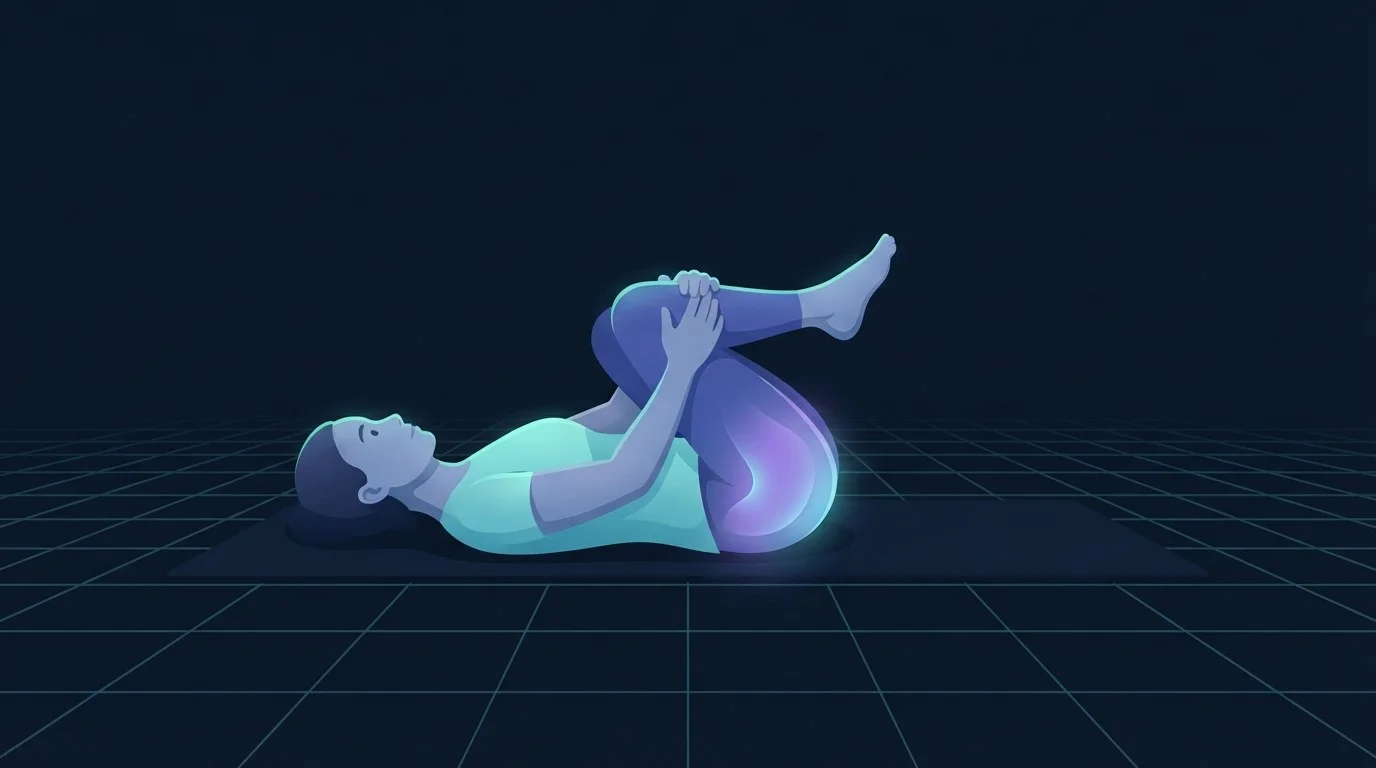
1. Supine figure-4 (the anchor stretch)
Lie on your back with knees bent. Cross the painful ankle over the opposite thigh just above the knee, reach through the gap, and pull the supporting thigh toward your chest until the stretch appears deep in the buttock. Pull the thigh higher rather than pushing the crossed knee away.
Dosing: 20 to 30 seconds, three rounds per side, once or twice a day.
2. Seated figure-4
The office version. Sit tall, cross the ankle over the opposite knee, keep your back long and hinge forward from the hips rather than rounding through your spine. Useful because you can do it at the desk where the pain is being generated.
Dosing: 20 to 30 seconds, two rounds per side, every couple of hours on long sitting days.
3. Half-pigeon or reclined pigeon
The floor version with a larger range. Bring the painful-side shin forward across the mat, keep the back leg long behind you, and lower your chest toward the front shin. If the front knee complains, do it lying on your back with the ankle crossed and the other foot on a wall. Our half-pigeon and pigeon pose pages cover the setup detail and the common compensations.
Dosing: 30 to 45 seconds per side, two rounds, on the days you have a mat and a floor.
4. Supine cross-body knee pull
Lie on your back, bring the painful-side knee up, then draw it diagonally across toward the opposite shoulder with both hands. This one biases adduction rather than rotation and is the gentlest entry point when the figure-4 is too spicy. The hip abductor stretch is a close cousin worth rotating in.
Dosing: 20 to 30 seconds, two or three rounds per side, daily.
Find out what's really holding you back
FitCraft, our mobile fitness app, pairs you with an AI coach who builds you a personalized plan around your goals, schedule, and fitness level. Every FitCraft program is designed by Domenic Angelino, MPH (Brown University) and NSCA-CSCS, with research published in the Journal of Strength and Conditioning Research and Medicine & Science in Sports & Exercise.
Take the Free Assessment Free • 2 minutes • No credit cardNow the half that changes the demand rather than the symptom. The logic comes from a 2010 case report in the Journal of Orthopaedic and Sports Physical Therapy: Tonley and colleagues described a patient whose piriformis symptoms had not responded to stretching, whose movement analysis during a single-leg step-down showed the hip collapsing into adduction and internal rotation, and whose hip abductors and external rotators tested weak. Strengthening those muscles and retraining the step-down resolved the symptoms. One case is one case. The mechanism it describes, a deep rotator working overtime because the bigger stabilisers are not, matches what a lot of people with stubborn buttock pain are living.
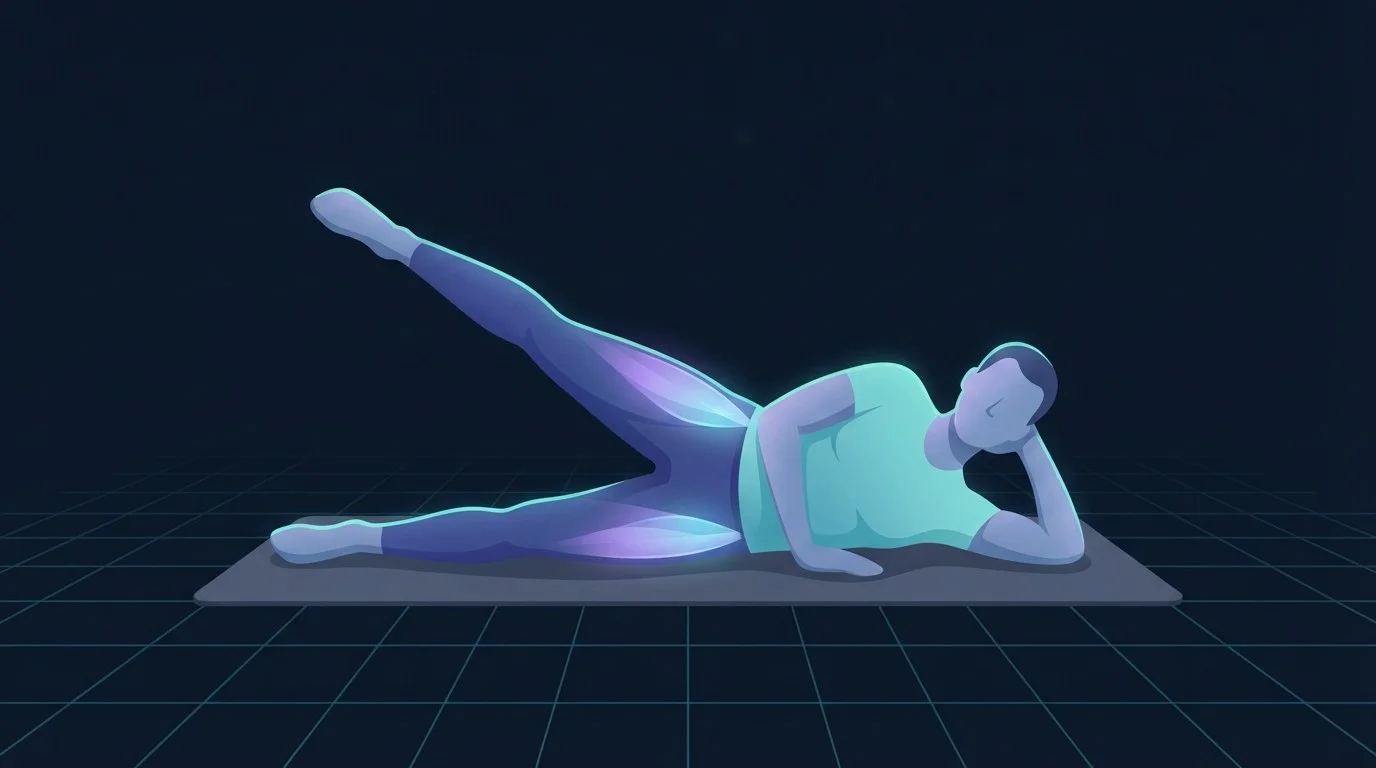
5. Side-lying hip abduction
Lie on your side, bottom knee bent, top leg straight and slightly behind the line of your body, and lift it toward the ceiling without letting your pelvis roll back. This is consistently the highest gluteus medius exercise in the electromyography literature, and it needs nothing but a floor.
Dosing: 2 to 3 sets of 12 to 15 per side, three days a week.
6. Clamshells
Side-lying, hips and knees bent, feet together, open the top knee without rolling the pelvis backward. Worth knowing that clamshells hit the deep rotators harder than they hit the big glutes: a 2026 muscle-functional-MRI study by Kim and colleagues in Sports Health measured a 14.5 percent activation increase in the piriformis itself from clamshells, against 4.5 percent in the gluteus medius. If you want to train the muscle that's bothering you rather than stretch it, this is the drill. See our clamshells page for the pelvis position that makes or breaks it.
Dosing: 2 sets of 15 to 20 per side, three days a week.
7. Glute bridges, then single-leg bridges
Feet flat, drive through the heels, finish the lift with the glutes rather than the lower back. In the same 2026 study the single-leg bridge raised gluteus medius activation by 11.6 percent and piriformis activation by 13.1 percent, so it trains the stabiliser and the deep rotator together. Progress to one leg when 20 two-legged reps feel easy. Our glute bridges page has the pelvic tilt cue.
Dosing: 2 to 3 sets of 12 to 15, or 8 to 12 per side on one leg, three days a week.
8. Controlled step-downs
Stand on a low step, painful side on the step, and lower the other heel slowly toward the floor while keeping the standing knee tracking over the middle of the foot and the pelvis level. This is the movement retraining half of the Tonley protocol, and it's where the strength you built in moves 5 to 7 gets connected to something you actually do.
Dosing: 2 sets of 8 to 10 per side, slow, three days a week. Use a wall for fingertip balance.
A Daily Routine You Will Actually Keep
Ten minutes, three of those days a little longer. Stretching earns short-term relief, so it goes in every day. Strengthening changes the demand, so it goes in three times a week with a rest day between.
| Day | Morning (4 min) | During the day | Evening (10 min) |
|---|---|---|---|
| Mon, Wed, Fri | Supine figure-4, 3 x 30s per side | Seated figure-4 every 2 hours | Stretches, then moves 5 to 8 |
| Tue, Thu, Sat | Supine figure-4, 3 x 30s per side | Seated figure-4 every 2 hours, plus a 5 minute walk | Half-pigeon and cross-body knee pull |
| Sun | Optional | Longer easy walk | Off |
Two rules for the block. Stretch to a firm pull, never into the pain you're trying to treat, and never into anything that produces pins and needles down the leg. And break up sitting before the clock runs out rather than after: standing up at 12 minutes when your threshold is 15 is worth more than any stretch you do at minute 40.
If the sitting itself is the thing wrecking you, the hip flexors on the front of the joint are usually part of the same story, and our guide to tight hip flexors covers that side of the hip. For the broader range work that keeps the joint moving in every direction, see hip mobility exercises.
What Helps Less Than You Think
Digging a lacrosse ball straight into the sore spot is the most popular and least advisable item on the internet's list. The deep gluteal space is where the sciatic nerve lives. Sustained hard pressure on an already irritated nerve can leave you worse for days. Soft tissue work on the surrounding glute mass is fine; grinding on the exact tender point is not.
Stretching harder is the second one. The modelling data says the ceiling on a conventional stretch is around 12 percent elongation, and the way past it is a deeper hip angle rather than more force. Yanking produces a bigger sensation, not a longer muscle.
Stretching only is the third. If your hip collapses inward every time you take a step down a kerb, a muscle that stabilises the hip will keep getting recruited into a job it's too small for, and thirty seconds of relief each morning won't change that. That is the whole point of the strengthening half.
Rest alone is the fourth. Complete rest reduces the load, then the load comes back unchanged the moment you return to normal life. Deep gluteal irritation usually responds better to modified activity plus strengthening than to a fortnight on the sofa. If working out at all feels like the risk right now, a plan built around floor-based glute work is a reasonable way back in, which is most of what a no-equipment home workout app is good for.
When to See a Clinician
Some of this is a wait-and-see problem. Some of it isn't. Stop the routine and seek care the same day if any of the following show up.
- Any change in bowel or bladder control, including new difficulty starting or stopping urination, incontinence, or numbness in the saddle area between the legs. This combination can signal cauda equina syndrome, which is a surgical emergency. Do not wait for a routine appointment.
- Progressive weakness in the leg or foot, including a foot that slaps the floor, trouble pushing off the toes, or a leg that gives way.
- Numbness that's spreading or that persists rather than coming and going with position.
- Pain in both legs at once, or pain that has moved from one side to both.
- Fever, unexplained weight loss, a history of cancer, recent significant trauma, or night pain that wakes you. These are standard back-pain red flags and they apply here too.
- No meaningful change after six weeks of consistent stretching and strengthening. Not an emergency, but the point to stop self-managing.
For context on what happens after six weeks: in a 250-patient series by Michel and colleagues, combined medication and rehabilitation resolved symptoms in 51.2 percent of cases, and the remainder needed further treatment. Half of a conservative caseload getting better without anything invasive is a good outcome. It also means half didn't, and that group needed a clinician rather than another stretch.
The Bottom Line
Do the figure-4, pull the thigh toward the chest rather than across the body, hold it 20 to 30 seconds, and repeat it two or three times a day. Then do the part that makes the relief last: side-lying abduction, clamshells, bridges and slow step-downs, three days a week. Hold the diagnosis loosely, because the evidence for piriformis syndrome as a distinct entity is thinner than the internet implies, and keep the red flag list somewhere you'll remember it.
Your hip isn't broken and you're not stuck with this. It is a small muscle doing a big muscle's job in a crowded space, and the fix is mostly about giving the big muscles their job back. If the hip is part of a wider posture and pelvis picture, our guide on how to fix anterior pelvic tilt covers the front-and-back balance that sits underneath all of it.
Frequently Asked Questions
What is the best piriformis stretch?
The supine figure-4 is the best starting position for most people, because it combines the three things the piriformis responds to: deep hip flexion, external rotation, and adduction. Three-dimensional modelling by Gulledge and colleagues in 2014 found that conventional versions of this stretch lengthened the muscle by roughly 12 percent, and that driving hip flexion toward 115 degrees while adding about 40 degrees of external rotation and 25 degrees of adduction increased that elongation by a further 30 to 40 percent. Depth of hip flexion matters more than how hard you pull.
How often should you do a piriformis stretch?
Daily is fine, and twice daily is reasonable during a flare. Hold each position 20 to 30 seconds and repeat it two or three times per side, which takes about five minutes. Stretching gives short-term relief, so spacing it through the day usually beats one long session. Pair it with hip abductor and external rotator strengthening three days a week, because that's the part that changes how the hip behaves between sessions.
How do you tell piriformis pain from a disc problem?
Deep gluteal pain tends to sit in the buttock, worsen after 15 to 20 minutes of sitting, ease when you stand and walk, and reproduce when you press midway between the tailbone and the hip bone. Nerve root pain from the spine more often changes with coughing, sneezing or bending, follows a clearer band down the leg, and comes with numbness or weakness in a specific pattern. Neither picture is diagnostic on its own. Hopayian and Danielyan concluded in 2018 that the accuracy of the physical tests for piriformis syndrome cannot be established from the studies published so far, so treat a self-check as a hint, not an answer.
Should you stretch or strengthen the piriformis?
Both, and strengthening is the part most people skip. A 2010 case report by Tonley and colleagues described a runner whose piriformis symptoms had not responded to stretching and who improved after a programme of hip abductor and external rotator strengthening plus movement retraining. The reasoning is mechanical: when the hip collapses into adduction and internal rotation under load, the deep rotators work overtime. Stretching relieves the symptom, strength work changes the demand.
How long does piriformis pain take to settle?
Most people who respond to conservative care notice a difference within two to three weeks and see the bulk of their improvement over six to twelve weeks. In a 250-patient series published by Michel and colleagues in 2013, combined medication and rehabilitation resolved symptoms in 51 percent of cases, which is honest about both directions: half got better without anything invasive, and half needed more. If six weeks of consistent stretching and strengthening has produced nothing, that's the point to get assessed rather than push harder.
Can you run with piriformis pain?
Often yes, at reduced volume, provided the pain stays at a low level, settles within an hour of finishing, and doesn't come with numbness or weakness. Cut distance by roughly half, drop hills and speed work first, and keep the stretching and strengthening going on the days you don't run. Any numbness, any loss of strength in the foot or ankle, or pain that climbs during the run means stop and get it looked at.