You sit down to tie your shoes and something in the front of your hip catches. You squat and your heels lift. You lie on your back, pull one knee across your body, and the opposite side of the pelvis peels off the floor to meet it. None of that is an injury. It's a joint that has spent most of the last decade parked at roughly ninety degrees.
The usual response is to stretch harder, hold longer, and feel loose for about an hour. Then Monday comes back around and so does the tightness. That loop is frustrating enough that plenty of people decide their hips are just built this way.
They usually aren't. The research on range of motion is unusually clear about two things: how much work it takes to change it, and the fact that stretching isn't the only way to get there. This guide covers both, plus the six movements that between them cover every direction the hip is designed to travel.
What Counts as a Hip Mobility Exercise?
A hip mobility exercise takes the joint to the end of a range and asks you to control it there. That's the difference between mobility and flexibility. Flexibility is how far a joint can be pushed by something else: gravity, a strap, a partner. Mobility is how far you can take it yourself and still be in charge when you arrive.
The hip is a ball and socket, so it moves in six directions: flexion, extension, abduction, adduction, internal rotation and external rotation. Most routines cover two. People stretch their hip flexors and their hamstrings, both of which live in the same forward-and-back plane, and never touch rotation at all. Then they wonder why a deep squat still feels blocked.
Mobility, flexibility and stability are three different things
- Flexibility is passive length. Someone pushes your knee toward your chest and you measure the angle.
- Mobility is active range. You lift the leg to that same angle yourself and hold it there.
- Stability is control at the end of that range, which is what makes new range usable under load.
The gap between passive and active range is the useful number. If someone can push your knee to your chest but you can't get it halfway there on your own, the tissue is long enough already. What's missing is strength and control on the other side of the joint. Stretching that hip more won't close the gap.
Why Do Hips Get Stiff in the First Place?
One position, repeated for years
Sitting holds the hip flexors short and the glutes long and quiet for hours at a time. Nothing about that is dramatic on any given day. Repeated for a decade, it produces a joint that hasn't been asked to visit its own end range in a very long time. If it's specifically the front of the hip that keeps locking up, our guide to tight hip flexors goes deeper on the Thomas test and on why tightness there is rarely short muscle.
The consequence shows up in how people walk. Anderson and Madigan compared healthy older adults with healthy young adults and found the older group walked with a hip extension angle roughly 30% smaller, and, critically, that they lacked the available hip extension range to walk any other way (Anderson and Madigan, Journal of Biomechanics, 2014). The gait change wasn't a choice. The range was gone, so the pattern reorganised around it.
The link with the lower back is real, and smaller than the internet says
Stiff hips and sore backs travel together. A 2024 systematic review pulled together 54 studies on hip biomechanics in people with low back pain and found a consistent reduction in hip range of motion, most clearly in internal rotation (Pizol et al., BMC Musculoskeletal Disorders, 2024).
Be careful with what that means. An earlier review of 24 studies asked the narrower question of whether hip range of motion is associated with nonspecific low back pain, and found limited hip internal rotation was the only movement impairment with a significant association. The authors rated the supporting evidence very low quality (Avman et al., Musculoskeletal Science and Practice, 2019). So the honest version is this: stiff hips and sore backs show up in the same people, internal rotation is the range most often missing, and nobody has demonstrated that restoring it makes the pain go away. Work on the hip because a hip that moves is worth having, not because you've been promised a cure.
The 10-Minute Hip Mobility Routine
Six movements, roughly 90 seconds each, and the joint is covered in all six of its directions. Do it barefoot on a mat, or on carpet with a folded towel under the knee. Nothing here needs equipment, though a light band and one dumbbell give you somewhere to progress to.
| Movement | What it opens | Dose | The cue that matters |
|---|---|---|---|
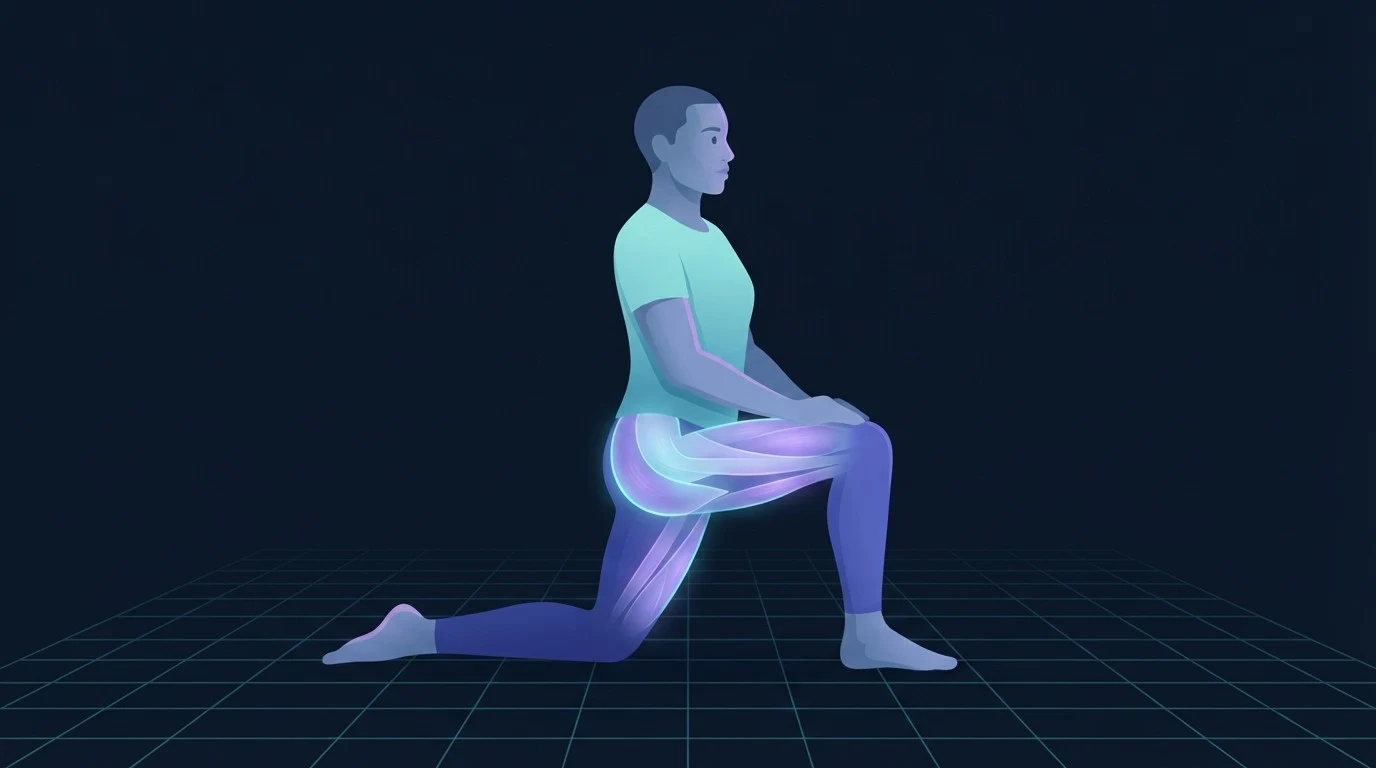
| Half-kneeling triplanar stretch | Hip extension, across three planes | 60 sec per side | Tuck the pelvis under before you press forward, or the lower back takes the range instead of the hip. |
| Seated 90/90 rotation | Internal and external rotation | 8 slow reps per side | Sit tall. The moment you round your back to get lower, the hip has stopped moving. |
| Half pigeon | Deep external rotation, glutes | 60 sec per side | Square the hips to the front. Letting the back hip drift open turns it into a groin stretch. |
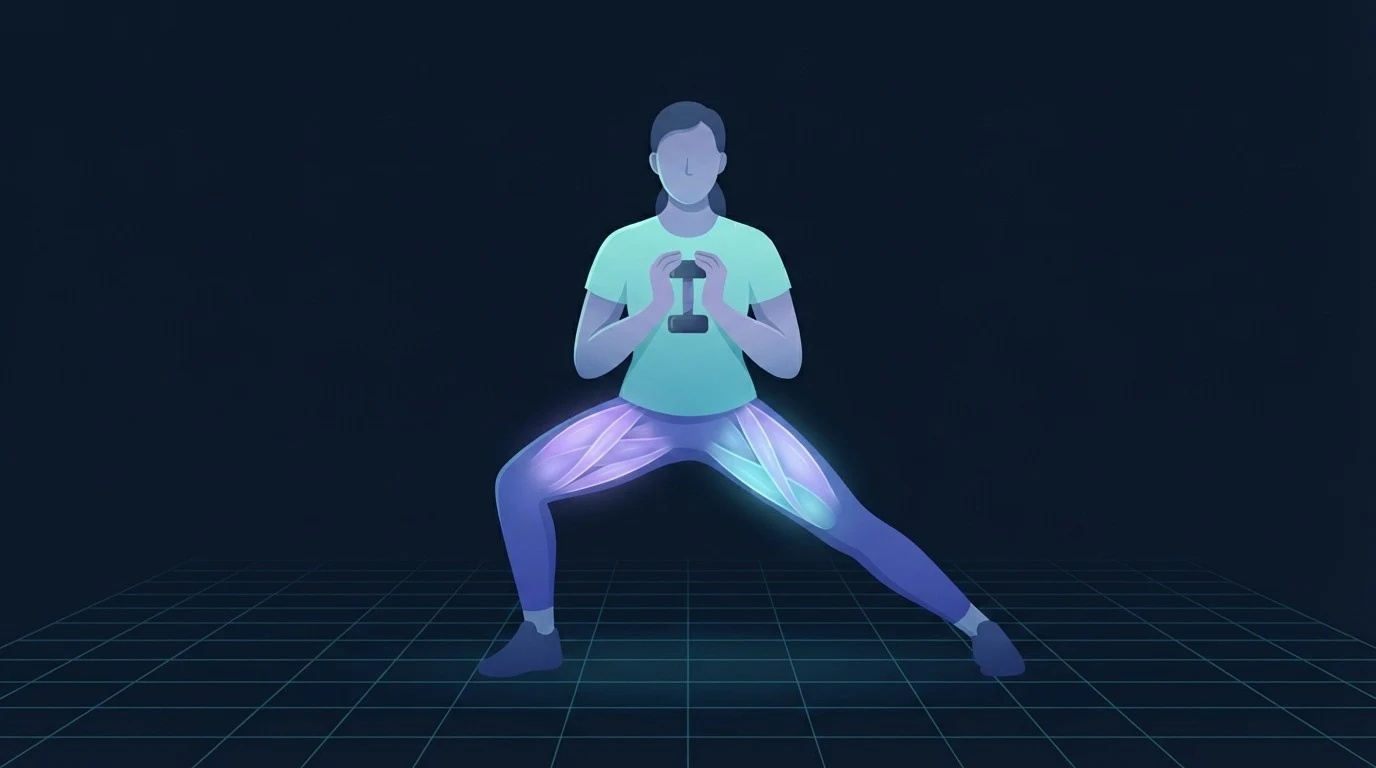
| Side lunges | Adduction and abduction | 8 reps per side | Keep the straight leg's foot flat. Rolling onto its edge hides the range you came for. |
| Glute bridges | Extension, under load | 12 reps, 2 sec hold at the top | Ribs down. Arching the back at the top feels like a bigger bridge and is a smaller one. |
| Clamshells or fire hydrants | Abductors and deep rotators | 12 reps per side | Pelvis still. If your whole torso rocks backward, the hip stopped working two reps ago. |
Two notes on running it. The order is deliberate: the long holds come first, while you're still willing to stay in one position, and the loaded work comes last so you finish by using the range you just found. And the 90/90 is the movement most people skip and most people need, because seated internal rotation is exactly the range the evidence keeps flagging as the one that goes missing. If you would rather run those positions as one flowing warm-up sequence, our guide to the worlds greatest stretch walks through all five of them in order.
Find out what's really holding you back
FitCraft, our mobile fitness app, pairs you with an AI coach who builds you a personalized plan around your goals, schedule, and fitness level. Every FitCraft program is designed by Domenic Angelino, MPH (Brown University) and NSCA-CSCS, with research published in the Journal of Strength and Conditioning Research and Medicine & Science in Sports & Exercise.
Take the Free Assessment Free • 2 minutes • No credit card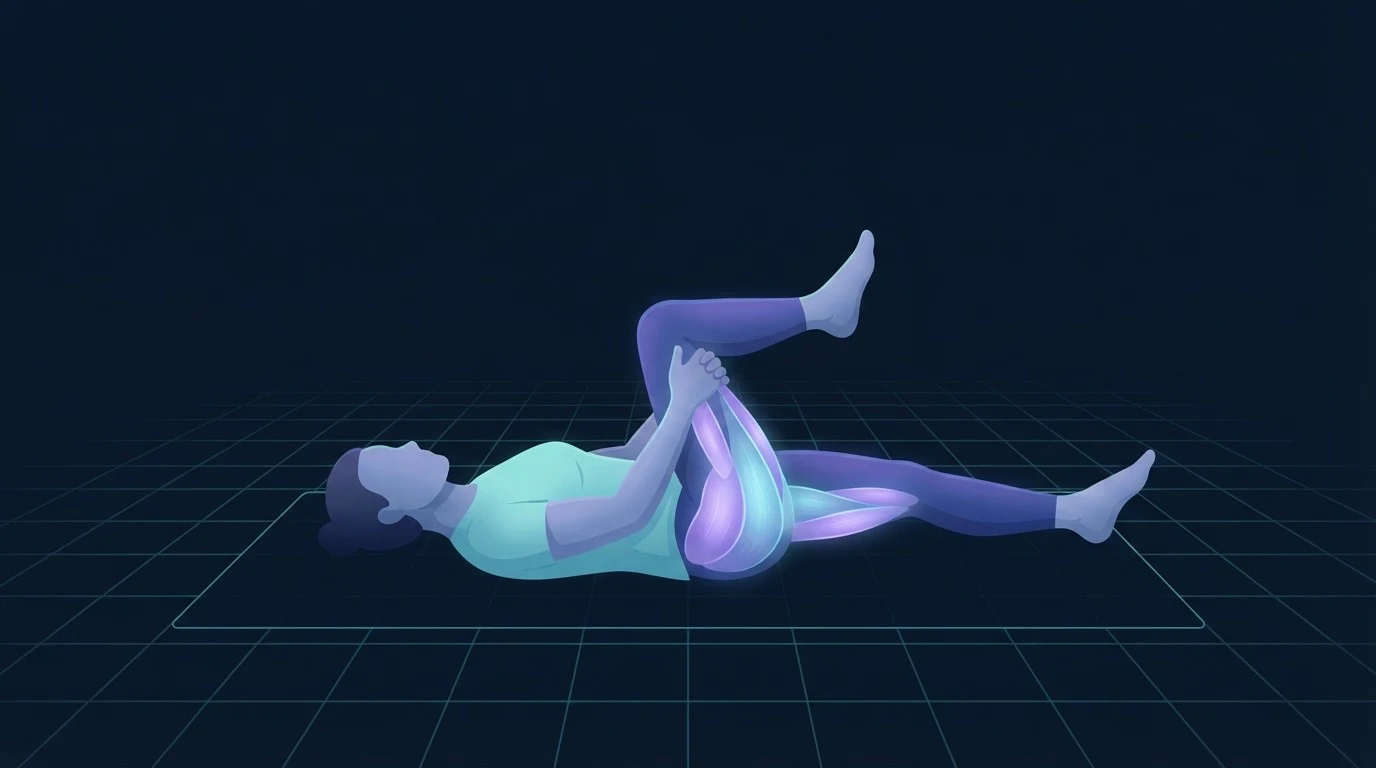
How Often Should You Do Hip Mobility Exercises?
This is the question with the cleanest answer in the field, and almost nobody applies it. A systematic review by Thomas and colleagues pooled stretching trials to work out what actually drives range-of-motion change, and the answer was weekly volume and weekly frequency, not how long any one session runs. Their conclusion: static stretching for at least five minutes per week per muscle group, across at least five days a week, improves range of motion, while the time spent stretching within a single session had no significant effect (Thomas et al., International Journal of Sports Medicine, 2018).
Read that twice, because it inverts what most people do. The Sunday-afternoon forty-minute mobility session is the least efficient way to spend forty minutes.
| Pattern | Weekly total | Days per week | Verdict against the evidence |
|---|---|---|---|
| One 40-minute session on Sunday | 40 min | 1 | Plenty of volume, wrong shape. Frequency is the variable that tracks with gains. |
| 10 minutes, 6 days a week | 60 min | 6 | Comfortably clear of the threshold on both volume and frequency. |
| 2 minutes, every morning | 14 min | 7 | Enough for two or three muscle groups. Rotate which ones across the week. |
| 5 minutes after every workout | 15 to 20 min | 3 to 4 | Workable, and it piggybacks on a habit you already have. |
Consistency beats duration here more decisively than almost anywhere else in training. If you can only protect ten minutes a day, protect ten minutes a day. And if the full routine is the barrier, the smallest version that still works is two positions before you make coffee.
Does Stretching Beat Strength Training for Hip Mobility?
No, and this is the finding that should change how you build the routine. A 2021 systematic review and meta-analysis compared strength training against stretching for improving range of motion across 11 studies and 452 participants. The difference between them wasn't statistically significant (effect size -0.22, 95% CI -0.55 to 0.12, p = 0.206). Training through a full range of motion improved flexibility about as well as stretching did (Afonso et al., Healthcare, 2021).
That matters for two reasons. The obvious one is time: a deep goblet squat or a full-range split squat buys range and strength in the same set. The subtler one is that strength arrives with control, so the new range is range you can use standing up rather than range you can only reach lying on the floor. The same principle drives stretch-mediated hypertrophy, where training a muscle at long lengths builds it faster than training it short.
So build the routine in two halves. Use the holds to buy range, then use loaded work at the end of that range to keep it. Add a little each week, the ordinary progressive overload rule applied to depth and control rather than to weight on a bar. A pair of dumbbells or a set of bands is enough, and if you'd rather have that structured for you without a gym, our roundup of the best no-equipment workout apps covers the options.
Should You Do Hip Mobility Work Before or After Training?
Both, but not the same version. Long static holds before a session cost you output. A systematic review of acute stretching effects in healthy active people found static stretching reduced subsequent performance by an average of 3.7% while dynamic stretching improved it by 1.3%, with a clear dose response: holds of 60 seconds or more produced a 4.6% deficit against 1.1% for holds under 60 seconds (Behm et al., Applied Physiology, Nutrition, and Metabolism, 2016).
Those numbers are small, and they only really bite if you're about to sprint or lift near your limit. The split is easy anyway. Before training, move through each position for a few controlled reps instead of parking in it. After training, or on a rest day, take the long holds. Our breakdown of static versus dynamic stretching works through the timing in more detail.
Who Gets the Most Out of Hip Mobility Exercises?
Older adults, where the payoff shows up in walking
An eight-week hip and ankle stretching program in 40 healthy older adults, average age 72, increased combined hip and knee motion during gait and increased freely chosen walking speed (Christiansen, Archives of Physical Medicine and Rehabilitation, 2008). Gait speed isn't a vanity metric. It tracks with independence.
The same theme runs through a 12-month follow-up of older adults with chronic low back pain, where hip extension range predicted repeated chair-rise performance and hip external rotation predicted gait speed (Coyle et al., ACR Open Rheumatology, 2021). Hip range keeps turning up as a predictor of the everyday tasks that decide whether someone stays independent.
People with hip osteoarthritis
A Cochrane review of nine trials and 549 participants found land-based exercise reduced pain in hip osteoarthritis (standardised mean difference -0.38, roughly 8 points on a 100-point scale) and improved physical function, with a number needed to treat of 6 for both outcomes (Fransen et al., Cochrane Database of Systematic Reviews, 2014). That's a modest, real effect for a condition where the alternative is usually waiting. Work with a clinician on the specifics, and see our guide to training around joint pain for the general approach.
Desk workers whose squat has quietly got shallower
If your hips feel fine walking around and pinch the moment you get below parallel, you're the standard case. Nothing is wrong. The joint has a range it hasn't visited since school, and it takes a few weeks of small daily deposits to get it back. And if the squat still stops short once the hips move freely, look one joint lower: our guide to ankle mobility exercises covers the knee-to-wall test that tells you whether the block is there.
What Hip Mobility Exercises Will Not Do
- They won't prevent injury on their own. A meta-analysis of 25 trials covering 26,610 participants found stretching had essentially no effect on injury rates (risk ratio 0.963, 95% CI 0.846 to 1.095), while strength training cut injuries to roughly a third (risk ratio 0.315) (Lauersen et al., British Journal of Sports Medicine, 2014). If injury prevention is the goal, the dumbbells are doing more work than the foam roller.
- They won't change your bone anatomy. Hip socket depth and femoral neck angle vary a lot between people. Some hips are structurally built for a deep squat and some aren't, and no amount of stretching moves bone. Pain that pinches sharply at the front of the hip at the end of a range is worth getting looked at rather than stretched into.
- They won't fix your back by themselves. The association between hip range and back pain is real; the causal claim isn't established. Treat mobility work as one part of a plan that also includes strength and sensible load management.
- They won't survive a long break. Range of motion detrains like everything else. This is a habit, not a project with an end date.
The Bottom Line
Hip mobility exercises work when the dose is right and the joint gets covered in all six of its directions, not just the two everybody stretches. Ten minutes most days beats forty minutes once a week, because frequency is what the pooled data rewards. And half the routine should be loaded rather than passive, because strength through a full range buys the same flexibility and hands you control along with it.
The floor for this is genuinely low. Two positions, before coffee, most mornings. That clears the weekly threshold the research points to, and it's the version people are still doing in March.
Frequently Asked Questions
What are the best hip mobility exercises?
The best hip mobility exercises are the ones that cover all three planes the hip moves in, because the joint is a ball and socket and a routine built only from forward-and-back stretches leaves most of it untouched. A complete set is a half-kneeling hip flexor stretch for extension, a 90/90 seated rotation for internal and external rotation, a side lunge for the adductors, a glute bridge for extension under load, and a clamshell or fire hydrant for the abductors and deep rotators. Six moves, roughly 90 seconds each, covers the joint.
How long does it take to improve hip mobility?
Most people see measurable range-of-motion change in three to six weeks of consistent work, and some of the change shows up in the first session because part of what limits you is stretch tolerance rather than tissue length. The pooled evidence says weekly volume and frequency drive the result: roughly five minutes per muscle group per week, spread across five or more days, is where range of motion reliably improves (Thomas et al., 2018). Two focused minutes a day beats a single long session on Sunday.
Should you do hip mobility exercises every day?
Daily is the easiest way to hit the weekly dose, and hip mobility work is low enough in intensity that it does not need a recovery day the way heavy lifting does. Weekly frequency is positively associated with range-of-motion gains in the pooled stretching data, while the length of any single session matters much less. If daily is unrealistic, four or five days a week gets you most of the benefit. One long session a week does not.
Can hip mobility exercises fix lower back pain?
They can be part of the answer, but treat them as one input rather than a cure. A 2024 systematic review of 54 studies found people with low back pain move with less hip range of motion, especially hip internal rotation (Pizol et al., 2024). A separate review of 24 studies found limited hip internal rotation was the only movement impairment significantly associated with nonspecific low back pain, and rated the supporting evidence very low quality (Avman et al., 2019). That is an association, not proof that restoring the range removes the pain. See a clinician for back pain that is severe, persistent, or radiating.
Are hip mobility exercises better before or after a workout?
Do the long static holds after training or on their own, and keep the pre-workout version short and moving. A systematic review of acute stretching found static stretching reduced subsequent performance by an average of 3.7% while dynamic stretching improved it by 1.3%, with a clear dose response: holds of 60 seconds or longer cost 4.6% while holds under 60 seconds cost only 1.1% (Behm et al., 2016). Before a session, use a few controlled reps of each position. Save the long holds for afterwards.
Do you need equipment for hip mobility exercises?
No. Every movement in the routine on this page works on a floor with nothing but a mat or a folded towel under the knee. A light resistance band makes clamshells and fire hydrants harder once bodyweight stops being a challenge, and a single dumbbell held at the chest gives you something to progress side lunges with, but neither is required to start.
Why do my hips feel tight even though I stretch them every day?
Tightness is a sensation, not a measurement, and it often reflects a range your nervous system does not trust rather than a muscle that is genuinely short. That is why passive stretching alone can relieve the feeling for an hour and change nothing by the next morning. Strength training through a full range of motion produces range-of-motion gains statistically indistinguishable from stretching (Afonso et al., 2021), so the fix is usually to add load and control at the end of the range instead of stretching the same position harder.