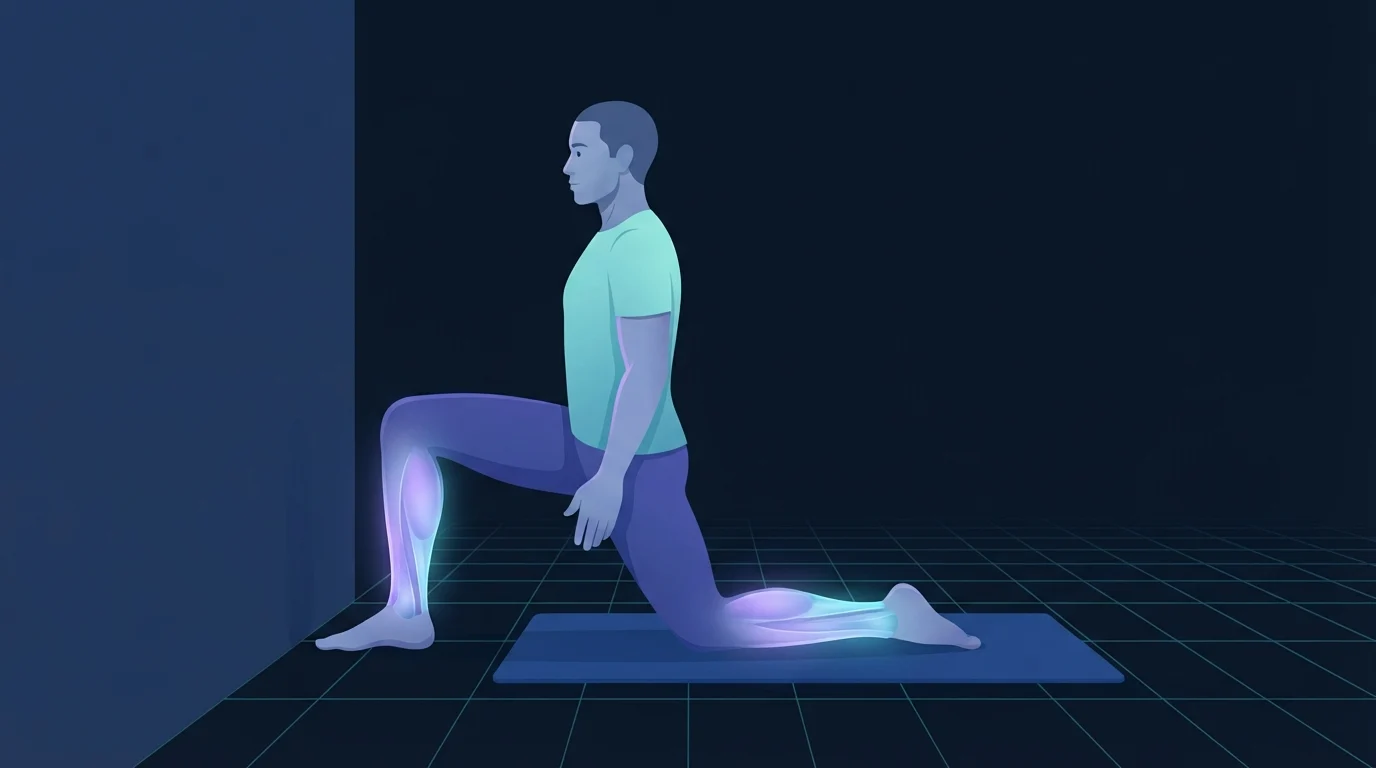
You sink into a squat and somewhere around parallel your heels start to float. Your chest folds forward to keep you upright. On a run, the same ankle feels like it's landing on a block of wood, and by mile three the calf on that side is the one that talks to you.
The usual advice is to stretch your calves. You do, for a week, and nothing changes. So you conclude that your ankles are just built stiff and you start putting plates under your heels and hoping nobody notices.
Here's the more useful framing. Ankle stiffness is a measurable thing, not a vibe, and the measurement takes two minutes with a tape measure and a wall. Once you know the number, the fix is more specific than "stretch your calves" and considerably more effective.
What Ankle Mobility Actually Means
Dorsiflexion is the range that matters
The ankle moves in several directions, but the one that limits squatting, lunging, running and landing is dorsiflexion: the shin travelling forward over a planted foot. Everything else about ankle mobility is a footnote next to it.
Two muscles sit behind that range. The gastrocnemius crosses the knee as well as the ankle, so it limits you most with the leg straight. The soleus sits underneath it and crosses only the ankle, so it limits you with the knee bent, which is exactly the position you're in at the bottom of a squat. That is why a straight-leg calf stretch can feel productive and change nothing about your squat. You stretched the wrong one.
Mobility, flexibility and stability are three different things
- Flexibility is passive length. Someone pushes your foot toward your shin and reads the angle.
- Mobility is active, weight-bearing range. You drive the knee forward yourself with the heel down.
- Stability is control once you get there, which is what turns new range into range you can land on.
Most home tests measure the middle one, which is the right one, because a squat is a weight-bearing task. If you can push your foot into plenty of dorsiflexion lying down but the knee stops dead the moment you stand on it, the tissue is long enough already and the missing piece is strength and control.
Why Stiff Ankles Show Up in Your Squat and Your Stride
The squat borrows range from the knee and hip
When a joint runs out of room, the body does not stop. It finds the range somewhere else. Researchers tested this directly by putting a 12-degree wedge under the forefoot to artificially restrict ankle dorsiflexion during a double-leg squat, then measuring what changed. The restricted condition produced less knee flexion, more inward knee movement, less quadriceps activation and more soleus activation (Macrum et al., Journal of Sport Rehabilitation, 2012).
Read that list again, because it's the whole argument for this page. A stiff ankle makes the squat shallower, makes the knee track worse, and takes work away from the muscle you were trying to train.
It isn't only a range problem, though. A study of 101 healthy adults looking at which hip and ankle variables predicted squat depth found the answer split by sex: in men, ankle dorsiflexion range was associated with how deep they could squat, while in women it was ankle dorsiflexion strength rather than range (Kim et al., Journal of Human Kinetics, 2015). So before you spend six weeks stretching, run the test below. If your range is fine, the problem is somewhere else and stretching will waste your time.
Landing and running load the ankle you have
Dorsiflexion range also changes how you absorb impact. In 35 healthy participants, those with greater passive ankle dorsiflexion showed more knee flexion during landing and smaller peak vertical ground reaction forces, a combination the authors linked to lower anterior cruciate ligament injury risk (Fong et al., Journal of Athletic Training, 2011). More available range means a softer landing strategy is even on the menu.
There's prospective data too. A one-year study following junior elite basketball players found that ankle dorsiflexion range discriminated between those who went on to develop patellar tendinopathy and those who did not, with an optimal cutoff around 36.5 degrees and an area under the curve of 0.81 (Backman and Danielson, American Journal of Sports Medicine, 2011).
For runners, be careful about overclaiming. A systematic review of clinical risk factors for Achilles tendinopathy found the evidence on ankle dorsiflexion range conflicting, while decreased plantar flexor strength did turn up as a limited-evidence risk factor (van der Vlist et al., British Journal of Sports Medicine, 2019). Translation: for running, calf strength has better evidence behind it than calf length. Do both, but if you only have time for one, do the calf raises.
The Knee-to-Wall Test: Measure Before You Fix
This is the test physiotherapists actually use, and it needs a wall and a tape measure. Four raters of varying experience tested the same subjects and produced intraclass correlation coefficients of 0.97 to 0.98 within raters and 0.97 to 0.99 between them (Bennell et al., Australian Journal of Physiotherapy, 1998). That's about as trustworthy as a home test gets.
| Step | What to do | The detail people get wrong |
|---|---|---|
| 1. Set up | Half kneel facing a wall, barefoot. Front foot flat, second toe and knee pointing straight at the wall. | Shoes change the answer. Take them off. |
| 2. Find the edge | Drive the front knee forward to touch the wall. If it touches easily, slide the foot back and try again. | The heel must stay glued down. Most people let it lift and record a number that isn't theirs. |
| 3. Measure | At the furthest point where the knee touches with the heel down, measure from the tip of the big toe to the wall. | Measure from the toe, not the heel, and keep the tape square to the wall. |
| 4. Compare sides | Repeat on the other leg. Write both numbers down. | The gap between sides tells you more than either number alone. |
How to read it. Around 9 to 10 cm is a common working benchmark for an unrestricted squat, and below about 5 cm you will feel it every time you go below parallel. The side-to-side comparison is the part worth taking seriously: in 35 healthy adults the average left-right difference was 0.1 cm, most people fell within 1.5 cm, and the outer edge of normal was roughly 3 cm (Hoch and McKeon, Manual Therapy, 2011). A 4 cm gap is not "tight calves". That's an ankle with a history.
Find out what's really holding you back
FitCraft, our mobile fitness app, pairs you with an AI coach who builds you a personalized plan around your goals, schedule, and fitness level. Every FitCraft program is designed by Domenic Angelino, MPH (Brown University) and NSCA-CSCS, with research published in the Journal of Strength and Conditioning Research and Medicine & Science in Sports & Exercise.
Take the Free Assessment Free • 2 minutes • No credit card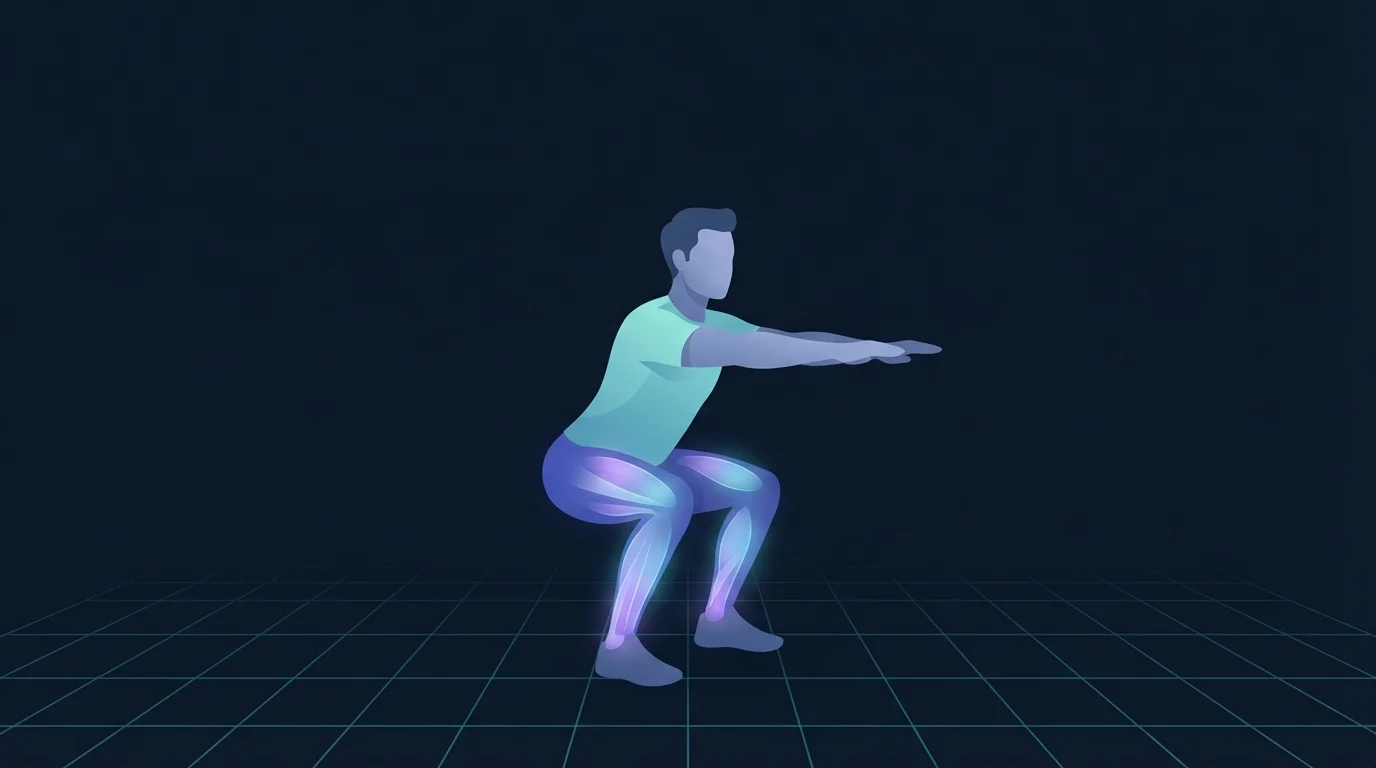
Eight Ankle Mobility Exercises, With Sets and Reps
Three jobs to cover: open the range, load the range, then control it on one leg. The list below runs in that order, and every dose assumes you're working both sides.
| Exercise | What it does | Sets and reps | Progression |
|---|---|---|---|
| Knee-to-wall ankle rocks | Weight-bearing dorsiflexion, soleus | 2 × 10 per side, 2 sec at the end | Slide the foot 1 cm further from the wall each week |
| Cross-legged ankle stretch | Bent-knee calf, ankle joint capsule | 60 sec per side | Add gentle pressure from the hand, then hold longer |
| Downward dog with heel drives | Straight-leg calf, gastrocnemius | 8 slow heel drives per side | Hold the bottom heel down for 3 sec each rep |
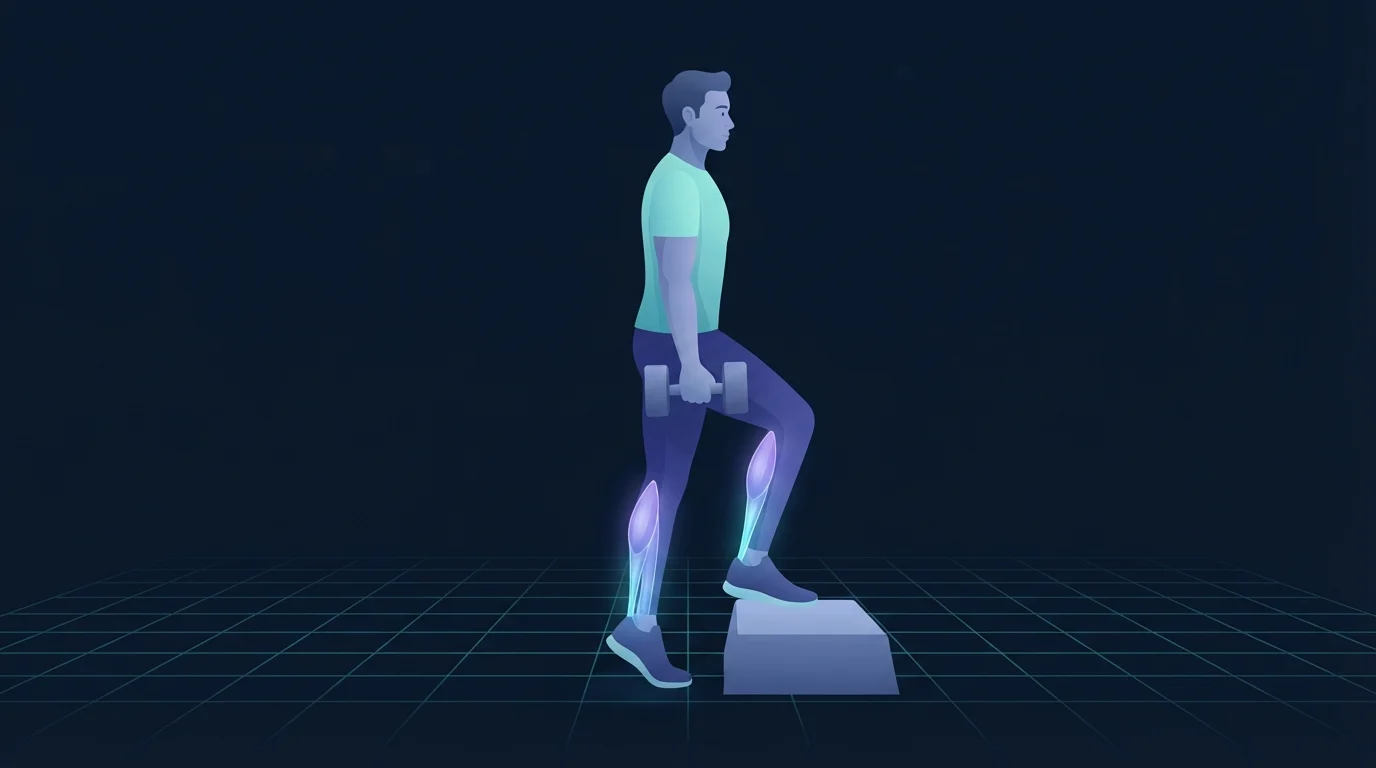
| Calf raises off a step | Gastrocnemius strength through full range | 3 × 12, 3 sec lower | Single leg, then single leg holding one dumbbell |
| Seated bent-knee calf raise | Soleus strength, the muscle the squat needs | 3 × 15 with a dumbbell on the knee | Pause 2 sec at the top, then add weight |
| Goblet squats, paused | Loaded end-range dorsiflexion | 3 × 8 with a 3 sec pause at the bottom | Drop the heel elevation, then add weight |
| Split squats, long front step | One ankle at a time, under load | 3 × 8 per side | Slow the descent to 4 sec, then hold dumbbells |
| Single-leg deadlift or single-leg stand | Balance and ankle control | 3 × 30 sec per side | Eyes closed, then on a folded towel or cushion |
Two notes on running it. Start the calf raises with straight legs and add the seated bent-knee version second, because the soleus is the one your squat is waiting on and it's the one almost nobody trains. And treat the paused goblet squat as the test-within-the-workout. If the pause feels less like a fight this week than last week, the range is moving.
The 10-Minute Ankle Mobility Routine
Barefoot, on a floor, next to a wall and a step. One dumbbell is useful and nothing here strictly needs it.
- Knee-to-wall rocks, 1 min per side. Slow, heel down, pause where it bites.
- Cross-legged ankle stretch, 1 min per side. Knee bent, which points it at the soleus.
- Downward dog heel drives, 1 min. Alternate legs, 3 seconds a side.
- Calf raises off a step, 2 min. Two sets of 12, all the way down and all the way up.
- Seated bent-knee calf raise, 1 min. One set of 15 with weight on the knee.
- Paused bodyweight squat or goblet squat, 2 min. Five reps, three seconds at the bottom.
- Single-leg balance, 1 min. Thirty seconds a side, eyes closed if it's easy.
If ten minutes is the barrier, the smallest version that still does something is knee-to-wall rocks and one set of slow calf raises. Ninety seconds. That's the version people are still doing in November.
How Often, and How Much Range to Expect
Frequency beats session length, and by a wide margin. A systematic review pooling stretching trials concluded that static stretching of at least five minutes per week per muscle group, spread across at least five days a week, improves range of motion, while the time spent stretching within any single session had no significant effect (Thomas et al., International Journal of Sports Medicine, 2018). The Sunday mobility marathon is the least efficient way to spend that time.
Now the expectations part, because this is where most ankle mobility content quietly oversells. A systematic review of five randomised trials and 318 participants pooled the effect of calf stretching on dorsiflexion and found a weighted mean difference of 2.07 degrees for up to 15 minutes of stretching, 3.03 degrees for 15 to 30 minutes, and 2.49 degrees beyond 30 minutes. The authors' own conclusion: a small but statistically significant increase, and it is unclear whether the change is clinically important (Radford et al., British Journal of Sports Medicine, 2006).
Two or three degrees is not nothing. It is also not the transformation the internet promises from a calf stretch. Which is exactly why the routine above is half loaded work.
Why Loading Beats Stretching Alone
A systematic review and meta-analysis compared strength training against stretching for improving range of motion across 11 studies and 452 participants and found no statistically significant difference between them (effect size -0.22, 95% CI -0.55 to 0.12, p = 0.206). Training through a full range improved flexibility about as well as stretching did (Afonso et al., Healthcare, 2021).
That's the practical unlock. A slow, full-depth calf raise off a step and a paused goblet squat buy range and strength in the same set, and the range they buy comes with the control to use it. The same logic drives stretch-mediated hypertrophy, where training a muscle at long lengths grows it faster than training it short. Progress the way you would progress anything else: a little more depth, a little more eccentric control, a little more weight. Plain progressive overload, pointed at an ankle.
Injury prevention pushes in the same direction. A meta-analysis of 25 trials covering 26,610 participants found stretching had essentially no effect on injury rates (risk ratio 0.963, 95% CI 0.846 to 1.095), while strength training cut injuries to roughly a third (risk ratio 0.315) (Lauersen et al., British Journal of Sports Medicine, 2014). And for ankle sprains specifically, the intervention with the best record is balance work: a systematic review and meta-analysis found proprioceptive training reduced ankle sprain rates in athletes both with and without a history of sprains (Schiftan et al., Journal of Science and Medicine in Sport, 2015). That single-leg balance drill at the end of the routine is not filler.
None of this needs a gym. A step, a wall and one dumbbell covers every movement on this page, and if you'd rather have the progressions decided for you, our roundup of the best home workout apps that need no equipment walks through what to look for.
Before or After Training?
Keep the long holds away from the start of a hard session. A systematic review of acute stretching in healthy active people found static stretching reduced subsequent performance by an average of 3.7% while dynamic stretching improved it by 1.3%, with a clear dose response: holds of 60 seconds or more cost 4.6% against 1.1% for holds under 60 seconds (Behm et al., Applied Physiology, Nutrition, and Metabolism, 2016).
So before lifting or running, do the moving version: knee-to-wall rocks, a few heel drives, done in ninety seconds. Save the 60-second holds for afterwards or a rest day. Our breakdown of static versus dynamic stretching goes through the timing in more detail.
What Ankle Mobility Exercises Will Not Do
- They won't add 5 cm to your knee-to-wall in a fortnight. The pooled stretching data says 2 to 3 degrees, and loaded work moves it further but still slowly. Plan in months.
- They won't override bone. Some ankles have a bony block at the front of the joint rather than a tight calf. Sharp pinching at the front of the ankle at end range is a reason to get looked at, not a reason to push harder.
- They won't prevent injury on their own. Stretching had no measurable effect on injury rates in the pooled trial data. Strength and balance work did.
- They won't fix a knee problem by themselves. Ankle range is one input into how the knee behaves. If the knee is the thing that hurts, our guide on how to strengthen your knees covers the rest of the picture.
- They won't survive a break. Range detrains like everything else. This is a habit, not a project with a finish line.
When to See a Clinician
Most stiff ankles are just under-used ankles. A few are not. Book an appointment if any of these describe you:
- A side-to-side gap over about 2 cm on the knee-to-wall test, especially with a history of sprains on that side. In a small retrospective study of 12 athletes back in unrestricted sport after a lateral ankle sprain, dorsiflexion range had recovered while the posterior glide of the talus remained restricted on the injured side (Denegar et al., Journal of Orthopaedic and Sports Physical Therapy, 2002). Range looking normal does not mean the joint is moving normally.
- Sharp pinching at the front of the ankle at the end of range, rather than a stretch behind it.
- The ankle giving way on uneven ground, or repeated sprains.
- Swelling, locking, or morning stiffness that lasts more than half an hour.
- Pain in the Achilles that is worse for the first few minutes of a run and returns the next morning.
The Bottom Line
Ankle mobility exercises work when you measure first and then train range and load together. Run the knee-to-wall test, write both numbers down, and let them decide whether you have a range problem at all. If you do, ten minutes most days beats an hour on Sunday, because weekly frequency is what the pooled data rewards.
And keep the expectations honest. Stretching alone buys a couple of degrees. Slow calf raises, paused squats and a minute of single-leg balance buy the rest, and they hand you control along with the range. Re-test in six weeks. The tape measure doesn't care how it felt.
Frequently Asked Questions
What are the best ankle mobility exercises?
The best ankle mobility exercises combine weight-bearing dorsiflexion drills with loaded calf work, because the joint needs both range and the strength to control it. A complete set is knee-to-wall ankle rocks, a bent-knee calf stretch for the soleus, a heel-drive downward dog for the gastrocnemius, full-range calf raises off a step, seated bent-knee calf raises, a paused goblet squat, a long-stride split squat, and a single-leg balance drill. Eight moves, about 10 minutes, covers range, load and control.
How do I test my ankle mobility at home?
Use the knee-to-wall test. Face a wall in a half-kneeling position, keep the front heel glued to the floor, and slide the foot back until the knee can just touch the wall without the heel lifting. Measure from the big toe to the wall. Most people should reach roughly 9 to 10 centimetres, and the two sides should be close: healthy adults averaged a left-right difference of 0.1 cm, with most within 1.5 cm (Hoch and McKeon, 2011). The test is highly reliable between testers, with intraclass correlation coefficients of 0.97 to 0.99 (Bennell et al., 1998).
Why do my heels lift when I squat?
Usually because the shin cannot travel far enough forward over the foot, so the body borrows the range from somewhere else. When researchers artificially restricted ankle dorsiflexion with a wedge, squatters produced less knee flexion, more inward knee collapse, less quadriceps activity and more soleus activity (Macrum et al., 2012). Heels lifting is the visible version of that trade. It can also be a strength problem rather than a range problem, so test both before you decide.
How long does it take to improve ankle mobility?
Expect small changes in three to six weeks and be realistic about the size of them. A systematic review of five trials and 318 participants found calf stretching produced about 2 degrees of extra dorsiflexion, and the authors said it was unclear whether that was clinically important (Radford et al., 2006). Weekly frequency drives most of the result, so short daily sessions beat one long weekend session, and adding loaded calf and squat work usually moves the number further than stretching alone.
Should you stretch or strengthen for ankle mobility?
Do both, and lean on the strength half. A meta-analysis of 11 studies and 452 participants found strength training through a full range improved range of motion about as well as stretching did, with no statistically significant difference between them (Afonso et al., 2021). Strength also arrives with control, so the new range works standing up under load rather than only in a stretch position on the floor.
Do ankle mobility exercises prevent injuries?
Not by themselves. A meta-analysis of 25 trials and 26,610 participants found stretching had essentially no effect on injury rates, while strength training cut injuries to roughly a third (Lauersen et al., 2014). For ankle sprains specifically, the intervention with the clearest track record is balance and proprioceptive training, which reduced sprain rates in athletes with and without a history of sprains (Schiftan et al., 2015). Put the balance drill in the routine and keep it there.
Why is one ankle stiffer than the other?
An old sprain is the usual reason, even one you considered healed. In a small retrospective study of 12 athletes who had returned to unrestricted sport after a lateral ankle sprain, dorsiflexion range had recovered but the posterior glide of the talus was still restricted on the injured side (Denegar et al., 2002). Side-to-side differences greater than about 1.5 to 2 cm on the knee-to-wall test are worth a clinician's opinion rather than more stretching.