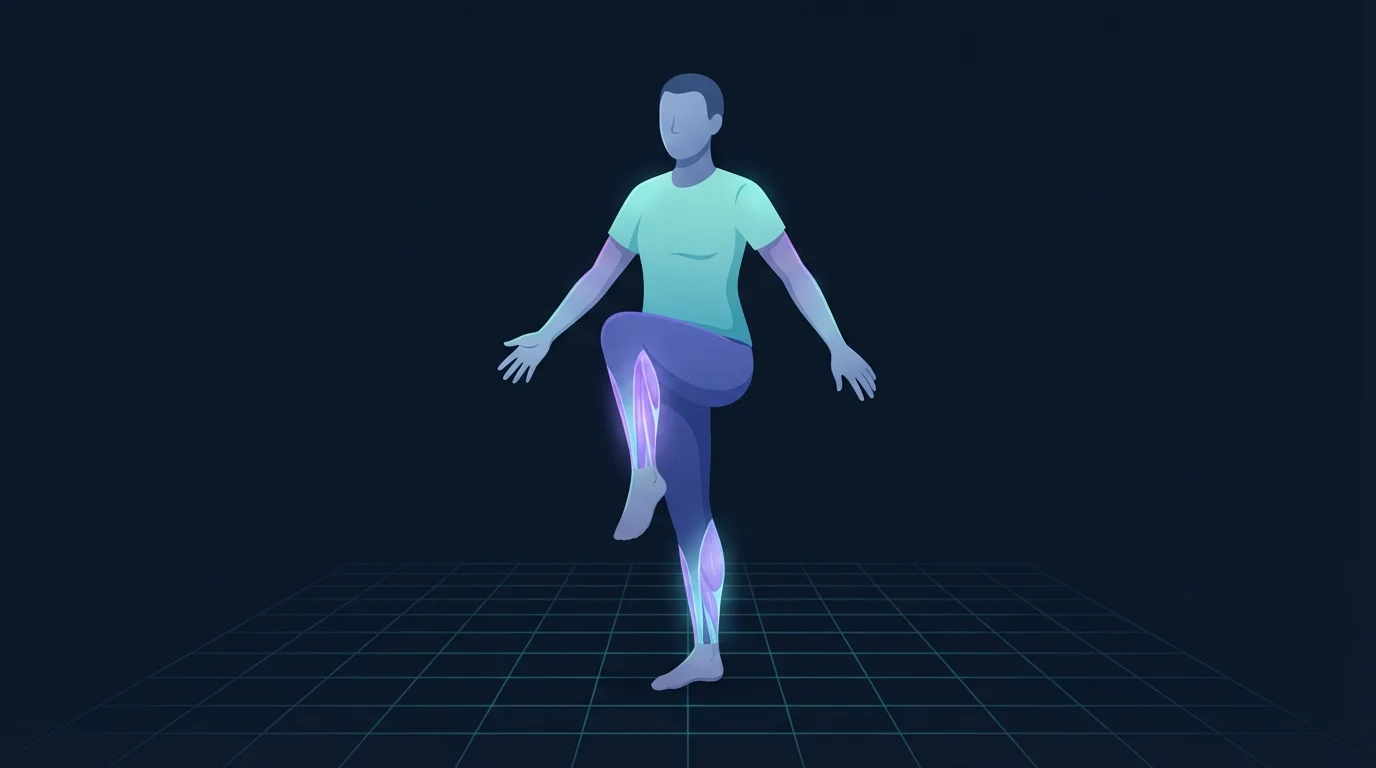
You rolled an ankle once. Maybe on a kerb, maybe on a trail, maybe stepping off a pavement in the dark. It swelled, you limped for a fortnight, and then it mostly stopped hurting and you got on with things.
Since then it's been the suspect one. It goes on uneven ground. It complains after long runs. You brace it for sport and you've quietly stopped trusting it on ladders and kerbs, and you've never quite been able to say what's wrong with it.
Here's the more useful framing. "Weak ankles" is a label covering three separate deficits, and they respond to three different kinds of work. Find out which ones are yours and six weeks does more than the last two years of hoping it settles.
Why Ankles Get Weak, and Why They Stay Weak
Ankle sprain is one of the most common injuries in existence. Doherty and colleagues (2014), pooling 181 prospective studies in Sports Medicine, found indoor and court sports carried the highest rate at about 7 sprains per 1,000 exposures, with females sprained roughly twice as often as males and children more often than adults.
The problem isn't the first sprain. It's what happens after it. A sprain does two things at once: it stretches the ligaments on the outside of the joint, and it degrades the joint's position sense, the stream of information your nervous system uses to know where your foot is without looking. The ligament heals. The position sense often doesn't, because nothing in ordinary life retrains it.
So the ankle keeps reporting its angle late, the peroneal muscles that should catch a roll fire late, and the same ankle goes over again on the same kind of ground. That loop is what people mean when they say their ankles are weak, and it has three fixable parts:
- Force production. The calf complex, which supplies most of the push in walking and running.
- Lateral control. The peroneals on the outside of the shin, which pull the foot outward and are the brake on an inversion roll.
- Position sense. Balance and proprioception, the part that decides whether the brake gets applied in time.
The Two-Minute Test: How Weak Are Your Ankles Right Now?
Test before you train. Without a starting number you can't tell whether six weeks of work did anything, and you'll end up guessing which of the three deficits to chase.
| Test | How to do it | What to look for |
|---|---|---|
| Single-leg heel raise | Barefoot, fingertips on a wall, knee straight, full height, about 1 per 2 seconds, to failure | Around 25 reps is typical; a gap over 3 between sides matters more than the number |
| Single-leg balance, eyes closed | Barefoot on a firm floor, hands on hips, other foot off the ground | 30 seconds each side; under 10 is a clear deficit |
| Knee to wall | Toes from the wall, drive the knee forward over the toes, heel down | Roughly 10 cm or more; a short side is a mobility problem, not a strength one |
On the heel raise, the numbers come from a large normative study. Visser and colleagues (2025), testing 500 healthy adults for the Brazilian Journal of Physical Therapy, reported a median of 25 single-leg heel raises on the dominant leg with a 95 percent reference interval of 13 to 50, and almost no difference between dominant and non-dominant sides. That last detail is the useful one: in healthy ankles the two legs match. A gap of more than a few reps is your answer about which side has been avoided.
Keep the protocol identical between tests. Hebert-Losier and colleagues (2009), reviewing the calf-raise literature in the Journal of Science and Medicine in Sport, found published protocols varied enormously in cadence, range and body position, which is exactly why your week-one result and your week-six result have to be run the same way to mean anything.
If the knee-to-wall side is short, mobility is the first constraint and our guide to ankle mobility exercises is the place to start. This page assumes the range is there and the control isn't.
Nine Exercises to Strengthen Ankles
Three blocks: drive, guard, control. Run all three. Doing only calf raises is the most common version of this routine and it's the reason so many people strengthen an ankle that still rolls.
| Exercise | What it builds | Dose |
|---|---|---|
| 1. Double-leg calf raise | Gastrocnemius, the starting point | 3 x 15, 3 sec down |
| 2. Single-leg calf raise off a step | Force production, side-to-side symmetry | 3 x 8-12 per side |
| 3. Bent-knee heel raise | Soleus, the deep calf that runs under load | 3 x 15 per side |
| 4. Tibialis raise | Front of the shin, deceleration and shin splint tolerance | 3 x 20 |
| 5. Band eversion | Peroneals, the brake on a rolling ankle | 3 x 15 per side, slow |
| 6. Band inversion | Tibialis posterior, arch support | 3 x 15 per side |
| 7. Single-leg balance progression | Position sense, the prevention lever | 3 x 30 sec per side, daily |
| 8. Single-leg Romanian deadlift | Control under a moving centre of mass | 3 x 8 per side |
| 9. Lateral hop and stick | Reactive control, the last block | 3 x 6 per side, week 5 onward |
Block one: drive (exercises 1 to 4)
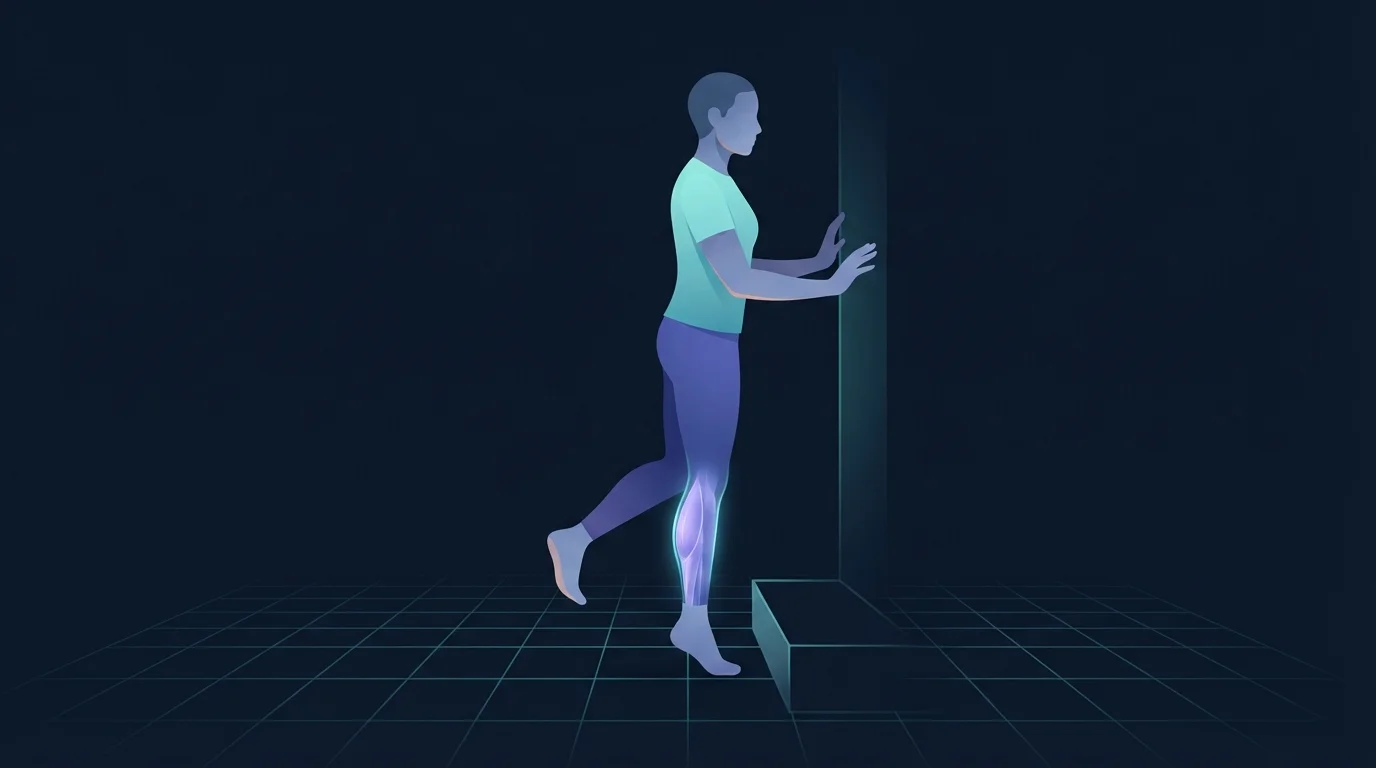
Start with a straight-knee calf raise on both legs, rising to full height and lowering over three seconds. Once you can do three sets of fifteen with a clean pause at the top, move to one leg off the edge of a stair so the heel drops below the step. That extra range is where the strength is, and it's the version the heel-raise test measures.
The bent-knee heel raise is the one nobody does. Bending the knee to about 30 degrees takes the gastrocnemius out and leaves the soleus doing the work, and the soleus is the muscle carrying you through the back half of a long run or a long day standing. Same movement, knee soft, three sets of fifteen.
Then flip to the front. Tibialis raises, standing with your back against a wall and your heels a few inches out, lifting the toes toward the shins for twenty slow reps. That muscle decelerates your foot on every step and is chronically undertrained in people who have been avoiding an ankle.
Block two: guard (exercises 5 and 6)
This is the block that separates a strong ankle from a stable one. Sit with the leg out straight, loop a light band around the forefoot, anchor it to the opposite side, and turn the sole of the foot outward against the band for fifteen slow reps. That's eversion, and it trains the peroneals. Then anchor the band on the other side and turn the sole inward for inversion.
Hall and colleagues (2015) randomised 39 people with chronic ankle instability in the Journal of Athletic Training and found a six-week resistance-band protocol improved strength in dorsiflexion, inversion and eversion, and improved how stable the ankle felt to the person standing on it. Six weeks, a band, three sessions a week. That's the whole intervention.
Block three: control (exercises 7 to 9)
Single-leg balance progresses in four steps, and you move on only when the current step is boring: eyes open on a firm floor, eyes closed on a firm floor, eyes closed on a cushion or folded towel, then eyes open while throwing and catching something. Thirty seconds a side.
The single-leg Romanian deadlift adds a moving centre of mass to that balance, which is much closer to what an ankle deals with on a trail. Hinge at the hip with a flat back, free leg extending behind as a counterweight, three sets of eight per side.
Last comes the reactive work. Hop sideways onto one leg and stick the landing for two full seconds before hopping back. Save this for week five and later, because it asks the ankle to absorb load fast and that's exactly what a deconditioned ankle can't do yet. Our page on calf hops covers the straight-line version to build up with first.
Find out what's really holding you back
FitCraft, our mobile fitness app, pairs you with an AI coach who builds you a personalized plan around your goals, schedule, and fitness level. Every FitCraft program is designed by Domenic Angelino, MPH (Brown University) and NSCA-CSCS, with research published in the Journal of Strength and Conditioning Research and Medicine & Science in Sports & Exercise.
Take the Free Assessment Free • 2 minutes • No credit card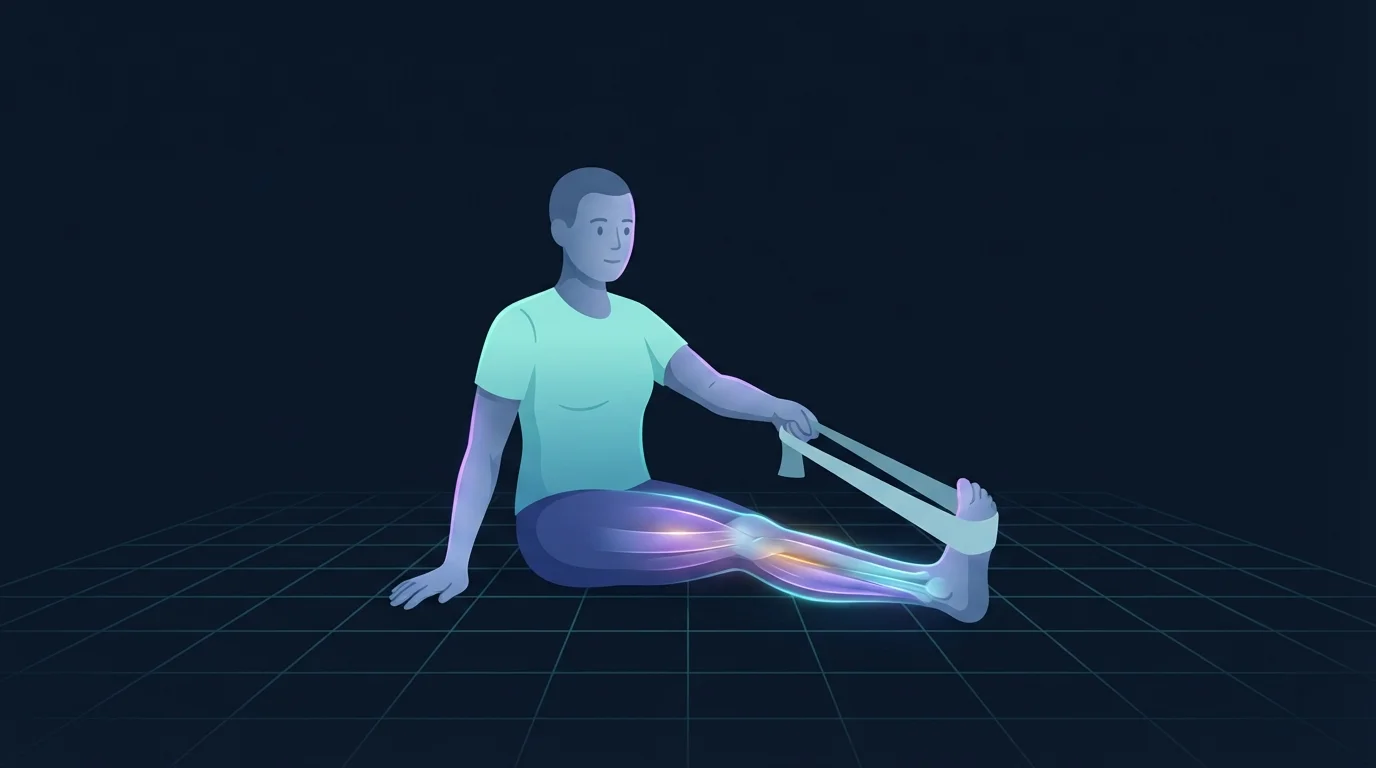
Balance and Proprioception: The Half That Prevents Sprains
If you only have ten minutes a week, spend it here. Balance training has better prevention evidence than any strength exercise on the list.
Schiftan, Ross and Hahne (2015), meta-analysing seven moderate-to-high quality randomised trials with 3,726 participants in the Journal of Science and Medicine in Sport, found proprioceptive training reduced ankle sprain incidence with a relative risk of 0.65 (95 percent CI 0.55 to 0.77). In the subgroup who had already sprained an ankle, the effect held at 0.64 (0.51 to 0.81). Roughly a third fewer sprains, from standing on one leg.
McKeon and Hertel (2008), reviewing the postural control literature in the Journal of Athletic Training, reached the same conclusion for prevention while noting the evidence was thinner for treating an already unstable ankle. Rivera and colleagues (2017) updated that verdict and recommended proprioceptive programmes as a routine part of injury prevention.
The benefit isn't limited to sport. Sherrington and colleagues (2019), in a Cochrane review of exercise and falls in community-dwelling older adults, found balance and functional exercise reduced the rate of falls by 24 percent with high-certainty evidence. Ankle position sense is a meaningful part of that, which is why this routine belongs in strength training after 60 as much as in a runner's week.
Dose: 10 to 20 minutes, three or more times a week, for at least four to six weeks. Balance work is low fatigue, so it stacks well onto something you already do every day.
Exercises to Strengthen Foot Muscles, Not Just the Ankle
The ankle sits on top of a foot with about twenty small muscles inside it, and those muscles control the arch that the ankle balances on. Training them has a surprisingly direct payoff.
Taddei and colleagues (2020) randomised recreational long-distance runners to a foot-strengthening protocol or a control group and followed them for a year in the American Journal of Sports Medicine. The foot-training group had a 2.42-fold lower rate of running-related injuries over twelve months. One eight-minute routine, done at home, three times a week.
Three movements cover most of it. Short foot: sitting with the foot flat, draw the ball of the foot toward the heel to raise the arch without curling the toes, hold five seconds, ten reps. Toe splay: spread all five toes apart and hold. Toe yoga: lift the big toe while keeping the other four down, then reverse. They feel ridiculous and they're genuinely hard for the first fortnight, which tells you how little those muscles have been doing.
Walking barefoot around the house counts as a low-grade version of the same thing. It isn't a replacement for the drills, and it costs nothing.
Ankle Stretches or Ankle Strengthening: Which One Do You Need?
These get lumped together and they solve different problems. The knee-to-wall test decides which one you're short on.
If your knee can't reach the wall with your toes about 10 cm back and your heel down, dorsiflexion range is your limiter. Stretching and joint mobilisation will help, and until that range exists, squats stay shallow and your stride stays short. That's the territory our ankle mobility guide covers in detail, including the measurement and an eight-exercise routine.
If the range is fine and the ankle still feels untrustworthy on uneven ground, stretching won't touch it. No amount of calf stretching builds a peroneal muscle that can catch a roll, and no amount of ankle circles rebuilds position sense. Ankle stretches are a range intervention. This page is a control intervention. Most people with a history of sprains need both, in that order.
Exercises for a Sprained Ankle: What the Evidence Supports
A fresh sprain is a different situation from a chronically suspect ankle, and the biggest mistake is doing nothing until it stops hurting.
Doherty and colleagues (2017), in an overview of systematic reviews published in the British Journal of Sports Medicine, reported strong evidence for early mobilisation after an acute ankle sprain, with moderate evidence supporting exercise therapy and manual therapy for pain, swelling and function. Resting an ankle until it feels normal is how the position-sense deficit gets locked in.
A sensible graded order, assuming a clinician has ruled out a fracture:
- Days 1 to 5. Gentle pain-free range: ankle alphabet, pumping the foot up and down, weight-bearing as tolerated.
- Week 1 to 2. Isometrics in all four directions, pushing the foot against a wall or your own hand, 5 seconds on, 10 reps.
- Week 2 to 4. Band eversion and inversion, double-leg calf raises, two-legged balance with eyes closed.
- Week 4 onward. Single-leg balance, single-leg calf raises, then the progression in the table above.
- Before returning to sport. Hopping and cutting, plus a brace or tape for the first few months. Bracing reduces repeat sprains and doesn't substitute for the training.
Timelines move if pain or swelling increases the day after a session. That's the signal you went up a block too early, not a reason to stop altogether.
A Six-Week Plan to Strengthen Ankles
Three sessions a week, 12 to 15 minutes each, plus daily balance work wherever it fits. Retest in week six with the same protocol you used in week one.
| Weeks | Strength (3 x a week) | Balance (daily) |
|---|---|---|
| 1-2 | Double-leg calf raise 3 x 15, bent-knee heel raise 3 x 15, tibialis raise 3 x 20, band eversion and inversion 3 x 15 | Eyes open, firm floor, 3 x 30 sec per side |
| 3-4 | Single-leg calf raise off a step 3 x 8, bent-knee heel raise 3 x 15 per side, band work 3 x 15 slower, single-leg RDL 3 x 8 | Eyes closed, firm floor, 3 x 30 sec per side |
| 5-6 | Single-leg calf raise 3 x 12, band work with a heavier band, single-leg RDL 3 x 8, lateral hop and stick 3 x 6 | Eyes closed on a cushion, then catching a ball, 3 x 30 sec |
Add the foot drills to any session you like. If twelve minutes is the barrier, the smallest useful version is one set of single-leg calf raises and 90 seconds of balance per side, which still hits two of the three deficits. That's the version people are still doing in month three. If planning the week is the part that stalls you, a no-equipment workout app can schedule the ankle block alongside the rest of your training so you're not deciding at the door.
Runners have one more reason to care. The calf is the single biggest contributor to propulsion at running speeds, so a weak plantarflexor is a slow one. Our guide to running faster puts this block in the wider context of force production and running economy.
When to See a Clinician
Strength work is the right answer for most suspect ankles and the wrong answer for some. Get it looked at rather than trained if any of these apply:
- You can't bear weight for four steps immediately after an injury, or there's bony tenderness over the knobs of the ankle, the outer midfoot or the inner arch.
- Swelling hasn't meaningfully settled after two weeks, or it returns every time you do anything.
- You get numbness, pins and needles, or weakness in the foot.
- The ankle gives way repeatedly with no obvious trigger, or locks and catches.
- Pain wakes you at night, or it's worst first thing and eases with movement.
- You have diabetes, peripheral neuropathy, inflammatory arthritis, or a previous ankle fracture or surgery.
A physiotherapist can also test the ligaments directly, which is something no self-test on this page can do.
The Bottom Line
Strengthening ankles means three things: heel raises for force, band eversion for the brake, and single-leg balance for the part that decides whether the brake gets used. Three sessions a week for six weeks, tested the same way at both ends.
Your ankle isn't fragile. It's been under-informed since the day you rolled it, and that's a training problem with an unusually good success rate.
Frequently Asked Questions
How long does it take to strengthen weak ankles?
Balance improves first, usually inside two to three weeks, because most of that early change is your nervous system getting better at reading the joint. Calf and peroneal strength takes longer. The randomised trials in this area typically run six weeks of band work three times a week before measuring a change, so six weeks is a fair first checkpoint. Plan on three months before an ankle that has rolled repeatedly stops feeling like the suspect one.
What are the best ankle stability exercises?
Single-leg balance progressions and resistance-band eversion are the two with the most direct evidence behind them. Balance work is what the prevention trials actually tested, and band eversion trains the peroneal muscles on the outside of the shin that have to catch the ankle when it starts to roll. Add single-leg calf raises for the propulsion half, and lateral hop-and-stick once the first three feel easy.
How often should I do ankle strengthening exercises?
Three sessions a week of 10 to 15 minutes is the dose used in most of the trials, and it's enough. Balance work is the exception: it's low fatigue, so daily is fine and easy to stack onto something you already do, like brushing your teeth on one leg. Heavy calf raises need a day between sessions because the calf takes real load and gets genuinely sore the first fortnight.
Why do my ankles keep rolling?
Usually because the first sprain was never rehabbed. A sprain stretches the ligaments and also degrades the joint's position sense, so the ankle stops reporting its own angle accurately and the muscles that should catch a roll fire late. Strength and ligament laxity both matter, but the position-sense deficit is the part that responds fastest to training, and it's why balance drills reduce repeat sprains more reliably than bracing alone.
Can you strengthen your ankles without equipment?
Yes, for most of it. Calf raises, single-leg calf raises off a stair, tibialis raises against a wall, single-leg balance, single-leg hinges and lateral hops need nothing but a floor and a step. The only piece worth buying is a light resistance band for eversion and inversion, because there's no bodyweight substitute for resisted side-to-side ankle work. A towel looped around the foot and held with both hands is a workable stand-in.
Do ankle braces make your ankles weaker?
The evidence doesn't support that worry. Bracing and taping reduce recurrent sprains, and studies have not found that wearing a brace causes measurable strength loss. The real risk is substitution: a brace that lets you skip the strength and balance work leaves the underlying deficit in place. Use the brace for sport in the months after a sprain and train the ankle on the other days.