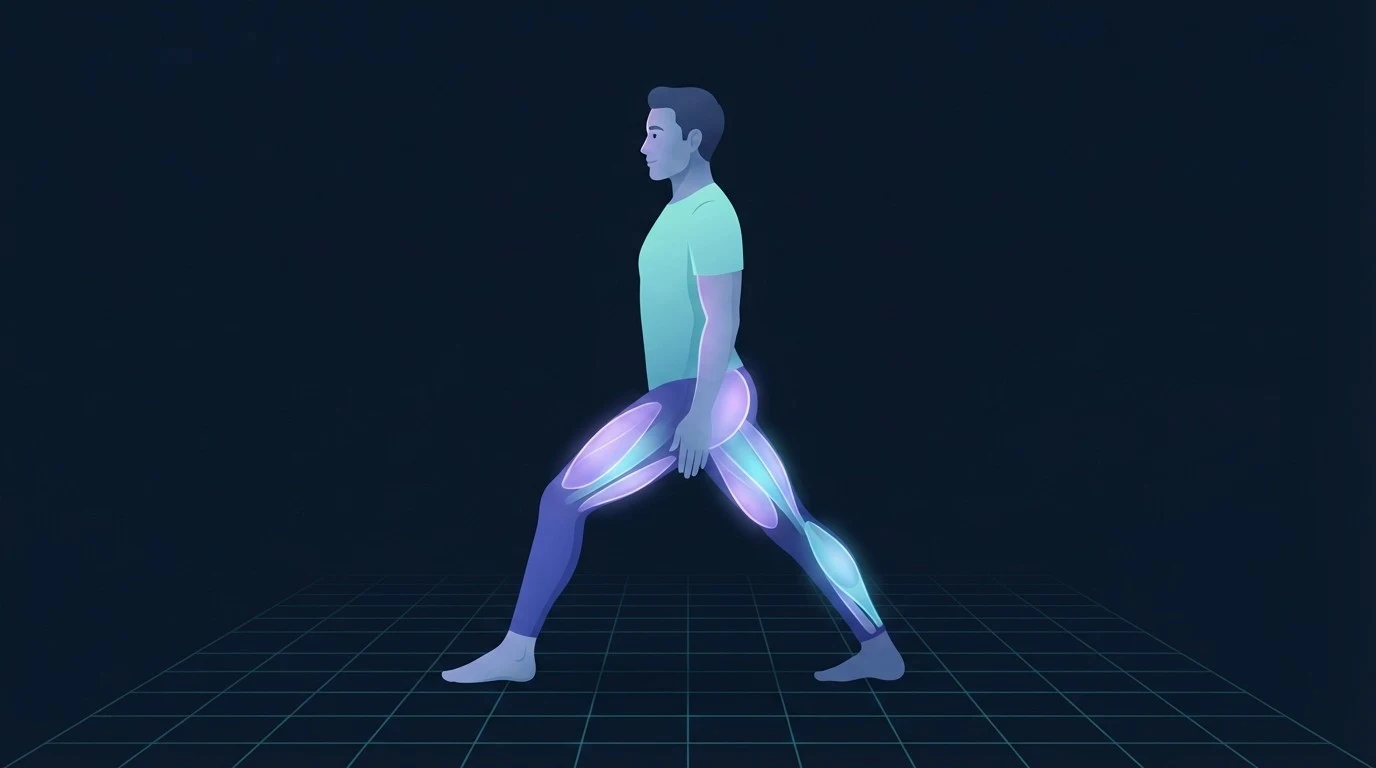
Knees announce themselves on stairs. Going up is usually fine. It is the way down, or the third flight, or standing up from a low sofa, that tells you something has quietly changed. Then it starts editing your week: you take the lift, you skip the hike, you stop squatting to pick things up off the floor.
What most people feel at that point is not just pain. It is a sense that the joint has become unreliable, that it might buckle, and that the sensible move is to use it less. That instinct is the trap. Cartilage, tendon and muscle all adapt to what you ask of them, and asking less makes the whole system weaker, which makes the knee feel less reliable, which makes you ask even less.
The way out is narrower than the internet suggests. You are not training your knee. You are training the muscles that cross it, and there are only four groups worth your attention.
Why Do Knees Get Weak in the First Place?
The knee is a hinge with very little muscle of its own. Almost everything that extends it, flexes it, decelerates it and keeps it tracking straight originates at the hip or the shin. So "weak knees" is nearly always shorthand for weak muscles arranged around a joint that is fine. The same argument runs one joint down the chain, and our guide to how to strengthen ankles has the heel-raise test and the nine exercises that go with it.
Two things drive that weakness. The first is ordinary disuse, which hits the quadriceps harder and faster than almost any other muscle group in the body. The second is pain itself: a sore or swollen knee reflexively damps down quadriceps activation, so you lose strength while you are protecting the joint, and the loss outlasts the flare-up.
It matters more than it sounds. An updated systematic review of 11 longitudinal studies covering 46,819 adults found that people with weaker knee extensors at baseline were more likely to develop symptomatic knee osteoarthritis years later, with an odds ratio of 1.85 in women and 1.43 in men (Oiestad et al., 2022). The same pattern held for radiographic osteoarthritis. The authors rate the evidence as low certainty and it is observational, so it shows association rather than proof of cause. Even read cautiously, the direction is one way: nobody has found that stronger legs make knees worse.
Which Four Muscle Groups Actually Strengthen Your Knees?
Four groups, four different jobs. Skip one and it becomes the thing that limits you.
1. Quadriceps: the brake
The quadriceps straighten the knee, and more importantly they control it on the way down. Every step off a kerb, every descent into a chair, every stair you walk down is the quadriceps lengthening under load while the knee bends. They also stabilise the kneecap in its groove, which is why quadriceps work sits at the centre of nearly every rehab protocol for anterior knee pain. If you only have time to train one group, this is it.
2. Glutes: the steering
The glutes do not cross the knee at all, and they still change what happens there. The gluteus medius and maximus control how much the thigh rotates inward and collapses toward the midline. When they are weak, the knee drifts inward under load and the kneecap tracks badly. A systematic review of 14 studies found strong evidence that adding hip and glute work to quadriceps rehabilitation reduced pain and improved function in patellofemoral pain in the short term, with greater pain reduction at one year than quadriceps work alone (Lack et al., 2015). A Cochrane review of 31 trials and 1,690 participants reached a similar conclusion, though it graded the evidence as very low quality (van der Heijden et al., 2015). This is the group people skip most often.
3. Hamstrings: the counterweight
The hamstrings bend the knee and pull the shin backward, which directly opposes the forward shear the quadriceps create. A leg with strong quadriceps and neglected hamstrings is not balanced, it is just strong in one direction. Hamstrings also do most of the work absorbing force when you decelerate, and they are the group that reliably goes missing when someone trains legs with machines and squats alone.
4. Calves: the shock absorber
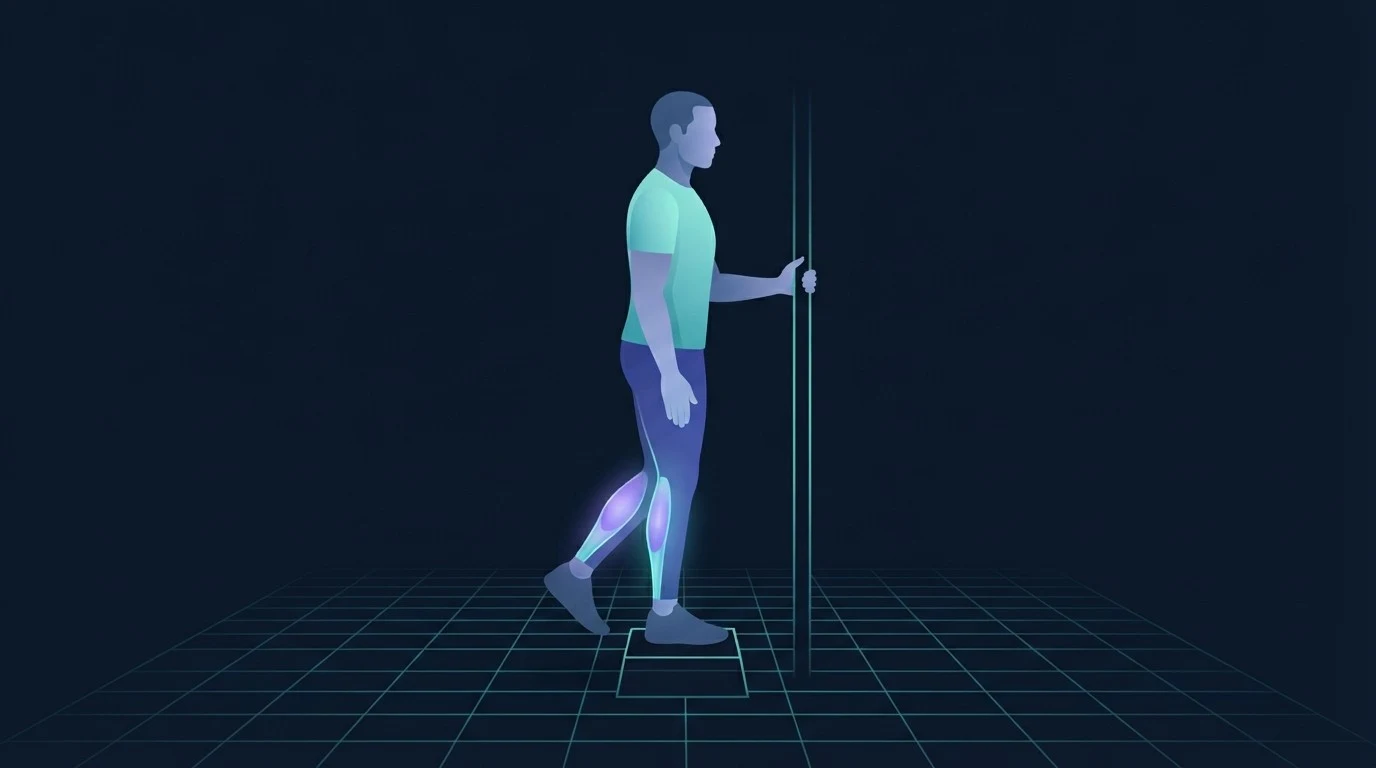
The gastrocnemius crosses the knee, attaching above the joint on the femur, so it contributes directly to knee stability. More practically, the calf complex is your first line of defence at heel strike and on landing. When it is weak, more of every step travels up the chain to the knee. Calf raises are the least glamorous item on this list and the one most likely to be missing from a program built by someone who trains for looks.
| Muscle group | Job at the knee | Best home exercise | Starting dose |
|---|---|---|---|
| Quadriceps | Straightens the knee and brakes it on the way down | Sit-to-stand, then split squat | 3 x 8-12 |
| Glutes | Stops the thigh rotating in and the knee collapsing inward | Glute bridge | 3 x 12-15 |
| Hamstrings | Bends the knee and resists forward shear on the shin | Romanian deadlift | 3 x 8-10 |
| Calves | Absorbs impact and crosses the back of the knee | Calf raise | 3 x 12-20 |
Find out what's really holding you back
FitCraft, our mobile fitness app, pairs you with an AI coach who builds you a personalized plan around your goals, schedule, and fitness level. Every FitCraft program is designed by Domenic Angelino, MPH (Brown University) and NSCA-CSCS, with research published in the Journal of Strength and Conditioning Research and Medicine & Science in Sports & Exercise.
Take the Free Assessment Free • 2 minutes • No credit card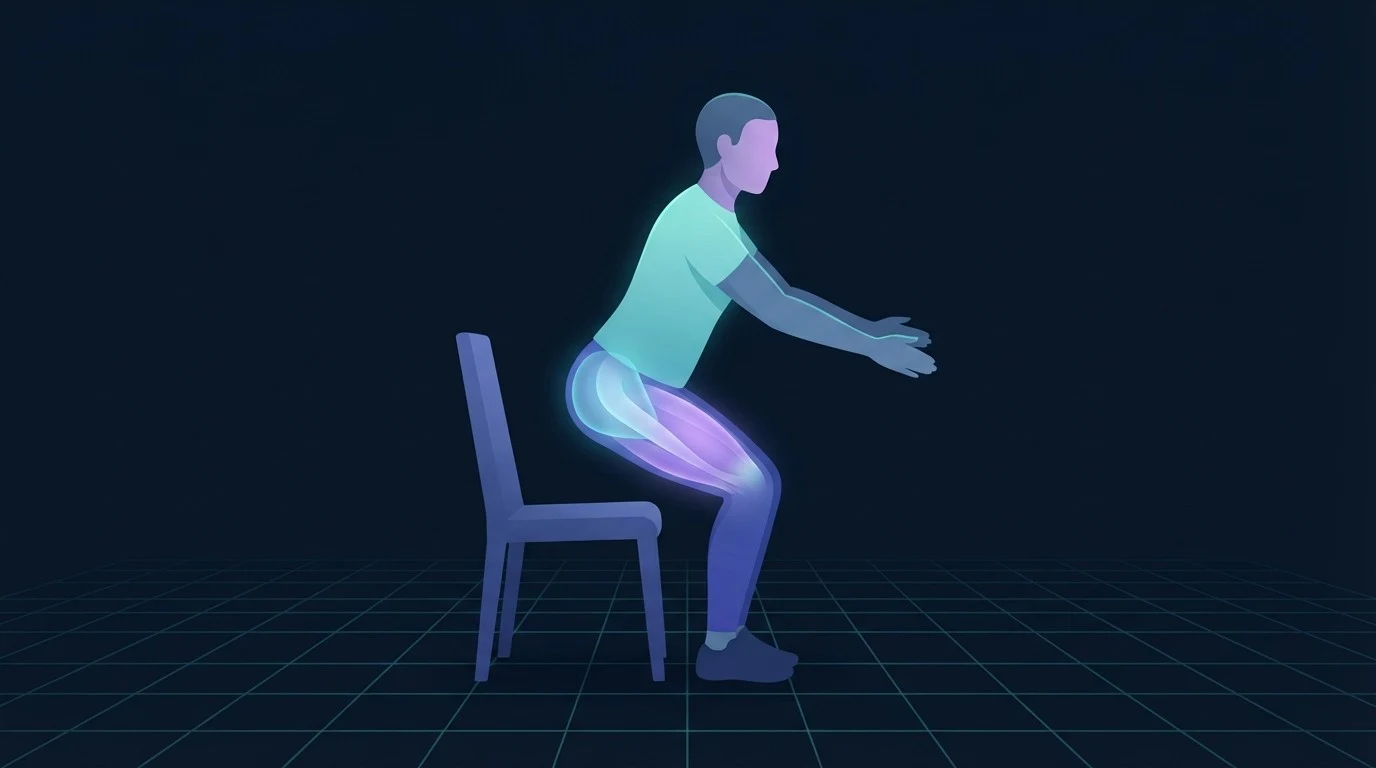
What Does the Research Say About Strengthening and Knee Pain?
Exercise for knee pain has been studied more thoroughly than almost any other conservative treatment, and the headline finding has held up across two decades of revisions.
The 2024 update of the Cochrane review on exercise for knee osteoarthritis pooled 139 trials and 12,468 participants. Against no treatment or usual care, exercise improved pain by a mean of 13.14 points on a 0 to 100 scale (56 studies, 4,184 participants) and physical function by 12.53 points (54 studies, 4,352 participants), with moderate-certainty evidence (Lawford et al., 2024). The review authors are careful to note that against the thresholds they used for minimal important difference, the clinical importance of those gains is uncertain, and that participants knew which group they were in. Still: 139 trials pointing the same way is about as good as musculoskeletal evidence gets.
The more useful question for anyone actually doing the work is how much strength you need to gain. A meta-regression of 45 trials and 4,699 participants compared programs that met the American College of Sports Medicine definition of strength training against everything else. The proper strength programs produced better knee extensor strength, as you would expect, but no better pain or disability outcomes on average. The regression explained why: knee extensor strength had to increase by roughly 30 to 40 percent before a matching improvement in pain and disability became likely (Bartholdy et al., 2017). Most programs in the literature, and most programs people run at home, never get there. They stop at the point where the exercises feel manageable.
Getting to a 30 percent strength gain is a matter of progressive overload over months, not of training harder on any single day. That distinction has been tested directly. A Cochrane review of six trials and 656 participants comparing higher-intensity with lower-intensity exercise programs in knee and hip osteoarthritis found small differences that were unlikely to be clinically important, and no advantage that persisted at follow-up (Regnaux et al., 2015). Consistency across weeks is doing more of the work than effort within a session.
One more finding worth knowing if you have been told to avoid loading a painful knee. A secondary analysis of a randomized trial in 67 people with medial knee osteoarthritis and varus alignment compared 12 weeks of weightbearing quadriceps exercise against non-weightbearing quadriceps exercise, and found no difference between them in peak medial tibiofemoral contact force during walking (Starkey et al., 2022). Standing up out of a chair did not load the joint more than a seated leg extension did. Pick the version you will do.
Does Strengthening Have to Hurt?
Some ache during and after these exercises is normal, and it isn't evidence that you're causing damage. A 2025 systematic review pooled 16 randomized trials comparing exercise that deliberately provoked pain against exercise that avoided it, in adults with chronic musculoskeletal pain. There was no difference in pain intensity or disability at any time point, and no difference in fear avoidance or catastrophising in the short term (Tran et al., 2025). The confidence intervals were wide and every trial carried a high risk of bias, so the honest reading is that pain during exercise probably does not need to be avoided, rather than that provoking pain helps.
A workable rule: discomfort up to about 4 out of 10 during a set is fine if it settles within 24 hours and the knee is no worse the next morning. Sharp pain, swelling that appears after training, a knee that locks or gives way, or pain that keeps climbing session after session are all reasons to stop and get assessed. Those aren't stubbornness problems.
How to Strengthen Knees at Home: An 8-Week Plan
Two sessions a week, on non-consecutive days. A third session speeds things up but is not the difference between working and not working. Everything below can be done with a chair, a step and a pair of dumbbells.
| Weeks | What changes | Session shape |
|---|---|---|
| 1-2 | Learn the patterns, finish every set feeling like you had 4 or 5 reps left | 2 sets per exercise, bodyweight only |
| 3-4 | Add a third set, then add reps until you reach the top of each range | 3 sets per exercise, bodyweight |
| 5-6 | Add load. Hold dumbbells, or move to single-leg versions | 3 sets, back to the bottom of each rep range |
| 7-8 | Add reps again, and add a slow 3-second lowering phase | 3 sets, 2 or 3 reps left in the tank |
The session itself:
| Exercise | Sets x reps | Notes |
|---|---|---|
| Sit-to-stand from a chair | 3 x 8-12 | Lower for 3 seconds. Progress to a lower chair, then to holding a dumbbell |
| Glute bridge | 3 x 12-15 | Two-second squeeze at the top. Progress to one leg at a time |
| Romanian deadlift | 3 x 8-10 | Hinge at the hips with a soft knee. You should feel it in the hamstrings, not the low back |
| Split squat | 2-3 x 8-10 per side | Hold a doorframe for balance. This is the single biggest quadriceps builder here |
| Calf raise | 3 x 12-20 | Full range, pause at the top. Progress to one leg before you add weight |
| Step-down from a low step | 2 x 6-8 per side | Add from week 5. Lower the free heel slowly toward the floor and tap |
Two details do most of the work. Slow the lowering phase down to about three seconds, because that is where the quadriceps take the load and where eccentric training earns its reputation. And write down what you did, because progressive overload is bookkeeping before it is anything else. If week 6 looks like week 2 with more sweat, nothing is going to change.
If the knee is not tolerating loaded movement yet, an isometric holds well as a bridge: a wall sit or a straight-leg quadriceps contraction held for 30 to 45 seconds, five times, gives the muscle a stimulus without asking the joint to move through range.
How Long Before Your Knees Feel Different?
Weeks one to three are neural. You get better at recruiting muscle you already own, so the exercises feel easier before anything looks different. That improvement is real and it is not yet the thing that protects the joint.
Weeks four to eight are where measurable strength shows up, and where most people notice stairs first. Weeks eight to twelve are where you approach the 30 percent territory Bartholdy's regression identified, assuming you kept adding load. Most people who say strengthening "did not work" stopped somewhere in week five, which is precisely the window where the effort has been spent and the payoff has not arrived. Our guide on why consistency beats intensity covers what to do when that week arrives, because it will.
What to Skip While You Build
- Braces and sleeves as a substitute. Fine for confidence during activity. They don't make anything stronger, and worn all day they can become the reason you never load the leg.
- Stretching as the main event. Mobility work has its place, and no amount of it produces the strength gain the evidence points at.
- Rest as a strategy. Rest is for an acute flare, measured in days. Sustained rest is how a stiff knee becomes a weak one.
- Jumping into high-impact work early. Running and plyometrics aren't off the table forever, but they're a poor first step. Build the four groups first, and see our roundup of low-impact exercises for bad knees for what to do in the meantime.
- Training only the quadriceps. Leg extensions alone will get you a stronger front thigh and leave the steering and the shock absorption exactly where they were.
The Bottom Line
Strengthening your knees means loading four muscle groups, twice a week, for long enough that the strength actually changes. Quadriceps for braking, glutes for steering, hamstrings for balance, calves for impact. The evidence for exercise here is broad and consistent, and the failure mode is almost never the exercise selection. It's stopping at week five, or never adding load, so the strength never rises far enough to matter.
You're not fragile and your knee isn't broken. It has been asked to do less for a while, and it obliged. Ask it for more, in small increments, and it will oblige that too. If knee pain is part of a broader joint picture, our guide to training with joint pain covers how to adjust the rest of your week around it.
Frequently Asked Questions
How long does it take to strengthen your knees?
Expect the first changes in about two to four weeks, mostly from your nervous system learning to recruit the muscle you already have. Real muscle growth and the strength gain that changes how a knee feels takes eight to twelve weeks of consistent training. A meta-regression of 45 randomized trials found knee extensor strength has to rise by roughly 30 to 40 percent before pain and function reliably improve alongside it, and nobody gets there in a fortnight.
What is the best exercise to strengthen knees?
There is no single best exercise, because four muscle groups control the knee and no one movement loads all of them well. The most useful starting pair is a sit-to-stand from a chair for the quadriceps and glutes, and a hip hinge such as a Romanian deadlift or a glute bridge for the hamstrings and glutes. Add a calf raise and a split squat once those feel easy. The exercise you will actually repeat twice a week beats the theoretically optimal one you skip.
Can you strengthen your knees if they already hurt?
In most cases yes, and strengthening is one of the better-evidenced things you can do about knee pain. A 2024 Cochrane review of 139 trials and 12,468 participants found exercise improved pain by about 13 points on a 0 to 100 scale compared with no treatment. A 2025 review of 16 trials also found no difference in outcomes between exercise that provoked some pain and exercise that avoided it, so mild discomfort is not automatically a reason to stop. Sharp pain, swelling, locking, giving way, or pain that keeps climbing after the session are reasons to get assessed rather than push on.
Do squats damage your knees?
For most people squats build knees rather than damage them. Squatting is the same movement pattern as standing up from a chair, which you already do dozens of times a day. What causes trouble is load added faster than tissue can adapt, not the squat itself. Start with a depth where the movement feels controlled, keep the tempo slow, and add reps before you add weight. If a particular depth reliably hurts, work above it and let the range come back as strength does.
How often should you train to strengthen your knees?
Two to three sessions a week, on non-consecutive days, is the dose almost every trial uses. Two is the practical floor, and a third session mostly speeds things up rather than changing the destination. A 2015 Cochrane review comparing higher-intensity with lower-intensity exercise programs in knee and hip osteoarthritis found no clinically important advantage for the harder programs, so there is no prize for grinding.
Does walking strengthen your knees?
Walking is excellent for knee health and it is not strength training. The load on the quadriceps and glutes during a walk sits far below what it takes to make a muscle bigger or stronger, so walking maintains what you have rather than building more. Keep walking, then add two short resistance sessions a week on top of it. The two do different jobs and the combination beats either one.