The 11 Moves at a Glance
| Move | Knee demand | What it builds | Best for |
|---|---|---|---|
| Wall sits | Low (no movement) | Quad strength | Painful, irritable knees |
| Quarter squats | Low to moderate | Quad strength through range | Rebuilding the squat pattern |
| Calf raises | Very low | Calf and ankle support | Below-the-knee stability |
| Glute bridges | Very low | Glutes and hamstrings | Hip strength without knee load |
| Romanian deadlifts | Very low | Hamstrings, hip hinge | Posterior chain strength |
| Clamshells | None | Glute medius | Warm-up and knee tracking |
| Side planks | None | Lateral hip and core | Pelvic stability |
| Bird dogs | None (kneeling) | Core and balance | Coordination work |
| Dead bugs | None | Deep core | Floor-based core training |
| Marching in place | Very low | Circulation, warm-up | Zero-impact movement breaks |
| Supported split squats | Moderate | Single-leg strength | Graduation move once pain settles |
The instinct with a painful knee is to protect it by moving less. The research says the opposite. Our full breakdown of the evidence on exercise for knee osteoarthritis covers dozens of trials, and the pattern is consistent: the right kind of loading reduces pain and improves function, while rest lets the muscles that protect the joint waste away.
This list applies that research at home. Every move keeps impact at zero, most keep the knee itself nearly still, and each one links to a full form page. One note before you start: "bad knees" covers everything from mild ache to post-surgical rehab. This article is for the achy-but-cleared crowd. If your knee is swollen, unstable, or undiagnosed, see a clinician before you see a workout list.
Why Does Exercise Help a Knee That Hurts?
Two findings anchor everything below. First, exercise works as a treatment. The 2015 Cochrane review by Fransen et al. pooled 54 trials of land-based exercise for knee osteoarthritis and found high-quality evidence of pain reduction, around 12 points on a 100-point scale, plus improved physical function and quality of life. Adverse events were rare and minor.
Second, loading the knee doesn't wear it out. A 2019 systematic review by Bricca et al. in the British Journal of Sports Medicine examined randomized trials of knee-loading exercise in people with or at risk of knee osteoarthritis and found no evidence of harm to articular cartilage. The "save your remaining cartilage by resting" model doesn't hold up.
Where should that loading go? Mostly the quads. A 2017 meta-regression by Bartholdy et al. across 45 trials found that programs following strength-training principles produced greater knee-extensor strength gains, and estimated that increasing quad strength by 30 to 40 percent would likely translate into meaningful improvements in pain and disability. That's why this list leans so hard on quad and hip work rather than stretching.
Do This, Skip That: Knee-Friendly Swaps
Most knee-pain advice tells you what to avoid and stops there. The more useful version is a swap: keep the training effect, drop the part that flares the joint.
| Skip this for now | Do this instead | Why the swap works |
|---|---|---|
| Deep squats and jump squats | Quarter squats or wall sits | Force behind the kneecap climbs as the knee bends deeper; shallow range and isometric holds train the quads with a fraction of that stress |
| Jumping lunges and deep forward lunges | Supported split squats, short range | Removes impact and braking forces while keeping the single-leg strength stimulus |
| Running and jump rope on flare-up days | Cycling, swimming, or marching in place | Swaps repeated impact for smooth, supported knee motion that still trains the heart |
| Knee-dominant leg work when everything hurts | Glute bridges and Romanian deadlifts | Hip-dominant patterns strengthen the leg while the knee stays nearly still |
| Downhill walking and stair descents for exercise | Flat or slightly uphill walking | Downhill and downstairs load the quads eccentrically at angles painful knees tolerate worst |
| Breaststroke kick if it provokes pain | Freestyle with a gentle flutter kick | The whip kick drives the knee through rotation under load; flutter kick keeps motion in a friendly plane |
"For now" is doing real work in that first column. None of those movements is banned forever. They're simply the wrong entry point for an irritable joint, and most people can reintroduce them gradually as strength returns.
Strengthen the Knee Directly
1. Wall Sits
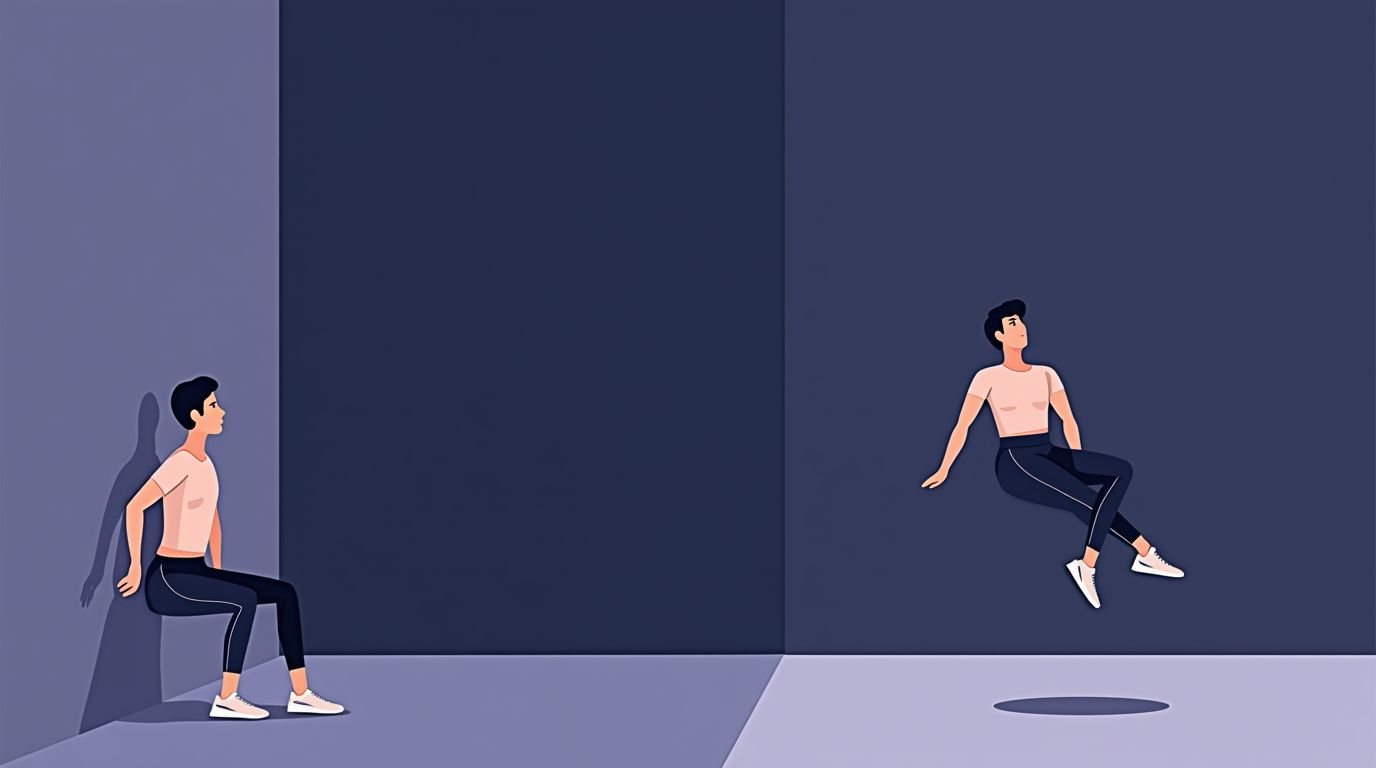
Wall sits are our top pick for a reason: they load the quads hard while the knee joint holds completely still, which irritable knees tolerate better than almost anything else. Slide down to a depth that feels workable, hold, breathe, repeat. Chair pose from yoga trains the same shape if you prefer an unsupported version.
The trade-off: isometric holds build strength mostly at the angle you train, so vary your depth across sets and pair them with a moving pattern like quarter squats.
2. Quarter Squats
The quarter squat rebuilds the most useful movement pattern you own, sitting down and standing up, through the shallow range where kneecap stress stays low. Push through your heels and keep the descent slow.
The trade-off: it's tempting to camp at shallow range forever. The joint adapts to what you give it, so nudge your depth a little deeper every couple of weeks as comfort allows.
3. Calf Raises
Calf raises strengthen the muscles crossing the back of the knee and stabilizing the ankle below it. When the ankle is strong and controlled, less chaos travels up the chain to the knee. Do them on both legs, holding a wall for balance.
The trade-off: they do little for the quads, which carry most of the protective load. Treat calf raises as a supporting act.
Build the Hips That Unload the Knee
The knee is a hinge caught between two neighbors. When the hips are weak, the thigh collapses inward and the knee pays for it. These four moves strengthen the muscles that keep the knee tracking straight, and none of them asks the knee to bear meaningful load.
4. Glute Bridges
Glute bridges train hip extension with your back on the floor and the knee doing almost nothing. Drive through your heels, squeeze at the top, lower with control. If full range feels cranky behind the knee, partial glute bridges are the on-ramp.
The trade-off: bodyweight bridges get easy within weeks. Progress to single-leg versions or slow the tempo to keep them earning their spot.
5. Romanian Deadlifts
The Romanian deadlift teaches the hip hinge: hips travel back, knees stay softly bent, hamstrings stretch and drive you back up. Bodyweight or a light household weight is plenty to start. It's the most strength-per-rep of any move here, with almost zero knee motion.
The trade-off: it's the most technique-dependent entry on this list. A rounding lower back shifts stress somewhere you don't want it, so learn the pattern unloaded first.
6. Clamshells
Clamshells wake up the gluteus medius, the side-hip muscle that stops your knee from diving inward when you walk or climb stairs. Lie on your side, feet together, open the top knee without rolling your pelvis back.
The trade-off: the stimulus is modest. Clamshells prepare the hip for harder work; they're a warm-up staple, not a main course.
7. Side Planks
The side plank is the strength version of the clamshell, loading the lateral hip and trunk together in one hold. Stack your shoulders and hips, lift, and hold a straight line.
The trade-off: wrists and shoulders often complain before the hip does. Start with short holds from the forearm and build time gradually.
Knowing what to do is the easy part.
FitCraft, our mobile fitness app, pairs you with an AI coach who builds you a personalized plan around your goals, schedule, and fitness level. Every FitCraft program is designed by Domenic Angelino, MPH (Brown University) and NSCA-CSCS, with research published in the Journal of Strength and Conditioning Research and Medicine & Science in Sports & Exercise.
Take the Free Assessment Free • 2 minutes • No credit cardStability, Core, and Gentle Movement
8. Bird Dogs
Bird dogs train balance and trunk control from all fours: extend the opposite arm and leg, hold, return. That coordination matters more than it looks. Steadier hips and trunk mean fewer of the small wobbles a sore knee has to absorb.
The trade-off: kneeling on a hard floor can bother the kneecap itself. A folded towel or mat under the knees usually solves it; if not, dead bugs cover similar ground on your back.
9. Dead Bugs
Dead bugs are core training with zero knee involvement: lying on your back, lower the opposite arm and leg while your lower back stays pressed to the floor.
The trade-off: intensity is low, and that's the point. They fill the core slot in a session without spending any of your knee's tolerance budget.
10. Marching in Place
Marching in place is the movement-break move: it raises your heart rate, lubricates the joint, and breaks up long sitting spells without a single moment of impact. Use it as a warm-up before the strength work above or in two-minute doses through the day.
The trade-off: it won't build strength. Its job is circulation and consistency, not adaptation.
11. Supported Split Squats
The split squat, done holding a chair or counter with a short range of motion, is the graduation exercise. Single-leg strength is what stairs, hikes, and getting off the floor actually demand, and this is the gentlest way to start rebuilding it.
The trade-off: it's the most knee-demanding move on this list. Save it for later weeks, keep the front shin vertical, and skip it entirely while symptoms are flared.

Which Cardio Is Easiest on Bad Knees?
Strength work protects the joint, but you still need something for your heart. Three options tolerate painful knees best, and the evidence backs the water as much as the road. In a 2016 randomized trial by Alkatan et al. in the Journal of Rheumatology, sedentary adults with osteoarthritis did 12 weeks of either swimming or stationary cycling. Both groups cut joint pain and stiffness and improved knee muscle power by 15 to 30 percent, with neither mode beating the other.
- Cycling: set the saddle high enough that your knee keeps a slight bend at the bottom of the stroke, then favor low resistance and a quick, easy cadence. A too-low saddle is the most common reason cycling hurts.
- Swimming and water walking: buoyancy strips most of your bodyweight off the joint while the water adds gentle resistance. Freestyle is usually the friendliest stroke; skip the breaststroke kick if it provokes pain.
- Walking: flat routes, supportive shoes, and short frequent walks beat one long weekend slog. Slight uphills are usually comfortable; long downhills are the part painful knees complain about.
Aim for 20 to 30 minutes, around 3 times a week, at an effort where you can still talk. Which mode? Whichever one you'll repeat.
How We Chose These 11
Plenty of "knee-friendly" lists are just generic beginner workouts with the jumping removed. Our criteria were stricter:
- Joint demand per unit of benefit. Every move delivers its stimulus with low compressive and shear stress on the knee, which is why isometrics, shallow ranges, and hip-dominant patterns dominate the list.
- Alignment with the trial evidence. The list is weighted toward quadriceps and hip strengthening because that's what the knee osteoarthritis exercise trials, from the Cochrane pool to the Bartholdy meta-regression, actually used and measured.
- A regression exists for bad days. Almost every entry has an easier version (partial bridges, shallower wall sits, shorter side-plank holds) so a flare-up shrinks the workout instead of canceling it.
- Home-executable. A wall, a floor, and a chair cover all 11. No machines, no gym visit on a day your knee already hurts.
- Full pattern coverage. Quads, hips, calves, core, and single-leg control each get direct work, because a knee is only as safe as the chain around it.
What we didn't do: test these on a rehab cohort ourselves. Rankings reflect the published evidence plus coaching judgment about tolerability, and your own clinician outranks both.
Which Should You Start With?
- Knee aches most days: start with wall sits, glute bridges, and clamshells, 3 days a week, plus short flat walks. Add quarter squats in week 2 or 3.
- Knee only complains during hard exercise: run the full 11 as a circuit, and use the swap table to replace the specific movements that provoke it.
- Coming back from a sedentary stretch: begin with the floor moves (bridges, dead bugs, clamshells) and marching before loading the standing work.
- Carrying extra weight or over 50: the same list applies; cycling and water work will likely feel best for cardio. Our joint pain fitness guide covers how to program around multiple achy joints at once.
- Diagnosed osteoarthritis: read the research summary, then bring this list to your clinician or physical therapist and build the plan together.
Two of these moves involve floors and low positions. If getting down and up is itself the hard part, that's worth telling your clinician too; it changes which entries come first, not whether you can train.
Frequently Asked Questions
Is it safe to exercise with bad knees?
For most people, yes. A 2015 Cochrane review of 54 trials found high-quality evidence that exercise reduces knee osteoarthritis pain and improves function, with adverse events being rare and minor. A 2019 systematic review in the British Journal of Sports Medicine also found no evidence that knee-loading exercise harms cartilage. If you have a diagnosed knee condition, a recent injury, or pain that's worsening, get cleared by a clinician first.
Do squats damage your knees?
Squatting itself doesn't damage healthy knees, but depth and load change how a painful knee tolerates it. Compressive force behind the kneecap rises as the knee bends deeper, which is why quarter squats and wall sits are usually comfortable when deep squats aren't. Start shallow, keep it pain-tolerable, and add depth gradually as the joint adapts.
What is the best cardio for bad knees?
Cycling, swimming, and flat walking are the three best-tolerated options. A 2016 trial in the Journal of Rheumatology found 12 weeks of either swimming or cycling reduced joint pain and stiffness in adults with osteoarthritis, with knee muscle power improving 15 to 30 percent. Pick whichever one you can do 3 times a week without next-day flare-ups.
Should I stop if my knee hurts during exercise?
Not necessarily. Rehab programs commonly treat mild discomfort that settles quickly after the session as acceptable, while sharp pain, swelling, or pain that's worse the next morning is a signal to scale back range, load, or volume. Since everyone's threshold differs, ask your clinician or physical therapist where your line should be.
How long does it take for exercise to reduce knee pain?
Most trials that show meaningful pain reduction run 8 to 12 weeks, and many people notice day-to-day improvement within 3 to 6 weeks. The benefit fades when training stops, so the goal is a routine you can hold onto, not a short program you finish once.