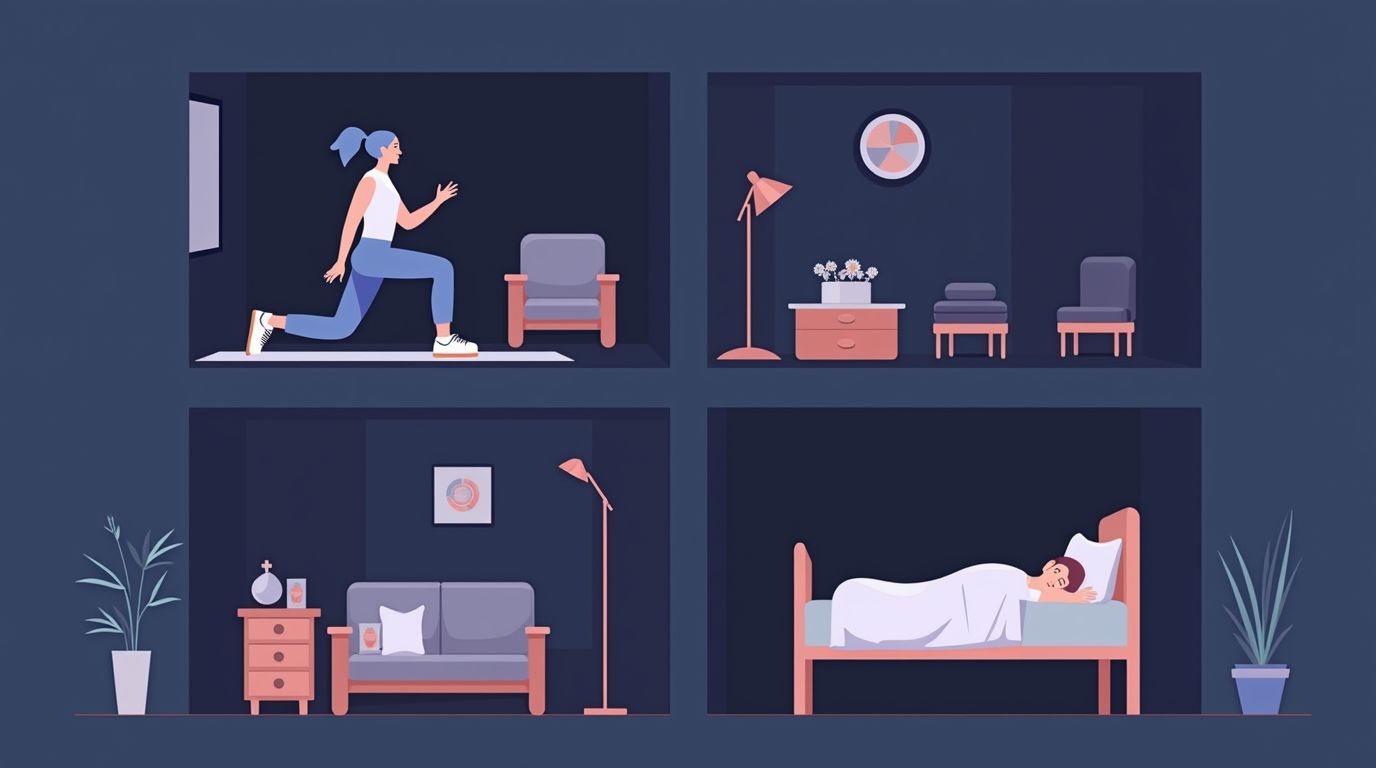
Quick Comparison: Every Move Rated for Noise
Noise ratings use three levels. Silent means no foot impact at all: your feet stay planted or your body stays on the floor. Soft means your feet reposition but never leave the ground together, so it sounds like someone walking around. Audible means an airborne phase with a landing. Nothing on this list is audible. That's the point.
| Exercise | Noise rating | Main muscles | Apartment note |
|---|---|---|---|
| Glute bridges | Silent | Glutes, hamstrings | Back stays on the floor the whole time |
| Wall sits | Silent | Quads, glutes | Zero movement; strongest blood pressure evidence |
| Slow-tempo squats | Silent | Quads, glutes | Feet never move; tempo is the intensity dial |
| Forearm planks | Silent | Core, shoulders | Static hold, nothing to hear |
| Dead bugs | Silent | Deep core | Slow limb movement on your back |
| Split squats | Soft | Quads, glutes, adductors | Feet planted per set; only setup steps make sound |
| Walk-out burpees | Soft | Full body | The quiet burpee: step out, step in, no jump |
| Bird dogs | Silent | Back, glutes, core | On all fours, slow and controlled |
| Calf raises | Silent | Calves | Silent only if you lower under control |
| Marching in place | Soft | Hip flexors, calves | Sounds like normal walking to anyone below |
| Donkey kicks | Silent | Glutes | Kneeling position, nothing touches down |
| Clamshells | Silent | Glute medius | Side-lying; the quietest exercise that exists |
Why does jumping bother neighbors so much?
It comes down to physics, not thin walls. When you land from a jump, the impact produces peak ground reaction forces averaging about 4.5 times your body weight, according to normative force-plate data from McNair and Prapavessis (1999) in the Journal of Science and Medicine in Sport. That force travels through the floor joists as a low-frequency thud that insulation does almost nothing to absorb. A person walking generates a fraction of that. A person doing glute bridges generates essentially none.
So the fix isn't tiptoeing through jump squats. The fix is choosing exercises where the force stays inside your muscles instead of hitting the floor. That constraint sounds limiting. It isn't. Some of the most effective training tools in the research literature, isometric holds and slow eccentrics among them, happen to be the quietest.
The same constraint works for intervals, and the beginner routine in our HIIT programming guide reaches interval intensity with one foot on the floor the whole time.
One example worth knowing: a 2023 network meta-analysis by Edwards et al. in the British Journal of Sports Medicine pooled 270 randomized trials with 15,827 participants and found that isometric exercise reduced resting blood pressure more than aerobic exercise, dynamic resistance training, or HIIT. The single most effective sub-mode? The wall squat, an exercise you can do against your bedroom wall in complete silence.
The 12 Best No-Jumping Apartment Exercises, Ranked
Ranked by training value per unit of noise. Every entry links to a full form guide in our exercise library.
1. Glute Bridges (Silent)
The best starting point for a quiet lower-body session. Your back stays on the floor, your feet stay planted, and the hip extension pattern trains the glutes and hamstrings that sitting all day switches off. Progress to single-leg bridges or pause reps when two-leg versions get easy. Full form guide: glute bridges. For a complete lower-body session built around this pattern, see our roundup of the best glute exercises at home.
The honest limitation: trained lifters outgrow the bodyweight version fast. Without a way to add load, you'll need single-leg and tempo variations to keep it challenging.
2. Wall Sits (Silent)
An isometric hold with better research behind it than almost anything else on this list. The wall sit was the top blood-pressure-lowering exercise sub-mode in the Edwards meta-analysis cited above, and it builds serious quad endurance with literally zero movement and zero sound.
The honest limitation: isometric strength is somewhat angle-specific. A wall sit makes you strong near the position you hold, so it complements moving exercises rather than replacing them.
3. Slow-Tempo Squats (Silent)
A bodyweight squat with a 4-second descent and a 2-second stand is a different exercise from a fast air squat. Your feet never move, so it's perfectly quiet, and the extended time under tension does the work that impact would otherwise do. Form guide: squats. More on the tempo science below.
The honest limitation: counting tempo takes discipline. Most people speed up by rep six without noticing, and the exercise quietly gets easier.
4. Forearm Planks (Silent)
The classic core hold. Nothing moves, nothing lands, and your downstairs neighbor could be napping directly below you without a clue. The forearm plank trains the core exactly as it functions in daily life: resisting motion, not creating it.
The honest limitation: once you pass about 60 seconds, longer holds add boredom faster than they add fitness. Progress by lifting a leg or an arm instead of extending the clock.
5. Dead Bugs (Silent)
Lying on your back, moving opposite arm and leg while your lower back stays glued to the floor. Dead bugs teach the core control that planks build in a static position, and they're gentler on cranky lower backs than almost any alternative.
The honest limitation: they only work done slowly. Rushed dead bugs are arm-waving, not training.
6. Split Squats (Soft)
Single-leg training is the apartment dweller's secret weapon: putting all your weight on one leg roughly doubles the load without a single airborne moment. In a split squat both feet stay planted through the whole set, so the only sound is you stepping into position.
The honest limitation: there's a real balance learning curve. Expect wobbly first sessions, and hold a wall or chair until the position settles.
Knowing what to do is the easy part.
FitCraft, our mobile fitness app, pairs you with an AI coach who builds you a personalized plan around your goals, schedule, and fitness level. Every FitCraft program is designed by Domenic Angelino, MPH (Brown University) and NSCA-CSCS, with research published in the Journal of Strength and Conditioning Research and Medicine & Science in Sports & Exercise.
Take the Free Assessment Free • 2 minutes • No credit card7. Walk-Out Burpees (Soft)
The quiet burpee exists, and it keeps most of what makes burpees effective. Hinge at the hips, place your hands on the floor, walk your feet or hands back one at a time into a plank, walk them back in, and stand tall with a reach overhead. No kick-back, no jump at the top, no landing. Your heart rate still climbs because your whole body still travels through a big range every rep.
The honest limitation: it's the loudest thing on this list, mostly from hands contacting the floor. A mat under your hands makes it near-silent on any surface.
8. Bird Dogs (Silent)
From all fours, extend opposite arm and leg, pause, return. Bird dogs train spinal stability and balance at the same time, which is why physical therapists hand them out so freely.
The honest limitation: they're easy to do badly. If your hips rotate as the leg lifts, the exercise stops working. Film a set from behind once to check.
9. Calf Raises (Silent, With One Rule)
Rise onto your toes, pause, and lower over 3 full seconds. Calf raises are silent only if you obey the lowering rule: dropping your heels to the floor fast is a mini-impact, repeated 20 times. Controlled, they're soundless and surprisingly hard.
The honest limitation: calves recover fast and need either high reps or slow eccentrics to get meaningful work. Sets of 8 quick reps do very little.
10. Marching in Place (Soft)
The step-based cardio option. Marching in place with deliberate knee lift, done briskly between strength moves, keeps your heart rate elevated through a whole session. To anyone below, it registers as someone walking around their apartment, because that's roughly what it is.
The honest limitation: the intensity ceiling is low. It works as active rest between harder moves, not as a standalone conditioning plan.
11. Donkey Kicks (Silent)
Kneeling glute work where the moving leg never touches down mid-set. Donkey kicks isolate the glutes through a range that bridges don't quite reach, and pair naturally with them in a superset.
The honest limitation: it's an isolation move with a small range. It finishes a session; it can't anchor one.
12. Clamshells (Silent)
Side-lying, knees bent, top knee opens like a shell. Clamshells target the glute medius, the hip stabilizer that keeps knees tracking well in every other exercise on this list. Probably the quietest exercise in existence.
The honest limitation: without a resistance band above the knees, most people outgrow them within weeks.
The Quiet Intensity Trick: Slow Down Instead of Jumping
Jump training creates intensity through speed and impact. In an apartment you need a different lever, and the research points clearly at tempo. A 2012 study by Burd et al. in the Journal of Physiology found that slow 6-second repetitions taken to fatigue produced greater muscle protein synthesis than the same movement performed quickly. And a 2015 meta-analysis by Schoenfeld, Ogborn, and Krieger in Sports Medicine concluded that repetition durations from roughly 2 to 8 seconds produce comparable muscle growth, so slowing down costs you nothing while making each rep harder and quieter.
The practical recipe: pick any move from the list, lower for 3 to 5 seconds, pause 1 second at the hardest point, and come up under control. Ten squats at that tempo will humble people who breeze through thirty fast ones. We break down the full evidence in our time under tension research review.
How We Ranked These
Four criteria, weighted for apartment training specifically:
- Noise per rep. We rated each move silent, soft, or audible based on whether anything impacts the floor. Only silent and soft moves made the list. Jump squats, jumping jacks, standard burpees, high knees, and fast mountain climbers all rate audible and were excluded outright.
- Training value. Moves that work large muscle groups or well-researched patterns ranked above isolation work, which is why glute bridges sit at 1 and clamshells at 12.
- Progression headroom. A quiet exercise you outgrow in two weeks isn't much use. Single-leg and tempo variations extended the useful life of the top picks.
- Space required. Everything here fits in a mat-sized footprint. Nothing needs a running start, a doorway bar, or a landlord conversation.
We didn't lab-test floor transmission; ratings come from the mechanics of each movement (airborne phase or not, impact or not) plus the ground reaction force literature cited above.
Which Moves Should You Choose?
If you want a simple full-body session: glute bridges, slow-tempo squats, forearm planks, and walk-out burpees cover push, hold, hinge, and conditioning in about 20 minutes.
If your main worry is a grumpy neighbor: build entirely from the silent tier. Bridges, wall sits, dead bugs, bird dogs, donkey kicks, and clamshells make a complete session with zero foot impact.
If your knees complain: lead with bridges, clamshells, and wall sits at a shallow angle, and see our guide to the best low-impact exercises for bad knees before adding split squats.
If you want cardio without jumping: alternate walk-out burpees and marching in place in timed rounds. Thirty seconds on, fifteen off, repeated for ten minutes, is honest conditioning at walking-level noise. For a longer version of that idea, our guide to low impact cardio at home builds ten quiet moves into three 20-minute routines, including a no-jump interval session.
And if you'd rather not assemble any of this yourself, FitCraft's home workout app for no-equipment training builds bodyweight sessions like these into structured multi-week programs, with an AI coach demonstrating every move on an interactive 3D model.
Frequently Asked Questions
Can you get a good workout without jumping?
Yes. Jumping is one way to create training stress, not the only way. Slow tempos, isometric holds, single-leg variations, and shorter rest periods all raise difficulty without any impact. Research on repetition duration shows repetitions lasting anywhere from about 2 to 8 seconds build muscle comparably, so slowing a squat down makes it harder and quieter at the same time.
What exercises are completely silent in an apartment?
Floor-based and static exercises are effectively silent: glute bridges, dead bugs, forearm planks, bird dogs, clamshells, and donkey kicks involve no foot impact at all. Wall sits and slow-tempo squats are also silent because your feet never leave the ground. If a downstairs neighbor can hear anything, it is usually furniture creak, not the exercise itself.
How do I make bodyweight exercises harder without adding impact?
Use time under tension: slow each repetition to a 3-to-5 second lowering phase, pause at the hardest position, and shorten your rest. You can also move to single-leg or single-arm versions, which roughly double the load on the working side. Both approaches scale intensity through control rather than speed, which is exactly what an apartment demands.
Are burpees possible in an apartment?
Yes, with the walk-out variant. Instead of kicking your feet back and jumping at the top, you hinge down, walk your hands out to a plank one hand at a time, walk them back, and stand tall with a reach. You keep most of the conditioning effect because the whole body still moves through a large range, but there is no airborne phase and no landing thud.
Will my downstairs neighbors hear me working out?
Only if your workout involves impact. Landing from a jump produces peak ground reaction forces averaging about 4.5 times body weight, and that force is what travels through the floor structure. Exercises where your feet stay planted or your body stays on the floor transmit very little. A cheap exercise mat under you absorbs most of what remains.