Quick Comparison
| Exercise | Pattern | Targets | Watch out |
|---|---|---|---|
| Push-up | Push | Chest, triceps, shoulders | Balance with pulling work |
| Bodyweight squat | Squat | Quads, glutes, adductors | Only works if kept progressive |
| Inverted row | Pull | Upper back, biceps, grip | Needs something to pull against |
| Single-leg Romanian deadlift | Hip hinge | Hamstrings, glutes, lower back | Hold support until balance grooves |
| Plank | Anti-extension core | Deep core, obliques | Trunk stiffness, not stomach tightening |
| Bulgarian split squat | Single-leg | Squat muscles, plus balance | One side usually weaker |
If you've spent any time on r/bodyweightfitness, you've seen the list debates. Push-ups versus dips. Squats versus pistol squats versus Bulgarians. Pull-ups versus rows. Each Redditor has a favorite. Each thread runs 200 comments long. And almost none of them name what actually matters: the movement pattern, not the specific exercise.
The research-backed answer is simpler than the comments make it sound. Six movement patterns cover every muscle group your body has. Pick one exercise per pattern, do it close to failure with reasonable volume, progress to a harder variation as you get stronger, and you've done what 90 percent of "best bodyweight exercise" lists are trying to do. This article walks through the six patterns, the specific exercises inside each one that the research actually supports, how to program them, and what to do when bodyweight reps start getting too easy.
The Six Movement Patterns
Almost every meaningful strength exercise falls into one of six patterns. If you cover all six, you cover the body. If you skip one, something gets neglected.
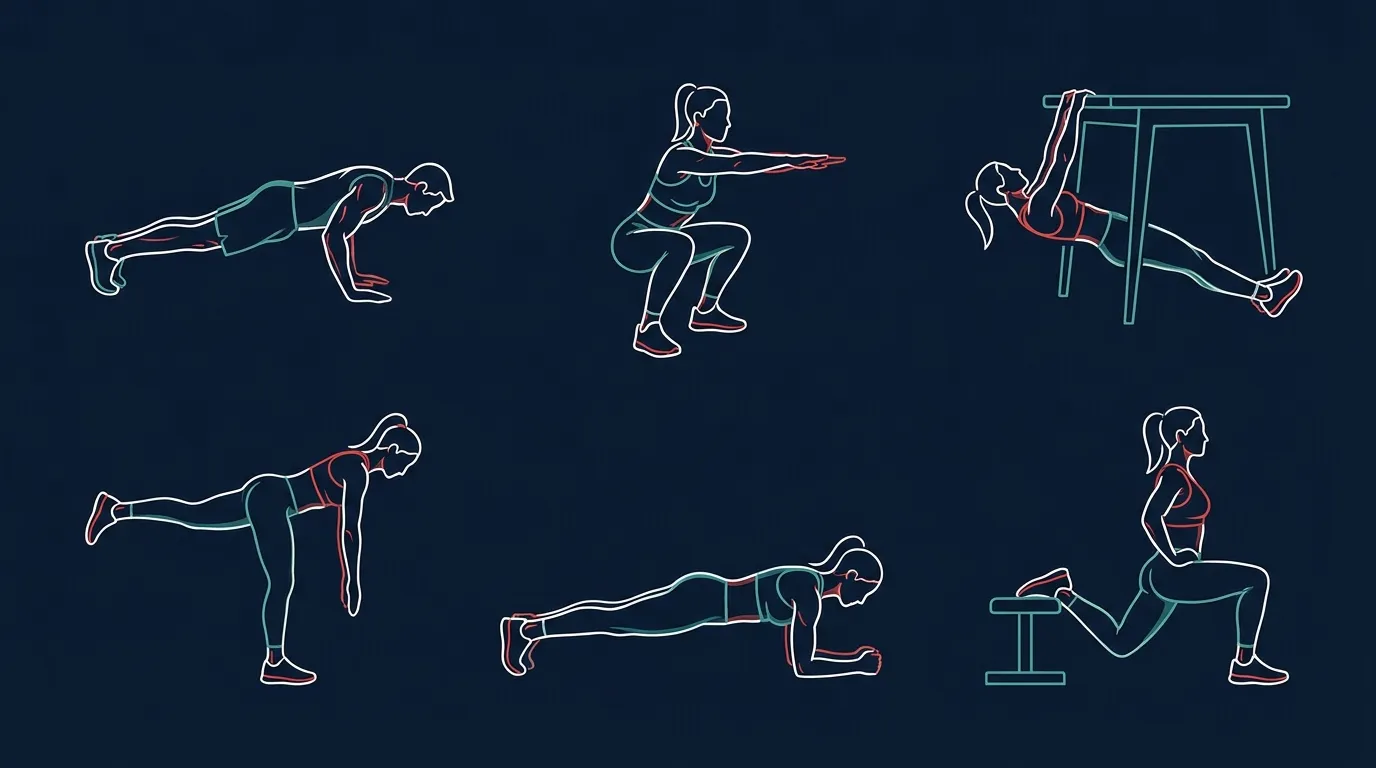
1. Push (horizontal). Push-up family. Trains chest, triceps, shoulders, and the serratus that stabilizes the shoulder blade. Kikuchi and Nakazato (2017) in the Journal of Exercise Science and Fitness ran 9 men through 8 weeks of push-up training and 9 men through low-load (40 percent of 1RM) bench press training. Pectoralis major thickness rose 18.3 percent in the push-up group. Triceps thickness rose 9.5 percent. Both numbers were statistically similar to the bench press group's gains. Push-ups produce real, measurable muscle growth when programmed seriously, not as a warm-up. If arms are your main goal, we break the pattern down further in the best arm exercises without weights.
2. Squat. Bodyweight squat family. Trains quads, glutes, adductors, and the entire posterior chain. Wei et al. (2023) in Scientific Reports randomized 13 sedentary young women to 6 weeks of either progressive bodyweight squat training or barbell back squat training. Both groups gained similar lower-limb isokinetic peak torque and muscle thickness. The barbell group did lose more body fat over the same window, but for strength and muscle gains specifically, bodyweight squats kept up. The trick is the word "progressive": bodyweight squats only work if you keep progressing the difficulty (tempo, range, single-leg variations) as you get stronger.
3. Pull (horizontal). Inverted row family. Trains the upper back, rear delts, biceps, and grip. This is the pattern most home programs neglect because it requires something to pull against. The fix: a sturdy table you can lie under, a low bar, a doorway pull-up bar set at hip height, or a TRX. A horizontal pull balances the pushing pattern and prevents the rounded-shoulder, neck-forward posture that comes from push-only training.
4. Hip hinge. Single-leg Romanian deadlift family. Trains the hamstrings, glutes, lower back, and core stability. Without weights, the hinge is hard to load through the two-leg version (your bodyweight alone barely challenges a hinge). Going single-leg solves it. Hold something for balance (a wall, a chair) at first and graduate to free-standing once the pattern is grooved.
5. Anti-extension core. Plank family. Trains the deep core, the obliques, and the muscles that stabilize the spine against rotation and extension. Planks, hollow body holds, dead bugs, and ab wheel rollouts (if you have one) all fit here. The job of these exercises is not to "tighten" your stomach. It is to teach your trunk to stay stiff while the limbs move, which transfers directly to every other lift you do.
6. Single-leg. Bulgarian split squat family. Trains the same muscles as a squat but exposes side-to-side strength imbalances and challenges balance. Most people are noticeably weaker on one side. Single-leg work corrects it. Bulgarian split squats, step-ups, reverse lunges, and pistol squat progressions all fit here.
Cover those six and you've covered the body. Skip pulling, you build a hunched posture. Skip hinging, your hamstrings stay short and your lower back picks up the slack. Skip single-leg, your left-right imbalances grow until they show up as a knee or hip problem. The pattern coverage matters more than the specific exercise inside the pattern.
What the Research Says About Why This Works
For years the gym-bro position was that you need heavy external load to build muscle. The repetition-continuum research from the last decade dismantled that.
Lasevicius et al. (2022) in the Journal of Strength and Conditioning Research compared low-load (30 percent of 1RM) and high-load (80 percent of 1RM) resistance training, with and without sets taken to muscle failure, across 25 untrained men over 8 weeks. The clean finding: low-load training matched high-load training for muscle hypertrophy when sets were taken to failure. When low-load sets stopped short of failure, growth was smaller. When high-load sets stopped short, growth was preserved. The translation: low load works, as long as you push the sets close enough that the last few reps are genuinely hard.
That mechanism is what makes bodyweight training work for hypertrophy. A bodyweight push-up is a low-load exercise. A bodyweight squat is a low-load exercise. Both produce real growth when sets are taken to failure (or within one to three reps of it). They stop working when you do 12 easy reps and stand around. The "low load needs failure" rule is what separates a bodyweight program that builds muscle from one that just maintains.
This connects directly to the research we've covered on training to failure versus reps in reserve. The summary version: high-load lifters can leave a couple of reps in the tank; low-load lifters cannot. If you train with bodyweight, push your last set close to failure on every movement.
Knowing what to do is the easy part.
FitCraft, our mobile fitness app, pairs you with an AI coach who builds you a personalized plan around your goals, schedule, and fitness level. Every FitCraft program is designed by Domenic Angelino, MPH (Brown University) and NSCA-CSCS, with research published in the Journal of Strength and Conditioning Research and Medicine & Science in Sports & Exercise.
Take the Free Assessment Free • 2 minutes • No credit cardThe Beginner List: Six Exercises, Three Days a Week
If you've never done structured strength training, start here:
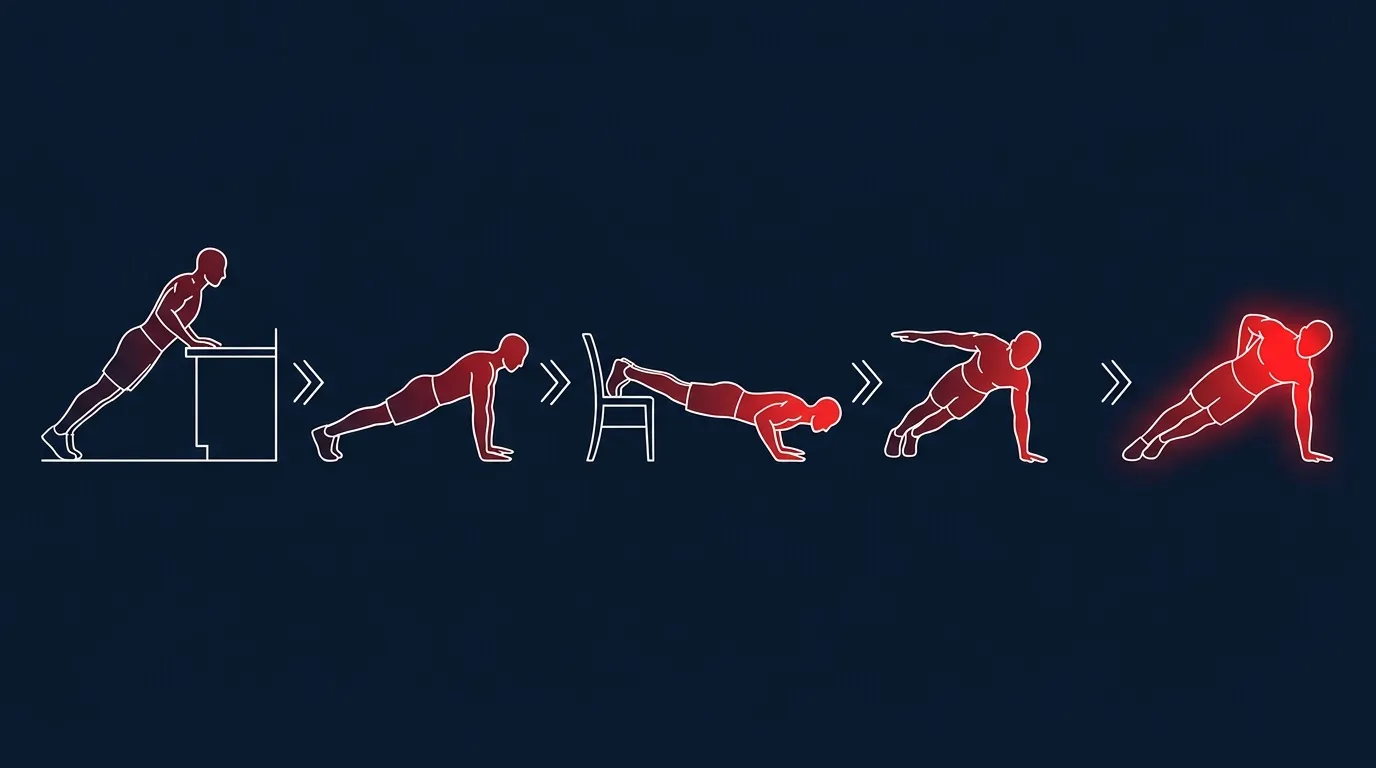
- Push: Incline push-up (hands on a counter, then a chair, then standard floor push-up).
- Squat: Bodyweight squat to a chair (or supported, holding a doorway), then unsupported.
- Pull: Table row (lie under a sturdy kitchen table and pull your chest up to it). If that's not available, use a doorway pull bar set at hip height.
- Hinge: Glute bridge, then single-leg glute bridge, then single-leg Romanian deadlift (no weight needed).
- Plank: Modified plank (knees down) for 20 to 30 seconds, then full plank.
- Single-leg: Assisted split squat (holding a wall or doorway), then Bulgarian split squat (rear foot on a chair).
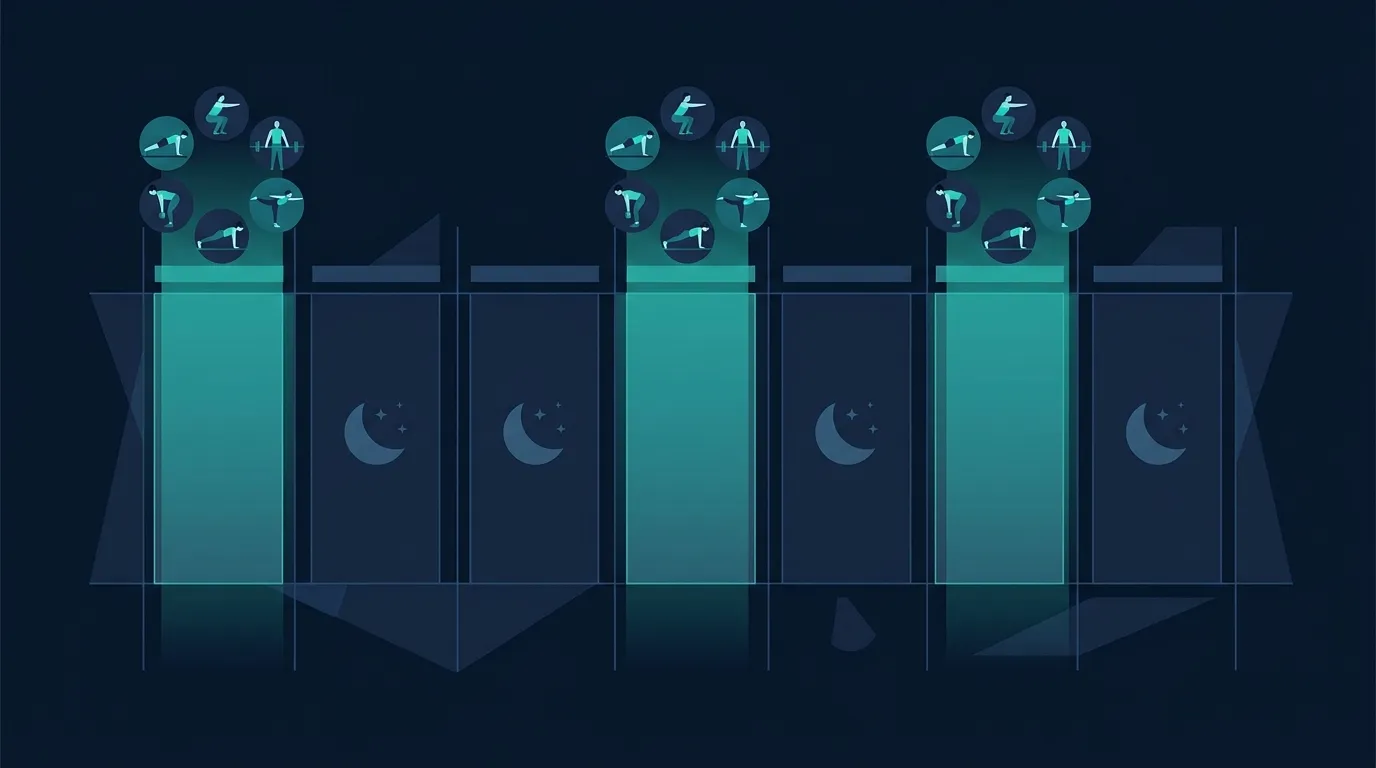
Three sets of each, 8 to 15 reps depending on the difficulty of the version you're on, with the last set pushed close to failure. Three sessions a week. Day off between sessions. That covers the entire body in about 25 to 35 minutes. The 2020 Minute Calisthenics trial protocol by Hollingsworth and colleagues in BMC Public Health used something even simpler (one set each of push-ups, rows, and squats daily) to test whether tiny habit-based bodyweight training builds the habit in untrained adults. The principle they leaned on is the principle to start with: build the habit first, scale the volume second.
If you're starting from a longer break and want a slower ramp, our getting back into working out guide covers the return-to-training side of the same idea.
When Bodyweight Stops Being Hard Enough
Eventually the reps stop being challenging. A standard push-up that used to be hard now goes 20 reps easy. The natural temptation is to add more reps. That works for a while. But once you're hitting 30 or 40 reps and the limiting factor is your aerobic system rather than your muscle, it's time to make the exercise harder, not longer.
The progression ladders inside each pattern:
Push: incline push-up → standard push-up → decline push-up (feet on a chair) → archer push-up (one arm reaches wide while the other does the work) → assisted one-arm push-up → one-arm push-up. Pseudo planche push-ups (hands turned outward, shoulders shifted forward over the hands) ramp the front-delt demand if you want to bias the shoulders.
Squat: chair-supported squat → unsupported squat → tempo squat (3 seconds down, 1 second pause, 1 second up) → split squat → Bulgarian split squat → pistol squat progressions (assisted, box, full).
Pull: table row → inverted row with feet on the floor → inverted row with feet elevated → pull-up (assisted with a band) → strict pull-up → archer pull-up → one-arm pull-up progressions.
Hinge: glute bridge → single-leg glute bridge → single-leg Romanian deadlift (bodyweight) → single-leg Romanian deadlift with a household object held in the hand (gallon of water, backpack with books) for added load.
Plank: modified plank → full plank → forearm plank with reach (extend one arm forward) → hollow body hold → ab wheel rollout (if you own one) or knee plank → standing plank.
Single-leg: assisted split squat → Bulgarian split squat → walking lunge → step-up to a bench → jumping split squat (for power).
The pattern is the same in every ladder: increase difficulty by changing leverage, range of motion, tempo, or stability, not by adding endless reps. When you can do roughly 25 to 30 clean reps of any exercise, move up one rung.
What Bodyweight Training Cannot Easily Do
Honesty matters here. Bodyweight training is excellent at building strength, muscle, mobility, and a base of fitness with zero equipment. It struggles with two specific things. Those two gaps are exactly what our calisthenics vs weights guide digs into, along with when it is worth adding a pair of dumbbells.
Maximal strength once you're well-trained. An intermediate trainee can build serious muscle with bodyweight alone. An advanced trainee chasing the highest possible 1RM bench press or squat will eventually need external load. The bodyweight progressions are not infinite. Once you're doing one-arm push-ups and pistol squats for sets of 5, you're at the practical ceiling, and that ceiling is around what an intermediate-strength lifter can do with weights.
Heavy posterior chain work, especially the hamstrings. The hip hinge pattern is hard to load with bodyweight beyond single-leg variations. Hamstring-specific work (Nordic hamstring curls are an exception, and they're brutal) is limited. If hamstring development is a specific goal, the hinge pattern is the place bodyweight training feels its limits first.
Neither of these is a reason to skip bodyweight training. Both are reasons to add a few minimal pieces of equipment when you're ready: a doorway pull-up bar, a pair of adjustable dumbbells, a kettlebell. For 95 percent of people, those three additions extend bodyweight training another 5 to 10 years before any other equipment becomes useful.
Frequently Asked Questions
What are the best bodyweight exercises?
The research-backed answer is to cover six movement patterns rather than chase any single best exercise. The six are: a push (push-up and variations), a squat (bodyweight squat and progressions), a horizontal pull (inverted row or table row), a hip hinge (single-leg or two-leg Romanian-style hinge), an anti-extension core hold (plank or hollow hold), and a single-leg pattern (split squat or step-up). Push-ups produced muscle thickness gains of about 18.3 percent in the pectoralis major and 9.5 percent in the triceps over 8 weeks in a 2017 Journal of Exercise Science and Fitness trial by Kikuchi and Nakazato, comparable to low-load bench press. Progressive bodyweight squats matched barbell squats for leg strength and hypertrophy in a 2023 Scientific Reports study by Wei et al. in sedentary young women. The right list depends on what equipment you have, but those six patterns built consistently with progression will cover almost everyone's strength needs at home.
Are bodyweight exercises enough to build muscle?
For most people, yes, especially in the first one to two years of training. The mechanism is what matters: muscle growth comes from training close to failure with sufficient volume, not from any specific external load. Lasevicius et al. (2022) in the Journal of Strength and Conditioning Research showed that low-load training produces equivalent hypertrophy to high-load training when sets are taken to muscle failure. Push-ups, harder push-up variations (decline, archer, pike, pseudo planche), and inverted rows can be progressed indefinitely for the upper body. Pistol squats, Bulgarian split squats, and jump squats progress the lower body. Once you can do 25 to 30 clean reps of a movement, swap for a harder variation rather than chasing more reps.
What are the best bodyweight exercises for building muscle?
Pick the hardest version of each pattern you can perform with clean form for 6 to 12 reps. For the upper body: push-up progressions (decline, archer, one-arm assisted), pull-up or chin-up if you have a bar, inverted row under a sturdy table. For the lower body: Bulgarian split squat, pistol squat progressions (assisted or box), single-leg Romanian deadlift, jump squats. For the core: hollow body hold, hanging leg raise (if you have a bar), plank progressions. The same volume guideline holds as with weights: roughly 10 to 20 hard sets per muscle group per week, distributed across two or three sessions. Push the sets close to failure (1 to 3 reps in reserve), progress the difficulty of the variation when reps get easy, and the muscle will grow.
What are the best bodyweight exercises for chest?
Standard push-ups, decline push-ups (feet elevated), archer push-ups, and one-arm push-up progressions. The 2017 Kikuchi and Nakazato trial in the Journal of Exercise Science and Fitness showed 8 weeks of push-up training produced 18.3 percent muscle thickness gains in the pectoralis major, comparable to low-load bench press. As push-ups get easy, the standard progression is: standard then decline (feet on a chair) then archer (one arm reaches wide) then assisted one-arm push-ups. Pseudo planche push-ups (hands turned outward, shoulders shifted forward over the hands) emphasize the upper chest and front delts. Dips on parallel bars or sturdy chairs hit the chest if you lean forward. Pair pushing with pulling (rows or pull-ups) to keep the shoulders balanced.
What are the best bodyweight exercises for beginners?
Start with regressed versions of the six core patterns. For pushing: incline push-ups (hands on a counter or sturdy table) before standard push-ups. For squatting: chair-supported bodyweight squats before unsupported squats. For pulling: table rows (lie under a sturdy table and pull your chest to it). For hinging: glute bridges before single-leg work. For core: dead bugs and modified planks (knees down) before full planks. For single-leg: assisted split squats before Bulgarian split squats. The 2020 Minute Calisthenics protocol by Hollingsworth et al. in BMC Public Health used exactly this kind of habit-based, minimum-viable starting point (one set of push-ups, rows, and squats daily) to build adherence in untrained adults. The first eight weeks are about showing up; the volume comes later.