
You did the 30-minute HIIT video. You were dripping, your legs were shaking, you could barely get up the stairs the next day. Six weeks later your fitness has not moved and you have started dreading Tuesdays.
Here is the uncomfortable part: that session was probably too hard to be easy and too easy to be hard. You spent half an hour somewhere in the middle, which is the one place where the body gets a large fatigue bill and a small adaptation. The word HIIT got attached to it because the format looked like intervals, and the format isn't what makes intervals work.
None of that's a discipline problem. It's a dosing problem, and dosing problems have specifications. Below is the specification.
What HIIT Is, and What It Is Not
High-intensity interval training is repeated bouts of exercise performed at or near your maximum sustainable intensity, separated by periods of low-intensity recovery or rest. Two things define it and neither of them is the exercise you pick.
- The work bout has to be genuinely hard. Think 8 to 9 out of 10 on a perceived-effort scale, breathing that makes talking impractical, and a bout you could not extend by another 50 percent. If you could keep going for twice as long, you were not at interval intensity.
- The recovery has to be long enough to repeat it. The purpose of the rest is to let the next bout be just as hard as the first. When people shorten recovery to make a session feel tougher, every bout after the second one drops in intensity and the whole workout slides into the moderate zone.
So a HIIT workout at home isn't simply a fast circuit. It's not a follow-along video where the instructor never stops talking for 40 minutes. And it's not defined by burpees. You can do HIIT on a stationary bike, on a staircase, or marching in place if that's genuinely hard for you right now.
| Format | Work bout | Effort | What it's for |
|---|---|---|---|
| Sprint intervals | 10 to 30 sec | All out, 10 of 10 | Maximum stimulus, minimum time |
| Short HIIT | 30 to 60 sec | 9 of 10 | Home routines, bodyweight work |
| Long HIIT | 2 to 4 min | 8 to 9 of 10 | The largest VO2 max gains |
| Circuit training | 30 to 60 sec | 6 to 7 of 10 | Muscular endurance, not HIIT |
| Steady cardio | 20 to 60 min | 4 to 6 of 10 | Aerobic base, easy recovery |
Two things this page deliberately doesn't do. It doesn't re-argue interval training against steady cardio, because our review of HIIT vs steady-state cardio research already holds that evidence in one place. And it doesn't list no-impact substitutions, because our low impact cardio at home guide carries a complete no-jump interval routine with movement cues. This page is the programming: ratios, dose, frequency, and three sessions you can run tonight.
Work-to-Rest Ratios, and How to Pick One
The ratio is just the work bout divided by the recovery bout. It follows from one rule: the shorter and harder the bout, the longer the rest has to be.
| Work | Rest | Ratio | Rounds | Best for |
|---|---|---|---|---|
| 20 sec all out | 2 min easy | 1:6 | 3 to 6 | Time-crunched, well recovered |
| 30 sec hard | 45 to 60 sec | 1:1.5 to 1:2 | 8 to 12 | Beginners, bodyweight moves |
| 40 sec hard | 20 sec | 2:1 | 12 to 16 | Intermediate blocks and finishers |
| 2 to 4 min hard | Equal time easy | 1:1 | 4 to 6 | Raising VO2 max |
The 40:20 ratio is the most popular one online and the most commonly misused, because twenty seconds isn't enough recovery for a genuinely maximal bout. It works when the session is organised into blocks with a full minute between them, which is how the intermediate routine below uses it. Run 16 rounds of 40:20 with no block breaks and you have built a very uncomfortable moderate-intensity workout.
Without a lab or a chest strap, use RPE and the talk test together. At interval intensity you can get out two or three words, not a sentence. At the end of the recovery bout you should be able to speak a full sentence again. If you cannot, extend the recovery rather than pressing on, because the next bout is about to be a fake one.
What the Evidence Says About Dose
The single most useful finding for a home exerciser is how little hard work it takes to move the needle. Gillen and colleagues (2016), publishing in PLOS ONE, put 27 sedentary men through 12 weeks of either sprint interval training or moderate continuous training. The sprint group did three 20-second all-out efforts inside a 10-minute session, three times a week, which works out to about one minute of hard work per session and 30 minutes of total weekly training. The continuous group did 45 minutes of steady cycling, three times a week, for 150 minutes weekly. VO2peak rose 19 percent in both groups. Insulin sensitivity improved in both.
That doesn't mean one minute is optimal, only that the floor is much lower than people assume. On what is optimal, Wen and colleagues (2019) pooled 53 randomised controlled trials in the Journal of Science and Medicine in Sport and concluded that long work intervals of at least 2 minutes, higher session volumes and programmes running 4 to 12 weeks produced the largest VO2 max gains. Shorter intervals of 30 seconds or less, lower volumes and programmes under 4 weeks still produced clear benefits against controls. The practical read: start where you can hold the intensity, and grow the work bouts before you grow the number of sessions.
The size of the effect depends on who you're. Weston, Wisloff and Coombes (2014), in the British Journal of Sports Medicine, pooled 10 studies of 273 patients with cardiometabolic disease and found interval training raised VO2peak by 3.03 mL/kg/min more than moderate continuous training, roughly 9.1 percent, close to double the continuous group's improvement. Batacan and colleagues (2017), reviewing 65 intervention studies in the same journal, found that programmes shorter than 12 weeks already improved VO2 max, diastolic blood pressure and fasting glucose in people with overweight or obesity, while programmes of 12 weeks or longer additionally shifted waist circumference, body fat percentage, resting heart rate and systolic blood pressure. Twelve weeks is where body composition starts showing up. Four weeks is where fitness does.
And bodyweight versions count. Machado and colleagues (2019), writing in Clinical Physiology and Functional Imaging, describe whole-body HIIT built from calisthenics as an effective and safe method for improving physical fitness and body composition, applicable across populations and ages. You don't need a bike, a rower or a treadmill for any of this.
Find out what's really holding you back
FitCraft, our mobile fitness app, pairs you with an AI coach who builds you a personalized plan around your goals, schedule, and fitness level. Every FitCraft program is designed by Domenic Angelino, MPH (Brown University) and NSCA-CSCS, with research published in the Journal of Strength and Conditioning Research and Medicine & Science in Sports & Exercise.
Take the Free Assessment Free • 2 minutes • No credit cardThree Complete Home HIIT Workouts
Every one of these needs a doorway's worth of floor space and nothing else. Pick the one that matches where you're, not where you want to be. The most common mistake is starting at the advanced routine, running it twice, and quitting on week two with a sore achilles.
Beginner: 15 minutes
Eight rounds, 30 seconds of work and 45 seconds of walking recovery. Rotate through four moves, two rounds each. The target for the work bout is hard but controlled, roughly an 8 out of 10, with the last five seconds feeling like a decision.
| Segment | Time | What to do |
|---|---|---|
| Warm-up | 3 min | Marching, arm circles, 10 slow bodyweight squats, 20 easy jumping jacks |
| Rounds 1 and 5 | 30 sec each | High knees |
| Rounds 2 and 6 | 30 sec each | Squat kicks |
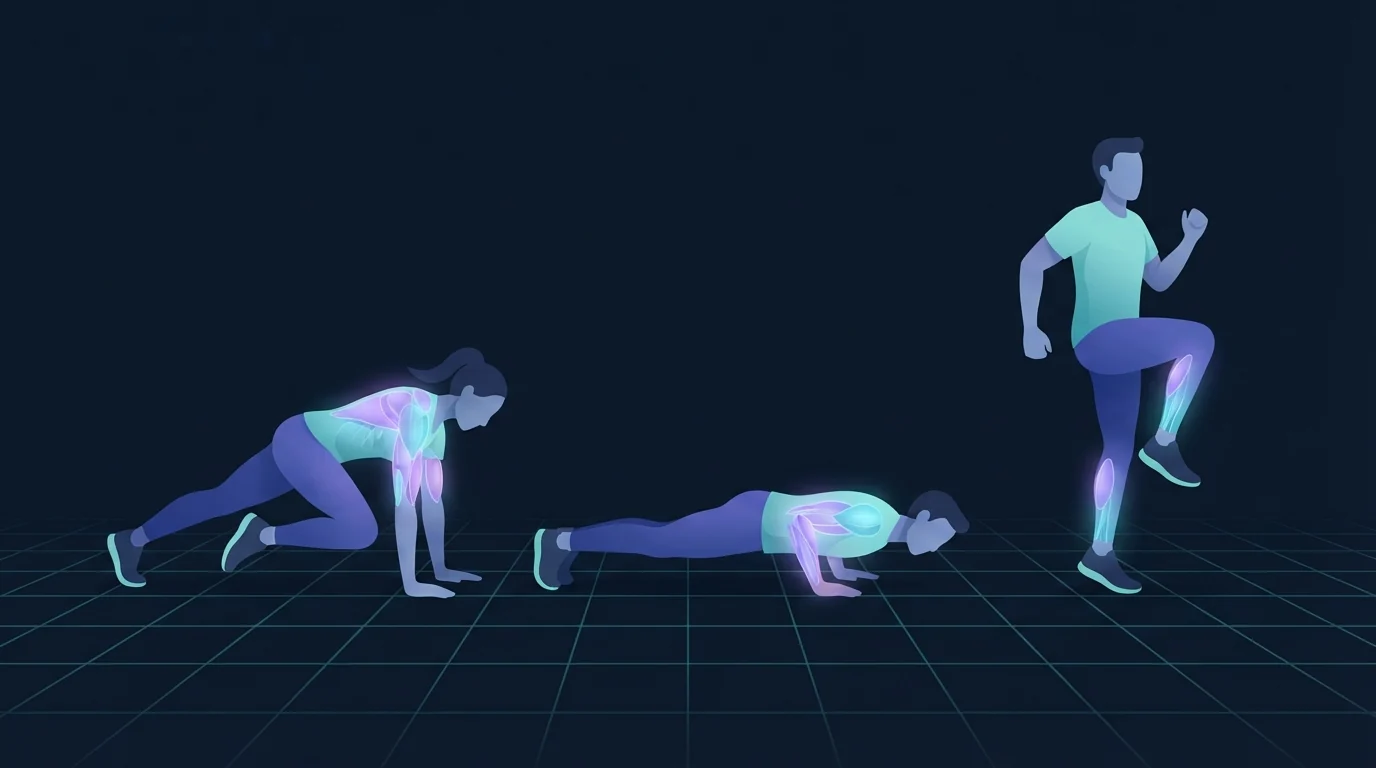
| Rounds 3 and 7 | 30 sec each | Mountain climbers |
| Rounds 4 and 8 | 30 sec each | Rear lunges, alternating |
| Recovery | 45 sec after each round | Walk the room, hands off knees, breathe through the nose |
| Cool-down | 2 min | Easy walking, then a quiet standing breath for 30 seconds |
Intermediate: 20 minutes
Three blocks of four minutes. Each block is four rounds of 40 seconds of work and 20 seconds of rest, and you get a full minute of walking between blocks. The block structure is what makes 40:20 honest, because the minute between blocks restores enough to make round one of the next block as hard as round one of the first.
| Segment | Time | What to do |
|---|---|---|
| Warm-up | 4 min | Walk, 10 walk-outs, 20 jacks, 6 slow lunges each side |
| Block 1 | 4 min | 40:20 x 4: jump squats, push-ups, mountain climbers, plank jacks |
| Between blocks | 1 min | Walking recovery, nothing clever |
| Block 2 | 4 min | 40:20 x 4: burpees, rear lunges, high knees, side lunges |
| Between blocks | 1 min | Walking recovery |
| Block 3 | 4 min | 40:20 x 4: repeat block 1, pacing for equal rounds |
| Cool-down | 2 min | Easy walking, calf and hip flexor stretch |
Advanced: 25 minutes
Four long intervals of 3 minutes with 90 seconds of walking recovery. This is the format the meta-analytic evidence favours for raising VO2 max, and it's considerably less fun than short bouts, which is the honest trade. Each 3-minute interval is a continuous rotation of four movements at 45 seconds each, held at an 8 out of 10 the whole way instead of sprinted at the start.
| Segment | Time | What to do |
|---|---|---|
| Warm-up | 5 min | 3 min easy running in place, then 2 min of squats, lunges and jacks |
| Interval 1 | 3 min | Burpees, jump squats, mountain climbers, high knees, 45 sec each |
| Interval 2 | 3 min | Jump squats, push-ups, plank jacks, running in place, 45 sec each |
| Interval 3 | 3 min | Repeat interval 1, same pace, no fade |
| Interval 4 | 3 min | Repeat interval 2, same pace, no fade |
| Recovery | 90 sec after each | Walk, stay upright, don't sit down |
| Cool-down | 2 min | Walking, then slow nasal breathing until the heart rate settles |
The pacing rule for all three: your last round should be within about 10 percent of your first. If round eight is visibly slower than round one, the session was a time trial with rests in it, not an interval workout. Slow round one down next time. That's the same discipline a tempo run demands, and people get it wrong in exactly the same way.
How Often Per Week
Two sessions if you're new to intervals, three if you have a base and a reason. Never on consecutive days. That's the entire prescription, and the temptation to exceed it's the most reliable way to end a HIIT habit in week five.
The reasoning is that interval work is a stimulus with a recovery cost attached, and the cost is paid out of the rest of your week. A fourth session doesn't add a fourth dose of adaptation, it turns your easy days into tired days. The World Health Organization's 2020 physical activity guidelines put the weekly target at 75 to 150 minutes of vigorous activity or 150 to 300 minutes of moderate activity for adults. Three 20-minute sessions land you near the middle of the vigorous range with room left for walking and strength work, which is where the aerobic base that makes intervals possible is actually built. Our guide to increasing stamina covers that base in detail.
One honest note on how this feels. Stork and colleagues (2017) reviewed 42 studies covering 1,258 participants and 55 interval protocols in Health Psychology Review, and found that in-task affect tends to be more negative during interval exercise than during continuous exercise, while post-exercise enjoyment and preference come out equal or better. Intervals feel worse while you're doing them and better once you stop. Plan for the first part so the second part gets a chance to happen.
Warm-Up and Cool-Down
Both get skipped and both are load-bearing when the first hard bout arrives 90 seconds into a session.
- Warm-up, 3 to 5 minutes. Two minutes of easy continuous movement to raise body temperature, then a rehearsal of the actual movements at low intensity: a few slow squats, a few slow lunges, two easy rounds of whatever the first work bout is. Save static stretching for later in the day.
- One primer bout. Twenty seconds at about 80 percent of your work-bout effort, then a minute of walking. This one addition does more for the quality of round one than anything else on this list.
- Cool-down, 2 to 3 minutes. Keep walking rather than sitting, which lets heart rate come down gradually instead of dropping off a cliff. Then 30 to 60 seconds of slow nasal breathing. Add calf, hip flexor and quad stretches if you have jumped.
Who Should Not Do HIIT at Home
Interval intensity briefly pushes heart rate and blood pressure near their ceilings, and bodyweight HIIT adds repeated impact on top of that. Some people should build the base first or get cleared first.
- Get medical clearance before starting if you have known or suspected cardiovascular disease, uncontrolled hypertension, chest pain or unusual breathlessness on exertion, or a history of cardiac symptoms.
- Build four to six weeks of easy cardio first if you have been sedentary for a long stretch. Brisk walking most days is the on-ramp, and it's not a lesser version of training.
- Use the no-impact route if you have knee, hip, ankle or back pain, are postpartum, or live above someone. Fast step-ups, squat pulses, shadow boxing and carries reach interval intensity with one foot on the floor throughout. The routine for that lives in our low impact cardio at home guide.
- Skip the session entirely when you're ill with anything below the neck, badly underslept, or already sore from the previous interval day. An interval session you're not recovered for is a fatigue purchase with no adaptation attached.

Progression Over Six Weeks
Change one variable at a time, and change it every two weeks rather than every session. Growing the work bout is the highest-value progression, because that's what the interval-length evidence favours.
| Week | Sessions | Session | What changed |
|---|---|---|---|
| 1 and 2 | 2 | Beginner, 8 rounds of 30:45 | Nothing. Learn the pacing. |
| 3 | 2 | Beginner, 10 rounds of 30:45 | Two more rounds |
| 4 | 2 | Intermediate, 2 blocks instead of 3 | Bout length up to 40 sec |
| 5 | 3 | Intermediate, full 3 blocks | A third session added |
| 6 | 2 to 3 | Advanced, 3 intervals instead of 4 | Bout length up to 3 min |
Notice what week 6 doesn't do: it doesn't run four sessions or stack the advanced routine on consecutive days. If week 6 goes well, week 7 adds the fourth 3-minute interval and that's the whole progression for the next month. If you would rather not manage this yourself, a home workout app that needs no equipment handles the ratios and the progression so the only decision left is starting. And if you want the intervals to point at something, a HYROX race is built almost entirely out of this quality.
The Bottom Line
A HIIT workout at home works when the hard part is genuinely hard, the recovery is long enough to repeat it, and the whole thing happens two or three times a week instead of five. Fifteen to 25 minutes is plenty. The research floor is startlingly low, and the ceiling on how much you should do is lower than most programmes suggest.
If HIIT has not worked for you before, the odds are it was never HIIT. You were in the middle, paying a hard-workout price for a moderate-workout result. Move the intensity up, move the volume down, and the same 20 minutes starts doing something.
Frequently Asked Questions
What counts as a HIIT workout at home?
A home workout is HIIT when the hard bouts actually reach a hard intensity, roughly 8 or 9 out of 10 on a perceived-effort scale, and are separated by recovery long enough that you can hit that intensity again. The exercise choice does not decide it, the intensity does. A 45-minute follow-along video where you never fully recover and never reach your ceiling is circuit training with a HIIT label on it.
How long should a HIIT workout be?
Fifteen to 25 minutes including warm-up and cool-down is the usable range for most people at home, with 8 to 20 minutes of actual interval work inside that. The hard minutes are what counts. In a 12-week trial, sprint interval training with about one minute of all-out work per session, three times a week, produced the same 19 percent gain in VO2peak as 45-minute continuous sessions (Gillen et al., 2016).
How many times a week should you do HIIT?
Two to three sessions a week, never on back-to-back days, is the ceiling for almost everyone. HIIT is a stimulus with a recovery cost, and a fourth or fifth session usually subtracts more from your easy training than it adds. Fill the rest of the week with walking, easy cardio and strength work, which is where the aerobic base that makes intervals possible actually gets built.
Can you do HIIT at home without jumping?
Yes. Intensity comes from effort, not from leaving the floor. Fast step-ups, squat pulses, shadow boxing, slow mountain climbers and loaded carries all reach interval intensity with one foot down, which matters if you have joint pain or downstairs neighbours. Our low impact cardio at home guide has a complete no-jump interval routine built on that principle.
Do you need equipment for a HIIT workout at home?
No. Whole-body HIIT built from calisthenics is an established and effective approach for improving fitness and body composition (Machado et al., 2019), and bodyweight movements make it easy to reach a high heart rate without loading a joint through a heavy range. A single moderate dumbbell or kettlebell adds options later, but nothing in a beginner or intermediate routine needs it.
Who should not do HIIT?
Anyone with known or suspected cardiovascular disease, uncontrolled high blood pressure, chest pain or unusual breathlessness on exertion should get medical clearance before doing anything at HIIT intensity. People who have been sedentary for a long stretch, who are pregnant or postpartum, or who are managing a joint or tendon injury should build four to six weeks of steady easy cardio first and then start with the beginner routine rather than jumping into 30-second all-out work.