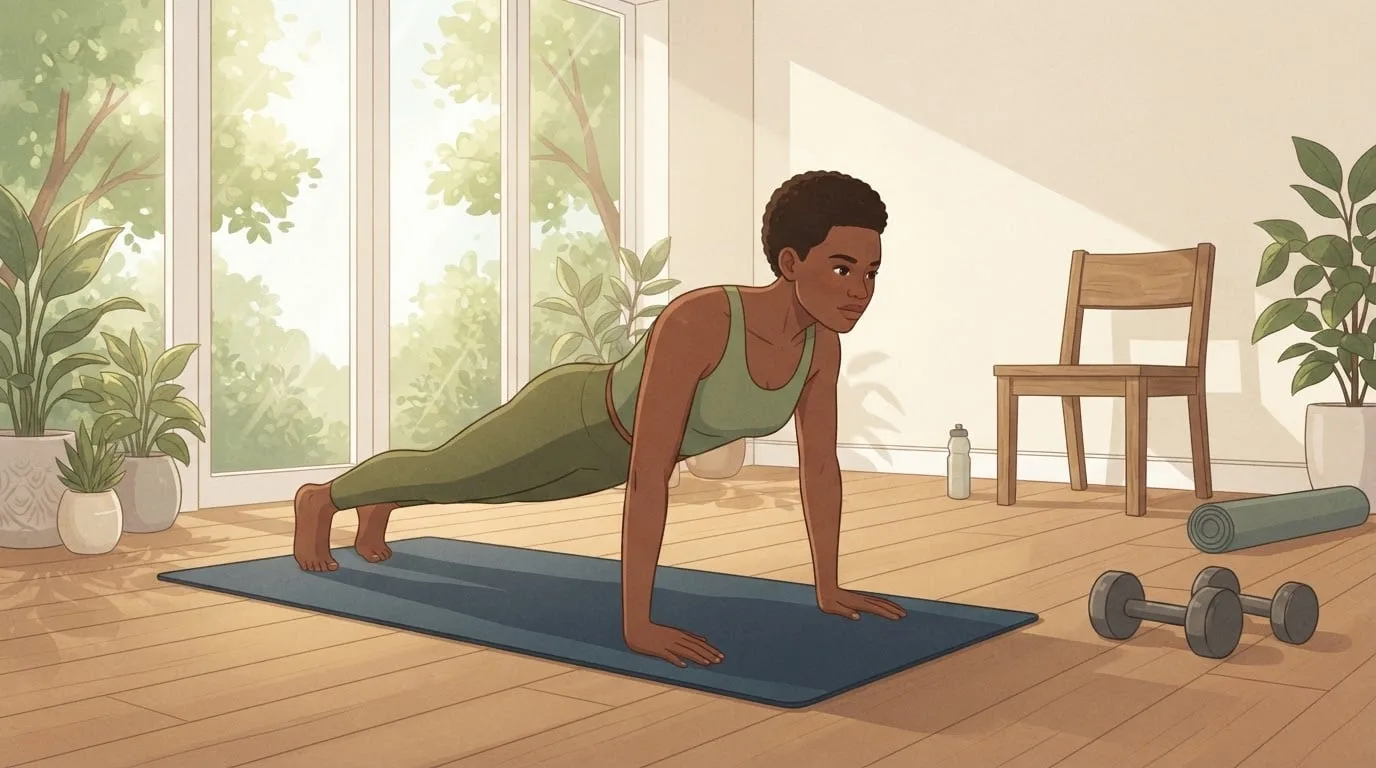
Circuit training is what most people picture when they say they want to get fit at home. You set out a few stations on the living room floor and move from one to the next. By the third round you're breathing hard and your legs can feel it.
The trouble is that most home circuits are put together at random. A follow-along video strings together 12 jumping moves, nothing trains your back, and the rest periods are either too long to keep your heart rate up or too short to do good reps. You finish sweaty and a bit sore, and a month later you're no stronger. That's a design problem, not an effort problem.
This guide starts with what circuit exercises are and how a circuit differs from HIIT. Then you get three complete home circuits by level, with stations, work and rest times and rounds. After that comes the research on circuit training for strength and fitness, a version for older adults, and how to build, schedule and progress your own.
What Is Circuit Training?
Circuit training is a workout format in which you do a series of exercises back to back with little rest between them, then repeat the series. Each exercise is a station. One trip through all the stations is a round, sometimes called a circuit. Five settings define every circuit workout:
- Stations: usually 6 to 10 exercises that mix lower body, upper body and core, sometimes with a cardio move.
- Work: a set time, usually 30 to 45 seconds, or a set number of reps, usually 10 to 15.
- Rest between stations: 10 to 30 seconds, or just the time it takes to get into position.
- Rounds: 2 to 4 trips through the whole list.
- Rest between rounds: 1 to 2 minutes.
The format works because you don't wait around. While your legs recover, your arms are working, so you get more done in less time. A well-known example is the bodyweight circuit that Klika and Jordan (2013) published in ACSM's Health & Fitness Journal. It used 12 exercises done for 30 seconds each, about 10 seconds to switch, and an order that alternates muscle groups so each one gets a short break. It needed only body weight, a chair and a wall.
Circuit Training vs HIIT: What's the Difference?
HIIT is defined by intensity: short bouts at about 8 or 9 out of 10 effort, with enough recovery to hit that level again on the next bout. A circuit is defined by structure: a rotation through different exercises. Most home circuits run at a moderate-to-hard effort, around 6 or 7 out of 10 for breathing, with each station ending a couple of reps short of failure, so they build muscular endurance and strength more than top-end fitness. You can turn a circuit into HIIT by using fewer, harder moves with longer rests, but then the intensity matters more than the rotation. If intervals are what you want, our guide to the HIIT workout at home covers work-to-rest ratios and three interval routines.
Three Home Circuits by Level
Warm up for 5 minutes before any of these: a minute of marching with arm swings, arm circles, 10 slow squats, 10 hip hinges and 10 counter push-ups. You'll need a mat, a sturdy chair, a kitchen counter and, for the advanced circuit, a pair of dumbbells. Time the work and rest with a watch or a wall clock, or count reps instead if that's easier.
Beginner circuit: no equipment, about 20 minutes
Do 6 stations with 30 seconds of work and 30 seconds of rest. Complete 3 rounds and rest 1 minute between rounds. In your first week, do 2 rounds.
| Station | Work / rest | How to do it |
|---|---|---|
| 1. Sit-to-stand | 30 s / 30 s | Sit tall on a chair, feet flat. Stand up without using your hands, then sit back down slowly. |
| 2. Counter push-up | 30 s / 30 s | Hands on the edge of a kitchen counter, body straight. Lower your chest to the edge and push away. |
| 3. Glute bridge | 30 s / 30 s | Lie on your back with knees bent. Squeeze your glutes to lift your hips, pause, lower slowly. |
| 4. Corner row | 30 s / 30 s | Stand with your back to an inside wall corner, upper arms against both walls at shoulder height. Press your elbows into the walls to push your body away, then lean back slowly. |
| 5. Standing march | 30 s / 30 s | March in place, knees toward hip height, arms swinging. Hold the counter if you need balance. |
| 6. Dead bug | 30 s / 30 s | On your back, arms up, knees over hips. Lower one arm and the opposite leg slowly, keeping your lower back on the floor. |
Each round takes 6 minutes, so 3 rounds plus 2 rests come to 20 minutes. Aim to finish each station with 2 or 3 reps left in you. If you can talk in full sentences at the end of a round, move a little faster next time.
Intermediate circuit: bodyweight, about 26 minutes
Do 8 stations with 40 seconds of work and 20 seconds of rest. Complete 3 rounds and rest 1 minute between rounds.
| Station | Work / rest | Notes |
|---|---|---|
| 1. Squat | 40 s / 20 s | Full depth you can control, chest up. |
| 2. Push-up | 40 s / 20 s | Drop to your knees when your hips start to sag. |
| 3. Alternating reverse lunge | 40 s / 20 s | Step back, lower until both knees bend to about 90 degrees. |
| 4. Corner row | 40 s / 20 s | Walk your feet farther from the corner than in the beginner circuit to make it harder. |
| 5. Single-leg glute bridge | 40 s / 20 s | Switch legs at 20 seconds. |
| 6. Mountain climbers | 40 s / 20 s | Hands under shoulders, drive the knees in at a steady pace. |
| 7. Side plank | 40 s / 20 s | Switch sides at 20 seconds. Knees down if needed. |
| 8. Skater steps | 40 s / 20 s | Step wide to one side and swing the back leg behind you, then switch. Hop it once it feels easy. |
Each round takes 8 minutes, so 3 rounds plus 2 rests come to about 26 minutes.
Advanced circuit: dumbbells, 27 to 36 minutes
Do 8 stations with 45 seconds of work and 15 seconds of rest. Complete 3 or 4 rounds and rest 90 seconds between rounds. Choose dumbbells heavy enough that the last few reps of each 45 seconds are hard, and use lighter ones for the overhead press if you need to.
| Station | Work / rest | Notes |
|---|---|---|
| 1. Goblet squat | 45 s / 15 s | One dumbbell held upright at your chest. |
| 2. Feet-elevated push-up | 45 s / 15 s | Feet on a low step or the bottom stair. |
| 3. Dumbbell Romanian deadlift | 45 s / 15 s | Soft knees, flat back, push your hips back. |
| 4. Bent-over dumbbell row | 45 s / 15 s | Hinge forward, pull both dumbbells toward your hips. |
| 5. Dumbbell reverse lunge | 45 s / 15 s | Alternate legs, dumbbells at your sides. |
| 6. Dumbbell overhead press | 45 s / 15 s | Ribs down, press straight up. |
| 7. Burpee | 45 s / 15 s | Step back and forward instead of jumping if you need a quieter version. |
| 8. Dead bug | 45 s / 15 s | Hold one light dumbbell in both hands overhead to make it harder. |
Three rounds take about 27 minutes, including the rests. A fourth round brings the session to about 36 minutes. Keep the effort steady across the rounds rather than sprinting the first one.
Find out what's really holding you back
FitCraft, our mobile fitness app, pairs you with an AI coach who builds you a personalized plan around your goals, schedule, and fitness level. Every FitCraft program is designed by Domenic Angelino, MPH (Brown University) and NSCA-CSCS, with research published in the Journal of Strength and Conditioning Research and Medicine & Science in Sports & Exercise.
Take the Free Assessment Free • 2 minutes • No credit cardCircuit Training Exercises: What to Put at Each Station
A balanced circuit covers the main ways your body moves. Pick one exercise from each of the first six rows and you have a full-body circuit workout at home. Add a cardio station if you want more heart-rate work.
| Movement | Bodyweight options | Dumbbell options |
|---|---|---|
| Squat | Sit-to-stand, squat, pause squat | Goblet squat |
| Hinge | Glute bridge, single-leg glute bridge | Romanian deadlift |
| Push | Counter, knee, floor or feet-elevated push-up | Floor press, overhead press |
| Pull | Corner row, superman hold | Bent-over row, one-arm row on a chair |
| Single leg | Reverse lunge, step-up onto a stair | Dumbbell lunge, split squat |
| Core | Dead bug, plank, side plank | Dead bug holding a dumbbell |
| Cardio (optional) | Step jacks, march, skater steps, mountain climbers, burpees | None needed |
Pulling is the movement most home circuits skip. Pushing moves are easy to do on the floor, so many routines end up with three kinds of push-up and nothing for the upper back. Keep at least one pull in every circuit.
What the Research Says About Circuit Training
Circuit training is one of the few formats with good evidence for building strength and aerobic fitness in the same session.
- It raises both fitness and strength. Muñoz-Martínez and colleagues (2017) pooled 8 studies on VO2 max (118 adults) and 8 on bench press strength (237 adults). Circuit-style resistance training raised both, compared with control groups. The biggest aerobic gains came from programs of about 14 to 30 sessions over 6 to 12 weeks, with sessions of at least 20 to 30 minutes.
- Bodyweight alone can do a lot. Myers and colleagues (2015) assigned 34 inactive young women to either a bodyweight-only circuit or separate weight training plus cardio, 3 days a week for 5 weeks. The circuit group raised VO2 max by 11%, while the other group didn't change. Chest strength rose 20.6% with the circuit and 35.6% with weights, and only the weights group gained back and front-thigh strength.
- Short rests don't cost strength when the work is hard. Alcaraz and colleagues (2011) randomly assigned 33 strength-trained men to heavy lifting done as a circuit with about 35 seconds between sets, the same lifting done as traditional sets with 3-minute rests, or no training, three times a week for 8 weeks. Both training groups gained the same strength and lean mass, and only the circuit group lowered its body fat percentage, in shorter sessions.
- Light loads build muscle if you push them. A review by Schoenfeld and colleagues (2021) concluded that muscle can be built across a wide range of loads when sets are taken close to failure. That's why bodyweight and light-dumbbell stations still work, as long as the last reps are genuinely hard.
The Myers result is the most useful one for home training. A bodyweight circuit is great for fitness and chest strength, but it falls behind on the back and the thighs. The fix is a real pull at every session and leg moves that keep getting harder, such as single-leg bridges, split squats and, later, dumbbells.
Circuit Training Workouts for Seniors
Circuits suit older adults well, because the stations are short, the effort is moderate and the format keeps sessions brief. Buch and colleagues (2017) pooled 10 studies of circuit resistance training in 362 adults with an average age of 64.5. With about 3 sessions a week of around 42 minutes, lower-body strength rose by about 12 kg and upper-body strength by about 1 kg. Programs longer than 24 sessions did better for upper-body strength and aerobic capacity.
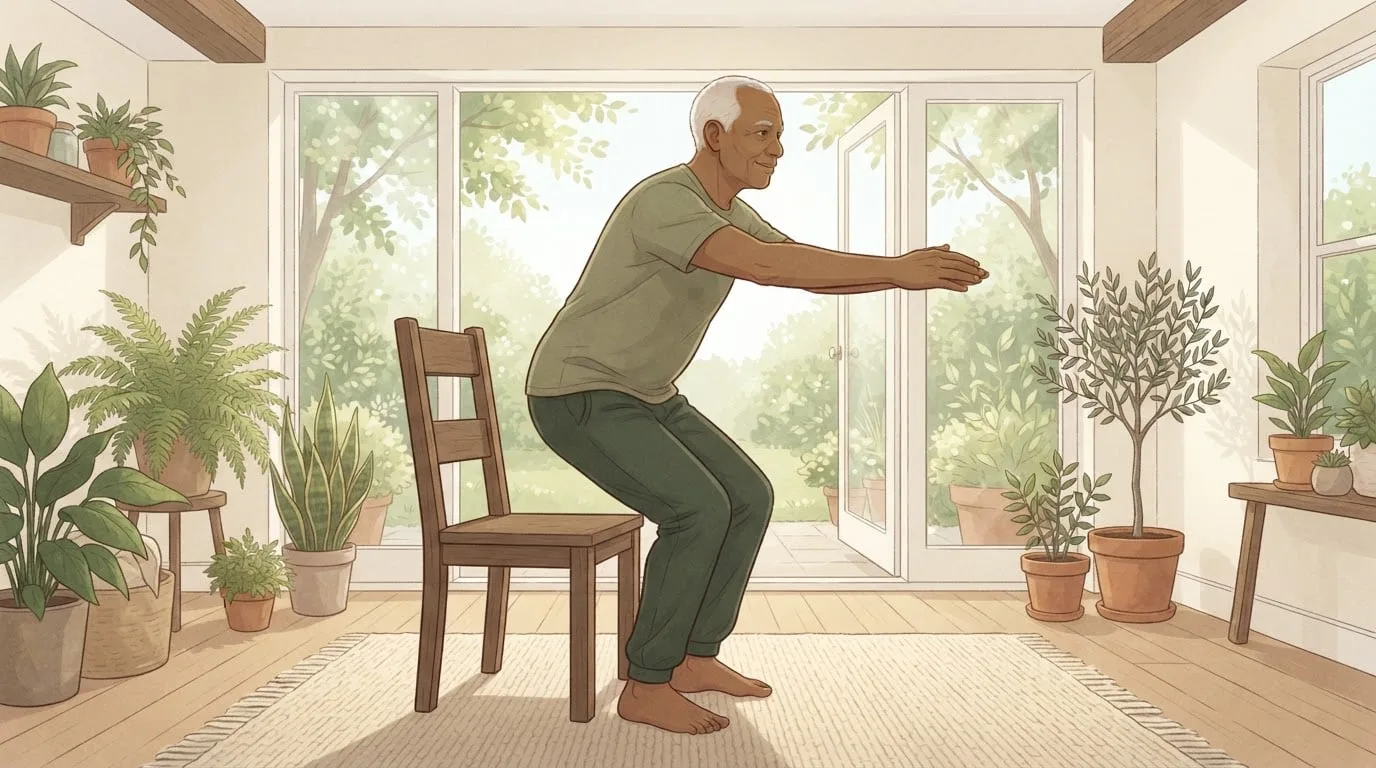
Heavier circuits work in this age group too. In Romero-Arenas and colleagues (2013), 37 healthy adults averaging about 62 years old trained twice a week for 12 weeks. A high-resistance circuit matched traditional strength training for strength, lean mass and bone density, and only the circuit group lost fat mass.
A good starting circuit for older adults uses a sturdy chair against a wall and a kitchen counter for balance:
- Sit-to-stand from the chair.
- Counter push-up.
- Standing march holding the counter.
- Heel raises holding the counter.
- Standing hip extension: hold the counter and swing one straight leg slowly back, then switch.
- Side steps along the counter, 4 steps each way.
Do 30 seconds at each station with 45 seconds of rest, for 2 or 3 rounds, 2 or 3 days a week. Move to the beginner circuit above once this feels easy.
How to Build Your Own Circuit at Home
Once you've done the circuits above for a few weeks, you can design your own. Follow these steps:
- Pick 6 to 8 stations, one from each movement in the table above, plus a cardio move if you like.
- Order them so body parts take turns: squat, push, hinge, pull, single leg, core, cardio. Never put two hard leg moves or two push-ups back to back.
- Set the work and rest to match your goal, using the table below.
- Set the effort. End each station with 1 to 3 reps in reserve. If you could have done 6 more, the station was too easy.
- Choose 2 to 4 rounds and rest 1 to 2 minutes between them.
- Bookend it with a 5-minute warm-up and 2 minutes of easy walking afterwards.
| Goal | Work | Rest between stations | Rounds |
|---|---|---|---|
| Getting started | 30 s | 30 s | 2 to 3 |
| General fitness | 40 s | 20 s | 3 |
| Strength focus | 8 to 12 hard reps with dumbbells or a harder variation | 30 to 45 s | 3 to 4 |
| Conditioning | 45 s | 15 s | 3 to 4 |
Time or reps? Time keeps you moving and is easier to follow. Reps make progress easier to see. A good middle ground is to work for a set time and write down how many reps you did, then try to beat that number next session. For why the rest periods here are so much shorter than in heavy lifting, see our guide to how long to rest between sets.
How Often Should You Do Circuit Training?
Two to four circuit sessions a week is the right range for most people. Most of the studies above used 2 or 3 sessions a week, and the meta-analysis by Muñoz-Martínez found the biggest fitness gains after about 14 to 30 sessions. That's roughly 5 to 10 weeks at three a week.
Leave a day between hard full-body circuits so your muscles can recover, and use the days in between for walking, easy cycling, yoga or mobility. If you want to train more often, split the stations into an upper-body circuit and a lower-body circuit and alternate them.
How to Progress a Home Circuit Over 6 Weeks
A circuit stops working once it stops being hard. You have five ways to make it harder, and you should change only one at a time:
- More reps in the same time, at the same quality.
- A harder variation, such as counter push-ups to floor push-ups, or squats to split squats.
- More work and less rest, such as going from 30 seconds on and 30 off to 40 on and 20 off.
- Another round.
- Added load, such as holding dumbbells for squats and lunges.
| Week | Sessions | Plan |
|---|---|---|
| 1 | 2 | Beginner circuit, 2 rounds. Learn the moves. |
| 2 | 3 | Beginner circuit, 2 rounds. Count and write down your reps. |
| 3 | 3 | Beginner circuit, 3 rounds. |
| 4 | 3 | Beginner circuit, 3 rounds. Beat last week's reps on every station. |
| 5 | 3 | Intermediate circuit at 30 seconds on and 30 off, 3 rounds. |
| 6 | 3 | Intermediate circuit at 40 seconds on and 20 off, 3 rounds. |
From there, add a fourth round, then move to the advanced circuit when you have dumbbells. If you'd rather train with straight sets and longer rests on some days, our full body workout routine has bodyweight and dumbbell plans in that format.
If you'd rather not design circuits yourself, our comparison of the best no-equipment workout apps looks at the options. FitCraft is one of them: a 3D AI coach demonstrates each exercise, says your name while you work, and your workouts adjust as you progress, with streaks and leaderboards to keep you coming back. Its workouts cover bodyweight and dumbbell strength, cardio, yoga and mobility.
The Bottom Line
Circuit training at home means moving through 6 to 10 stations with short rests and repeating the round 2 to 4 times. It raises aerobic fitness and strength in the same session, for young adults and older adults alike. Start with the beginner circuit, keep a pull and a hinge in every circuit, end each station with a few reps left, and make one thing harder every week or two. Two to four sessions a week is enough.
The workouts above will do their job if you keep showing up for them. As one FitCraft user, Mike, put it: "The streak system got me hooked. I didn't want to break my chain."
Frequently Asked Questions
What are some good ideas for circuit training at home?
A good home circuit uses 6 to 8 stations that cover the whole body: a squat, a push-up, a hinge such as a glute bridge, a pull such as a corner row or dumbbell row, a lunge, a core move and an optional cardio move. Work for 30 to 45 seconds at each station, rest 15 to 30 seconds, and repeat the round 2 to 4 times. A chair, a counter, a staircase and a pair of dumbbells give you enough variety for months.
What are 6 effective exercises for circuit training?
Six effective exercises for a home circuit are the squat, push-up, reverse lunge, row, glute bridge and plank. Together they train the legs, chest, back, glutes and core, and each one has easier and harder versions, from counter push-ups to feet-elevated push-ups. Use a corner row or a dumbbell row for the pull, because most no-equipment circuits leave the back out.
What is the 5 5 5 30 rule?
The 5-5-5-30 rule is a short routine from social media: 5 push-ups, 5 squats, 5 lunges and a 30-second plank, usually done soon after waking. Versions differ on whether the lunges count per leg. It takes about two minutes, so it works as a habit starter or a warm-up, but it's too little work on its own to build much strength or fitness. Repeat it 3 or 4 times as a mini circuit to turn it into a real session.
What are the golden 6 exercises?
The Golden Six is an old-school barbell bodybuilding routine linked to Arnold Schwarzenegger: the squat, wide-grip bench press, chin-up, behind-the-neck press, barbell curl and sit-up. At home you can train the same muscle groups in a circuit with goblet squats, push-ups, dumbbell rows, dumbbell overhead presses, dumbbell curls and dead bugs.
What are some good circuit training workouts for seniors?
A good circuit for older adults uses a sturdy chair and a kitchen counter for support: sit-to-stands, counter push-ups, standing marches, heel raises, a standing hip extension and side steps along the counter. Do 30 seconds at each station with 45 seconds of rest, for 2 or 3 rounds, 2 or 3 days a week. A meta-analysis of 10 studies in adults averaging 64 years old found circuit resistance training raised lower-body strength by about 12 kg.
How long should a circuit workout at home take?
Plan on 20 to 30 minutes of circuit work plus a 5-minute warm-up. In a meta-analysis of circuit training studies, the largest gains in aerobic fitness came from programs of about 14 to 30 sessions over 6 to 12 weeks, with sessions of at least about 20 to 30 minutes. A 20-minute beginner circuit done three times a week fits that range.
Can you build muscle with circuit training at home?
Yes, if each station is hard enough. Muscle grows across a wide range of loads when sets end close to failure, so bodyweight moves and light dumbbells work as long as the last few reps of each station are a real struggle. In trained men, a circuit with heavy loads and about 35 seconds of rest between sets built the same strength and lean mass as traditional training with 3-minute rests.