You've saved four different programs. One needs six days, one opens with a barbell lift you've never performed, and one has you doing arms on a Tuesday. None of them survived contact with a week where the kid got sick and the meeting ran late. So you're back to improvising, and improvising for three months tends to look a lot like standing still.
The frustrating part isn't the training. It's the constant low-grade sense that you're doing it wrong, that there's a right program out there and you keep failing to find it.
There isn't. There's a set of movement patterns, a weekly number of hard sets, and a container that fits your calendar. A full body routine is the simplest container anyone has built, and it's the one that forgives the weeks real life takes from you.
What Counts as a Full Body Workout Routine
A session is full body if it touches every major movement pattern. Not every muscle by name, every pattern. There are six, and each one buys something the others can't.
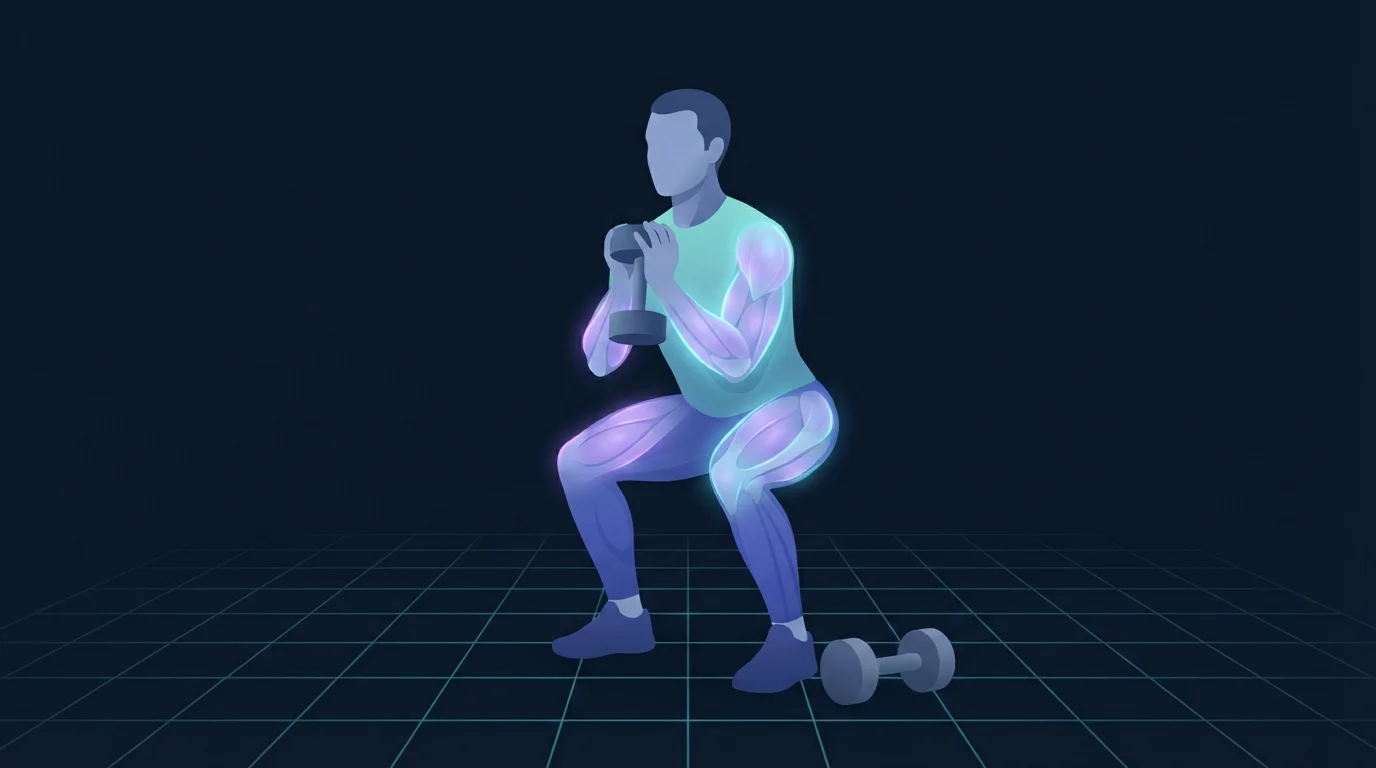
- Squat. Knee-dominant, quads and glutes. Goblet squats, split squats, wall sits.
- Hinge. Hip-dominant, hamstrings, glutes and the whole back line. Romanian deadlifts, glute bridges, good mornings.
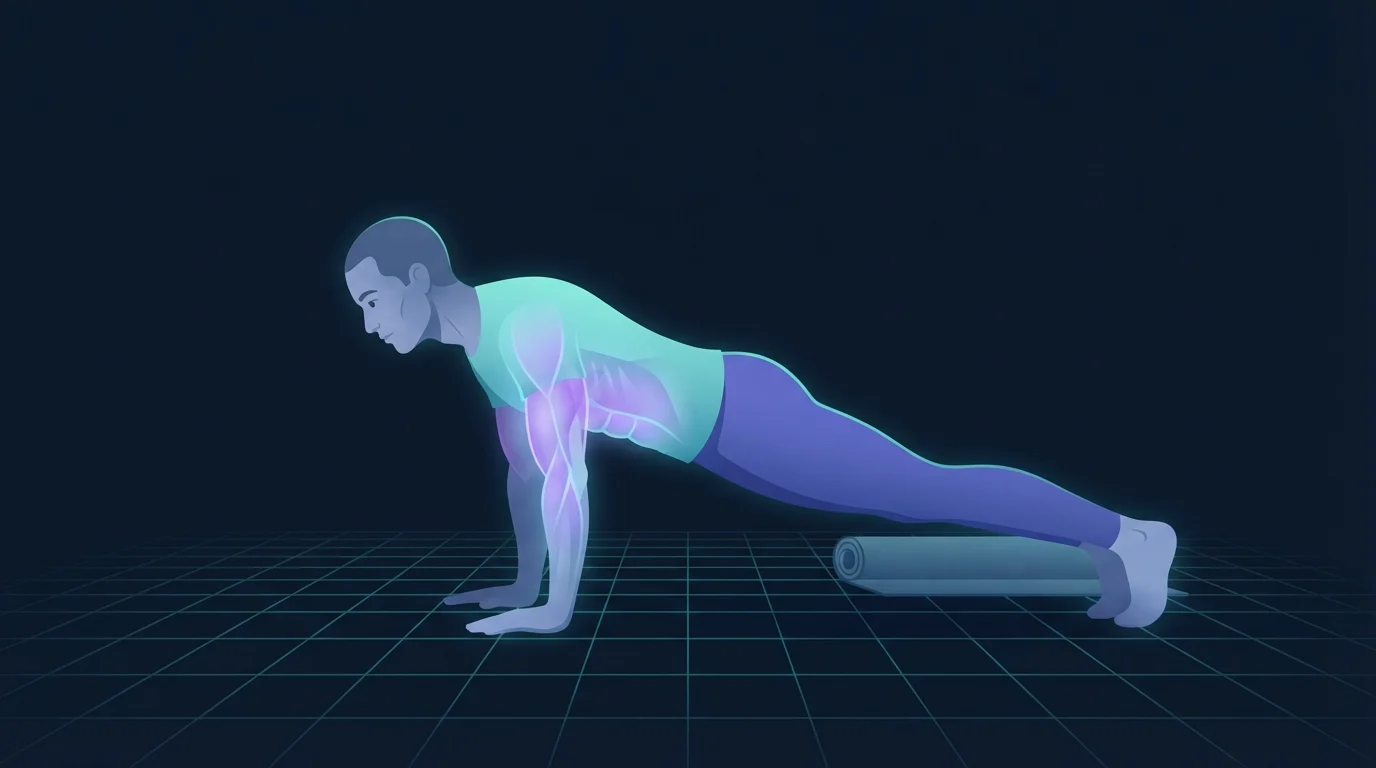
- Push. Chest, front shoulders, triceps. Push-ups, floor press, overhead press.
- Pull. Lats, mid back, rear shoulders, biceps. Inverted rows, one-arm rows, chin-ups.
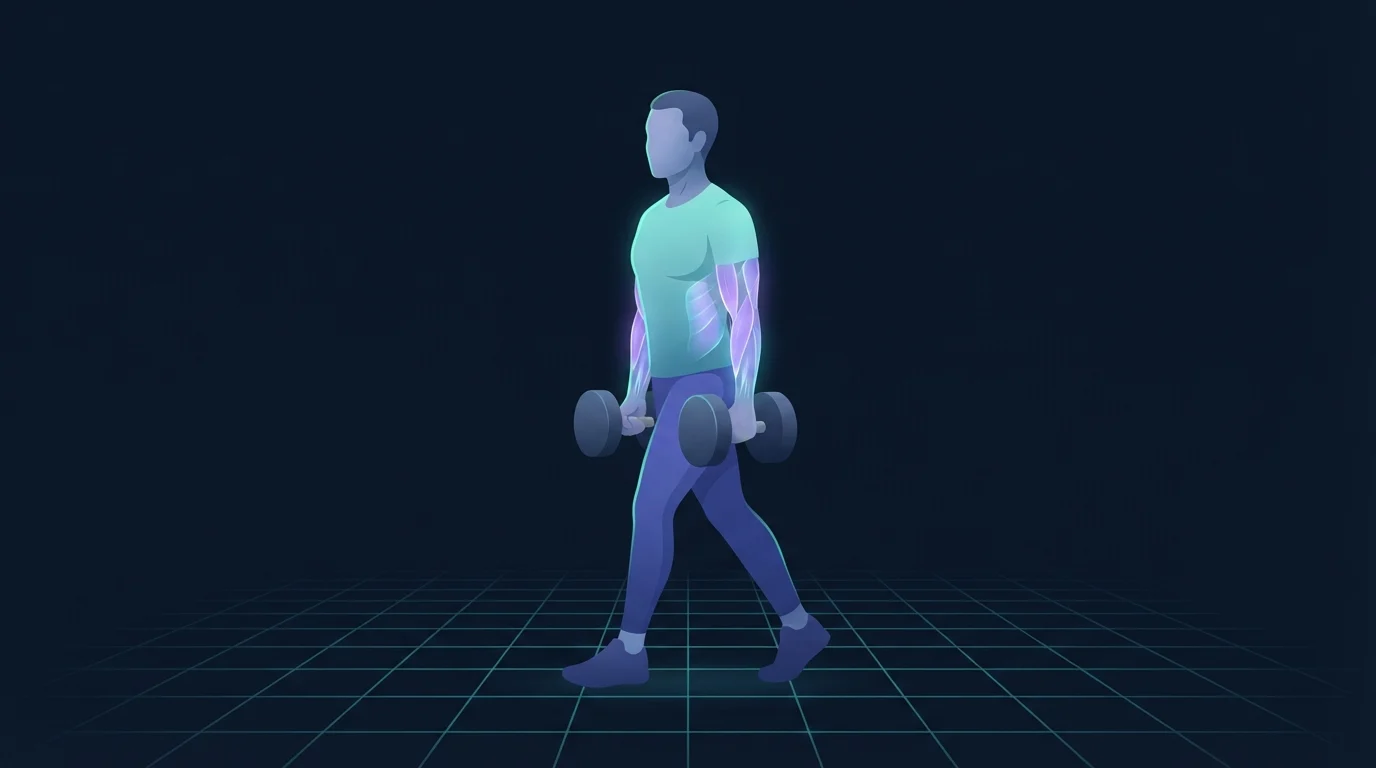
- Carry. Grip, trunk, upper back, and the only pattern that trains bracing while you move. We cover the evidence in our review of the farmer's carry research.
- Trunk. Anti-extension and anti-rotation work the compounds underdeliver. Planks, dead bugs, side planks.
Pick one exercise per pattern and you have a session. Pick a second squat or a second pull on days when that pattern matters most to you, and you have a session with an emphasis. That's the entire design logic, and it's why full body sessions are so hard to get badly wrong.
The mistake people make is building the session from muscles instead of patterns. Start with "chest, back, shoulders, arms, legs" and you end up with eight exercises, a 75-minute workout, and nothing trained hard. Start with patterns and you get five or six exercises that cover the same anatomy in 45 minutes. Our guide on how many exercises per workout works that arithmetic from the other direction.
How Many Sets Per Muscle Per Week
This is the number that decides whether the routine works, so it gets the space before any exercise list does.
Schoenfeld, Ogborn and Krieger (2017), in the Journal of Sports Sciences, pooled 34 treatment groups from 15 studies and found a graded dose-response between weekly set count and muscle growth: more hard sets, more muscle, with a threshold around 10 weekly sets per muscle group for near-maximal hypertrophy. The 2026 ACSM position stand on resistance training lands in the same place, calling for at least 10 hard sets per muscle per week for growth and at least two weekly sessions per muscle group.
Frequency, on its own, does much less than the internet claims. Schoenfeld, Ogborn and Krieger (2016) first pooled 10 studies in Sports Medicine and recommended training each muscle at least twice a week, then Schoenfeld, Grgic and Krieger (2019) restricted the analysis to 25 volume-equated studies and found no significant hypertrophy difference between low and high frequencies. Strength is the exception: Grgic and colleagues (2018) pooled 22 studies and found two or three weekly sessions per muscle beat one, with a small-to-moderate effect. Our training frequency research page walks through where those meta-analyses disagree.
Here's why that combination favours full body at two or three days. If frequency is close to neutral and volume is what matters, the only thing a layout has to do is deliver the sets. At three days a week, a full body routine delivers them evenly, three exposures per muscle, three or four sets each time.
| Days per week | Sets per pattern per session | Weekly sets per muscle | Who it fits |
|---|---|---|---|
| 2 days | 4 to 5 | 8 to 10 | Beginners, unpredictable weeks, maintaining through a busy stretch |
| 3 days | 3 to 4 | 9 to 15 | Most people, most of the time |
| 4 days | 2 to 3 | 10 to 14 | Works, but an upper lower split is usually a better container here |
Count only hard sets, meaning sets you stopped within one to three reps of failure. Warm-up sets don't count, and neither does a set you ended because you got bored. Refalo and colleagues (2023), in Sports Medicine, found hypertrophy improved as sets were taken closer to failure, with the benefit flattening out once you're within a few reps of it. Which is the useful version: you don't have to grind to failure, you do have to get close.
The Warm-Up That Takes Five Minutes
Warm-ups get skipped because most of them are too long to be believable. Fradkin, Zazryn and Smoliga (2010), in the Journal of Strength and Conditioning Research, pooled 32 studies and found performance improved in 79 percent of the outcomes measured after a warm-up. The effect is real, and five minutes captures most of it.
- Two minutes of anything that raises your temperature. March in place, skip rope, jog up and down the stairs, go up and down off a chair.
- Thirty seconds each of four dynamic movements. Leg swings front to back, hip circles, arm circles, cat-cow.
- One ramp set of the first exercise. Half the weight or an easier leverage, 8 to 10 slow reps. This is the part people skip and the part that matters most.
Save the long static stretching for after, or for a separate session. It's not dangerous before lifting, it just doesn't help the sets you're about to do.
Routine 1: Bodyweight Only
No equipment beyond a floor, a chair or bench, and something to hang from or get under for pulling. If you genuinely have nothing to pull on, put a broomstick across two chairs and row under it, or use a towel looped around a door handle.
Three days a week, non-consecutive. Three sets of everything unless noted. The sets look easy on paper; they aren't, because the progressions get hard fast.
| Day | Exercises | Sets and reps |
|---|---|---|
| Day A (squat-led) |
Bodyweight squat or split squat Push-up (incline, floor or feet-elevated) Inverted row Single-leg glute bridge Plank Suitcase carry with a backpack |
4 x 10-20 3 x 6-15 3 x 6-12 3 x 10-15 each side 3 x 30-60 sec 2 x 40 m each side |
| Day B (hinge-led) |
Single-leg Romanian deadlift, slow Pike push-up Chin-up or towel row Rear lunge Dead bug Superman hold |
4 x 8-12 each side 3 x 5-12 3 x as many as possible 3 x 10-15 each side 3 x 8 each side 2 x 20-40 sec |
| Day C (single-leg and trunk) |
Rear-foot-elevated split squat Close-grip or diamond push-up Inverted row, feet elevated Nordic-style hamstring lower or hip hinge hold Side plank Hollow hold |
4 x 8-15 each side 3 x 5-12 3 x 6-12 3 x 5-8 3 x 20-40 sec each side 2 x 20-40 sec |
The load is the leverage. When floor push-ups get comfortable at 15 reps, elevate your feet rather than adding reps forever. When split squats get easy, elevate the back foot, then slow the lowering phase to four seconds. Schoenfeld and colleagues (2021) re-examined the repetition continuum and concluded that loads as light as 30 percent of one-rep max build similar muscle to heavy loads when sets are taken close to failure, which is the entire licence bodyweight training needs. Strength gains specifically still favour heavier loads, so that caveat travels with it.
Find out what's really holding you back
FitCraft, our mobile fitness app, pairs you with an AI coach who builds you a personalized plan around your goals, schedule, and fitness level. Every FitCraft program is designed by Domenic Angelino, MPH (Brown University) and NSCA-CSCS, with research published in the Journal of Strength and Conditioning Research and Medicine & Science in Sports & Exercise.
Take the Free Assessment Free • 2 minutes • No credit cardRoutine 2: Dumbbells Only
One pair of adjustable dumbbells, a bench or sturdy chair, and floor space. This is the version most people should run, because load is the cleanest progression variable there is and dumbbells give you it in small increments.
| Day | Exercises | Sets and reps |
|---|---|---|
| Day A (squat-led) |
Goblet squat Dumbbell floor or bench press One-arm dumbbell row Dumbbell Romanian deadlift Plank Farmer's carry |
4 x 8-12 3 x 6-10 3 x 8-12 each side 3 x 8-12 3 x 30-60 sec 2 x 40 m |
| Day B (hinge-led) |
Dumbbell Romanian deadlift, heavier Seated dumbbell overhead press Chin-up or chest-supported row Rear-foot-elevated split squat Dead bug Standing calf raise |
4 x 6-10 3 x 8-12 3 x 6-12 3 x 8-12 each side 3 x 8 each side 2 x 12-20 |
| Day C (single-leg and arms) |
Dumbbell split squat or step-up Incline dumbbell press Renegade row or one-arm row Single-leg Romanian deadlift Lateral raise Curl and overhead extension superset |
4 x 10-15 each side 3 x 8-12 3 x 8-12 each side 3 x 8-12 each side 2 x 12-20 2 x 10-15 |
Rest 2 to 3 minutes after the first two exercises of each day and 60 to 90 seconds after the rest. That isn't fussiness. Schoenfeld, Pope and colleagues (2016) put trained men through eight weeks of identical programs separated only by rest length and found the three-minute group gained more strength and more muscle thickness than the one-minute group. Short rest costs you reps, and reps are sets in disguise.
If you'd rather have this built and progressed for you than run the bookkeeping yourself, our dumbbell workout app page covers how FitCraft's multi-week programs handle full body days with a single pair of dumbbells.
Routine 3: Dumbbells Plus Bands
Bands solve the two things dumbbells are worst at in a home setting: heavy pulling, and the small posterior-chain muscles that need volume rather than load. Lopes and colleagues (2019), in SAGE Open Medicine, pooled eight randomised trials and found elastic resistance produced strength gains similar to conventional resistance training. Bands aren't a downgrade, they're a different loading curve. Our full review of the resistance band training research covers where they beat free weights and where they don't.
| Day | Exercises | Sets and reps |
|---|---|---|
| Day A (squat-led) |
Goblet squat with a band around the knees Dumbbell floor press Band-assisted chin-up or banded row Dumbbell Romanian deadlift Band pull-apart Plank |
4 x 8-12 3 x 6-10 3 x 6-12 3 x 8-12 3 x 15-25 3 x 30-60 sec |
| Day B (hinge-led) |
Banded dumbbell Romanian deadlift Dumbbell overhead press Banded lat pulldown, anchored high Rear-foot-elevated split squat Banded clamshell Dead bug |
4 x 6-10 3 x 8-12 3 x 10-15 3 x 8-12 each side 2 x 15-20 each side 3 x 8 each side |
| Day C (single-leg and trunk) |
Banded step-up or split squat Incline dumbbell press Banded single-arm row Single-leg Romanian deadlift Banded Pallof press Side plank |
4 x 10-15 each side 3 x 8-12 3 x 10-15 each side 3 x 8-12 each side 3 x 10 each side 3 x 20-40 sec each side |
One rule keeps this tier honest: a band should never replace a dumbbell on a movement where you could load the dumbbell heavier. Use bands for pulling volume, rear-delt and glute work, and anti-rotation. Keep the squat, the hinge and the press on iron.
The 2-Day Version of Any of These Three
Two days is not a compromised version of this routine. It's the version that survives most calendars, and it still clears the twice-a-week frequency floor for every muscle. You just need to compress three sessions into two without losing a pattern.
Run Day A and Day B, 72 hours apart, and fold the useful half of Day C into them. Add one set to the main squat and hinge on each day, and move the single-leg work from Day C to whichever day feels lighter. That puts you at 8 to 10 weekly sets per muscle, which is the bottom of the productive range rather than the middle of it, and the sessions run 50 to 60 minutes instead of 45.
Whether two days is enough depends on what you want from it. For strength, general health and holding onto muscle, it clearly is. For maximum size, it's the slow lane rather than the wrong lane. Our comparison of full body vs split workout programming works through that trade-off at every day count from two to five.
Sets, Reps, Rest and How Hard to Push
The prescriptions above are specific, but they only work if the numbers behind them mean something.
- Reps. Anything from 5 to 30 builds muscle when the set is taken close enough to failure. Use 6 to 12 on the main lifts because it's the most efficient place to sit, and 12 to 20 on accessories and bodyweight work where load is capped.
- Effort. Stop each working set with one to three reps left in the tank. That's an RIR of 1 to 3. Going to outright failure on every set adds fatigue faster than it adds growth.
- Rest. Two to three minutes after compounds, 60 to 90 seconds after accessories. If you're short on time, superset a push with a pull rather than cutting rest on the squat.
- Tempo. Two seconds down, no pause, drive up. Slow the lowering phase to three or four seconds only when you've run out of ways to add load.
- Session length. Forty to fifty-five minutes of work. If it's running past 70, you have too many exercises, not too much intensity.
The 8-Week Progression
Progressive overload is bookkeeping before it's anything else. If week 8 looks like week 1 with more sweat, nothing moves. Here's the version that works without a spreadsheet: add reps, then load, then sets, then back off.
| Week | What changes | Sets per pattern | Target effort |
|---|---|---|---|
| 1 | Find your loads. Leave 3 or 4 reps in reserve on everything. | 3 | RIR 3-4 |
| 2 | Same loads, add 1 to 2 reps per set where you can. | 3 | RIR 2-3 |
| 3 | Hit the top of the rep range on the main lifts, then add load next session. | 3 | RIR 2 |
| 4 | New loads at the bottom of the rep range. Add a fourth set to the squat and hinge. | 3-4 | RIR 2 |
| 5 | Climb the rep range again on the new loads. | 3-4 | RIR 1-2 |
| 6 | Deload. Halve the sets, keep the loads, finish every session feeling fresh. | 2 | RIR 4-5 |
| 7 | Back to week 5 loads, full sets, add a fourth set to the pushes and pulls. | 4 | RIR 1-2 |
| 8 | Push for a rep or load personal best on one lift per session, then restart at week 1 with the new numbers. | 4 | RIR 0-1 on the top set |
Two rules make or break this. Write down what you lifted, every session, in whatever app or notebook you'll actually open. And change one variable at a time, because if you add load and sets and reps in the same week you'll never know which one stopped working.
When a Full Body Routine Stops Being the Right Container
Full body training has a real ceiling, and it's a logistical one. Once your weekly target passes roughly 15 hard sets per muscle, you're asking a single session to hold 5 or 6 sets for every pattern, and the session runs long enough that the last third is measurably worse than the first.
Three signs you've reached it: your sessions have crept past 70 minutes, you can reliably train four or more days a week, and you're no longer adding load every second or third week on the main lifts. When two of those are true, split the week. An upper lower split is the natural next container at four days, and a push pull legs routine is the one at five or six.
Until then, splitting early is the more common mistake. A body-part split run three days a week gives every muscle one weekly exposure and no way to recover the missing sets, which is exactly the arrangement the frequency literature rates worst.
The Bottom Line
A full body workout routine works because it's hard to get wrong and easy to finish. Six patterns, three sessions, 3 to 5 sets each, taken close to failure, with the load creeping up every couple of weeks. That's the whole method, and it holds whether you own a dumbbell rack or nothing but a floor.
Pick the equipment tier you actually have, run it for eight weeks, and write down what you lift. If a week falls apart, you've lost one session out of three rather than a whole half of your body, and the next session covers the same ground anyway. That forgiveness is the real feature.
Frequently Asked Questions
What is a good full body workout routine?
A good full body workout routine covers six patterns in every session: a squat, a hinge, an upper-body push, an upper-body pull, a loaded carry and some direct trunk work. Run it two or three days a week on non-consecutive days, do 3 to 5 sets of each pattern, and take every working set to within one to three reps of failure. That lands each muscle between 9 and 15 hard sets a week, which is inside the range the dose-response research calls productive, and it keeps sessions to 40 to 55 minutes.
How many days a week should I do a full body workout routine?
Two or three, on non-consecutive days. Three is the sweet spot because it gives every muscle three weekly exposures and lets you keep per-session volume low enough that sessions stay under an hour. Two still works and clears the twice-a-week frequency floor, but you have to accept either slightly lower weekly volume or slightly longer sessions. Four full-body days a week is possible if you keep each muscle to 2 or 3 sets per session, but most people are better served by an upper lower split at that point.
Can you build muscle with a bodyweight full body workout routine?
Yes, as long as the sets are genuinely hard. A 2021 re-examination of the repetition continuum found that loads as light as 30 percent of one-rep max build similar muscle to heavy loads when sets are taken close to failure. Bodyweight training gets hard the same way: harder leverages rather than heavier weight. Move from incline push-ups to floor push-ups to feet-elevated to one-arm-assisted, and from split squats to rear-foot-elevated split squats to slow single-leg squats.
How long should a full body workout take?
Forty to fifty-five minutes of working time, plus a five-minute warm-up. Six exercises at 3 sets each is 18 hard sets, and with 2 to 3 minutes of rest after compounds and 60 to 90 seconds after accessories that fills roughly 45 minutes. If your session is running past 70 minutes you have too many exercises rather than too much intensity, and the last few sets are costing you more in fatigue than they return in growth.
How do you progress a full body workout routine?
Add reps first, then load, then sets, in that order. When you hit the top of the prescribed rep range on every set with one to three reps still in reserve, add the smallest available weight increase next session and drop back to the bottom of the range. Once load stalls on a lift, add one set to that lift rather than to the whole session. Cut total sets roughly in half for one week every fifth or sixth week and keep the loads the same.
Is a full body workout routine better than a split?
Neither is better in a vacuum. Weekly hard sets per muscle is what drives growth, and a 2019 meta-analysis of 25 volume-equated studies found no significant hypertrophy difference between low and high training frequencies. Full body wins below four training days because it's the only layout that reaches every muscle more than once. Splits win above four days because they let you add volume without any single session running long.