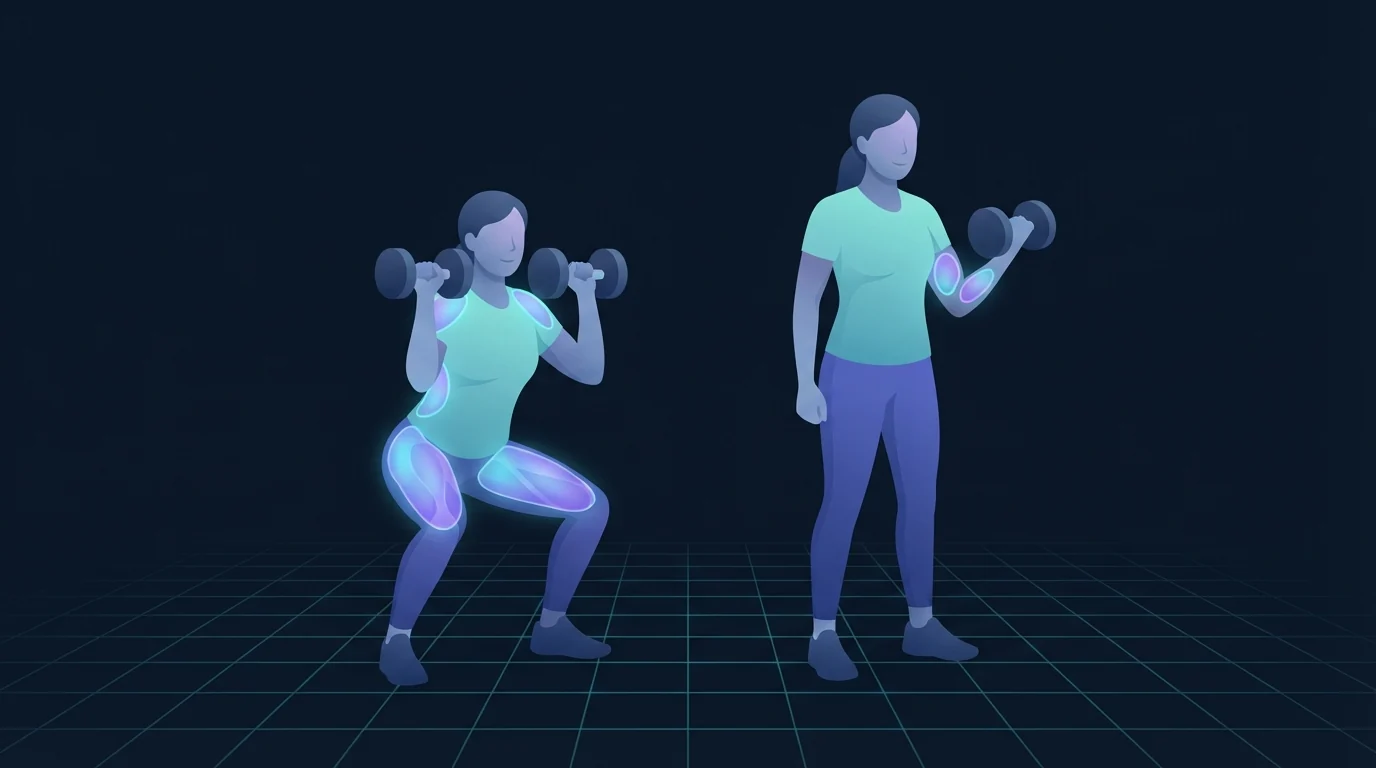
You open a workout app or a program PDF and count eleven exercises. You've got 45 minutes. Somewhere between exercise seven and exercise nine the session stops being training and starts being a chore you're rushing through with worse and worse form.
So you cut some. Then you wonder whether cutting them cost you, whether the guy on the internet doing nine exercises knows something you don't, and whether the reason you're not growing is that you're not doing enough.
That doubt is the expensive part. The honest answer is that exercise count barely matters, and the number most people should use is smaller than the one they're using now.
The Short Answer: 3 to 6 Exercises Per Workout
Here's the decision table. Find the row that matches your session and use that number.
| Your session | Time | Exercises | Sets each | Hard sets total |
|---|---|---|---|---|
| Time-crunched full body | 20-30 min | 3 | 2-3 | 6-9 |
| Beginner full body | 35-45 min | 3-4 | 3 | 9-12 |
| Intermediate full body | 50-60 min | 5-6 | 3 | 15-18 |
| Upper or lower day | 45-60 min | 4-6 | 3 | 12-18 |
| Push, pull or legs day | 50-65 min | 5-7 | 3-4 | 18-24 |
| Arms or accessory day | 30-40 min | 3-4 | 3-4 | 12-16 |
Notice what changes down the rows and what doesn't. Session length moves. Exercise count barely does. A 65-minute push day has seven exercises and a 25-minute full-body session has three, which is a doubling of time for a bit over a doubling of exercises. The count is capped by attention and fatigue long before it's capped by anything physiological.
Why Exercise Count Is the Wrong Unit
Muscle responds to hard sets, not to variety. The cleanest evidence for that is Schoenfeld, Ogborn and Krieger (2017) in the Journal of Sports Sciences, a dose-response meta-analysis of 34 treatment groups drawn from 15 studies. Weekly set count predicted hypertrophy in a graded way, with a threshold effect around 10 weekly sets per muscle group for near-maximal growth. Nothing in that analysis cared how many different lifts those sets came from.
The 2026 ACSM position stand reaches the same place, recommending at least 10 hard sets per muscle per week for hypertrophy and 2 to 3 sets per exercise for strength, with heavier loads and the key lifts performed early in the session. Its companion Pelland and colleagues (2026) meta-regression in Sports Medicine models the same curve: more weekly sets keep adding size with shallow diminishing returns, while strength tops out much earlier.
So the planning sequence runs backwards from how most people do it. Decide your weekly sets per muscle first. Divide by how many days you train. Whatever lands in each session is your exercise count, and it will nearly always be three to six.
An example. You want 15 weekly sets for your back. You train four days on an upper lower split, so your back gets two sessions. That's 7 or 8 sets a session, which is two exercises at three to four sets. Not five back exercises. Two.
Find out what's really holding you back
FitCraft, our mobile fitness app, pairs you with an AI coach who builds you a personalized plan around your goals, schedule, and fitness level. Every FitCraft program is designed by Domenic Angelino, MPH (Brown University) and NSCA-CSCS, with research published in the Journal of Strength and Conditioning Research and Medicine & Science in Sports & Exercise.
Take the Free Assessment Free • 2 minutes • No credit cardWhy More Exercises Isn't More Progress
Three things go wrong when a session grows past six or seven exercises.
Effort collapses in the back half
The first two exercises in a session get your best work. By exercise eight you're 70 minutes in, your grip is shot, and the set you write down as "3 x 12" was really three sets you stopped four reps short. Those sets count in your log and not in your body. This is why the ACSM stand puts the lifts that matter most early in the session.
Rotating lifts stops you getting good at any of them
Kassiano and colleagues (2022) reviewed the exercise-variation literature in the Journal of Strength and Conditioning Research and drew a careful line. Some systematic variation, chosen for anatomy and biomechanics, can help regional growth and maximal strength. Excessive, random rotation between lifts may hinder adaptations, because a movement you do rarely is one you're never skilled enough at to load properly. Adding exercises for novelty is exactly the version they warn against.
The counterweight is worth naming. Baz-Valle and colleagues (2019) in PLoS One randomized 21 resistance-trained men to eight weeks of either fixed exercise selection or app-randomized selection each session. Both groups made large gains in bench and squat one-rep max with no difference between them, and the varied group reported higher motivation to train. Variety doesn't buy growth. It can buy interest, and interest buys adherence, so if rotating one accessory keeps you showing up, rotate it.
The extra exercises usually duplicate work
A session with a bench press, an incline press, a machine press, a cable fly and a push-up finisher has one press pattern wearing five hats. The chest already got its weekly stimulus by the third of those. What's missing from that session is a row, a hinge, or the time you just spent.
How Session Length Sets the Ceiling
Time is the real constraint, and it's a well-studied one. Iversen, Norum, Schoenfeld and Fimland (2021) wrote a narrative review in Sports Medicine specifically on time-efficient programming. Their recommendation for a minimal session is three exercises: one leg pressing pattern such as a squat, one upper-body pull such as a chin-up or row, and one upper-body push such as a press. They set the practical floor at four weekly sets per muscle group, while noting that higher volumes do more, and they favour compound exercises because more muscle trained per minute is the whole point when minutes are short.
Rough arithmetic for planning: a compound lift with proper rest eats 8 to 10 minutes for three sets. An accessory with shorter rest eats 5 to 6. Add a 6-minute warm-up. That puts a 45-minute session at roughly two compounds plus two or three accessories, which is four to five exercises. The number falls out of the clock, not out of a preference. Our piece on how long a workout should be works the same problem from the other direction.
Beginner, Intermediate, Advanced
Beginner (0 to 6 months). Three to four exercises, all compound, two or three times a week. A squat pattern, a hinge, a push and a pull. Beginners get a large adaptive response from a small dose, so a fifth exercise mostly buys soreness. Skill on the four lifts is the real asset you're building.
Intermediate (6 months to 2 years). Four to six. The compounds stay, and you add one or two isolation exercises for the muscles your compounds underwork, usually rear delts, hamstrings, calves and arms. This is where a split starts to earn its keep, because the weekly set count has grown past what two full-body days can hold.
Advanced (2 years plus). Five to seven, on more days rather than longer days. The reason advanced lifters look like they do more exercises is that they train more often, so the per-session count barely moves. What changes is weekly volume and the precision of exercise selection, not how many lifts you cram into a Tuesday.
How to Pick the Three to Six
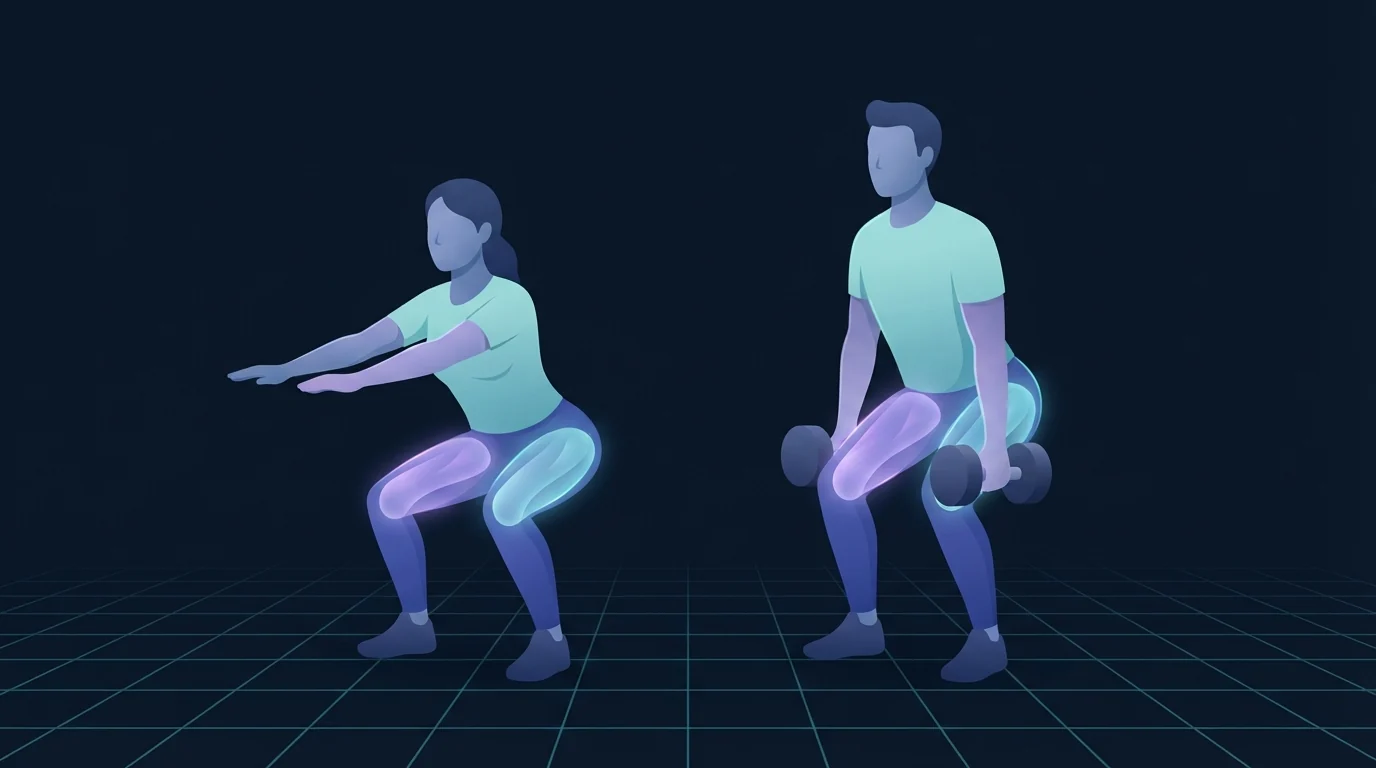
Fill the slots in this order and you'll rarely get it wrong.
- One or two big compounds first. Whatever pattern the day is built around, heaviest and freshest. These carry most of your weekly volume for the biggest muscles.
- One opposing pattern. If the day leads with pressing, row. If it leads with squatting, hinge. Balance here prevents most of the nagging shoulder and low back complaints that end programs.
- One or two accessories for the gaps. Rear delts, hamstrings, calves, biceps, core. Things the compounds genuinely underwork, not things the compounds already cover from a slightly different angle.
- Stop. If you want more stimulus, add a set to an exercise you're already doing before you add a seventh exercise. Same volume, better effort, less time.
Rep ranges are a separate decision from exercise count, and a less important one than people assume. Our breakdown of how many reps you should do covers why a set of 5 and a set of 25 can grow the same muscle.
If assembling this yourself is the part that never quite happens, having it handed to you is a reasonable answer. Our personalized training program page walks through how FitCraft builds a multi-week plan around your goal and the days you actually have.
The Bottom Line
Three to six exercises per workout, three sets each, taken close enough to failure that the last rep is genuinely hard. Add sets before you add exercises. Add days before you add session length. And measure your week in hard sets per muscle, because that's the number the research has actually studied.
You were never behind because your list was too short. A long workout you rush through with fading effort is worse than a short one you finish properly, and the shorter one is the one you'll still be doing in six months.
Frequently Asked Questions
How many exercises per workout should I do?
Three to six covers almost everyone. Three is enough for a 20 to 30 minute full-body session if all three are compound lifts. Five or six suits a 45 to 60 minute session on an upper or lower day. Past six you are usually adding fatigue rather than stimulus, because the last exercises get your worst effort and your weekly set count was already met.
How many exercises per muscle group in one session?
One or two is plenty in a single session. One compound lift that trains the muscle heavily, plus one accessory that hits an angle or range the compound misses. What matters is the weekly total: a dose-response meta-analysis of 15 studies found muscle growth rose with weekly set volume, with near-maximal hypertrophy appearing around 10 sets per muscle per week (Schoenfeld 2017). Two exercises at three sets each, twice a week, already clears that.
Is 10 exercises too many for one workout?
For almost everyone, yes. Ten exercises at three sets is 30 working sets and roughly 90 minutes. Effort drops sharply in the back half of a session that long, so the final exercises contribute far less than their set count suggests. The same weekly volume split across two shorter sessions produces the same or better results with less fatigue and a much higher chance you finish it.
Do more exercises build more muscle?
No. Hard sets per muscle per week drive growth, and exercises are just the container those sets arrive in. A 2022 systematic review found that some systematic variation can help regional growth, but excessive rotation of exercises may actually hinder adaptations because you never get good enough at any single lift to load it properly. A 2019 trial found randomized exercise selection matched fixed selection for size and strength, while improving motivation.
How many exercises should a beginner do per workout?
Three to four, all compound movements, two or three times a week. A squat pattern, a hinge, an upper-body push and an upper-body pull cover the whole body. Beginners get a large response from a small dose, so extra exercises mostly buy soreness and extra time. Adding a fifth and sixth exercise makes sense once you have six months of consistent training and your weekly set count needs somewhere to go.
How many exercises can you fit in a 30 minute workout?
Three to four, at three sets each, if you keep rest to 60 to 90 seconds on accessories and pair non-competing exercises back to back. A narrative review on time-efficient training recommended building short sessions around one leg pressing exercise, one upper-body push and one upper-body pull, and noted that at least four weekly sets per muscle group is the practical floor for time-constrained trainees.