You've saved a dozen workout routines. One is from a bodybuilder who trains six days a week, one needs a barbell you don't own, and one looked great until it asked for 90 minutes on a Tuesday. None of them was built for your week, your gear or your goal, so none of them lasted.
The most common version of this question online comes from people who already know the basic exercises and still don't know what to do once they start a session. That's a planning problem, and it's very fixable. A plan that fits your life removes the daily decisions, which is where most routines quietly fall apart.
Building your own exercise plan is less complicated than the fitness industry makes it look. It comes down to nine decisions made in order. Below is each one with a rule of thumb and the evidence behind it, then a worked example and a blank template you can copy. If you're brand new and would rather start from a ready-made week, our workout schedule for beginners has 2-, 3- and 4-day calendars with every workout filled in, and this guide explains the reasoning behind them.
How to Create a Workout Plan: The 9 Steps at a Glance
| Step | Decision | Rule of thumb |
|---|---|---|
| 1. Goal | One main goal | Build muscle, get stronger, lose fat or general fitness |
| 2. Days | Days you can train in a bad week | Usually 2 to 5, with a fixed time for each |
| 3. Split | How the work is divided across days | 2 to 3 days: full body. 4 days: upper/lower |
| 4. Exercises | One per movement pattern | Squat, hinge, push, pull, single leg, core |
| 5. Sets and reps | Matched to the goal | About 10+ hard sets per muscle a week for muscle |
| 6. Progression | A written rule | Add reps to the top of the range, then add weight |
| 7. Deloads | Planned lighter weeks | When progress stalls, or every 4 to 8 weeks of hard training |
| 8. Tracking | A log of every session | Weight, reps and how many reps you had left |
| 9. Change | When to switch things up | After 8 to 12 weeks, or 3 weeks without progress |
Step 1: Pick One Main Goal
Start with the result you want most over the next three months. The common choices are building muscle, getting stronger, losing fat and general fitness or health. You can have a second goal, but one has to lead, because it decides your rep ranges and how much cardio sits around the lifting.
Writing the goal down is worth the minute it takes. McEwan and colleagues (2016) pooled 52 goal-setting interventions with 5,912 participants and found a medium, positive effect on physical activity. Make the goal specific and partly about behavior you control:
- Vague: "Get in shape."
- Specific: "Train three times a week for 12 weeks and go from 5 push-ups to 15."
- Specific, muscle goal: "Train four days a week for 12 weeks and move up two dumbbell sizes on my main lifts."
Step 2: Count the Days You Can Actually Train
Look at a normal week and count the days you could train even when work runs late and someone gets sick. Use that number as your plan's frequency, even if you could do more in a good week. Then decide the time slot and the session length for each day. A plan with four 60-minute sessions that you average 2.5 times a week is really a 2.5-day plan.
Short sessions are fine if you spend them well. In a review of time-efficient training, Iversen and colleagues (2021) concluded that weekly training volume matters more than how often you train. They suggested a minimum of about 4 weekly sets per muscle group in a 6 to 15 rep-max range for people short on time. Supersets, where you pair two exercises back to back, can roughly halve session time while keeping the same number of sets.
Step 3: Choose a Workout Split That Fits Those Days
A split is how you divide the week's work across your training days. It's a container. Choose it after you know your days, never before.
| Days per week | Split | How often each muscle is trained |
|---|---|---|
| 2 | Full body, twice | Twice a week |
| 3 | Full body, three times | Three times a week |
| 4 | Upper/lower, twice through | Twice a week |
| 5 | Upper/lower plus one full-body day, or push/pull/legs plus upper/lower | Twice a week |
| 6 | Push/pull/legs, twice through | Twice a week |
Each muscle should get at least two sessions a week, which the 2026 ACSM position stand (Currier and colleagues) linked to better strength gains. Past that, the split matters much less than the total number of hard sets it lets you fit in. Our comparison of full body vs split workouts goes through the frequency research and sample weeks for each layout. If you land on four days, the 4 day workout split guide has two complete versions built for dumbbells.
Step 4: Choose Exercises by Movement Pattern
Build each session from movement patterns rather than a list of muscles. Start with "chest, back, shoulders, arms, legs" and you end up with nine exercises and no time to train any of them hard. Start with patterns and five or six exercises cover the whole body. Iversen and colleagues recommend at least one squat or leg-press pattern, one upper-body pull and one upper-body push in every program.
| Pattern | Home and dumbbell options | Gym options |
|---|---|---|
| Squat | Goblet squat, heel-elevated goblet squat | Leg press, hack squat machine |
| Hinge | Dumbbell Romanian deadlift, hip thrust on a bench | Back extension, cable pull-through |
| Horizontal push | Push-up, dumbbell floor or bench press | Chest press machine |
| Vertical push | Seated dumbbell press, pike push-up | Shoulder press machine |
| Horizontal pull | One-arm dumbbell row, inverted row under a table | Seated cable row |
| Vertical pull | Band pulldown, chin-up if you have a bar | Lat pulldown |
| Single leg | Reverse lunge, split squat, step-up | Same, with heavier dumbbells |
| Core and carry | Dead bug, side plank, suitcase carry | Cable anti-rotation press |
For a full-body day, pick one exercise each from squat, hinge, a push, a pull and core, and add a single-leg move if time allows. Put the lift you most want to improve first, because the ACSM review found strength improved more for exercises done at the start of a session. Add one or two single-joint moves such as curls or lateral raises only after the patterns are covered.
How to create a workout plan at home
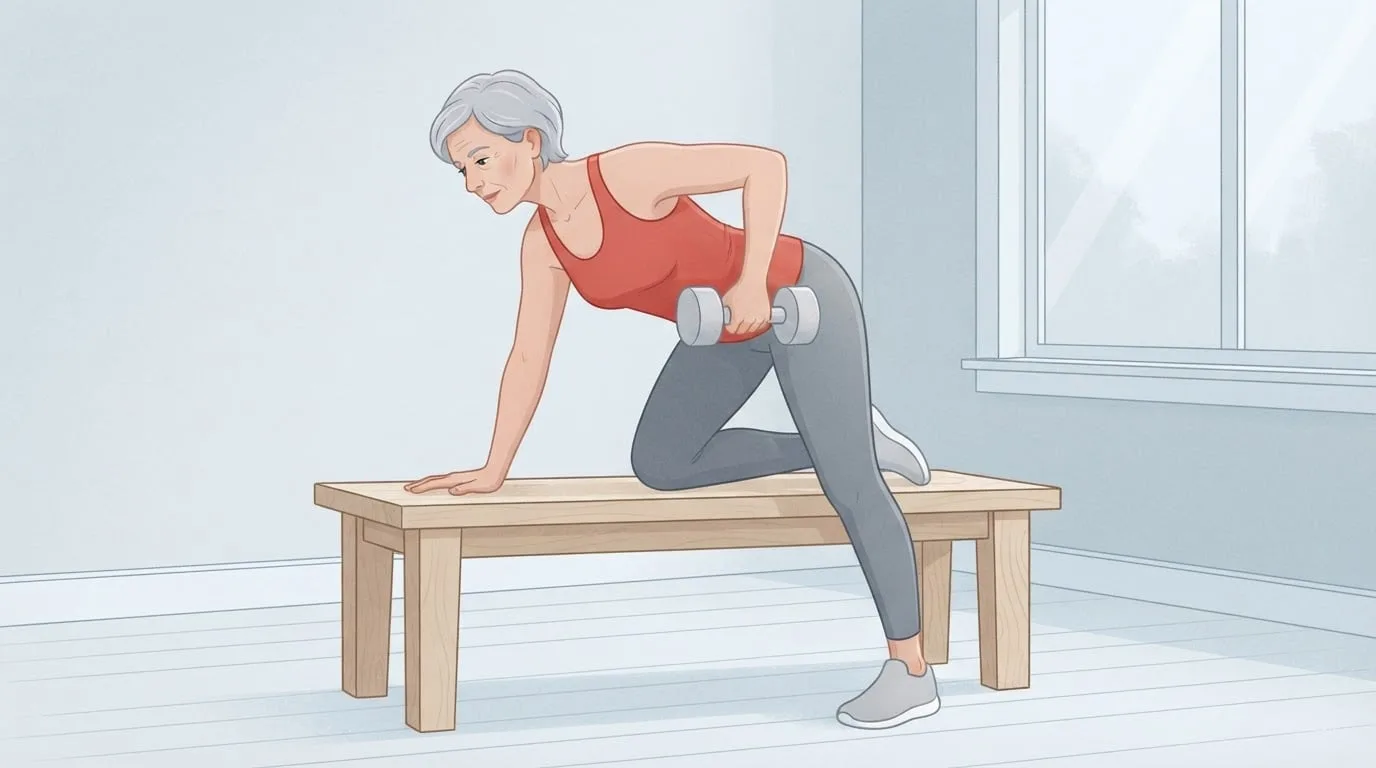
A home plan follows exactly the same steps. A pair of adjustable dumbbells, a sturdy bench or chair and a resistance band cover every pattern in the table. The ACSM position stand found that equipment type didn't consistently change strength or muscle outcomes, so a dumbbell plan done hard is a real plan. The one limit at home is very heavy loading for maximal strength. If your heaviest dumbbells start to feel light, switch to single-leg versions, slow the lowering phase to three or four seconds, or work closer to failure.
Step 5: Set Sets and Reps by Goal
This is where your goal changes the numbers. The ACSM position stand reviewed 137 systematic reviews covering more than 30,000 healthy adults. Strength improved most with heavier loads of at least 80% of one-rep max, 2 to 3 sets per exercise, a full range of motion and at least two sessions a week. Muscle growth improved most with higher volumes of 10 or more sets per week. Training to complete failure, equipment type and periodization didn't consistently change outcomes.
Two meta-analyses from 2017 fill in the detail. Schoenfeld, Ogborn and Krieger pooled 34 treatment groups from 15 studies and found a graded dose-response between weekly sets and muscle growth. Each extra weekly set added about 0.37% to the gain. Schoenfeld, Grgic, Ogborn and Krieger pooled 21 studies comparing light loads (60% of one-rep max or less) with heavier ones, all with sets taken to failure. Muscle growth was similar, but one-rep max strength rose more with heavy loads.
| Goal | Reps, sets and rest | Effort |
|---|---|---|
| Build muscle | 6 to 15 reps; 10 or more hard sets per muscle a week; 1 to 3 min rest | Stop 1 to 3 reps short of failure |
| Get stronger | 3 to 6 reps on the first one or two lifts, 8 to 12 on the rest; 2 to 3 sets each; 2 to 3 min rest | Stop 1 to 3 reps short on heavy sets |
| Lose fat | Lift 2 to 4 days a week as for muscle, plus 150 to 300 min of moderate cardio a week | Stop 1 to 3 reps short |
| General fitness | 8 to 15 reps; 4 to 10 sets per muscle a week; 1 to 2 min rest | Stop 2 to 3 reps short |
"Hard sets" means sets that end within a few reps of failure. Warm-up sets don't count. Stopping 1 to 3 reps short is called training with reps in reserve, and it gets most of the benefit of failure with far less fatigue. Beginners should sit at the easier end for the first two or three weeks while they learn the movements.
Find out what's really holding you back
FitCraft, our mobile fitness app, pairs you with an AI coach who builds you a personalized plan around your goals, schedule, and fitness level. Every FitCraft program is designed by Domenic Angelino, MPH (Brown University) and NSCA-CSCS, with research published in the Journal of Strength and Conditioning Research and Medicine & Science in Sports & Exercise.
Take the Free Assessment Free • 2 minutes • No credit cardStep 6: Write Down Your Progression Rule
A plan without a progression rule is a list of exercises. Progressive overload means asking a little more of your muscles over time, and you need to decide how you'll do that before the first session. The simplest rule is double progression:
- Give every exercise a rep range, such as 8 to 12.
- Use a weight you can lift for the bottom of the range with 1 to 3 reps to spare.
- Add reps session by session until you reach the top of the range on every set.
- Move up to the smallest weight jump you have, usually 1 to 2.5 kg (2.5 to 5 lb) per dumbbell, and drop back to the bottom of the range.
- For bodyweight exercises, the next step is a harder version, such as moving from incline push-ups to floor push-ups.
Adding reps counts as real progress. Plotkin and colleagues (2022) randomized 43 trained adults to add load at fixed reps or add reps at a fixed load for 8 weeks. Muscle growth was similar between the groups, and strength gains slightly favored adding load. That's why double progression uses both. Our beginner schedule shows this rule laid out week by week over the first 12 weeks.
Step 7: Plan Your Deloads
A deload is a planned lighter week, usually with about half your normal sets or noticeably lighter weights, that lets fatigue clear. Full weeks off aren't required for growth. Coleman and colleagues (2024) found that a week without training in the middle of a 9-week program didn't change muscle growth, but it slightly slowed strength gains compared with training straight through. So write a simple rule into your plan: take a lighter week when your lifts stall for two sessions in a row and you feel run down, or every 4 to 8 weeks once you're training hard. Beginners in their first 8 to 12 weeks rarely need one. Our deload week guide covers the three ways to run one and how to tell when you need it.
Step 8: Track Every Session
Tracking turns a plan into feedback. In a meta-regression of 122 physical activity and healthy eating interventions with 44,747 people, Michie and colleagues (2009) found self-monitoring explained more of the difference between interventions than any other technique. Programs that combined self-monitoring with at least one other self-regulation technique, such as goal setting or feedback, worked better than the rest, with effect sizes of 0.42 against 0.26.
For each session, log five things: the date, the exercise, the weight, the reps for each set and roughly how many reps you had left on the last set. A notebook works. So does a notes app or a spreadsheet. Once a week, read it back and ask one question: did anything go up? If not for three weeks, that's your signal for step 9.
Attendance deserves its own record, because a plan you follow 90% of the time beats a better plan you follow half the time. FitCraft keeps your workout days on a calendar with streaks and calendar rewards, and a 3D AI coach demonstrates each exercise and says your name as you train. If you'd rather have the plan built around your goals, schedule and equipment for you, our page on a personalized training program explains how that works.
Step 9: Know When to Change the Plan
Change the plan when it stops working, and keep it when it simply feels familiar. Some variety helps, but too much hurts. A systematic review of 8 studies and 241 participants by Kassiano and colleagues (2022) found that planned, systematic exercise variation can improve regional muscle growth and strength, while excessive random rotation may hinder gains. Variety can help motivation, though. In a trial by Baz-Valle and colleagues (2019), trained men whose exercises were randomized every session made similar muscle and strength gains over 8 weeks to a fixed-exercise group, and their motivation to train improved.
Change something when one of these is true:
- You've finished the 8 to 12 weeks you planned.
- An exercise has stalled for three weeks despite good sleep, enough food and a lighter week.
- Your goal or your available days changed.
- You're bored enough that you've started skipping sessions.
Change one thing at a time, and swap exercises within the same movement pattern. A stalled goblet squat becomes a heel-elevated goblet squat or a split squat, and the squat stays in the plan.
A Worked Example: Building a Plan From Scratch
Here's the method applied to one person. Sam is 31, has trained on and off for a year, and wants to build muscle. Sam can train Monday, Tuesday, Thursday and Saturday mornings for about 45 minutes, and owns adjustable dumbbells, a flat bench and a resistance band.
| Step | Sam's decision |
|---|---|
| 1. Goal | Build muscle; move up two dumbbell sizes on the main lifts in 12 weeks |
| 2. Days | Four mornings, 45 minutes each |
| 3. Split | Upper/lower, twice through |
| 4. Exercises | A push, a pull and arms on upper days; a squat, a hinge, a single-leg move and core on lower days |
| 5. Sets and reps | 3 sets of 8 to 12 on main lifts, 2 sets of 12 to 15 on small ones; about 9 to 12 hard sets per major muscle a week |
| 6. Progression | Double progression in each rep range |
| 7. Deload | Half the sets for one week if lifts stall twice in a row, or in week 8 |
| 8. Tracking | Notebook: weight, reps, reps left on the last set |
| 9. Change | Review at week 12 and swap exercises within each pattern |
| Day | Session | Exercises (sets x reps) |
|---|---|---|
| Monday | Upper A | Dumbbell bench press 4 x 8-12; one-arm row 3 x 10-12; seated dumbbell press 3 x 8-12; dumbbell curl 2 x 12-15 |
| Tuesday | Lower A | Goblet squat 3 x 8-12; dumbbell Romanian deadlift 3 x 8-12; rear-foot-elevated split squat 2 x 8-12; dead bug 2 x 8 |
| Thursday | Upper B | Push-up 3 x 8-15; bent-over dumbbell row 3 x 10-12; band pulldown 3 x 12-15; dumbbell fly 2 x 12-15; overhead triceps extension 2 x 12-15 |
| Saturday | Lower B | Hip thrust on the bench 3 x 10-15; single-leg Romanian deadlift 3 x 8-10; reverse lunge 2 x 10; calf raise 3 x 12-20; side plank 2 x 30 sec |
Notice what Sam didn't do: no seventh exercise, no extra arm day and no plan to change everything in week 4. The plan fits the four mornings Sam actually has. It hits every muscle twice a week, and it says in advance what happens when the reps go up and when they stop going up.
A Blank Workout Plan Template
Copy this into a notebook or a spreadsheet and fill in the middle column. Every row maps to one of the nine steps, so a filled-in template is a finished plan.
| Field | What to write | Example |
|---|---|---|
| Main goal | One goal and how you'll measure it in 12 weeks | Go from 5 to 15 push-ups |
| Days and times | The days you can keep in a bad week, with a time slot | Mon, Wed, Fri at 6:30 a.m. |
| Session length | Minutes per session, including warm-up | 40 minutes |
| Split | Full body, upper/lower or push/pull/legs | Full body |
| Exercises per day | One per pattern: squat, hinge, push, pull, single leg, core | Goblet squat, RDL, push-up, row, lunge, dead bug |
| Sets, reps and rest | Per exercise, from the goal table | 3 x 8-12, 90 sec rest |
| Effort | Reps left at the end of each set | 1 to 3 reps in reserve |
| Progression rule | When and how you add reps, weight or difficulty | Top of range on all sets, then next dumbbell |
| Deload rule | When you'll take a lighter week | Two stalled sessions in a row, or week 8 |
| Cardio | Type, days and minutes per week | Brisk walks, Tue and Sat, 30 min |
| Tracking | Where you'll log each session | Notebook in the gym bag |
| Review date | When you'll decide what to change | End of week 12 |
Can ChatGPT or an AI Tool Create a Workout Plan?
Yes. An AI chatbot can draft a workout plan in seconds, and the draft is only as good as what you tell it. Give it your goal, days, session length, equipment and experience, then check the result against the nine steps above. The common problems are too many exercises per session, no progression rule, exercises that need gear you don't have and weekly sets far above or below what your goal needs. A chatbot also can't watch you move, so start every new exercise lighter than you think you need.
If you'd rather skip the prompt writing, our AI workout plan generator asks five questions about your goal, experience, days, equipment and session length. It returns a weekly plan with sets, reps and rest. It runs on fixed rules rather than a language model, so the same answers always give the same plan.
The Bottom Line
To create a workout plan that lasts, make nine decisions in order: one goal, honest days, a split that fits them, one exercise per movement pattern, sets and reps matched to the goal, a written progression rule, a deload rule, a training log and a review date. Then run it for 8 to 12 weeks before you judge it. The plan that fits your real week will beat a cleverer plan you can't keep.
Having a plan you don't have to think about each morning is half the battle. As one FitCraft user, Tim, put it: "I didn't think an app could replace my trainer. My AI coach proved me wrong."
Frequently Asked Questions
What is the 3-2-1 rule for working out?
The 3-2-1 rule is a popular weekly layout of three strength sessions, two Pilates or other low-impact sessions and one cardio session, with a rest day. It's a reasonable template if the three strength days are full body and you add walking, because one cardio session alone rarely reaches the 150 weekly minutes of moderate activity that health guidelines recommend.
Can ChatGPT create a workout plan?
Yes, ChatGPT and similar AI tools can draft a workout plan in seconds if you give them your goal, days, session length and equipment. Check the draft against the basics before you use it: one main goal, days you can really keep, every movement pattern covered, about 10 hard sets per muscle per week for muscle growth and a written progression rule. An AI tool can't watch your form, so start light.
How can I create a workout plan at home?
Create a home workout plan the same way as a gym plan, using bodyweight, a pair of adjustable dumbbells and a resistance band. Pick one exercise for each movement pattern (squat, hinge, push, pull, single leg and core), train each muscle at least twice a week and progress by adding reps, then weight or a harder variation. The 2026 ACSM position stand found equipment type didn't consistently change results.
What are 7 exercises I can do every day as a beginner?
Seven beginner exercises gentle enough for most people to practice every day are the bodyweight squat, glute bridge, incline push-up, bird dog, dead bug, calf raise and a brisk walk. Keep the daily version easy, one or two sets well short of tiring, and save harder sets with weights for two or three days a week with a rest day between them.
What is the easiest workout plan for beginners?
The easiest workout plan for beginners is two or three full-body sessions a week on non-consecutive days, each with five exercises: a squat, a hinge, a push, a pull and a core move, done for 2 to 3 sets of 8 to 12 reps. Add brisk walks on some of the other days and keep the same plan for at least 8 weeks.
How do I create a workout plan to build muscle?
To build muscle, plan about 10 or more hard sets per muscle group each week, spread over at least two sessions per muscle. Use roughly 6 to 15 reps per set, stop each set 1 to 3 reps short of failure and rest 1 to 3 minutes. Progress by adding reps until you reach the top of the range, then add weight.
How do I create a workout plan for weight loss?
A workout plan for weight loss keeps the strength training of a muscle-building plan, two to four sessions a week, so you hold on to muscle while you lose fat. Add 150 to 300 minutes of moderate cardio such as brisk walking spread across the week. The calorie deficit from food does most of the work on the scale, and the training decides how much of the weight you lose is fat.