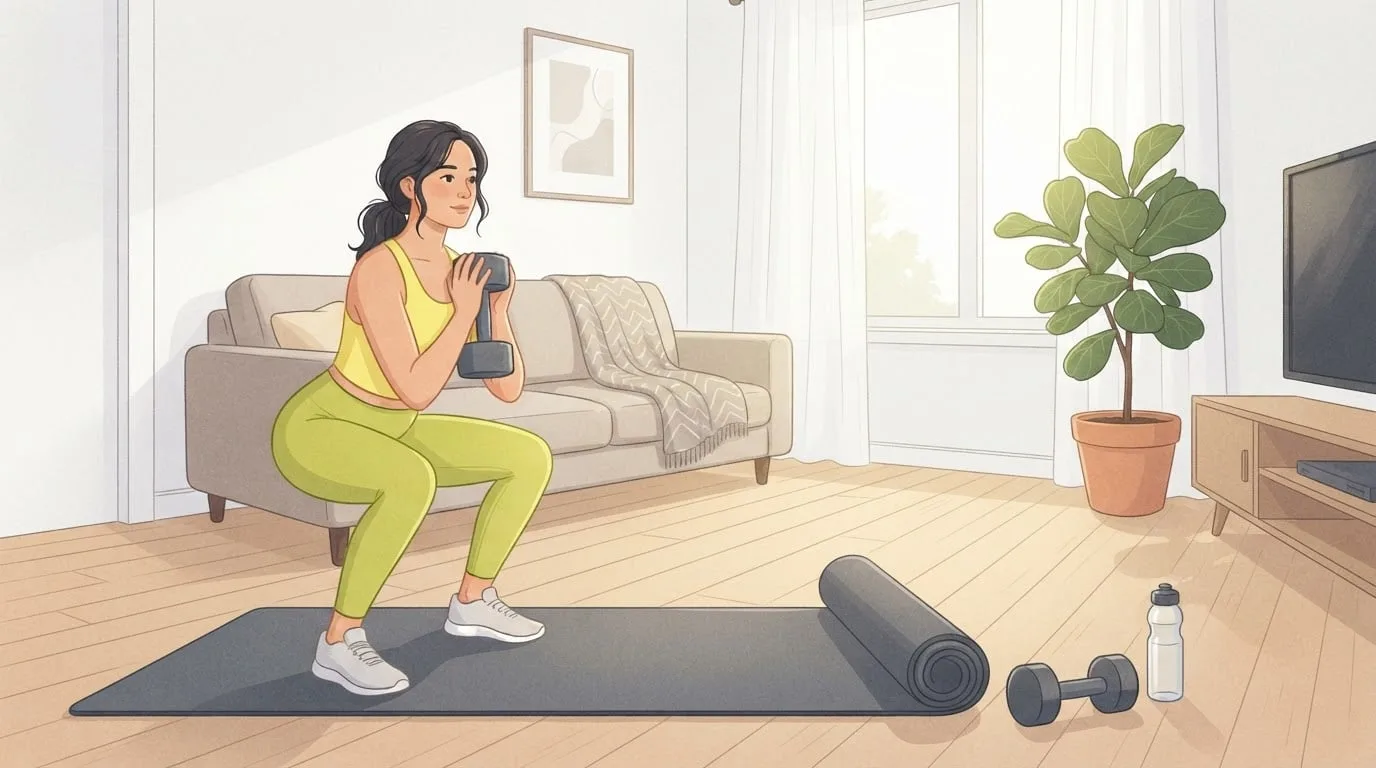
You've decided to start. Then you search for a plan and find a 6-day bodybuilding split, a 30-day challenge and someone telling you to train at 5 a.m. Each plan assumes a week you don't have. So you pick the hardest one, do it for nine days and stop.
That pattern is common, and it isn't a character flaw. In records from 5,240 members of one fitness center, Sperandei and colleagues (2016) found that 63% of new members gave up before their third month, and fewer than 4% kept going for a full year. Early quitting usually says more about the schedule than about the person trying to follow it.
A beginner exercise routine has one job in the first three months: it has to happen every week. Below you'll find three ready-made weekly calendars for 2, 3 and 4 days, the exact workout for each day with sets, reps and rest, a walking layer, how long to stay on it, how to progress, what to do on rest days and how to fit it around a job. Everything uses bodyweight and a pair of dumbbells, and the same calendars work for women and men. They also work as a gym workout schedule, with machine swaps listed near the end.
Which Beginner Workout Schedule Should You Pick?
Pick the number of days you can manage even in a bad week. A schedule you keep during a busy stretch beats a better one you abandon.
| Days you can count on | Schedule | Who it suits |
|---|---|---|
| 2 days | 2-day full body, about 45 minutes each | Very busy weeks, shift work, starting from zero |
| 3 days | 3-day full body, 35 to 45 minutes each (the default) | Most beginners, most of the time |
| 4 days | 4-day upper/lower, 40 to 50 minutes each | After 8 to 12 weeks, or when you want more muscle |
If you're torn between two numbers, our answer to how many days a week you should work out walks through the frequency research. For most people starting out, three days is the sweet spot, and two days still gets real results.
The Default: A 3-Day Full Body Workout Schedule for Beginners
Three full-body days a week is the best workout regimen for most beginners because it's simple and forgiving. Every muscle gets trained three times a week, and a missed session doesn't leave anything untrained for a whole week. Put a rest day or a walk between strength days.
| Day | What you do | Time |
|---|---|---|
| Monday | Workout A | 35 to 45 min |
| Tuesday | Brisk walk | 20 to 30 min |
| Wednesday | Workout B | 35 to 45 min |
| Thursday | Rest, or an easy walk | Optional |
| Friday | Workout A | 35 to 45 min |
| Saturday | Longer walk, bike ride or swim | 30 to 45 min |
| Sunday | Full rest | None |
The next week flips the order to B, A, B, so each workout comes up three times every two weeks. Any three days with a gap between them work just as well: Tuesday, Thursday and Saturday, or Sunday, Tuesday and Thursday. Start each session with five minutes of easy movement, such as marching on the spot, a few bodyweight squats and arm circles, then one light set of the first exercise.
Workout A
| Exercise | Sets x reps | Rest |
|---|---|---|
| Goblet squat (one dumbbell held at the chest; squat to a chair if you're brand new) | 3 x 8-12 | 90 sec |
| Incline push-up (hands on a sturdy table, counter or bench) | 3 x 6-12 | 60 to 90 sec |
| One-arm dumbbell row (free hand on a chair or bench) | 3 x 10-12 per side | 60 sec |
| Glute bridge (rest a dumbbell on your hips once 15 reps is easy) | 2 x 12-15 | 60 sec |
| Dead bug | 2 x 6-8 per side | 45 sec |
Workout B
| Exercise | Sets x reps | Rest |
|---|---|---|
| Dumbbell Romanian deadlift | 3 x 8-12 | 90 sec |
| Reverse lunge (hold a chair for balance at first) | 2 x 8-10 per leg | 60 to 90 sec |
| Dumbbell floor press | 3 x 8-12 | 90 sec |
| Bent-over dumbbell row, both arms | 3 x 10-12 | 60 sec |
| Seated dumbbell shoulder press | 2 x 8-10 | 60 sec |
| Side plank (knees down is fine) | 2 x 15-30 sec per side | 45 sec |
Each workout covers a squat or lunge, a hip hinge, a push, a pull and the core. In weeks 1 and 2, do 2 sets of everything and stop each set when you could still do about 3 more good reps. From week 3, do the full sets shown and stop with 1 or 2 reps left. That margin is called reps in reserve, and it keeps you close enough to failure to make progress without wrecking your form or your next session.
When this schedule starts to feel easy and you want longer sessions with more exercise choices, our full body workout routine has three complete routines to move on to.
The 2-Day Beginner Workout Schedule
Two days a week still counts as a real schedule. The WHO 2020 physical activity guidelines (Bull and colleagues) recommend muscle-strengthening activity on 2 or more days a week for all adults, so two well-used sessions already meet the strength part of the guideline. Leave at least two days between them.
| Day | What you do | Time |
|---|---|---|
| Monday | Workout A, plus one extra set of the squat and the row | About 45 min |
| Tuesday | Brisk walk | 20 to 30 min |
| Wednesday | Rest, or an easy walk | Optional |
| Thursday | Workout B, plus one extra set of the deadlift and the press | About 45 min |
| Friday | Rest | None |
| Saturday | Longer walk, bike ride or swim | 30 to 45 min |
| Sunday | Brisk walk or full rest | Optional |
The extra set on the first two exercises of each workout makes up some of the weekly work you lose by dropping a day. Tuesday and Friday, or Wednesday and Saturday, work as well as Monday and Thursday.
The 4-Day Upper/Lower Beginner Schedule
A 4-day schedule splits the body in half: two upper-body days and two lower-body days. Each muscle still gets trained twice a week, and each session can go deeper on fewer muscles. It suits you once you've finished 8 to 12 weeks of the 3-day plan, or if your 3-day sessions keep running past an hour.
| Day | What you do | Main exercises (2 to 3 sets of 8 to 12) |
|---|---|---|
| Monday | Upper 1 | Dumbbell floor press, one-arm row, seated shoulder press, band pull-apart, dumbbell curl |
| Tuesday | Lower 1 | Goblet squat, Romanian deadlift, reverse lunge, calf raise, dead bug |
| Wednesday | Brisk walk or rest | 20 to 30 min of walking |
| Thursday | Upper 2 | Push-up, bent-over row, half-kneeling one-arm press, rear-delt fly, overhead triceps extension |
| Friday | Lower 2 | Split squat, single-leg Romanian deadlift, glute bridge, side plank |
| Saturday | Longer walk or a sport you enjoy | 30 to 60 min |
| Sunday | Full rest | None |
Training on back-to-back days is fine here, because Tuesday's legs aren't the muscles you trained on Monday. Our upper lower split guide has the full version of this plan, including how to count weekly sets once you add more.
Add a Walking or Cardio Layer
Strength work is half of the WHO guideline. The other half is 150 to 300 minutes a week of moderate aerobic activity, such as brisk walking, or 75 to 150 minutes of vigorous activity. You don't need to hit that in week one. Build it in layers on the days between strength sessions.

- Weeks 1 and 2: two brisk walks of 20 minutes on non-lifting days.
- Weeks 3 and 4: three walks of 25 to 30 minutes, one of them on the weekend.
- Weeks 5 to 8: grow the weekend walk to 45 minutes and add a short walk after one lifting session. That lands you near 150 minutes a week.
Brisk means you can talk in full sentences but couldn't sing. Cycling, swimming, an elliptical or stair climbing count just as much as walking. If you track steps, the numbers are friendlier than the famous 10,000. In a meta-analysis of 15 cohorts and 47,471 adults, Paluch and colleagues (2022) found the risk of death kept falling as steps rose until about 6,000 to 8,000 steps a day for adults 60 and older and 8,000 to 10,000 for younger adults.
Game-style rewards help some people keep the walking habit going. In the BE FIT randomized trial (Patel and colleagues, 2017), adults who earned points and levels as a family hit their daily step goals on 53% of days during the 12-week game, against 32% in the control group.
Find out what's really holding you back
FitCraft, our mobile fitness app, pairs you with an AI coach who builds you a personalized plan around your goals, schedule, and fitness level. Every FitCraft program is designed by Domenic Angelino, MPH (Brown University) and NSCA-CSCS, with research published in the Journal of Strength and Conditioning Research and Medicine & Science in Sports & Exercise.
Take the Free Assessment Free • 2 minutes • No credit cardHow Long Should a Beginner Stay on One Schedule?
Stay on the same schedule for at least 8 weeks, and 12 is better. Changing plans every two weeks resets the learning curve and makes it impossible to tell whether anything is working.
Habit research supports that patience. Kaushal and Rhodes (2015) followed 111 new gym members for 12 weeks and found that exercising at least four times a week for six weeks was the minimum it took to build an exercise habit. Your three strength days plus a walk or two count toward that. Lally and colleagues (2010) tracked 96 people building a new daily behavior and found a median of 66 days before it became automatic, with a range from 18 to 254 days. They also found that missing a single day didn't materially set the habit back. So one skipped workout is a blip. Two in a row is the moment to get back on the calendar.
Check in at three points:
- Week 4: you know every exercise without looking it up, and most sessions finish on time.
- Week 8: you're using heavier dumbbells or harder versions on most exercises than in week 1.
- Week 12: decide whether to keep going, add a fourth day or move to a longer routine.
How to Progress Week by Week
Progress means doing a little more over time: more reps, then more weight or a harder version of the move. The simplest rule for a beginner is double progression. Work within the rep range until you hit the top of it on every set, then go up to the next dumbbell size and start again at the bottom of the range.
| Weeks | Sets | What changes |
|---|---|---|
| 1 and 2 | 2 per exercise | Learn the moves. Stop each set with about 3 reps left. |
| 3 and 4 | As listed (2 or 3) | Stop with 1 or 2 reps left. Add reps each session where you can. |
| 5 to 8 | As listed | Hit the top of the range on every set, then move up one dumbbell size or one harder version. |
| 9 to 12 | Add 1 set to your two main lifts | Keep the same rule. Take an easier week if you feel run down. |
For bodyweight moves, the harder version is the progression. Incline push-ups move to a lower surface, then the floor. Reverse lunges become split squats with dumbbells. The general rules behind this, including when to add weight versus reps and how sets and reps change with your goal, are laid out step by step in our guide on how to create a workout plan.
What to Do on Rest Days
A rest day is a day off from strength training, and moving on it still helps. Your muscles repair and get stronger between sessions, so the days in between are part of the plan.
- Walk. Most of your cardio layer happens on rest days, and easy movement often makes sore muscles feel looser.
- Mobility for 10 minutes. Hip, upper-back and ankle mobility work makes the next squat and press feel smoother.
- Sleep at least seven hours. Sleep is when much of your recovery happens.
- Keep one full day off. Beginners don't need seven active days, and a planned day off makes the other six easier to keep.
Expect sore muscles after the first few sessions, usually peaking one to three days later. That's delayed onset muscle soreness, and it fades fast once your body is used to the moves. Sharp pain in a joint is different: stop that exercise and get it checked.
How to Fit a Workout Schedule Around Work
The schedule that fits your job is the one with a fixed time and place. A meta-analysis of 26 studies by Bélanger-Gravel and colleagues (2013) found that forming an implementation intention, a plan that names when and where you'll exercise, increased physical activity with a small-to-medium effect. It worked best when the plan also said what you'll do when something gets in the way.
Write your plan as an if-then sentence: "On Monday, Wednesday and Friday at 6:30 a.m., I do my workout in the living room before I shower." Then add the backup: "If I miss the morning, I do the 20-minute version after dinner."

Pick your slot
- Before work: the fewest interruptions and the easiest slot to protect. Lay out your clothes and dumbbells the night before.
- Lunch: works with a gym near the office or a 20-minute dumbbell session at home if you work remotely.
- After work: go straight from the door to the workout before you sit down. Keep hard sessions a few hours before bed if late workouts keep you awake.
The 20-minute backup session
On the days a full session won't fit, do this instead of skipping. After two minutes of warming up, do four rounds of 10 goblet squats, 10 one-arm rows per side, 8 to 10 push-ups (incline if needed) and 10 dumbbell Romanian deadlifts. Move straight from one exercise to the next and rest 60 seconds between rounds. It covers the squat, hinge, push and pull, and it keeps the week intact.
Sticking to the calendar is the hard part, and it's the part an app can help with. Our comparison of the best fitness apps for beginners looks at the options built for people starting from zero. FitCraft is one of them: a 3D AI coach demonstrates every exercise and says your name during the workout, and the app keeps your workout days on a calendar with streaks and calendar rewards. Its bodyweight and dumbbell workouts fit a living room, a hotel room or a lunch break.
Is a Beginner Workout Schedule Different for Women and Men?
No. The same schedule works for both, and only the starting weights differ. Roberts, Nuckols and Krieger (2020) pooled studies in which men and women followed the same resistance training program. They found similar gains in muscle size and lower-body strength, and a larger relative gain in upper-body strength for women.
So a beginner workout schedule for women doesn't need lighter "toning" sets or a different structure, and a gym workout schedule for men doesn't need more days to start. Pick weights that let you reach the rep range with 1 or 2 reps to spare, whatever they are.
Using This Schedule at the Gym
If you'd rather work out at the gym, keep the calendar exactly as it is and swap a few exercises for the equipment there. The movement each day trains stays the same.
| Home exercise | Gym swap | Pattern |
|---|---|---|
| Goblet squat | Leg press or goblet squat with a heavier dumbbell | Squat |
| Dumbbell Romanian deadlift | Dumbbell Romanian deadlift or back extension | Hinge |
| Incline push-up or floor press | Chest press machine or dumbbell bench press | Push |
| One-arm or bent-over row | Seated cable row or lat pulldown | Pull |
| Seated dumbbell shoulder press | Shoulder press machine | Overhead push |
Machines are a reasonable choice for beginners because they guide the path of the movement. Dumbbells at home train the same movement patterns. Use whichever setup you'll actually show up for.
The Bottom Line
A good workout schedule for beginners is three full-body sessions a week on non-consecutive days, with brisk walks on two or three of the days between. Use 2 to 3 sets of 8 to 12 reps, stay on the plan for 8 to 12 weeks, add reps before weight, and give each workout a fixed time and a 20-minute backup. If three days won't fit, two days still works. Once three days feel routine, move up to four.
As one FitCraft user, Jim, put it: "I kept telling myself I'd start Monday. FitCraft made me start on a Wednesday and I haven't stopped." If you've been waiting for the perfect week to begin, the schedule above works from whatever day you start it. And if you're starting from a standstill, our guide on how to start working out with zero fitness background covers the first week in more detail.
Frequently Asked Questions
How do beginners start working out?
Beginners should start with two or three short full-body sessions a week on non-consecutive days, plus a brisk walk on some of the days in between. Use light dumbbells or bodyweight, do 2 sets of each exercise in the first two weeks, and stop every set with 2 or 3 good reps left. Add the third set and the third day once the moves feel familiar.
What is a good beginner 3-day full-body workout plan?
A good beginner 3-day full-body plan trains on Monday, Wednesday and Friday and alternates two workouts. Workout A is a goblet squat, incline push-up, one-arm dumbbell row, glute bridge and dead bug. Workout B is a dumbbell Romanian deadlift, reverse lunge, dumbbell floor press, bent-over row, seated shoulder press and side plank. Do 2 to 3 sets of 8 to 12 reps with 60 to 90 seconds of rest.
Are full-body workouts good for building muscle?
Yes. Full-body workouts build muscle well for beginners because three sessions a week train every muscle three times and add up to roughly 6 to 12 hard sets per muscle each week. Muscle growth tracks weekly hard sets more than the split you use, so a full-body schedule only falls short once you need more sets than three sessions can hold.
How to get fit in 4 weeks?
Four weeks is enough to build the routine and feel noticeably stronger, but not enough for a big change in how you look. Follow a 3-day full-body schedule, walk briskly on two or three other days, and sleep at least seven hours. Most of the strength you gain in the first month comes from your nervous system learning the movements; visible changes usually take 8 to 12 weeks.
What is the 3-3-3 rule gym?
The 3-3-3 rule is a beginner shorthand with no single official definition. The most common version is three exercises, three sets each, three days a week. It works as a starting point if the three exercises cover a squat or lunge, a push and a pull, but it usually leaves out a hip hinge and core work, which a five- or six-exercise full-body day adds.
Can you give me a 20 minute workout with weights?
Yes. Do four rounds of 10 goblet squats, 10 one-arm dumbbell rows per side, 8 to 10 push-ups and 10 dumbbell Romanian deadlifts, moving straight from one exercise to the next and resting 60 seconds between rounds. With a two-minute warm-up it takes about 20 minutes and covers the squat, hinge, push and pull.
How many rest days should a beginner take?
A beginner on a 3-day schedule has four days a week without strength training, and that's the right amount. Use two or three of them for a brisk walk or easy cardio and keep at least one as a full day off. Leave a day between strength sessions that train the same muscles until you move to a 4-day upper/lower split.