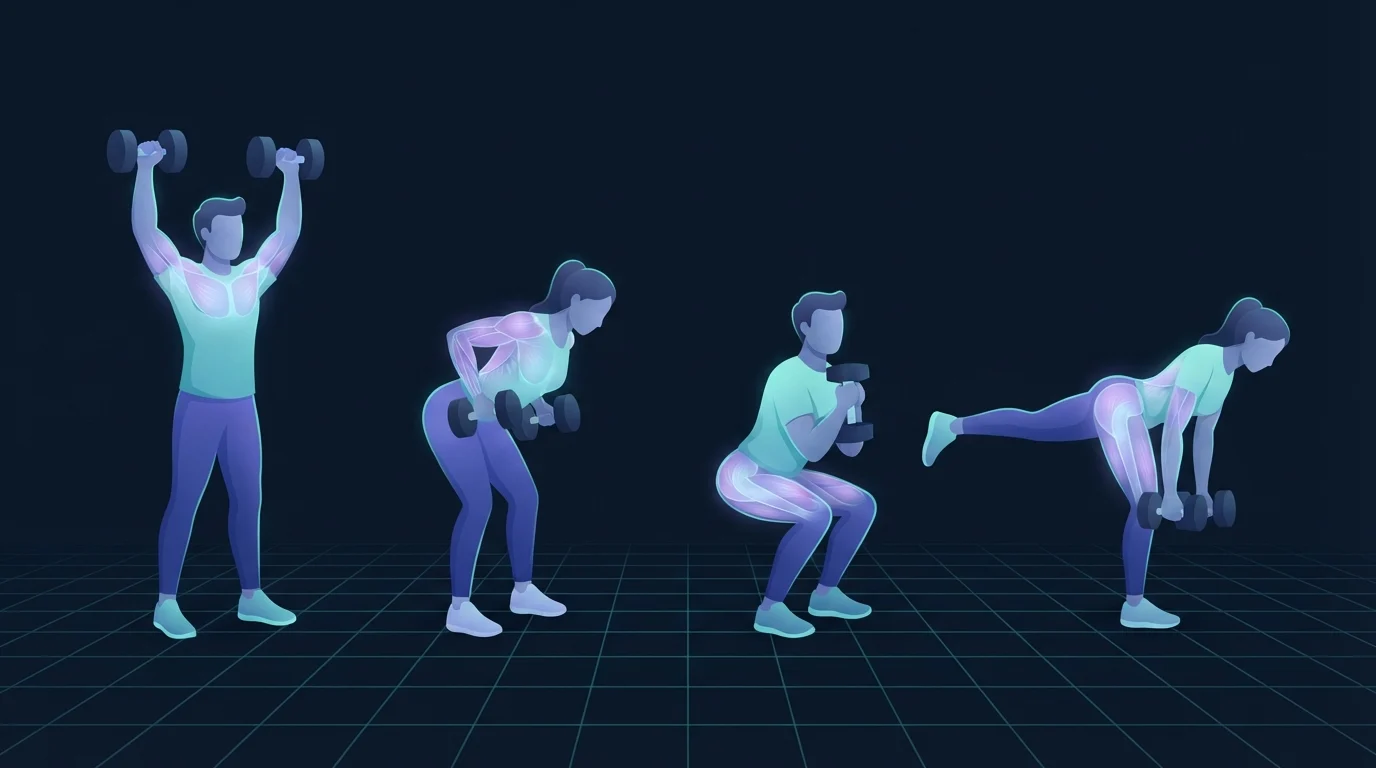
You have four evenings you can reliably protect. Not six, and not the three you have been scraping by on. So you go looking for a program that fits, and you find forty of them, half named after a numbering scheme, all of them assuming a squat rack and a training partner.
Then comes the part nobody mentions. You pick one, run it for six weeks, and the results look identical to the three-day plan you were doing before. You add a day, you give up an evening, and the mirror does not notice.
That happens for a boring reason, and it has nothing to do with which split you picked. Here is what the fourth day actually buys, the two ways to cut it that hold up, and the honest case for going back to three.
What a 4 Day Workout Split Is
A workout split is just a rule for deciding which muscles get trained on which day. Four days a week gives you three cuts that people actually run, plus one that has more history than evidence.
| Cut | The week | Times each muscle trained | Best for |
|---|---|---|---|
| Upper and lower | Upper, Lower, Upper, Lower | Twice | Most people, most goals |
| Push and pull | Push, Pull, Push, Pull | Twice | Shoulder or elbow issues that need pressing and pulling kept apart |
| Full body | Four short whole-body sessions | Four | Short sessions, very limited equipment |
| Four-way body part | Chest, Back, Legs, Shoulders and arms | Once | Advanced lifters chasing one lagging area |
Notice what the third column does. The first two cuts hand every muscle two exposures a week. The fourth hands it one. That single number drives almost everything that follows, because it decides how many sets a muscle has to absorb in one sitting.
Why the Fourth Day Is About Volume, Not Frequency
The frequency literature has a reputation for saying "train each muscle twice a week." It says something narrower than that, and the difference changes how you should build a week.
The starting point is Schoenfeld, Ogborn and Krieger (2016) in Sports Medicine, who pooled 10 studies comparing one session per muscle per week against two or more and found a modest advantage for the higher-frequency conditions. The trap in quoting that paper alone is that most of its included studies were not volume-equated, so the higher-frequency groups usually did more total sets as well.
Three years later the same group ran the tighter analysis. Schoenfeld, Grgic and Krieger (2019), in the Journal of Sports Sciences, reviewed 25 studies and reported no significant difference between higher and lower frequency once weekly volume was held constant. Splitting a given number of weekly sets across one, two or three sessions produced much the same growth. Grgic and colleagues (2018) found the parallel result for strength: frequency looked like it mattered until volume was equated, at which point the effect went away.
So the fourth day is not a stimulus. It is storage. What it stores is sets, and the target for those sets is reasonably well defined. Baz-Valle and colleagues (2022), reviewing the volume literature in the Journal of Human Kinetics, concluded that 12 to 20 weekly sets per muscle group is a sensible standard recommendation for hypertrophy in trained lifters.
Put those together and the arithmetic is unforgiving. If you want 16 hard sets for your back, one weekly back session has to carry all 16, and sets 11 through 16 arrive after 40 minutes of rowing. Two sessions of eight land the same total while everything still moves well. Our review of the training frequency research works through the individual trials.
Which gives you the actual decision rule for this page. Count the hard sets your current week delivers per muscle group. If the number is already 16 and you are finishing sessions strong, a fourth day buys you very little. If the number is 8 because your three sessions ran out of time, the fourth day is the fix.
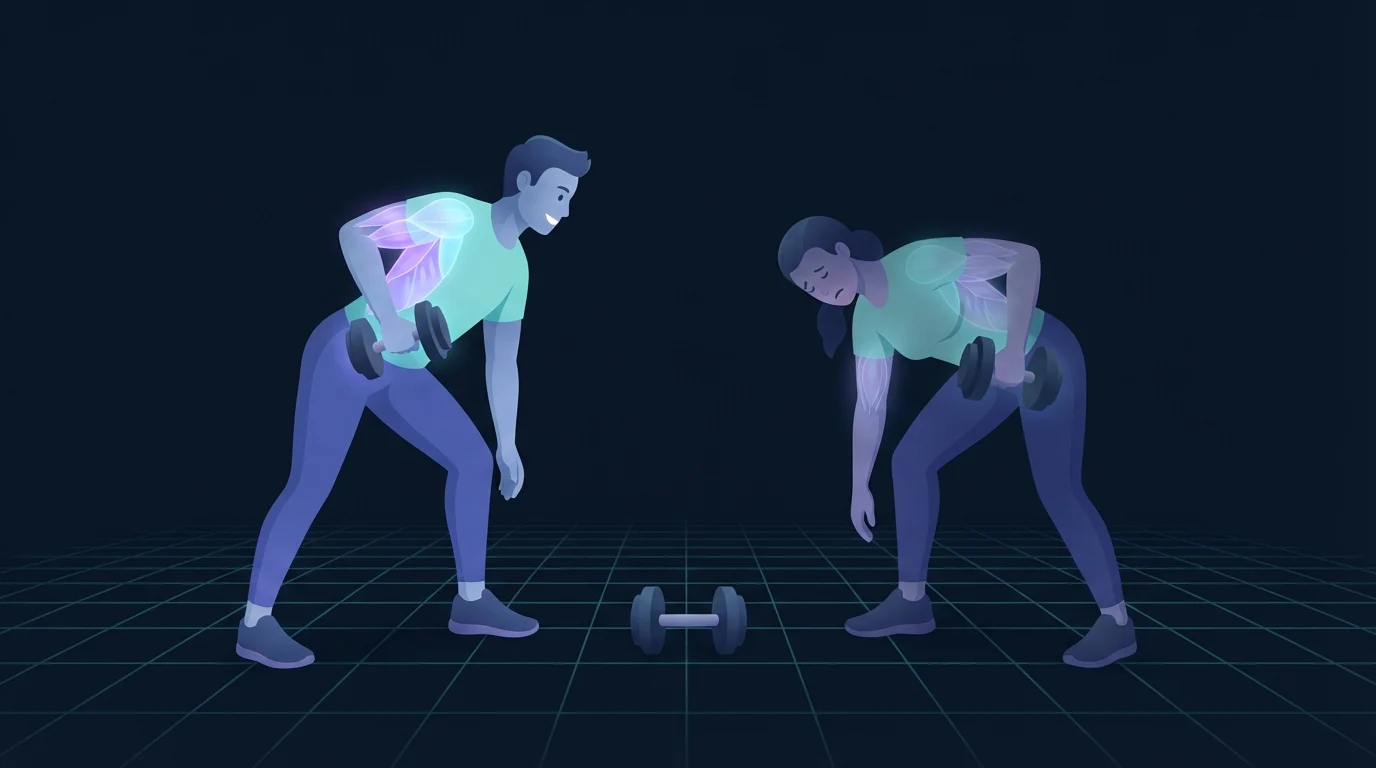
The 4 Day Workout Split, Upper Lower Version
Four days is the smallest week where each half of the body can get one heavier session and one higher-rep session. That pairing is the reason to prefer this layout over an emphasis rotation: heavy work drives the strength side, higher-rep work accumulates the volume, and neither has to be compromised to make room for the other. Two adjustable dumbbells, a bench or sturdy chair, and floor space run all of it.
| Day | Session | Main work |
|---|---|---|
| 1 | Lower, heavier | Goblet squat 4 x 6-8 · Dumbbell Romanian deadlift 3 x 8 · Rear-foot-elevated split squat 3 x 8 each · Standing calf raise 3 x 12 · Hollow hold 3 x 30 sec |
| 2 | Upper, heavier | Dumbbell floor or bench press 4 x 6-8 · One-arm row 4 x 8 each · Standing overhead press 3 x 8 · Chin-up or inverted row 3 x max · Band pull-apart 3 x 15 |
| 3 | Lower, higher rep | Reverse lunge 3 x 12 each · Hip thrust or glute bridge 3 x 15 · Single-leg Romanian deadlift 3 x 10 each · Slider or band leg curl 3 x 15 · Side plank 3 x 30 sec each |
| 4 | Upper, higher rep | Incline dumbbell press 3 x 12 · Chest-supported row 3 x 12 · Lateral raise 3 x 15 · Dumbbell curl 3 x 12 · Overhead triceps extension 3 x 12 · Rear delt raise 2 x 15 |
On heavier days leave two reps in the tank on the first set of each exercise and one on the last. On higher-rep days work closer to the edge, because the load is low enough that the risk is small and the effort is doing the work. Rest two to three minutes after the first two exercises of any day and about 90 seconds after the rest.
Run the weekly tally once, so you know what you actually bought. Back gets roughly 11 hard sets, chest around seven, quads around seven, hamstrings and glutes around 11, shoulders around eight, biceps and triceps five each on top of what the presses and rows already gave them. Chest, quads and arms sit at the bottom of the useful range, which is deliberate: those are the easiest places to add two sets once the week is running, and adding them from the start is how sessions grow to 75 minutes and stop happening.
Find out what's really holding you back
FitCraft, our mobile fitness app, pairs you with an AI coach who builds you a personalized plan around your goals, schedule, and fitness level. Every FitCraft program is designed by Domenic Angelino, MPH (Brown University) and NSCA-CSCS, with research published in the Journal of Strength and Conditioning Research and Medicine & Science in Sports & Exercise.
Take the Free Assessment Free • 2 minutes • No credit cardThe Push and Pull Alternative
Same four days, cut a different way. Pushing movements go together, pulling movements go together, and legs are distributed across both rather than getting their own day. People land here for two reasons: a cranky shoulder that behaves better when pressing and rowing sit 48 hours apart, or a preference for shorter, more focused sessions.
| Day | Session | Main work |
|---|---|---|
| 1 | Push, quad bias | Goblet squat · Dumbbell bench or floor press · Split squat · Overhead press · Lateral raise · Triceps extension |
| 2 | Pull, hinge bias | Romanian deadlift · One-arm row · Hip thrust · Chin-up or inverted row · Rear delt raise · Curl |
| 3 | Push, higher rep | Incline press · Reverse lunge · Push-up to failure · Lateral raise · Overhead triceps extension · Calf raise |
| 4 | Pull, higher rep | Chest-supported row · Single-leg Romanian deadlift · Band or slider leg curl · Face pull · Hammer curl · Side plank |
If you would rather give legs their own dedicated slots, that is a five or six day structure and it is covered properly in our push pull legs routine. If the heavy and higher-rep pairing above appeals but you want the classic A and B emphasis rotation instead, that version lives in our upper lower split guide. Neither is better. They are different containers for the same set count.
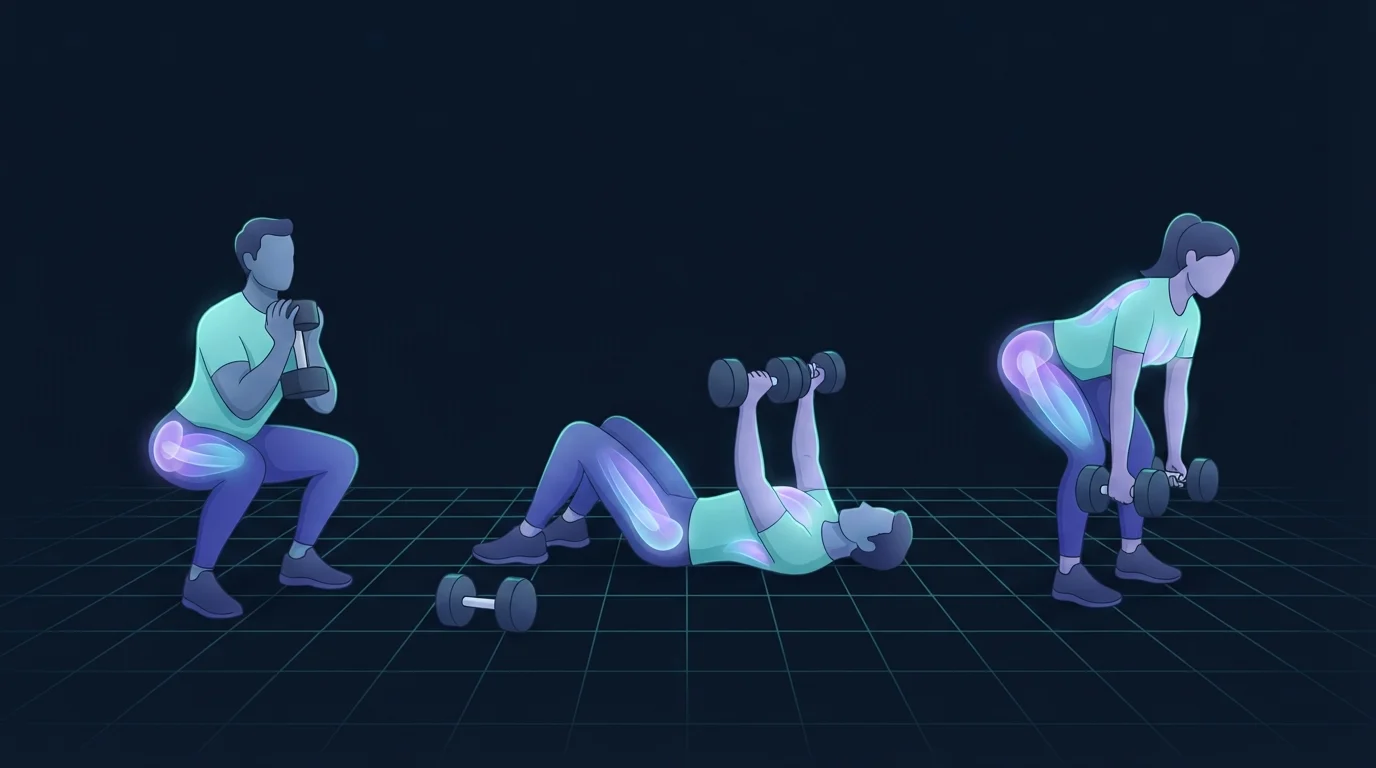
3 Day Workout Split: When Three Days Is the Better Call
A 3 day workout split is three sessions a week, and the version that holds up is full body rather than a body-part carve. The reason is the same frequency arithmetic in reverse: three full-body days train everything three times a week, which is more exposures than the four-day upper and lower layout delivers.
Schoenfeld and colleagues (2015), in the Journal of Strength and Conditioning Research, put 20 well-trained men through eight weeks of either a total-body routine performed three days a week or a split routine that trained each muscle group once a week, with weekly volume matched between groups. The total-body group showed significantly greater increases in forearm flexor thickness. Matched sets, different distribution, better result for the more frequent option.
| Day | Session | Main work |
|---|---|---|
| 1 | Full body, squat lead | Goblet squat 4 x 6-8 · Dumbbell bench or floor press 3 x 8 · One-arm row 3 x 10 each · Romanian deadlift 3 x 10 · Hollow hold 3 x 30 sec |
| 2 | Full body, press lead | Overhead press 4 x 6-8 · Reverse lunge 3 x 10 each · Chin-up or inverted row 3 x max · Hip thrust 3 x 12 · Lateral raise 3 x 15 |
| 3 | Full body, hinge lead | Single-leg Romanian deadlift 4 x 8 each · Incline press 3 x 12 · Chest-supported row 3 x 12 · Split squat 3 x 10 each · Curl and triceps extension 2 x 12 each |
There is a second, less flattering reason to consider three days, and it is worth saying out loud. Sperandei, Vieira and Reis (2016) tracked 5,240 fitness centre members in the Journal of Science and Medicine in Sport and found that 63 percent stopped attending before the third month, and fewer than 4 percent kept going for more than 12 continuous months. Those are gym members, and a home program has its own failure modes, but the shape of the curve is the same everywhere: the plan people abandon is almost never the one that asked too little.
So pick the number of days you have actually hit for the past four weeks, not the number you intend to hit. If that number is three, run the three-day plan properly and add a fourth day when it starts feeling easy to find. Our guide to full body vs split workouts walks through the same choice at two and five days a week.
Is the Bro Split Actually Dead?
The bro split workout is the four-way body-part carve: chest on Monday, back on Tuesday, legs on Thursday, shoulders and arms on Friday. It has produced a lot of muscular people, and it is also the format the frequency research is least kind to.
The problem is not the once-a-week frequency in isolation. On a strictly volume-equated basis, the 2019 review above found frequency does not much matter. The problem is that once-a-week frequency forces a volume distribution nobody defends: if chest needs 14 sets and chest is trained once, all 14 land on Monday. Sets 11 through 14 of a body part are slower, shallower and less well controlled than sets one through four, and the research equating volume was equating sets, not equating set quality.
Two ways to keep the format and fix the flaw. Cap each body part at about 10 sets in its session and add a fifth short day that mops up the leftovers. Or promote your weakest body part to a second slot in the week and leave the rest on one exposure. Both preserve what people actually like about the bro split, which is the feeling of really finishing a muscle off.
What About 5x5 and 5/3/1?
Neither of these is a split, which is why the comparison confuses people. They are progression models, and they come with a split attached almost by accident.
Classic 5x5 is a three-day full-body plan with two alternating sessions and a linear progression, adding a small amount of weight to the main lifts every session until you stall. The 5/3/1 family runs percentage-based waves off a training max, with one main barbell lift per session, typically spread across four days, and assistance work hung off it. Both are barbell-first programs. Both were designed for people who have a rack.
The useful part travels anyway. Pick one primary movement per session, track it, and progress it deliberately rather than by feel. Take a lighter week every fourth or fifth, which is what the 5/3/1 deload cycle formalises and what a home program usually skips. Those two habits are most of what makes a named program outperform an unnamed one.
What does not travel is the belief that the scheme itself is the active ingredient. Grgic and colleagues (2017), in PeerJ, pooled 13 studies comparing linear periodisation against daily undulating periodisation for muscle growth and found a standardised mean difference of -0.02, which is as close to nothing as a meta-analysis gets. The model you pick is far less important than the sets you complete and the weeks you string together.
Fitting Four Days Into a Real Week
| Layout | Days | Why it works |
|---|---|---|
| Two and two | Mon, Tue, Thu, Fri | Weekends free, two clean recovery blocks |
| Spread | Mon, Wed, Fri, Sat | Most recovery between the two hardest days |
| Rolling | Two on, one off, repeat | Ignores the calendar, best for shift work |
Back-to-back days are fine as long as consecutive sessions do not train the same muscles. Upper then lower is fine. Upper then upper is not. That single rule covers almost every scheduling question this layout raises.
When you miss a day, shift the week rather than deleting the session. Four sessions completed across nine days beats three completed in seven, and the habit of sliding instead of skipping is worth more over a year than any template choice on this page. Shift work has its own constraints, which our night shift workout guide handles directly.
Progression Without a Rack
Count hard sets only, meaning sets taken within a few reps in reserve of failure. Warm-ups are not sets and neither is anything you stopped because you were bored.
- Add reps within the prescribed range on every set before you touch the weight.
- Add load once the top of the range is clean, then drop back to the bottom of the range.
- Add a set to the lagging muscle group, not to everything at once.
- Take a lighter week every fifth or sixth week. A deload is not lost time, it is the thing that lets the next block start from a higher floor.
When the sessions start running long, pair non-competing exercises back to back instead of cutting sets. Iversen and colleagues (2021), reviewing time-efficient program design in Sports Medicine, list paired supersets of opposing muscles as one of the cleanest ways to shorten a session without losing working volume. A row paired with a press, or a leg curl paired with a calf raise, can take 10 minutes out of a day.
If you would rather have the week built, tracked and progressed for you than manage the arithmetic yourself, our roundup of the best dumbbell workout apps compares what the main options actually do with a four-day week.
Five Ways a Four-Day Week Breaks
Adding the day without adding sets. The single most common failure. You spread the same 30 weekly sets across four days instead of three, and the volume-equated research says exactly what will happen, which is nothing.
Making all four days hard. Two heavier days and two higher-rep days is the design. Four maximal days is a recipe for stalling everything at once around week five.
Stacking two upper days back to back. Usually an accident of rescheduling. Shift the order instead, and keep consecutive days on different halves of the body.
Letting the sessions grow. An hour is the working ceiling for most people. Every exercise you add past that gets done in a worse state than the one before it, and session length is the strongest predictor of the day you quietly start skipping.
Changing the template every three weeks. You cannot progress a program you keep replacing. Give any layout eight weeks before you judge it, and change one variable at a time when you do.
The Bottom Line
A 4 day workout split is the right container when your current week runs out of time before it runs out of sets. Cut it upper and lower, give each half one heavier day and one higher-rep day, land somewhere between 12 and 20 hard sets per muscle group, and do not let any session past an hour. If four evenings is optimistic rather than realistic, three full-body days will out-perform a four-day plan you only run half the time, and that is a genuine finding rather than a consolation prize.
The number of days was never the variable. The sets you finish well are.
Frequently Asked Questions
What is a 4 day workout split?
A 4 day workout split is a training week that divides your exercises across four sessions so each muscle group gets trained about twice. The three common cuts are upper and lower alternating, a push and pull rotation, and a four-way body-part split. Four days is the smallest week that comfortably fits 12 to 20 hard sets per muscle group, the range Baz-Valle and colleagues (2022) identified as the working target for trained lifters, without any single session running past an hour.
What is a 3 day workout split?
A 3 day workout split is three sessions a week, usually full body or a push, pull and legs rotation. Full body three times a week is the stronger version, because it trains every muscle three times instead of once. Schoenfeld and colleagues (2015) compared exactly that in 20 well-trained men over eight weeks with weekly volume matched, and the total-body group showed significantly greater forearm flexor thickness gains than the once-a-week split group.
Is a 4 day split better than a 3 day split?
Only if you use the fourth day to add hard sets. When weekly volume is held constant, frequency stops mattering: Schoenfeld, Grgic and Krieger's 2019 review of 25 studies found no significant hypertrophy difference between higher and lower frequencies on a volume-equated basis, and Grgic and colleagues (2018) found the same for strength. A four-day week that carries 16 sets per muscle beats a three-day week that carries 10. A four-day week that carries the same 10 sets spread thinner does not.
Is the bro split workout still worth doing?
It works, it is just rarely the best use of four days. Training one muscle group per session means each muscle gets one exposure a week, so all of its volume has to land in a single session, and the tenth through eighteenth set of a body part are visibly lower quality than the first six. If you love the format, run it as a four-way split and add one short full-body or arm session, or move the weakest body part to a second weekly slot.
Can you run a 4 day workout split with only dumbbells at home?
Yes. A pair of adjustable dumbbells, a bench or sturdy chair, and floor space covers every pattern a four-day week needs: a squat, a hinge, a single-leg movement, a horizontal press, a vertical press, a horizontal pull and a vertical pull. The one gap is loading heavy on the legs, which you close with single-leg work, slower lowering phases and paused reps rather than more weight.
Are 5x5 and 5/3/1 four-day splits?
Neither is a split. They are progression models built on barbells: classic 5x5 is a three-day full-body plan on a linear progression, and 5/3/1 runs percentage-based waves with one main lift per session, typically across four days. You can borrow the useful part, which is one tracked primary movement per session and a lighter week every fourth or fifth, without the barbell. Grgic and colleagues (2017) pooled 13 studies comparing linear and undulating models and found essentially no difference in hypertrophy between them.