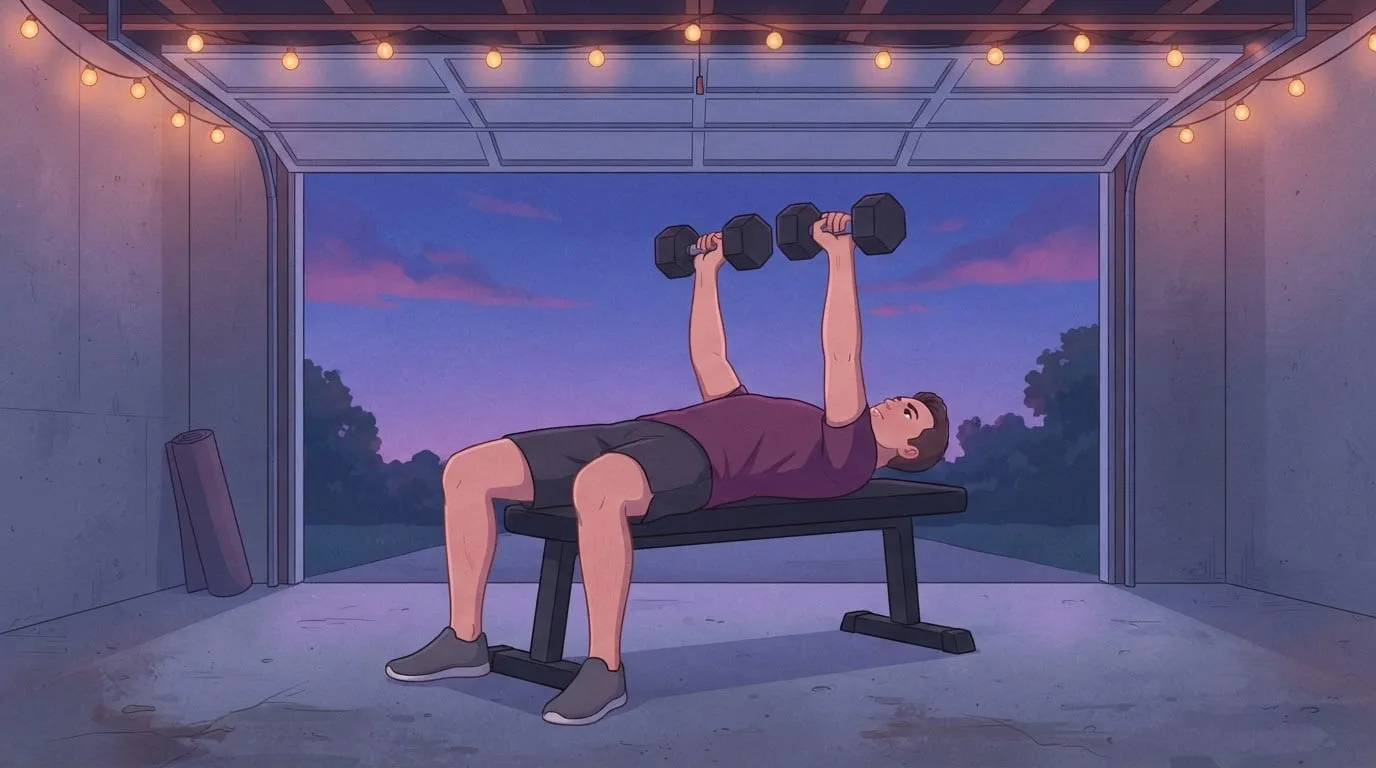
Maybe you started with the bro split because everyone at your gym did: chest on Monday, back on Tuesday and a whole session for arms on Friday. Then you read that it's outdated, that every muscle needs training twice a week, and that serious lifters moved on years ago.
So you second-guess a routine you actually enjoy. Or you switch plans every few weeks and never give any of them long enough to work. That switching costs you more muscle than any choice of split, because inconsistency is what stalls most people.
The research is kinder to the bro split than its reputation. Below you'll find what a bro split is, a full bro split workout plan you can run with dumbbells and a bench, what the frequency studies found, and who should use it.
What Is a Bro Split?
A bro split is a weekly training routine in which each workout targets one major muscle group, so every muscle gets one long, hard session a week. The name is gym slang for the split most gym regulars learn first. It comes from bodybuilding, where lifters wanted to train one body part from several angles in a single session.
The classic bro split routine runs Monday to Friday, with the weekend off:
- Monday: chest
- Tuesday: back
- Wednesday: shoulders
- Thursday: legs
- Friday: arms (biceps and triceps)
It's one of several ways to set up a workout split, which is simply the plan for which muscles you train on which days. Push pull legs groups muscles by the movement they do. An upper/lower split divides the body in half, and a full-body routine trains everything every session. The bro split is the only common split that gives each body part a day to itself.
The 5-Day Bro Split Workout Plan
This bro split workout plan uses only dumbbells, a flat or adjustable bench and your body weight. Each day has four to six exercises and 11 to 16 hard sets, which takes 45 to 60 minutes with rest. If you train at a gym, the swaps under each day are alternatives, and the plan works the same way with them.
| Day | Muscle group | Hard sets |
|---|---|---|
| Monday | Chest | 11 |
| Tuesday | Back | 11 |
| Wednesday | Shoulders | 11 |
| Thursday | Legs (quads, glutes, hamstrings, calves) | 16 |
| Friday | Arms (biceps and triceps) | 14 |
| Saturday and Sunday | Rest, or an easy walk | 0 |
Day 1: Chest
- Dumbbell bench press: 4 sets of 6 to 10 reps, 2 to 3 minutes rest. No bench? Do a dumbbell floor press.
- Incline dumbbell press, bench at about 30 degrees: 3 sets of 8 to 12, 2 minutes rest.
- Dumbbell fly: 2 sets of 10 to 15, 90 seconds rest. Lower until you feel a stretch across your chest, keeping a soft bend in the elbows.
- Push-up: 2 sets ending 1 or 2 reps short of failure. Raise your feet on a step once 20 reps feels easy.
Gym swap: a cable fly or a machine chest press in place of the dumbbell fly.
Day 2: Back
- One-arm dumbbell row: 4 sets of 8 to 12 per arm, 90 seconds to 2 minutes rest. Pull the dumbbell toward your hip with your elbow close to your ribs.
- Chest-supported dumbbell row, lying face down on an incline bench: 3 sets of 10 to 12, 2 minutes rest.
- Two-arm bent-over dumbbell row: 2 sets of 10 to 15, 90 seconds rest. Hinge forward with a flat back and pull both dumbbells toward your lower ribs.
- Inverted row under a sturdy table, or pull-ups if you have a bar: 2 sets ending 1 or 2 reps short of failure.
Gym swap: a lat pulldown and a seated cable row.
Day 3: Shoulders
- Dumbbell overhead press, seated or standing: 3 sets of 6 to 10, 2 to 3 minutes rest.
- Dumbbell lateral raise: 3 sets of 12 to 20, 60 to 90 seconds rest. Lead with your elbows and stop at shoulder height.
- Lean-away lateral raise, holding a door frame with your free hand: 2 sets of 10 to 15 per arm.
- Rear delt fly, bent over or lying face down on an incline bench: 3 sets of 12 to 20.
Gym swap: a cable lateral raise and a reverse pec deck.

Day 4: Legs
- Goblet squat: 4 sets of 8 to 12, 2 to 3 minutes rest.
- Dumbbell Romanian deadlift: 3 sets of 8 to 12, 2 minutes rest.
- Bulgarian split squat, back foot on a bench or couch: 3 sets of 8 to 12 per leg, 90 seconds to 2 minutes rest.
- Single-leg hip thrust, shoulders on the bench: 2 sets of 10 to 15 per leg.
- Standing calf raise on a step, holding dumbbells: 4 sets of 10 to 20.
Legs get the most sets because "legs" is four muscle groups. No single muscle gets more than 7 direct sets. Gym swap: a leg press, a leg curl and a seated calf raise.
Day 5: Arms
- Dumbbell curl: 3 sets of 8 to 12.
- Overhead dumbbell triceps extension: 3 sets of 10 to 15.
- Incline dumbbell curl, lying back on a bench set at about 45 degrees: 2 sets of 10 to 15.
- Lying dumbbell triceps extension, also called a dumbbell skull crusher: 2 sets of 10 to 12.
- Hammer curl: 2 sets of 10 to 12.
- Dumbbell triceps kickback: 2 sets of 12 to 15.
Alternate biceps and triceps exercises and rest 60 to 90 seconds between sets. If you want direct ab work, add 2 or 3 sets of planks or dead bugs to legs day or arms day.
Sets, Reps, Rest and Progression on a Bro Split
The plan spans 6 to 20 reps because muscle grows across a wide range of loads as long as sets end close to failure. A 2017 meta-analysis of 21 studies by Schoenfeld and colleagues, in the Journal of Strength and Conditioning Research, found similar muscle growth from light and heavy loads when sets were taken to failure. Heavy loads built more maximal strength. That's why the presses and squats sit at the heavy end and the raises and curls at the light end.
- Effort: end most sets with 1 to 3 reps in reserve. On raises, curls and extensions, where a missed rep is harmless, take the last set to failure or 1 rep short. On squats, Romanian deadlifts and presses, stop 2 reps short so your form holds.
- Rest: rest longer than gym habit suggests. In a trial by Schoenfeld and colleagues (2016), 21 trained men who rested 3 minutes between sets for 8 weeks gained more thigh muscle and more strength than men who rested 1 minute. Rest 2 to 3 minutes on presses, rows and squats and 60 to 90 seconds on small-muscle exercises.
- Progression: stay with a dumbbell until you reach the top of the rep range on every set, then move up a weight and start again at the bottom of the range.
Dumbbell jumps are big, often 10 to 20 percent on light exercises, so you'll spend weeks adding reps before the weight changes. That still counts as progress. In an 8-week trial by Plotkin and colleagues (2022), in PeerJ, 43 trained men and women who added reps at a fixed load built about as much leg muscle as a group that added load at fixed reps. Our hypertrophy workout plan shows how to build those steps into 12 weeks with planned lighter weeks.
Give the plan at least 8 to 12 weeks before you judge it, and expect your results to differ from a training partner's. Hubal and colleagues (2005) trained one arm of 585 adults for 12 weeks. On the same program, biceps size changed by anything from a 2 percent loss to a 59 percent gain.
Find out what's really holding you back
FitCraft, our mobile fitness app, pairs you with an AI coach who builds you a personalized plan around your goals, schedule, and fitness level. Every FitCraft program is designed by Domenic Angelino, MPH (Brown University) and NSCA-CSCS, with research published in the Journal of Strength and Conditioning Research and Medicine & Science in Sports & Exercise.
Take the Free Assessment Free • 2 minutes • No credit cardDoes a Bro Split Build Muscle? What the Frequency Research Shows
The case against the bro split comes mostly from one paper. Schoenfeld, Ogborn and Krieger (2016), in Sports Medicine, pooled 10 studies that compared weekly training frequencies. Training a muscle twice a week produced a larger effect on muscle growth than training it once (an effect size of 0.49 versus 0.30). The authors concluded that major muscles should be trained at least twice a week, and "the bro split is dead" grew from that line.
Later reviews with far more data softened it. In their 2019 meta-analysis in the Journal of Sports Sciences, Schoenfeld, Grgic and Krieger included 25 studies. They found no significant difference between higher and lower frequencies when weekly volume was matched, including in trained lifters and for the upper and lower body separately. Higher frequency only came out ahead when it also meant more total sets, and even then the gap was modest. Their conclusion was that, for a given volume, you can choose your frequency by preference.
Then researchers tested splits directly. Ramos-Campo and colleagues (2024), in the Journal of Strength and Conditioning Research, pooled 14 studies with 392 people that compared split routines with full-body routines. Strength gains were similar, and so was growth in the arms, the thighs and overall lean mass, as long as volume was equated.
The largest analysis so far, by Pelland and colleagues (2026) in Sports Medicine, modeled 67 studies and 2,058 people. More weekly sets reliably meant more growth, with smaller returns at the top end. The effect of frequency on muscle growth was compatible with being negligible. Frequency did matter for strength, which rose as people practiced their lifts more often.
The two trials closest to a bro split
Two randomized trials in trained men compared a once-a-week split with full-body training, and they point in opposite directions.
- Schoenfeld 2015. Schoenfeld and colleagues (2015) had 20 trained men train each muscle either once a week, with two or three muscle groups per session, or three times a week in full-body sessions. The full-body group gained more muscle thickness in the forearm flexors, the muscles that bend the elbow, and strength gains were similar.
- Bartolomei 2021. Bartolomei and colleagues (2021) gave 21 trained men the same exercises four days a week for 10 weeks, either one muscle group per session or everything in every session. Both did 5 sets of 6 reps, stopping 1 rep short of failure, with matched volume. The split group grew more thigh muscle, chest growth was similar, and the full-body group gained more on one slow-speed bench press test.
Two well-run trials with opposite results fit the meta-analyses above, which found that weekly hard sets decide most of the muscle growth.
Does a muscle need a full week to recover?
A common defense of the bro split is that each muscle gets a full week to recover. The week is longer than the growth signal from one session lasts. MacDougall and colleagues (1995) measured muscle protein synthesis in six young men after 12 hard sets of curls. It more than doubled at 24 hours and was nearly back to baseline by about 36 hours.
That short window is the main argument for training a muscle twice a week. The trials above suggest the long gap doesn't cost growth as long as the weekly sets get done. So the extra rest days are a side effect of the format rather than its strength.
Your Arms Get Trained More Than Once a Week
A bro split trains chest, back and legs once a week. Your arms and front shoulders get more than that, because they assist on other days. The Pelland meta-analysis predicted growth best when an exercise that only partly trains a muscle counted as half a set. Count that way, and this plan's week looks like this:
| Muscle | Direct sets | Assisting sets (count as half) | Days it works |
|---|---|---|---|
| Chest | 11 | None | 1 |
| Back | 11 | None | 1 |
| Side delts | 5 | 3 overhead presses | 1 |
| Rear delts | 3 | 11 rows | 2 |
| Biceps | 7 | 11 rows | 2 |
| Triceps | 7 | 9 chest presses and push-ups, 3 overhead presses | 3 |
| Quads | 7 | None | 1 |
| Hamstrings | 3 | 2 hip thrusts | 1 |
| Glutes | 2 | 10 squats, split squats and Romanian deadlifts | 1 |
The triceps work three days a week and the biceps two, which puts both near 12 to 13 effective sets. The muscles a bro split truly trains once are the chest, back, side delts and legs. Those are the ones to watch when something stops growing.

The Bro Split's Real Weakness: Too Many Sets in One Session
If frequency isn't the problem, what is? A bro split puts a muscle's whole week of work into one session, and that makes it tempting to keep adding sets. Sixteen sets on chest day feels productive. The evidence suggests the last few do little.
Remmert and colleagues (2025), in a preprint that hasn't been peer reviewed yet, modeled how much one session can deliver. Muscle growth kept rising up to about 11 sets for one muscle in a session, counting assisting sets as half, with no detectable benefit beyond that. For strength, the point came much sooner, at about 2 direct sets. The authors note there's little data at very high volumes, so treat 11 as a guide rather than a hard limit.
Three fixes keep the format and remove the flaw:
- Cap each muscle at about 10 hard sets per session. No single muscle in the plan above goes past 11 in a day.
- Give a lagging muscle a second, short slot. If you want 14 or more weekly sets for chest, move 3 or 4 of them to arms day. Side delts can take 3 sets of raises on legs day.
- Slide the week instead of skipping a day. Miss Monday on a bro split and your chest goes two weeks untrained. Train chest on Tuesday and push everything back a day.
Who Should Do a Bro Split?
Pick the split you'll actually run. The 2019 meta-analysis concluded that you can choose frequency by preference, and preference matters because the plan you enjoy is the plan you keep doing.
A bro split suits you if
- You can train five days a week, nearly every week, for 45 to 60 minutes.
- You like long, focused sessions on one muscle and the pump that comes with them.
- You've trained for a year or more and know your exercises well.
- Your main goal is muscle size, not strength on specific lifts or sport performance.
Pick another split if
- Your weeks are unpredictable and you often miss days. A full-body routine still covers every muscle when you only get two sessions in.
- You want to get stronger on specific lifts. Strength rises with practice frequency, which a bro split keeps low.
- You have three or four days a week, not five.
Is a bro split good for beginners?
It works, but it isn't the best start. Beginners gain on almost any sensible program, and their bigger job is learning squats, hinges, presses and rows. Three full-body days a week practice each movement three times instead of once. Start there, then switch to a bro split after six to twelve months if it suits your schedule.
Bro Split vs PPL and Upper/Lower
| Split | Days a week | Each muscle trained | Best for |
|---|---|---|---|
| Bro split | 5 | Once (arms two or three times through assisting work) | Lifters who like focused sessions and can train five days |
| Push pull legs | 3 or 6 | Once or twice | Lifters who like grouping muscles by movement |
| Upper/lower | 4 | Twice | Most intermediate lifters with four days |
| Full body | 2 or 3 | Two or three times | Beginners and busy weeks |
Push pull legs is the bro split's closest relative. A push day trains chest, shoulders and triceps together, which is how our push day workout is built. Run three days and PPL trains each muscle once a week, like a bro split. Run six and each muscle gets two sessions. Muscle growth is similar across all four splits when weekly sets match, so choose by schedule and by what you enjoy.
4-Day, 3-Day and 6-Day Bro Split Variations
4-day bro split
Pair each small muscle with a big one: chest and triceps, back and biceps, legs, then shoulders and abs. Sessions run longer, so trim the arm work to 4 to 6 sets on each paired day. Our 4 day workout split guide compares this setup with upper/lower templates.
3-day bro split
Train chest and back on day one, legs on day two, and shoulders and arms on day three. Each muscle still gets one session, so keep it near 8 to 10 sets. With only three days, though, full-body training reaches each muscle three times in the same total time, which is usually the better trade.
6-day bro split
Keep the five days and add a sixth for your weakest muscle group, such as a second short chest or shoulder session. Or run push pull legs twice through the week. Six training days need good sleep and at least one full rest day.
The Bottom Line
A bro split workout builds muscle about as well as other splits when the weekly sets add up. Its weak spots are long sessions where the last sets do little and missed days that cost a muscle a whole week. Cap each muscle near 10 hard sets a session, slide the week when life gets in the way, and run it for at least three months.
If you'd rather not plan the sets and weights yourself, a dumbbell workout app can do it for you. FitCraft builds programs from dumbbell and bodyweight exercises, an AI coach demonstrates each exercise on an interactive 3D model, and the workouts adjust as you progress. Streaks and leaderboards help with the part a five-day split depends on, which is showing up.
As one FitCraft user, Mike, 23, put it: "The streak system got me hooked. I didn't want to break my chain."
Frequently Asked Questions
What is a bro split in the gym?
A bro split in the gym is a routine that trains one major muscle group per session, usually chest, back, shoulders, legs and arms on five days, with the weekend off. Each muscle gets one long, hard session a week. The name comes from bodybuilding culture, where it has long been a popular way to train.
Is a bro split good for beginners?
A bro split works for beginners, but it usually isn't the best start. New lifters need to practice squats, hinges, presses and rows often, and three full-body days a week train each pattern three times instead of once. Switch to a bro split after six to twelve months if you enjoy it and can train five days a week.
How long should a bro split workout take?
A bro split workout usually takes 45 to 60 minutes: four to six exercises, about 11 to 16 hard sets and 1 to 3 minutes of rest between sets. A session that runs well past an hour usually means too many sets for one muscle, since growth seems to stop rising past about 11 sets for one muscle in a session.
Can you do a bro split 6 days a week?
Yes. Keep the five standard days and use the sixth for a short session on your weakest muscle group, or run push pull legs twice through the week instead. Six training days need good sleep and at least one full rest day.
What muscle is hardest to grow?
No muscle is hardest for everyone, because people differ more than muscles do. Lifters most often name the calves. In one study of 585 adults on the same 12-week arm program, biceps size changed by anything from a 2 percent loss to a 59 percent gain, so a stubborn muscle usually needs more weekly sets and more time rather than a different split.
Is a bro split better than push pull legs?
Neither is better for muscle growth when weekly sets are equal. A 2024 meta-analysis of 14 studies with 392 people found that split and full-body routines built similar muscle and strength. Pick push pull legs if you have three or six days a week, and a bro split if you have five and like focused sessions.