Push day is the session most people enjoy. Pressing feels strong, the chest and shoulders pump up quickly, and progress shows in the mirror. It's also the session people most often throw together: three kinds of bench press, no work for the side of the shoulder, and a triceps exercise picked from whatever equipment is free.
If you've followed a push day from a video and ended up with achy elbows, a chest that stopped growing and no idea whether to add weight next week, the plan let you down. Nobody designed that session around the three muscles it's supposed to train, so it couldn't tell you what to change.
This guide designs it with dumbbells and your body weight. You get six push day exercises in a set order, a full session with sets, reps and rest, a version with no equipment, a warm-up and cool-down, and what the training studies say about each choice. It's one of three sessions: our pull day workout and leg day workout cover the other two.
The 6 Best Push Day Exercises
These six push day lifts cover the chest, the front and side of the shoulders, and all three heads of the triceps. Two are heavy presses, two are moderate pressing movements, and two isolate the muscles the presses leave under-trained.
| # | Exercise | Equipment | Main muscles | Sets x reps |
|---|---|---|---|---|
| 1 | Dumbbell floor press or bench press | Two dumbbells; a bench is optional | Chest, front delts, triceps | 4 x 6-10 |
| 2 | Incline dumbbell press | Two dumbbells, an incline bench | Upper chest, front delts, triceps | 3 x 8-12 |
| 3 | Standing dumbbell overhead press | Two dumbbells | Front and side delts, triceps | 3 x 8-12 |
| 4 | Push-up, at the level that suits you | Floor, or a bench for incline push-ups | Chest, front delts, triceps, trunk | 2 sets, 1-2 reps short of failure |
| 5 | Dumbbell lateral raise | Two light dumbbells | Side delts | 3 x 12-20 |
| 6 | Overhead dumbbell triceps extension | One dumbbell | Triceps, especially the long head | 3 x 10-15 |
1. Dumbbell floor press or bench press
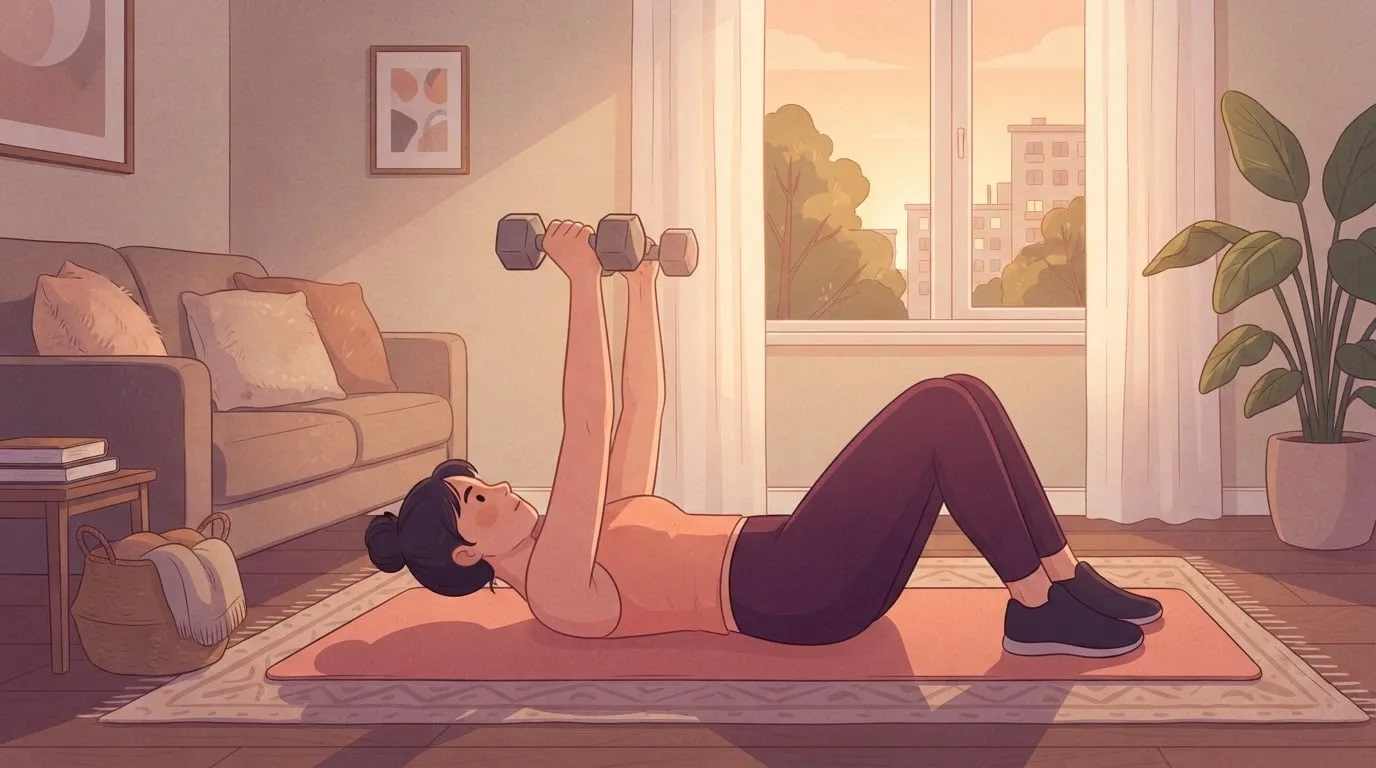
Lie on the floor with your knees bent, or on a flat bench with your feet planted. Hold the dumbbells over your chest, palms facing your feet or angled slightly in. Lower them until your upper arms touch the floor, or until the dumbbells sit beside your chest on a bench, keeping your elbows about 45 degrees from your sides instead of flared out in a T. Press back to straight arms. The floor version cuts the bottom of the range a little short, which suits sensitive shoulders, while the bench version gives the chest a longer stretch. Our dumbbell chest workout covers bench setups in more detail.
2. Incline dumbbell press
Set an adjustable bench to roughly 30 degrees. Start with the dumbbells at your upper chest and press them up until your arms are straight, then lower slowly. Keep the angle low: past about 45 degrees, the movement turns into a shoulder press, as the muscle section below explains. With no incline bench, a decline push-up with your feet on a step or couch trains a similar angle with your body weight.
3. Standing dumbbell overhead press
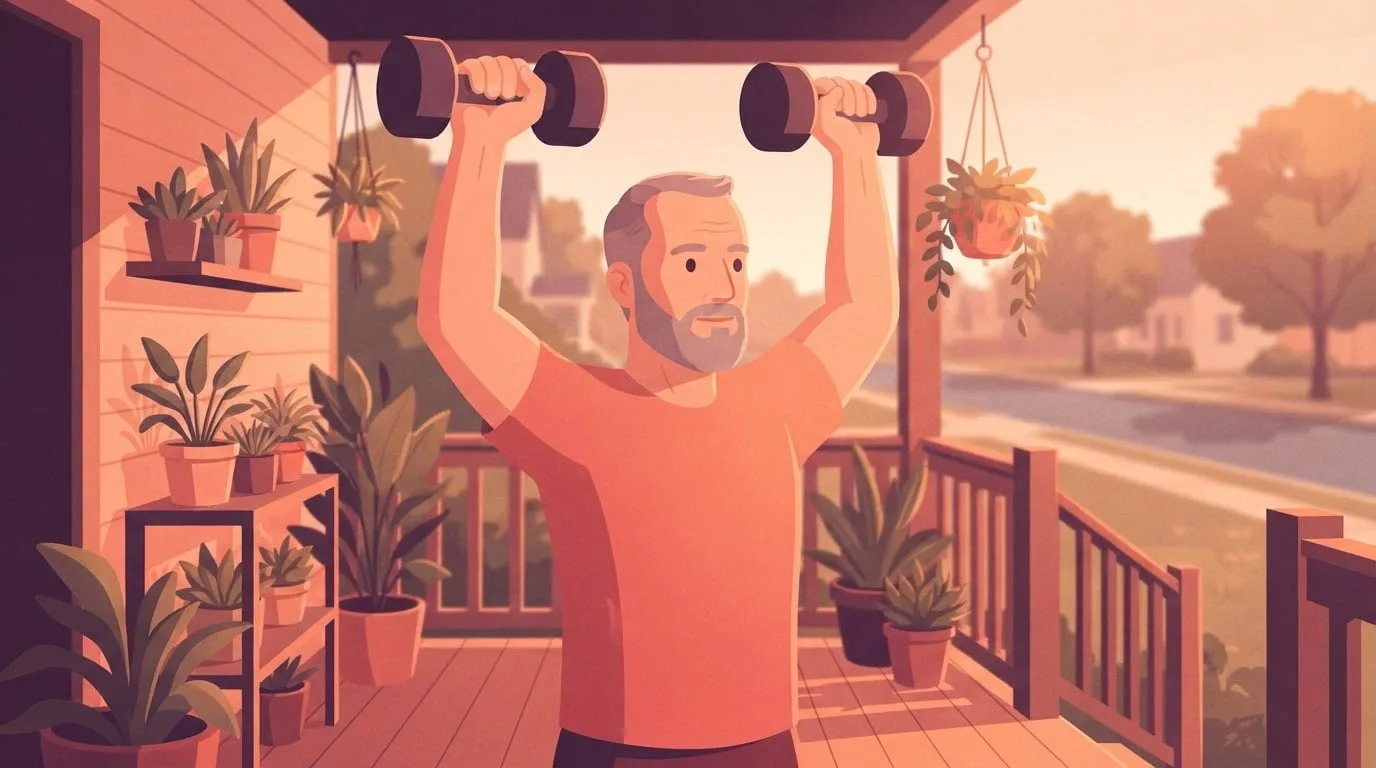
Stand with your feet hip-width apart and the dumbbells at shoulder height, palms forward or facing each other. Squeeze your glutes, keep your ribs down so your lower back doesn't arch, and press straight up until your arms are beside your ears. Lower to your shoulders under control. Standing makes your trunk steady the weight, and that changes how hard the shoulders work.
4. Push-up
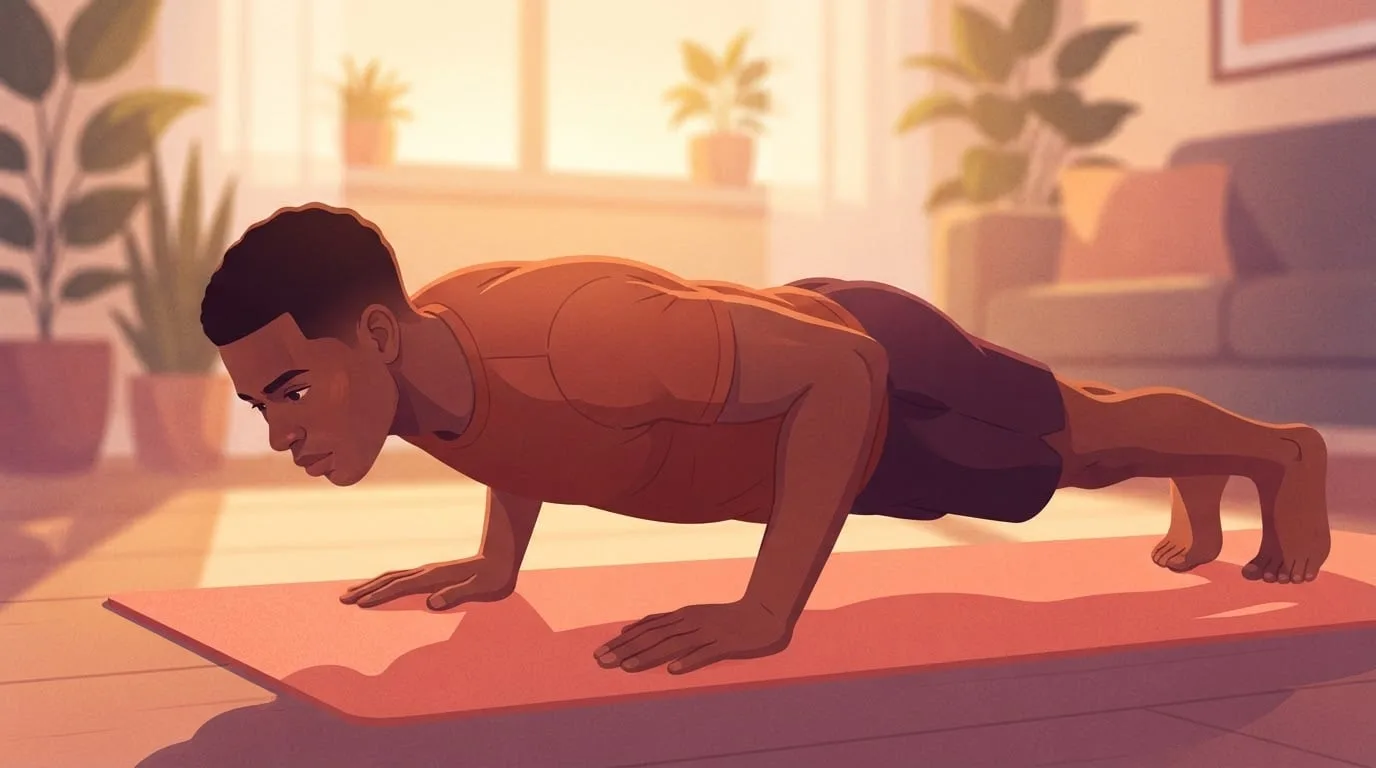
Place your hands just outside your shoulders, make a straight line from head to heels, and lower until your chest is about a fist's height above the floor. Pick the version that lets you do 8 to 20 good reps: hands on a bench or counter for an incline push-up, the floor for a standard one, or your feet on a step for a decline. Placed fourth, the push-up adds chest volume after the dumbbell presses without asking your shoulders to stabilize more weight.
5. Dumbbell lateral raise
Stand tall with light dumbbells at your sides and a soft bend in your elbows. Raise your arms out to the sides until they reach shoulder height, leading with your elbows, then lower over two or three seconds. None of the presses trains the side delts well, and the side delts are what make shoulders look wider, so this one stays. Choose a weight you can control for 12 reps or more. Our lateral raise page shows the arm path, and the dumbbell shoulder workout compares raise variations.
6. Overhead dumbbell triceps extension
Hold one dumbbell with both hands under its top end and press it overhead. Keep your upper arms close to your head and bend your elbows to lower the dumbbell behind your head until you feel a deep stretch along the back of your arms, then straighten your arms again. If standing makes your lower back arch, sit on a bench with back support.
The Push Day Workout: A 45-Minute Session
Here's the whole session in order. Take the longer rests after the three dumbbell presses, when the loads are heaviest, and the shorter rests after the rest.
| Order | Exercise | Sets x reps | Rest |
|---|---|---|---|
| Warm-up | Brisk movement, then 2 ramp-up sets of exercise 1 | 5-8 min | None |
| 1 | Dumbbell floor press or bench press | 4 x 6-10 | 2-3 min |
| 2 | Incline dumbbell press | 3 x 8-12 | 2 min |
| 3 | Standing dumbbell overhead press | 3 x 8-12 | 2 min |
| 4 | Push-up | 2 x 1-2 reps short of failure | 90 sec |
| 5 | Dumbbell lateral raise | 3 x 12-20 | 60 sec |
| 6 | Overhead dumbbell triceps extension | 3 x 10-15 | 60 sec |
That's 18 working sets. Nine of them load the chest directly, three hit the side delts, three isolate the triceps, and every press adds work for the front delts and triceps on top. If 18 sets leaves you wrecked for days, drop the push-ups and one set of the first press for your first month. When you can hit the top of the rep range on every set with a rep or two to spare, move up to the next dumbbell.
Push Day Workout at Home With No Equipment
No dumbbells? Your body weight covers every slot on push day except the side delts, and a pair of full water bottles handles those. This version takes about 35 minutes.
| Order | Exercise | Sets x reps | Rest |
|---|---|---|---|
| 1 | Decline push-up, feet on a step or couch | 4 x 6-15 | 2 min |
| 2 | Standard or wide push-up | 3 x 8-20 | 90 sec |
| 3 | Pike push-up | 3 x 6-12 | 2 min |
| 4 | Close-grip push-up | 3 x 8-15 | 90 sec |
| 5 | Chair dip, chair braced against a wall | 2 x 8-15 | 90 sec |
| 6 | Lateral raise with full water bottles | 3 x 15-25 | 60 sec |
The pike push-up does the overhead press's job: with your hips high and your body in an upside-down V, your shoulders push your weight up and away from the floor. Skip the chair dip if it pinches the front of your shoulder, and do a second set of close-grip push-ups instead. Once a push-up variation passes 20 reps, slow the lowering to three seconds or raise your feet higher, because a set you can repeat 30 times isn't adding much muscle.
What Muscles Does a Push Day Work?
Push day trains every muscle that moves a weight away from your body. Four groups do most of the work:
- Pectoralis major. The chest muscle has an upper (clavicular) part and a larger middle and lower (sternal) part. Flat presses favor the larger part, and incline presses shift some work toward the upper part.
- Front deltoids. They help in every press, so they rarely need an exercise of their own.
- Side deltoids. They raise the arm out to the side. Presses barely reach them, which is why the lateral raise is on the list.
- Triceps. Three heads straighten the elbow in every press. Only the long head crosses the shoulder joint, and that detail decides the last exercise of the session.
Rodríguez-Ridao and colleagues (2020), in the International Journal of Environmental Research and Public Health, measured muscle activity in 30 trained adults pressing at five bench angles from flat to 60 degrees. The upper chest peaked at 30 degrees. The middle and lower chest were most active on the flat bench. The front delts peaked at 60 degrees, and the triceps worked about the same at every angle. So a flat press and a 30-degree press each earn a slot, while a steep incline press is mostly a second shoulder press.
Find out what's really holding you back
FitCraft, our mobile fitness app, pairs you with an AI coach who builds you a personalized plan around your goals, schedule, and fitness level. Every FitCraft program is designed by Domenic Angelino, MPH (Brown University) and NSCA-CSCS, with research published in the Journal of Strength and Conditioning Research and Medicine & Science in Sports & Exercise.
Take the Free Assessment Free • 2 minutes • No credit cardPush-Ups or Dumbbell Presses? What the Training Studies Show
A push-up is a chest exercise in its own right, as long as it's hard enough. Two training studies tested that directly.
Calatayud and colleagues (2015), in the Journal of Strength and Conditioning Research, first matched a 6-rep-max bench press with a push-up made harder by an elastic band until both produced similar muscle activity. Thirty experienced lifters then trained one or the other for five weeks. Both groups gained strength on the bench press by similar amounts, and a control group didn't change.
Kikuchi and Nakazato (2017), in the Journal of Exercise Science and Fitness, went further and measured muscle. Eighteen young men trained twice a week for eight weeks with either a bench press at 40 percent of their max or push-ups adjusted, kneeling where needed, to the same load. Chest and triceps thickness rose by similar amounts in both groups, and so did bench press strength.
The limit is load. A standard push-up moves well under your full body weight, so a strong lifter outgrows it quickly. Our push-up progression ranks the variations from easiest to hardest. That's why the dumbbell session leads with presses and uses push-ups fourth, and why the no-equipment session uses decline and close-grip push-ups to keep the work hard.
Standing or Seated Overhead Press?
Stand for it if your back allows. Saeterbakken and Fimland (2013), in the Journal of Strength and Conditioning Research, had 15 men press at 80 percent of their max seated and standing, with a barbell and with dumbbells. The standing dumbbell press produced the highest shoulder activity of the four. Compared with sitting, standing with dumbbells raised side-delt activity by about 15 percent and rear-delt activity by about 24 percent, even though the men lifted about 10 percent less weight standing.
Lighter dumbbells and more shoulder work is a good trade at home, where the heaviest dumbbell you own is often the limit. Sit with your back against a bench if standing makes your lower back arch or ache.
Why the Triceps Exercise Goes Overhead
The long head of the triceps is the only head that crosses the shoulder, so lifting your arm overhead stretches it. Maeo and colleagues (2023), in the European Journal of Sport Science, had 21 adults train one arm with cable elbow extensions overhead and the other with the arm down by the side, 5 sets of 10, twice a week for 12 weeks. On MRI, the whole triceps grew 19.9 percent in the overhead arm against 13.9 percent in the other, and the long head grew 28.5 against 19.6 percent. The overhead arm did that while lifting 34 to 39 percent less weight.
The presses already train the triceps with the arms in front of the body. The overhead dumbbell extension covers the stretched position they miss, which is why it closes the session.
How Many Exercises Should Be on a Push Day?
Five or six exercises fits most people: two heavy presses, one or two lighter pressing movements, a side-delt raise and a triceps extension. Fewer than four usually leaves the side delts or triceps without direct work. More than seven usually means repeating a press at a slightly different angle, which adds fatigue faster than it adds muscle.
Order matters less than people think. Nunes and colleagues (2021), in the European Journal of Sport Science, pooled 11 studies on exercise order. Strength rose most in whichever exercise came first in the session, but muscle growth was similar either way. So put the press you most want to get stronger at first, usually the flat press, and don't worry that training triceps last will cost you triceps growth.
Sets, Reps and Rest on Push Day
The numbers in the session come from three findings that apply to every training day, not just this one.
- Reps: any range works if the set is hard. Lopez and colleagues (2021), in Medicine & Science in Sports & Exercise, compared low, moderate and heavy loads across 28 studies and 747 adults. Muscle growth was similar at every load, while strength rose more with heavier loads. That's why the first press sits at 6 to 10 reps and the raises at 12 to 20.
- Rest: longer after the big presses. In Schoenfeld and colleagues (2016), 21 trained men followed the same program for eight weeks with either 1-minute or 3-minute rests. The 3-minute group gained more strength on the bench press and squat, more thigh muscle, and showed a trend toward more triceps muscle.
- Effort: close to failure, not always at it. Refalo and colleagues (2023), in Sports Medicine, reviewed 15 studies and found no clear muscle-building advantage for training to complete failure over stopping a little short. Stop most sets with one to three reps left in the tank. Taking the last set of raises or extensions to failure is fine.
How many push sessions you run each week matters more than cramming extra sets into one. The push pull legs routine guide covers the frequency research and lays out three-day and six-day weeks.
What's a Good Warm-Up for Push Day?
A good push day warm-up takes 5 to 8 minutes and has two parts. Fradkin, Zazryn and Smoliga (2010), in the Journal of Strength and Conditioning Research, reviewed 32 high-quality studies and found that warming up improved performance in 79 percent of the outcomes measured, with little sign of harm.
- General, 2 to 3 minutes. March or jog in place, do jumping jacks and arm circles, until you're breathing a little harder and your shoulders move freely.
- Specific, 2 ramp-up sets. Do your first press for about 10 reps at half your working weight, then 4 or 5 reps at about three-quarters. If your shoulders feel stiff, add 10 scapular push-ups, where you keep your arms straight and let your shoulder blades sink together and spread apart.
Skip long static stretches for the chest right before pressing. If you want a fuller routine, our dynamic warm-up runs 10 moves in 9 minutes.
How to Cool Down After Push Day
A cool-down is optional. Van Hooren and Peake (2018), in Sports Medicine, reviewed the research on active cool-downs and found they did little for next-day performance, didn't prevent injuries and mostly didn't reduce muscle soreness. They may help your heart rate and breathing settle faster.
If you like to finish with one, walk easily for 3 to 5 minutes. Then hold a doorway chest stretch, with your forearm on the frame and your body turned away, and an overhead triceps stretch for about 30 seconds each. Do it because it helps you wind down, not because skipping it will cost you muscle.
Push Day Workout for Women
The push day workout for women is the same session, and the best push exercises for women are the same six. What often differs is the starting point. Janssen and colleagues (2000), in the Journal of Applied Physiology, measured muscle with whole-body MRI in 468 adults. Men carried more muscle than women overall, and the gap was larger in the upper body, at about 40 percent, than in the lower body, at about 33 percent. That's why many women find push-ups harder than squats at first.
A smaller starting point doesn't mean slower progress. Roberts, Nuckols and Krieger (2020), in the Journal of Strength and Conditioning Research, pooled studies that put women and men on the same programs. Muscle growth was similar, and women's relative gains in upper-body strength were larger. Start with incline push-ups at a height that allows 8 to 15 clean reps, choose dumbbells that leave one to three reps in reserve, and lower the incline or move up a dumbbell as those sets get easier.
Where Push Day Fits in Your Week
Push day is one of the three sessions in a push pull legs split. Pull day trains the lats, upper back, rear delts and biceps, the muscles that balance everything you pressed today. Leg day trains the quads, hamstrings, glutes and calves. Keep your weekly rowing sets roughly equal to your pressing sets, so your upper back keeps pace with your chest.
In FitCraft, an AI coach shows each press and raise on a 3D model you can spin and zoom, your coach calls you by name while you train, and your workouts adjust as you get stronger. Streaks and leaderboards give you a reason to come back for the next push day. If you're weighing ways to plan your lifting, our roundup of the best strength training apps compares the options, FitCraft included.
The Bottom Line
A push day workout needs two heavy presses, a standing overhead press, a push-up, a lateral raise and an overhead triceps extension: about 18 hard sets in 45 minutes. Rest longer after the big presses, stop most sets a rep or two short of failure, and add weight when you hit the top of each rep range. Push-ups and dumbbells are enough to build a strong chest, shoulders and triceps at home.
Mike, 23, put the hardest part plainly: "The streak system got me hooked. I didn't want to break my chain." The best push day is the one you'll repeat next week, and the week after.
Frequently Asked Questions
How many workouts should be on a push day?
Five or six exercises suit most people: two heavy presses, a push-up or lighter press, a lateral raise and an overhead triceps extension. That comes to about 15 to 18 hard sets in 40 to 50 minutes. If you're new to lifting, start with four exercises and 10 to 12 sets.
What is the 3-3-3 rule at the gym?
There's no official 3-3-3 rule. The phrase comes from social media, and it usually means picking 3 exercises and doing 3 sets of each on 3 days a week. As a push session it would be a chest press, an overhead press and a triceps extension, which is a fair start for a beginner but leaves out the side delts.
What's a good warm-up for push day?
Spend 2 to 3 minutes moving briskly, then do two lighter sets of your first press: about 10 reps at half your working weight and 4 or 5 reps at three-quarters. Add 10 scapular push-ups if your shoulders feel stiff. The whole warm-up takes 5 to 8 minutes.
How do I cool down after push day?
Walk easily for 3 to 5 minutes, then hold a doorway chest stretch and an overhead triceps stretch for about 30 seconds each. A 2018 review found that active cool-downs do little for soreness or next-day performance, so treat the cool-down as optional and do it because it helps you wind down.
What not to do immediately after a workout?
Don't stop dead and sit down if you feel lightheaded after hard sets; walk for a few minutes so your heart rate comes down gradually. Don't train the same pushing muscles hard again the next day, and don't go hours without water or a meal if you're trying to build muscle.
Is a push day workout different for women?
No. Women train the same chest, shoulder and triceps muscles with the same exercises, and a 2020 meta-analysis found similar muscle growth in women and men on the same programs. Many women start with easier push-up versions because a smaller share of their muscle sits in the upper body, then progress the same way.
What is the best pull workout?
A good pull workout pairs a vertical pull such as a chin-up or dumbbell pullover with two rows, a rear-delt raise and a biceps curl. That trains the lats, upper back, rear shoulders and biceps, the muscles push day leaves out. FitCraft's pull day workout guide lays out a dumbbell and bodyweight version.