Most people's warm-up is two arm swings and a hamstring stretch while the app loads. Or there's no warm-up at all, because the workout already feels like enough to fit into the day. Then the first set feels stiff and heavy, the first kilometer feels like wading, and it takes ten minutes of the workout itself to feel ready.
That stiff start can make a whole session feel like a chore, and a chore is easy to skip next time. A dynamic warm up fixes the start without adding much time. It's a short series of stretching warm up exercises done on the move, and the same routine works for full body days, leg days, runs and intervals.
Below is a numbered 9-minute routine you can copy, followed by the versions for strength training, running and HIIT, the evidence behind the order, and how to scale it if you're new.
The 9-Minute Dynamic Warm Up Routine
Ten moves, no equipment, in four short phases. This is a full body dynamic stretches sequence, so it fits in front of almost any workout. Move at a comfortable pace and keep breathing. You should finish a little warm and a little out of breath, never tired.
| Move | Dose | Phase |
|---|---|---|
| 1. March or jog in place | 60 seconds | Raise |
| 2. Jumping jacks | 30 seconds | Raise |
| 3. Glute bridges | 10 reps | Activate |
| 4. Bodyweight squats | 10 slow reps | Activate |
| 5. Walkouts | 5 reps | Mobilize |
| 6. World's greatest stretch | 3 per side | Mobilize |
| 7. Reverse lunge with overhead reach | 5 per side | Mobilize |
| 8. Leg swings | 10 forward-back and 10 side-to-side per leg | Mobilize |
| 9. Arm circles and hug swings | 10 each | Mobilize |
| 10. Fast high knees | 2 x 15 seconds, 20 seconds walking between | Potentiate |
- March or jog in place, 60 seconds. Start with an easy march and build to a light jog by the end. This is the start of raising your temperature.
- Jumping jacks, 30 seconds. Land softly on the balls of your feet. Step one foot out at a time if jumping doesn't suit your knees or your neighbors.
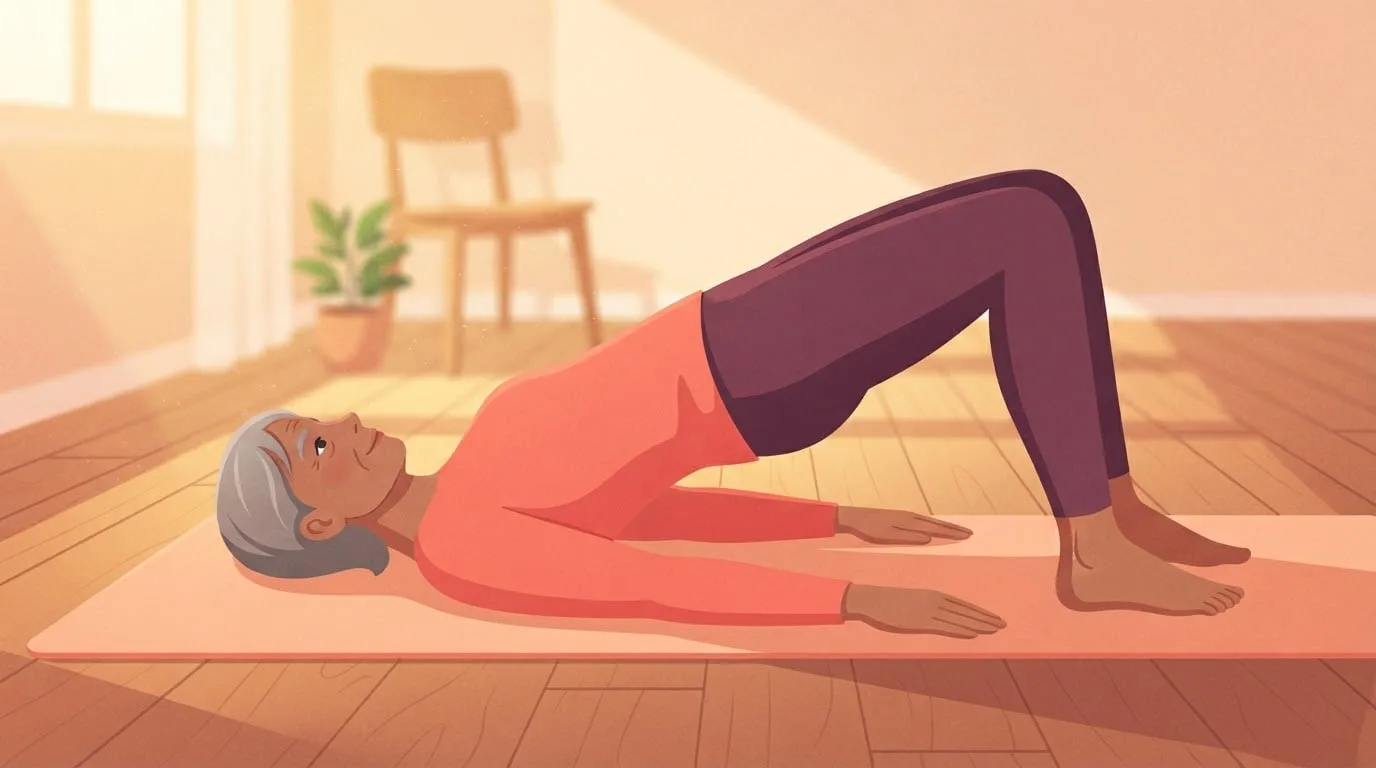
- Glute bridges, 10 reps. Lie on your back with your knees bent, push through your heels and lift your hips until your body is straight from knees to shoulders. Squeeze for two seconds at the top. The glute bridge page covers the form in detail.
- Bodyweight squats, 10 slow reps. Take three seconds down and one up, going only as deep as you can with your heels down and chest up.
- Walkouts, 5 reps. From standing, fold forward, put your hands on the floor and walk them out to a plank. Walk them back and stand up. Bend your knees as much as you need to.
- World's greatest stretch, 3 per side. Step into a long lunge, put the same-side elbow down toward the inside of your front foot, then rotate and reach that arm to the ceiling. Our world's greatest stretch guide breaks down each position.
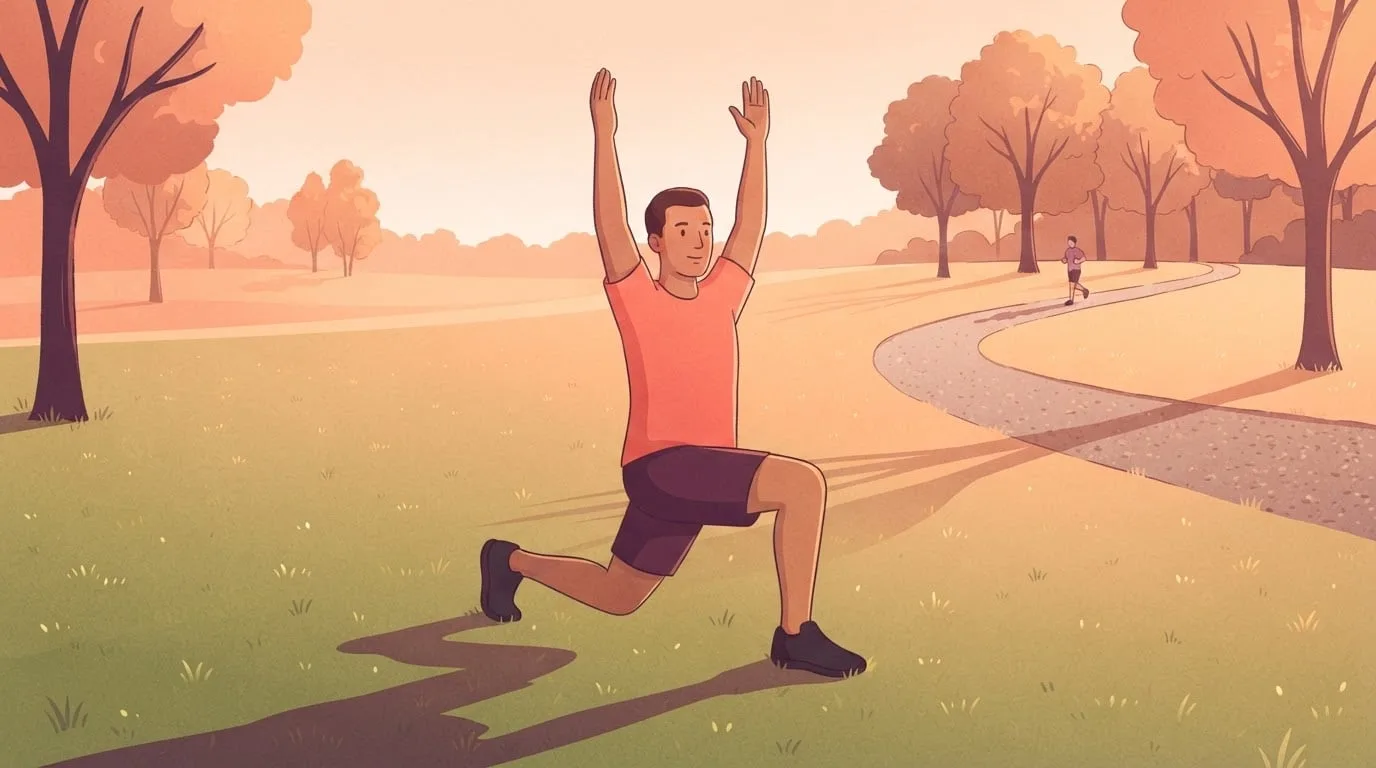
- Reverse lunge with overhead reach, 5 per side. Step back into a lunge and reach both arms overhead, leaning slightly away from the back leg. You'll feel the front of the back hip open.
- Leg swings. Hold a wall or a rail. Swing one leg forward and back 10 times, starting small and growing, then side to side across your body 10 times. Switch legs.
- Arm circles and hug swings, 10 each. Small circles that grow to big ones, forward then back, then swing your arms wide open and across your chest into a hug.
- Fast high knees, 2 x 15 seconds. Run in place with quick feet and knees driving up, as fast as feels good. Walk for 20 seconds between the two efforts.
That's about 8 minutes of movement plus transitions, so 9 minutes start to finish. Once it's familiar, you can do it without looking at the list. If you only have 5 minutes, keep moves 1, 4, 6, 8 and 10.

What Is a Dynamic Warm Up Good For?
A warm-up works mostly through heat. In a review in Sports Medicine, Bishop (2003) listed the temperature effects behind most of a warm-up's benefits: less stiffness in muscles and joints, faster nerve signals, and changes in how muscles produce force at speed. He also described effects that don't depend on temperature, such as raising your baseline oxygen uptake so your aerobic system is already running, a short-term boost in muscle output from earlier contractions, and simply feeling more ready.
The performance payoff is consistent. Fradkin, Zazryn and Smoliga (2010) pooled 32 high-quality studies in the Journal of Strength and Conditioning Research, counting only warm-ups that included more than stretching. Warming up improved performance in 79% of the measures examined, and the authors found little evidence that it harms anyone.
The "dynamic" part matters because moving through a range warms the tissue and rehearses the pattern at the same time. A squat in your warm-up is a squat your nervous system has already done once today when the first working set arrives.
The RAMP Framework: Why the Routine Runs in This Order
The order above comes from RAMP, a warm-up model from strength coach Ian Jeffreys that he lays out in his book The Warm-Up (Jeffreys, 2019). It has four phases:
- Raise: lift body temperature, heart rate and breathing with easy, whole-body movement. Moves 1 and 2.
- Activate: wake up the muscles the session relies on, often the glutes and the trunk. Moves 3 and 4.
- Mobilize: take the joints through the ranges the workout will use, with movement rather than long holds. Moves 5 to 9.
- Potentiate: finish with a few short efforts close to workout intensity, so the first real set or interval isn't a shock. Move 10.
Researchers have since landed in a similar place. In a 2026 Delphi study in the International Journal of Sports Physiology and Performance, Boullosa and colleagues asked 23 warm-up researchers from 12 countries to agree on what a warm-up should be. They settled on a three-layer model: general exercises, then specific exercises, then conditioning activities hard enough to boost performance for a short time. They agreed that a more complete warm-up tends to work better, and that it should fit the sport and the person.
Find out what's really holding you back
FitCraft, our mobile fitness app, pairs you with an AI coach who builds you a personalized plan around your goals, schedule, and fitness level. Every FitCraft program is designed by Domenic Angelino, MPH (Brown University) and NSCA-CSCS, with research published in the Journal of Strength and Conditioning Research and Medicine & Science in Sports & Exercise.
Take the Free Assessment Free • 2 minutes • No credit cardDynamic Warm Up Before Strength Training
Before a bodyweight or dumbbell session, do the full 9-minute routine. Then add two warm-up sets of your first exercise before your working sets. Warm-up sets are the "specific" layer: the same movement, lighter, so your body has rehearsed the exact pattern before it gets heavy.
Do warm-up sets work?
Yes, and they work best after a general warm-up. Abad and colleagues (2011), in the Journal of Strength and Conditioning Research, tested 13 trained people on a one-rep max leg press. With warm-up sets alone, they lifted less. When a general warm-up of 20 minutes of easy cycling came first, their one-rep max was 8.4% higher. You don't need 20 minutes before a home workout, but it shows the general and specific layers add up.
A practical version with dumbbells:
- Set 1: 8 to 10 reps with about half your working weight, or bodyweight only.
- Set 2: 3 to 5 reps with about three quarters of your working weight.
- Then start your working sets. Warm-up sets shouldn't tire you, so stop well short of effort.
Dynamic stretches for leg day
Before squats, lunges or Romanian deadlifts, give the hips and ankles extra time. After the routine, add 5 side lunges per side, 5 more slow bodyweight squats with a 3-second pause at the bottom, and 10 ankle rocks per side with your knee driving forward over your toes. Then do your warm-up sets with a light dumbbell.
Dynamic Warm Up Before a Run
Running is the easiest workout to start cold, because you can just start slowly. A short warm-up still makes the first kilometer feel better and matters more before faster running. Here's the running version:
- 3 to 5 minutes of brisk walking or very easy jogging. This replaces moves 1 and 2.
- Leg swings, 10 forward-back and 10 side-to-side per leg.
- Reverse lunges with an overhead reach, 5 per side.
- High knees and butt kicks, 15 seconds each.
- Skips, 2 x 15 meters (about 50 feet), light and bouncy.
- Before a fast run only: 2 to 4 strides of 15 to 20 seconds, building to about 80% of your sprint speed, with a full walk back between them.
So how long should you stretch before running? About 5 to 10 minutes in total, and most of it moving. A long hamstring hold at the start line isn't needed. For the stretches that belong after the run, see our guide to the best stretches for runners.
Dynamic Warm Up Before HIIT
HIIT asks for near-maximum effort in the first interval, so the potentiate phase matters most here. Do the full 9-minute routine, then 2 practice rounds of your first interval exercise at about 15 seconds each, the first at moderate effort and the second close to the pace you'll actually work at. Rest 30 seconds and start the workout.
If the session includes jumping, add 2 x 10 small pogo hops in place before the practice rounds, staying light on the balls of your feet. Swap them for fast marching if jumping isn't right for you yet.
How to Scale a Dynamic Warm Up for Beginners
If you're new to exercise, coming back after a long break or carrying extra weight, the routine still works. Make each move smaller and slower:
- Jumping jacks: do step jacks instead, stepping one foot out while raising your arms.
- Squats: squat to a chair, touching the seat lightly before you stand.
- Walkouts: put your hands on a sturdy chair or the edge of a couch instead of the floor, or do 5 wall push-ups.
- World's greatest stretch: keep the back knee on the floor, rest your hands on a step, and skip the rotation at first.
- Reverse lunges: hold the back of a chair and take a shorter step.
- Fast high knees: march with high knees at a brisk pace instead.
Start with half the reps if you need to. Five or six minutes is plenty early on. The test is how you feel at the end: a little warmer, breathing a little faster, and moving more easily than when you started. If you're tired after the warm-up, it was too much.
Remembering moves and reps is one more thing to think about when you're new. FitCraft's 3D AI coach talks you through each workout and demonstrates the exercises on interactive 3D models, workouts adjust as you progress, and streaks make it easier to keep showing up. If you're comparing options, our page on the best workout app for beginners explains how it works.
Static Stretching Before Power Work
Long static holds are the part of the old warm-up worth leaving out before jumping, sprinting or heavy lifting. Simic, Sarabon and Markovic (2013) pooled 104 studies in the Scandinavian Journal of Medicine and Science in Sports. Static stretching before exercise reduced strength by 5.4% on average and explosive performance by 2.0%, with the smallest losses when total stretch time per muscle was 45 seconds or less. They concluded that static stretching shouldn't be the only thing in a warm-up. A short hold for one tight spot is fine. Our science page on static vs dynamic stretching covers the full comparison.
Does a Dynamic Warm Up Prevent Injuries?
The injury evidence is weaker than most people assume. Fradkin, Gabbe and Cameron (2006) found five good randomized trials of warming up and injury in the Journal of Science and Medicine in Sport. Three showed fewer injuries and two showed no difference, so they called the evidence insufficient, with the weight leaning toward a benefit. The 2026 expert consensus went further: the panel found no support for the idea that a warm-up protects you from injury in that session.
The strongest injury data comes from football, and it's about a specific program. FIFA 11+ is a structured warm-up of about 20 minutes that includes running drills, leg and core strength work, balance, jumping and cutting. In a cluster randomized trial by Soligard and colleagues (2008) in the BMJ, 1,892 female players aged 13 to 17 used it for a season. Their risk of injury overall was 32% lower and their risk of severe injury 45% lower, though the drop in lower-limb injuries, the main outcome, fell short of significance. Pooling four FIFA 11+ trials, Thorborg and colleagues (2017) found 39% fewer injuries in the British Journal of Sports Medicine.
Two cautions about applying that to your workout. Those trials were in football players, a sport full of cutting, jumping and collisions. And FIFA 11+ works partly because it's strength and balance training done two or more times a week for months, dressed as a warm-up. Do the dynamic warm up to start your session well, and get your injury protection from regular strength training.
What to Do After the Workout
The end of the workout is where static stretching fits. Muscles are warm, and a temporary dip in strength no longer matters. Walk or move easily for a few minutes, then hold your stretches. Our post workout stretches guide has a 10-minute cool-down.
The Bottom Line
A dynamic warm up takes 5 to 10 minutes and runs in a simple order: get warm, wake up the muscles you'll use, move the joints through the range you'll need, then do a few fast efforts. The 9-minute routine above covers all four for almost any workout, with short add-ons for lifting, running and HIIT.
It won't make you injury-proof, and it doesn't need to. Its job is to make the first set, the first kilometer or the first interval feel like the middle of the workout instead of a cold start. Workouts that start well are easier to come back to.
Frequently Asked Questions
How long should I stretch before running?
Spend about 5 to 10 minutes warming up before running, and make it moving rather than holding stretches. Walk briskly or jog easily for 3 to 5 minutes, then do leg swings, lunges, high knees, butt kicks and skips. If one muscle feels tight, a short static hold under 30 to 45 seconds is fine, but long holds of 60 seconds or more are better left until after the run.
Do warm up sets work?
Yes. Warm-up sets rehearse the exact movement at a lighter load before your working sets, and they work best after a few minutes of general movement. In one study, trained lifters lifted 8.4% more on a one-rep max leg press when a general warm-up came before their specific warm-up sets than with the warm-up sets alone. A practical version is one set of 8 to 10 reps with half your working weight, then 3 to 5 reps with about three quarters of it.
What are dynamic stretches good for?
Dynamic stretches are good for preparing your body to move. They raise muscle temperature, take your joints through the range the workout needs and wake up the muscles you're about to use, without the short-term strength loss that long static holds can cause. A meta-analysis of 32 studies found that warming up improved performance in 79% of the measures tested.
What are the two types of warm-ups?
The two types of warm-ups are general and specific. A general warm-up raises your heart rate and body temperature with easy whole-body movement such as marching, jogging or jumping jacks. A specific warm-up rehearses the movements of the session ahead, such as bodyweight squats before goblet squats or strides before a fast run. The best warm-ups use both, in that order.
What are good dynamic warm ups?
Good dynamic warm ups include marching or jogging in place, jumping jacks, glute bridges, bodyweight squats, walkouts, the world's greatest stretch, reverse lunges with an overhead reach, leg swings and arm circles, finished with a few seconds of fast high knees. Together they take about 9 minutes and cover the whole body, so they work before strength training, running or HIIT.
How long should a dynamic warm up be?
A dynamic warm up should last about 5 to 10 minutes for most workouts. Aim to finish breathing a little faster, feeling warm and moving freely, but not tired. Go toward 10 minutes in cold weather, before fast or heavy work, and when you feel stiff, and toward 5 minutes before an easy session.