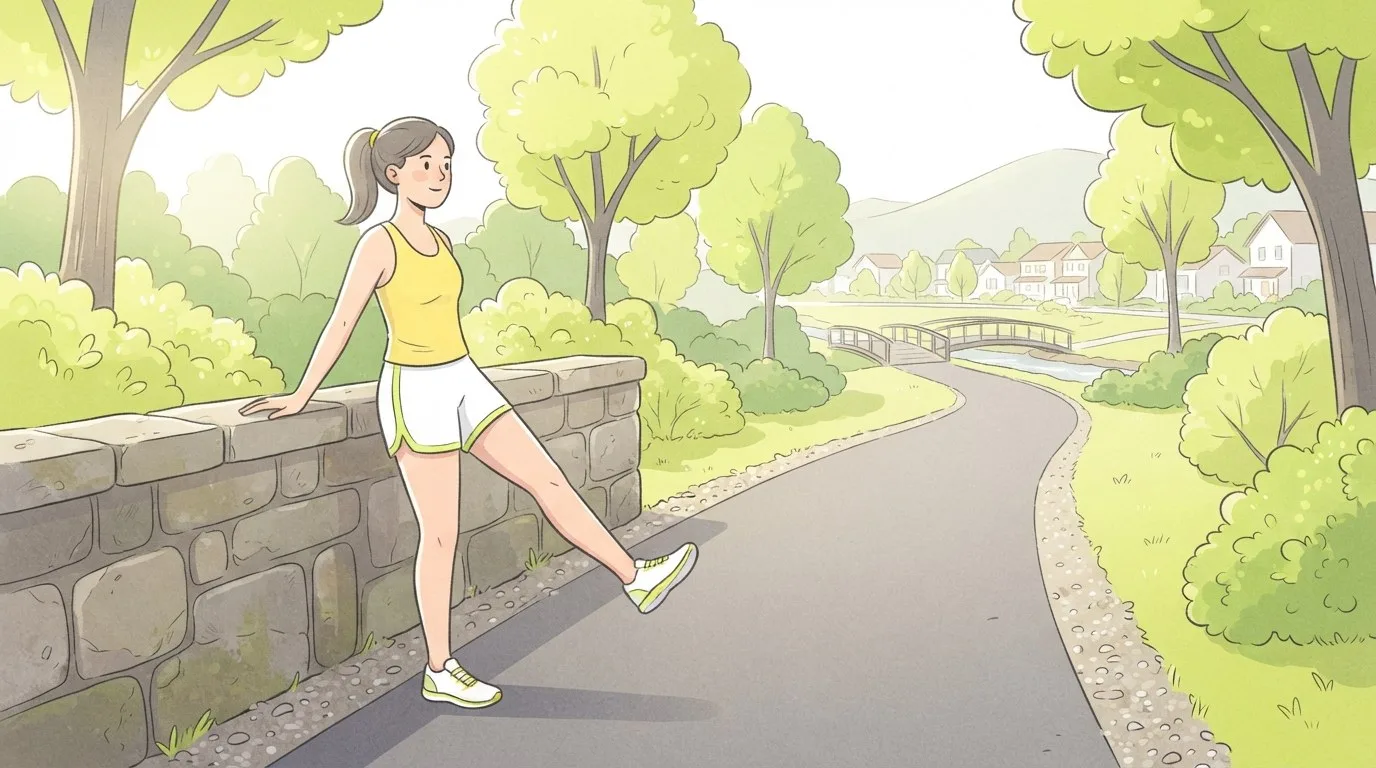
You finish a run, prop a foot on a park bench and hold a hamstring stretch for ten seconds because that's what runners do. Then you skip it for the next three runs, and when your knee starts aching in week six you wonder if that's why.
The advice doesn't help. One coach says stretch before every run, another says never, and a third says stretching is a waste of time. So the routine you end up with is a few rushed holds you don't really believe in, done when you remember.
What works is a short routine where each piece has a job. Moving stretches warm you up. Held stretches keep the range of motion you need. Strength work does the injury protection that stretching usually gets credit for. Below are the ten stretches, then what the research says about each part.
The 10 Best Stretches for Runners at a Glance
Do stretches 1 to 5 before you run, after two or three minutes of brisk walking. Do stretches 6 to 10 after the run, once your breathing has settled. Each half takes about five minutes.
| Stretch | When | What it targets | Dose |
|---|---|---|---|
| 1. Front-to-back leg swings | Before | Hamstrings, hip flexors | 10 to 15 per leg |
| 2. Side-to-side leg swings | Before | Inner thigh, outer hip | 10 to 15 per leg |
| 3. Walking lunge with a reach | Before | Hip flexors, quads, glutes | 6 to 8 per leg |
| 4. High knees and butt kicks | Before | Hip flexors, quads, hamstrings | 20 to 30 seconds each |
| 5. Ankle rocks | Before | Calves, Achilles, ankle | 10 per side |
| 6. Standing calf stretch | After | Both calf muscles | 30 to 60 seconds, straight and bent knee |
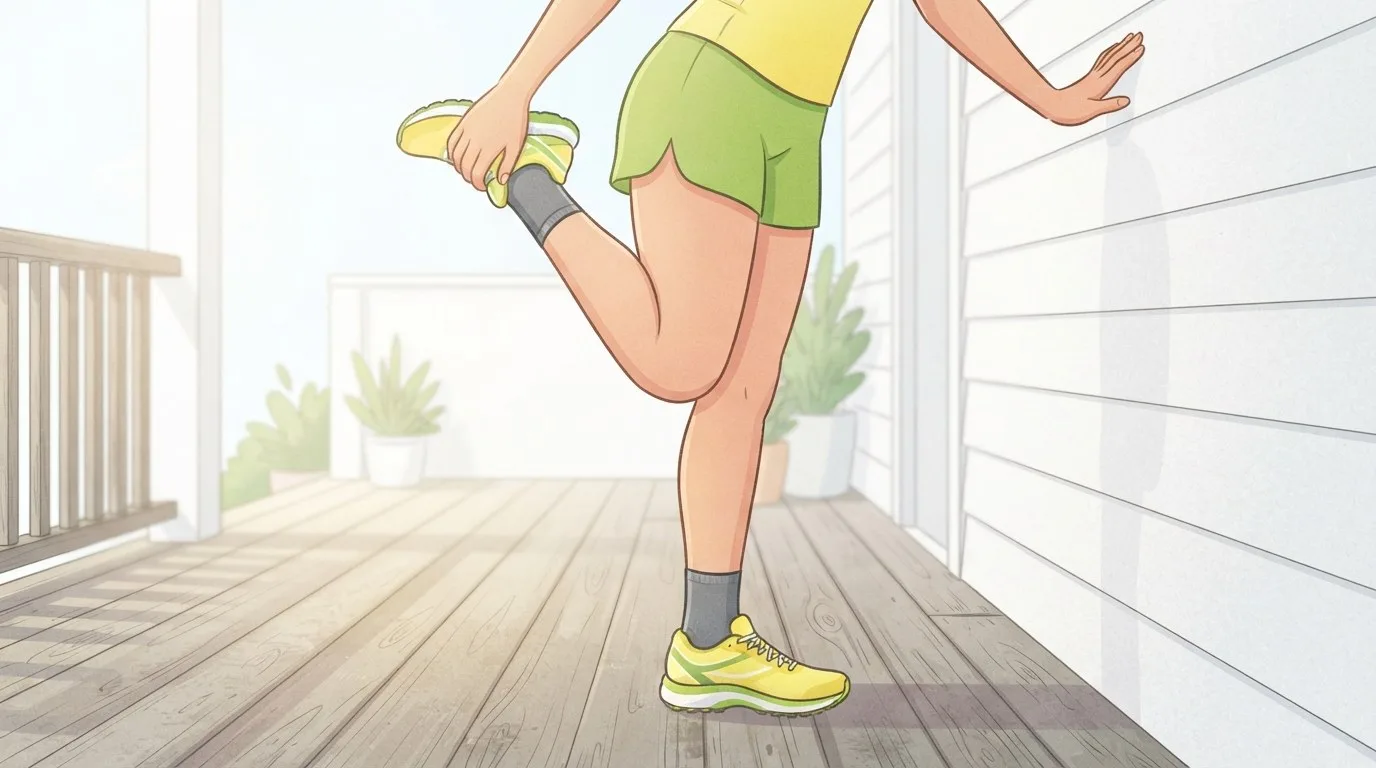
| 7. Standing quad stretch | After | Quadriceps | 30 to 60 seconds per leg |
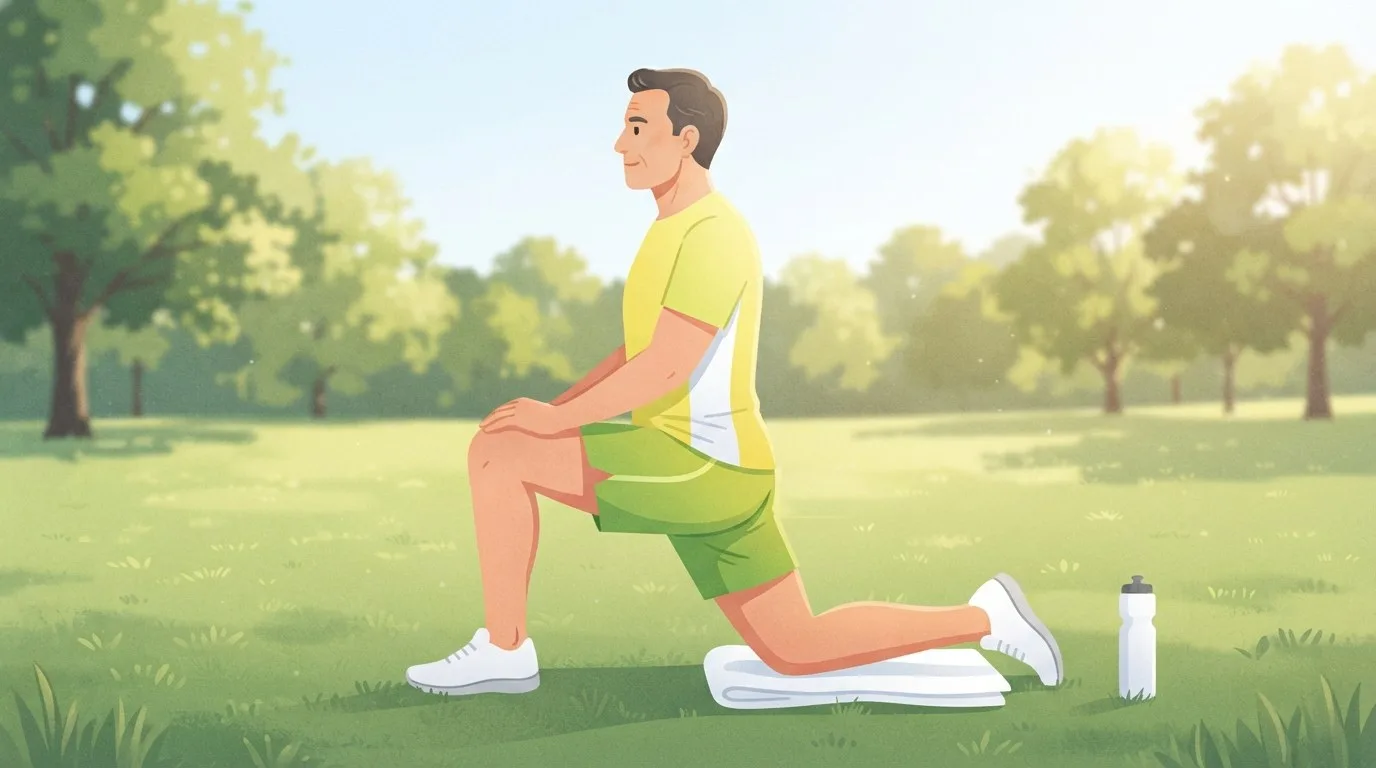
| 8. Half-kneeling hip flexor stretch | After | Hip flexors | 30 to 60 seconds per side |
| 9. Lying hamstring stretch | After | Hamstrings | 30 to 60 seconds per leg |
| 10. Figure-4 glute stretch | After | Glutes, deep hip rotators | 30 to 60 seconds per side |
Before You Run: 5 Dynamic Stretches
Dynamic stretches move a joint through its range without stopping at the end. They warm the muscles and rehearse the positions your stride uses, which is why they belong before a run. Start each one small and let the range grow over the first few reps.
1. Front-to-back leg swings
Stand side-on to a wall or fence with one hand on it. Swing your outside leg forward and back like a pendulum, with your torso tall and the standing knee soft. Start at knee height and let each swing go a little higher. Do 10 to 15 per leg. The forward swing loosens the hamstrings, and the back swing opens the hip flexors.
2. Side-to-side leg swings
Face the wall with both hands on it. Swing one leg across the front of your body and then out to the side, keeping your hips square to the wall. Do 10 to 15 per leg. This one moves the inner thigh and the outer hip, two areas that work hard to keep your pelvis level every time a foot lands.
3. Walking lunge with an overhead reach
Step forward into a long lunge, lower the back knee toward the ground and reach both arms overhead as you press the back hip forward. Then step through into the next lunge. Do 6 to 8 per leg. It's the moving version of the lunge and reach stretch, and it opens up the front of the hip that a day of sitting tightens.
4. High knees and butt kicks
Jog in place or over 15 to 20 meters, driving your knees to hip height for high knees. Then switch to butt kicks, flicking your heels toward your glutes. Do 20 to 30 seconds of each. These raise your heart rate and take the hip flexors, quads and hamstrings through a running motion at low speed.
5. Ankle rocks
Stand in a short split stance with your hands on a wall. Bend the front knee forward over your toes while the heel stays flat, then come back. Do 10 slow rocks per side. Running asks your ankle to bend further forward than walking does, so this is a useful last move before your first steps.
Then start your run at an easy pace for the first five minutes. The opening minutes of the run finish the warm-up that the stretches started.
After You Run: 5 Static Stretches
Static stretches hold one position. After a run, walk for two or three minutes until your breathing settles, then hold each stretch for 30 to 60 seconds per side. Aim for a mild pull of about 6 out of 10, never sharp pain.
6. Standing calf stretch, straight knee then bent knee
Put both hands on a wall and step one foot back. Keep the back heel down and the back knee straight to stretch the gastrocnemius, the large calf muscle, for 30 to 60 seconds. Then bend the back knee slightly, keep the heel down and hold again. The bent-knee version moves the stretch to the soleus, the deeper calf muscle that does much of the work in every stride.
7. Standing quad stretch
Stand on one leg with a hand on a wall. Bend the other knee and hold that ankle behind you, with both knees side by side. Squeeze the glute of the bent leg and tuck your pelvis under slightly, and you'll feel the stretch along the front of the thigh. Hold for 30 to 60 seconds per leg. If you can't reach your ankle, loop a towel around it.
8. Half-kneeling hip flexor stretch
Kneel on one knee on a towel with the other foot flat in front of you. Tuck your pelvis under, then shift your hips forward until you feel a stretch at the front of the back hip. Raise the arm on the kneeling side to reach the upper part of the muscle. Hold for 30 to 60 seconds per side. The half kneeling hip flexor stretch page shows the form step by step.
9. Lying hamstring stretch with a strap
Lie on your back and hook a strap or towel over the sole of one foot. Lift that leg, knee nearly straight, until the back of the thigh pulls, and keep the other knee bent with that foot flat on the floor. Hold for 30 to 60 seconds per leg. Lying down keeps your back neutral, which is why it beats the foot-on-a-bench version. Our guide to the best stretches for hamstrings adds six more options and a test for whether your hamstrings are really tight.
10. Figure-4 glute stretch
Lie on your back, cross one ankle over the opposite knee and pull that thigh toward your chest. Hold for 30 to 60 seconds per side. It stretches the glutes and the deep hip rotators, including the piriformis. If you feel pain deep in the buttock, the piriformis stretch guide explains which version to use. If your hips allow it, half pigeon stretches the same area further.
Should You Stretch Before Running?
Yes, as long as the stretches keep moving. The case against long static holds before a run comes from a direct test. Wilson and colleagues (2010), in the Journal of Strength and Conditioning Research, had 10 trained male distance runners do two 60-minute treadmill sessions. Before one, they did 16 minutes of static stretching for the lower body. Before the other, they sat quietly.
After stretching, the runners covered less ground in the 30-minute time trial that ended the session: 5.8 km against 6.0 km. They also burned more energy during the first 30 minutes at a fixed pace, 425 against 405 kcal. The stretching made the same running cost more.
Short holds are a different story. A 2016 review led by Behm, published in Applied Physiology, Nutrition, and Metabolism, showed that static stretching lowered performance by 3.7 percent on average when testing came straight after it, while dynamic stretching raised it by 1.3 percent. Longer holds cost more than short ones. When dynamic activity followed the stretching, no clear effect remained.
So a quick quad stretch at the trailhead won't ruin your run, but a quarter of an hour of long holds can. The full comparison is in our review of static vs dynamic stretching.
Find out what's really holding you back
FitCraft, our mobile fitness app, pairs you with an AI coach who builds you a personalized plan around your goals, schedule, and fitness level. Every FitCraft program is designed by Domenic Angelino, MPH (Brown University) and NSCA-CSCS, with research published in the Journal of Strength and Conditioning Research and Medicine & Science in Sports & Exercise.
Take the Free Assessment Free • 2 minutes • No credit cardHow Should You Stretch After a Run?
Walk for two or three minutes, then go through stretches 6 to 10 once, holding each for 30 to 60 seconds per side. That takes about eight minutes. If you have more time, add a second round of whichever stretch felt tightest.
Be realistic about what it does. Post-run stretching won't stop tomorrow's soreness. Herbert, de Noronha and Kamper's 2011 Cochrane review pooled 12 studies and found that stretching after exercise reduced soreness a day later by about 1 point on a 100-point scale. That's too small to notice.
What post-run stretching does well is keep your range of motion. Your muscles are warm, the holds feel easier, and a stretch tied to the end of every run becomes a habit you don't have to remember. Range of motion improves with regular practice across the week, so a few minutes after most runs adds up.
Does Stretching Prevent Running Injuries?
Not on its own. The largest trial is still Pope and colleagues (2000), in Medicine & Science in Sports & Exercise. They randomly assigned 1,538 army recruits to warm up with or without a 20-second stretch for six leg muscle groups, every session for 12 weeks. The stretch group had 158 lower-limb injuries and the control group had 175, a difference too small to matter. The recruits' fitness predicted injury better than stretching did.
A meta-analysis by Lauersen, Bertelsen and Andersen (2014), in the British Journal of Sports Medicine, pooled 25 trials with 26,610 participants and 3,464 injuries. Strength training cut the injury risk to less than a third (relative risk 0.315). Balance training cut it by about 45 percent. Stretching had no measurable effect (relative risk 0.963).
Stretching still has a job, just a different one. Stretch for range of motion and because it feels good after a run. Use strength work for injury protection, since it had the largest effect of anything in that meta-analysis.
Does Flexibility Make You a Better Runner?
Probably not, and very flexible runners may even pay a small price. Jones (2002), in the International Journal of Sports Medicine, tested 34 international-standard male distance runners. The runners with the worst sit-and-reach scores used the least oxygen at 16 km/h, and the link was strong (r = 0.68).
Craib and colleagues (1996), in Medicine & Science in Sports & Exercise, found the same pattern in 19 sub-elite runners. The runners with less ankle range and less hip rotation were the more economical ones.
The likely reason is elastic energy. Stiffer tendons and muscles store energy when your foot lands and give it back on push-off, like a firmer spring. Both studies show a correlation, so they don't prove that losing flexibility would make you faster. They do suggest runners don't need a gymnast's range. Aim for enough range to run with a full, easy stride, and spend the extra time on strength.
Stretches After Running for Knees
Pain around the front of the kneecap is often called runner's knee, or patellofemoral pain. Two stretches on this list matter most for it: the quad stretch (7) and the hip flexor stretch (8). In a two-year study of 282 physical education students by Witvrouw and colleagues (2000), in the American Journal of Sports Medicine, a tight quadriceps was one of four factors that predicted who developed this pain.
Stretching alone isn't the treatment, though. A 2018 international consensus statement led by Collins and colleagues, in the British Journal of Sports Medicine, recommends exercise therapy, especially a mix of hip-focused and knee-focused exercises. It supports foot orthoses for pain relief and advises against knee or lower-back mobilisations on their own. In practice, that means side-lying leg raises and glute bridges for the hips, plus wall sits and split squats for the knees, alongside the stretches.
Don't wait it out. Lankhorst and colleagues (2016), also in the British Journal of Sports Medicine, followed people with patellofemoral pain for five to eight years. More than half still reported an unfavourable recovery, and pain that had already lasted more than a year at the start predicted a worse outcome. That's a strong reason to start the exercise work early.
Do IT Band Stretches Work?
Less than most runners have been told. The iliotibial band is a thick strip of connective tissue down the outside of the thigh, and it's firmly attached to the thigh bone along most of its length. In cadaver tests by Falvey and colleagues (2010), in the Scandinavian Journal of Medicine & Science in Sports, three standard IT band stretches lengthened the band by less than 0.5 percent.
The muscles at the top of the band, the tensor fasciae latae and the glutes, do stretch, and the authors suggested future work should focus there. Stretches 2 and 10 reach that area. If pain on the outside of your knee keeps coming back, see a physical therapist rather than stretching harder.
Rest Day Stretches for Runners: A 15-Minute Routine
Rest days give you time for longer holds and the strength work that protects you. This routine takes about 15 minutes and needs a mat and, if you have one, a dumbbell.
| Part | What to do | Dose |
|---|---|---|
| Longer holds | Stretches 6 to 10 | 2 rounds of 45 to 60 seconds per side |
| Calf strength | Calf raises, slow on the way down | 3 sets of 15 |
| Hip strength | Side-lying leg raises | 2 sets of 12 per side |
| Balance and hinge | Single-leg deadlift | 2 sets of 8 per side |
For range beyond the legs, our list of the best mobility exercises adds the upper back and shoulders, plus a short daily routine. If your hips feel stuck rather than tight, the hip mobility exercises guide has a 10-minute routine built for them.
FitCraft covers the work around your runs: strength workouts with dumbbells and bodyweight, plus mobility and yoga sessions, with a 3D AI coach who demonstrates each exercise on an interactive model and workouts that adjust as you progress. Streaks and leaderboards give the rest-day sessions a reason to happen. If strength is the part you keep skipping, our comparison of the best strength training apps shows how the options stack up.
The Bottom Line
The best stretches for runners do two jobs. Moving stretches before a run warm you up without the performance cost of long holds. Held stretches after a run keep the range you need for an easy stride. Neither one prevents injuries by itself, so pair them with two short strength sessions a week.
You don't need an hour of stretching or a perfect routine. You need ten minutes you'll actually repeat after every run, and a little strength work on the days in between.
Frequently Asked Questions
How should you stretch after a run?
Walk for two or three minutes until your breathing settles, then hold five stretches for 30 to 60 seconds per side: a calf stretch, a quad stretch, a half-kneeling hip flexor stretch, a lying hamstring stretch and a figure-4 glute stretch. Aim for a mild pull rather than pain. The whole routine takes about eight minutes.
What is David Goggins' stretching routine?
David Goggins has said in interviews that he stretches for hours every day, around two hours in recent years, and credits it with keeping him running. That's one athlete's routine after years of extreme ultramarathon training, not a dose that research supports for most runners. Ten minutes of targeted stretching after runs, plus strength work twice a week, covers what the evidence backs.
What are some good leg stretches?
Good leg stretches for most people are a standing calf stretch, a standing quad stretch, a half-kneeling hip flexor stretch, a lying hamstring stretch with a strap and a figure-4 glute stretch. Together they cover the back of the lower leg, the front and back of the thigh, and the hip. Hold each one for 30 to 60 seconds per side.
How to stretch for runner knee pain?
For runner's knee, stretch the front of the thigh and hip with a standing quad stretch and a half-kneeling hip flexor stretch, 30 to 60 seconds each, after your runs. A tight quadriceps is a known risk factor for this pain. Stretching works best alongside hip and knee strengthening, which a 2018 international consensus statement recommends as the main treatment.
Does runner's knee ever fully go away?
Runner's knee often settles with the right exercise, but it can linger for years. A 5-to-8-year follow-up found that more than half of people with patellofemoral pain still reported an unfavourable recovery, and pain that had lasted more than a year at the start predicted a worse outcome. That's a good reason to start hip and knee strengthening early instead of waiting.
What is the #1 mistake that makes bad knees worse?
A big mistake is waiting for knee pain to fix itself, either by running through pain that keeps rising or by stopping all exercise. Long-lasting pain predicts a worse outcome in runner's knee, and exercise for the hips and knees is the recommended treatment. Cut your running back to a level that doesn't make the pain worse, and keep strengthening.
What are the best stretches for beginner runners?
Beginner runners can use the same ten stretches with smaller ranges: leg swings, walking lunges and gentle high knees before a run, then calf, quad, hip flexor, hamstring and glute stretches after it. Start the moving stretches small, hold the static ones at a mild pull, and put most of your effort into building running time gradually.