You sit. A lot. At your desk, in your car, on the couch. Every hour you spend sitting, your hip flexors shorten a little more, your thoracic spine stiffens, your shoulders round. Then you try to squat, or deadlift, or just pick something up off the floor, and something feels locked up. You can't quite get into position. You're fighting your own body.
The lunge reach is the antidote. It's a single movement that attacks two of the biggest mobility problems most people have: tight hip flexors and a stiff upper back. You drop into a deep lunge to stretch the hip flexors on the trailing leg, then rotate through the thoracic spine and reach overhead to open up the chest and mid-back. Two stretches welded into one pattern. And the research backs it up: a 2025 RCT in the International Journal of Sports Physical Therapy found that performing a lunge-and-reach stretch daily for six weeks produced statistically significant improvements in both hip flexor length and gluteal power (Ehresman et al., 2025). This stretch changes measurable function.
Quick Facts: Lunge Reach
- Equipment needed: None (a yoga mat or block is optional for comfort and reach modifications)
- Difficulty: Intermediate to advanced (kneeling beginner variation available)
- Modality: Active mobility drill, alternating left and right
- Body region: Hips (anterior), thoracic spine, shoulders, lateral chain
- FitCraft quest category: Mobility and warm-up
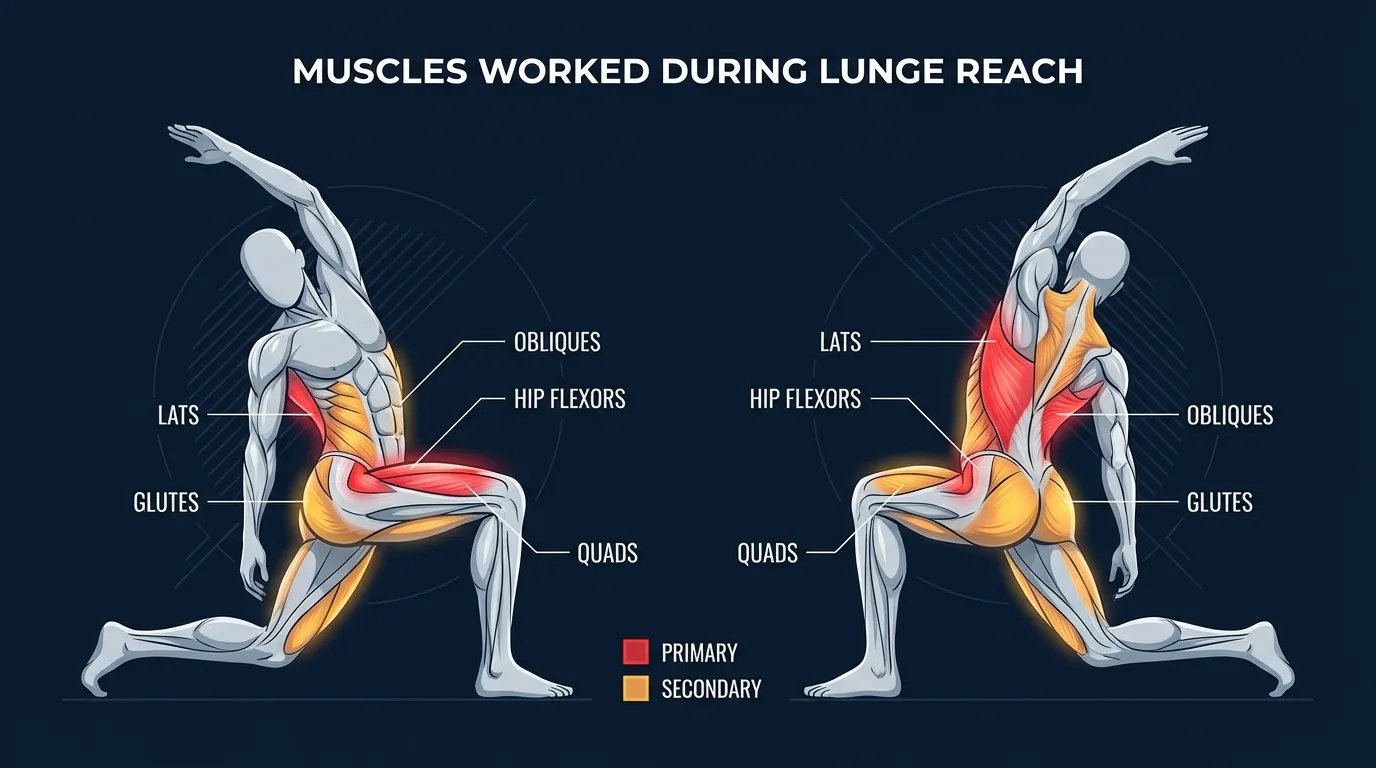
Areas Stretched and Mobilized
Primary stretch targets. The lunge reach lengthens the hip flexors of the trailing leg (psoas major, iliacus, and rectus femoris) as the hips sink forward and down. Simultaneously, the thoracic spine rotators (rotatores, multifidus, and the deep paraspinals at the mid-back) work through their available range as the torso opens toward the front knee.
Secondary stretch and active lengthening. The overhead reach lengthens the latissimus dorsi, the obliques, and the intercostals of the rotating side. The adductors of the front leg get a mild stretch from the wide-stance lunge position. The pectoralis major opens as the chest rotates upward.
Active stabilizers. The glutes (gluteus maximus and medius), quadriceps, and hamstrings of the front leg work isometrically to hold the deep lunge position. The deep core (transverse abdominis, internal obliques) braces the trunk so the rotation isolates to the thoracic spine rather than leaking into the lumbar spine. The deltoids and rotator cuff stabilize the overhead arm.
Evidence. Ehresman et al. (2025) ran a six-week RCT with college-aged participants who had tight hip flexors, comparing a daily five-minute lunge-and-reach intervention against a no-stretch control. The intervention group improved hip flexor length (Modified Thomas Test) by 5.92 ± 3.73 degrees (p=0.01) and single-leg broad jump distance by 12.39 ± 11.23 cm (p=0.02). Gluteal strength and endurance did not change significantly, suggesting that the broad jump improvement came from improved hip extension range rather than muscular adaptation. Translation: the stretch worked because it lengthened the tissue restricting hip extension, which freed the glutes to express force they already had.
How to Do the Lunge Reach (Step-by-Step)
- Step into a deep lunge. From standing, take a large step forward with your right foot. Bend your front knee to roughly 90 degrees, keeping it stacked directly over the ankle. Your back knee hovers just above the ground or rests on it lightly. Keep your torso upright, your core engaged, and your weight centered between both legs. Don't let the front knee shoot past the toes.
Coach Ty's cue: "Long step, tall torso. If your front knee chases your toes, the step wasn't long enough." - Plant your inside hand and sink the hips. Place your left hand (same side as the back leg) flat on the floor just inside your front foot. If you can't reach the floor, use a yoga block or place your fingertips down. Let your hips sink forward and down. You should feel a deep stretch through the hip flexor and quad of the trailing leg. Keep that back leg active by pushing through the ball of the foot rather than collapsing into the stretch.
Coach Ty's cue: "Push the back knee toward straight. A passive back leg dumps you into the hip joint instead of stretching the hip flexor." - Rotate and reach with your free hand. This is the key part. Rotate your torso toward your front knee, opening your chest to the side. Extend your right arm straight toward the ceiling. Follow your hand with your eyes and let the gaze lead the rotation. The rotation should come from your mid-back (thoracic spine), not your lower back. Your hips stay square to the ground while your upper body opens like a door. Feel the stretch across your chest, shoulder, and the entire side of your torso.
Coach Ty's cue: "Square the hips before you rotate. If the pelvis turns with you, you're twisting your lumbar spine. And the lumbar spine only has about 5 degrees of rotation." - Hold, breathe, and switch sides. Hold the rotated position for 2 to 5 seconds, breathing slowly. Each exhale, try to sink the hips a fraction deeper or rotate a fraction further. Don't force it. Return your hand to the floor, step back to standing, and repeat the entire sequence on the opposite side. That's one rep per side.
Coach Ty's cue: "Breathe into the tight spots. Slow exhalation lets the tissue release. Holding your breath locks it down."
Get this exercise in a personalized workout
FitCraft, our mobile fitness app, uses its AI coach Ty to program mobility work like this into your plan at the right volume and intensity, based on your level, goals, and equipment. Ty was designed and trained by Domenic Angelino, MPH (Brown University) and NSCA-CSCS, with research published in the Journal of Strength and Conditioning Research and Medicine & Science in Sports & Exercise.
Take the Free Assessment Free · 2 minutes · No credit card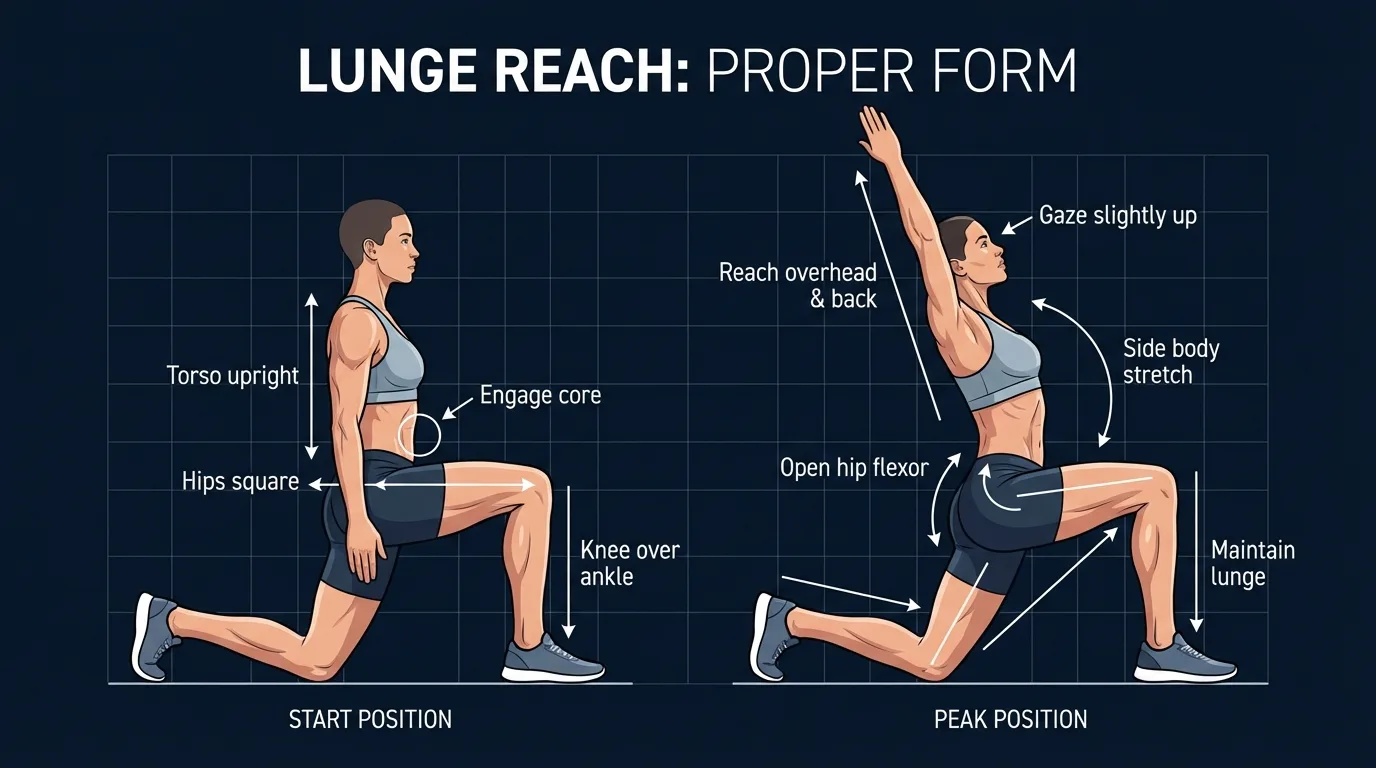
Common Mistakes to Avoid
- Rotating from the lower back instead of the thoracic spine. The lumbar spine has about 5 degrees of rotation. The thoracic spine has about 35 degrees. If you feel the twist in your lower back, you're forcing a joint that doesn't want to rotate. Fix it by anchoring the hips square and driving the twist from the ribcage. Think about rotating the sternum, not the belly button.
- Front knee collapsing inward. When you drop the inside hand to the floor, the front knee often caves toward the midline. This stresses the medial knee structures and takes the glute out of the equation. Push the front knee out over the little toe. Use the elbow to nudge it if needed.
- Skipping the back leg activation. A dead back leg turns this into a passive hip flexor hang. You'll get some stretch, but you'll also load the hip joint capsule and miss the active lengthening that produces lasting range of motion gains. Keep the back quad engaged and the heel pushing back.
- Lazy overhead reach. When you extend your arm up, actively reach as far as you can. Imagine someone is pulling your fingertips toward the ceiling. This lengthens the lat and the entire lateral chain on that side. A short reach means a short stretch.
- Rushing through reps. The lunge reach is not a cardio exercise. If you're blowing through reps in under a second each, you're using momentum, not mobility. Hold each position for at least 2 seconds. Breathe. Let the tissue actually lengthen.
Variations: From Kneeling to Dynamic Flow
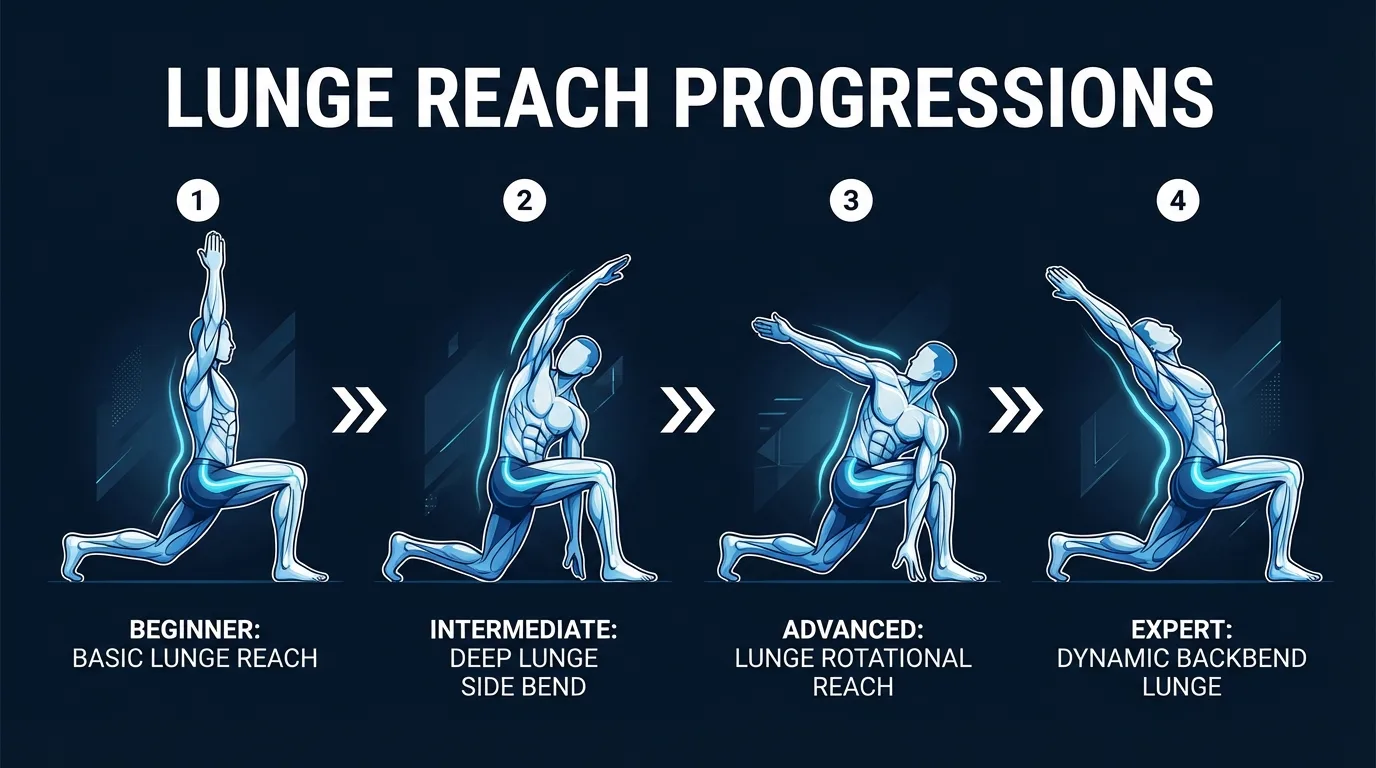
Kneeling Lunge Reach (Beginner)
Drop the back knee to the floor (use a mat or towel for padding). This removes the balance demand entirely and lets you focus on the hip flexor stretch and thoracic rotation. Place both hands on the inside of the front foot first, then rotate and reach with one hand. Start here if the full version feels unstable or if you can't get the inside hand to the floor without rounding your back. This is also the right starting point if you have any lower-back sensitivity or if the deep lunge position aggravates the knee.
Standing Lunge Reach (Standard)
The version described in the step-by-step above. The back knee hovers just above the floor, which adds a balance and quad-activation demand. This is the version used in the Ehresman et al. (2025) protocol that produced the 6-degree hip flexor improvement.
Dynamic Walking Lunge Reach (Advanced)
Instead of stepping back to standing between reps, walk forward. Each step flows directly into the next lunge reach. Left foot forward, rotate right. Right foot forward, rotate left. This builds coordination, hip drive, and thoracic mobility in a continuous sequence. Use it as a dynamic warm-up covering 10 to 15 yards. The walking version demands more balance and glute activation because you're moving through space rather than holding a static position.
Alternative Exercises
- Half-kneeling triplanar stretch: Same hip flexor target with added side-bend and rotation through all three planes. A close cousin of the lunge reach with a more contained position.
- Bent-over reach through: Isolates the thoracic rotation component without the hip flexor stretch. Good if the deep lunge is the limiting factor.
- Downward dog: Addresses posterior chain flexibility (hamstrings, calves) and shoulder mobility. A complementary stretch to the lunge reach, which focuses on the anterior chain.
- Cat-cow: Mobilizes the entire spine with less lower-body demand. If your hip flexors are too tight for a deep lunge, cat-cow warms up the thoracic spine first.
When to Avoid or Modify the Lunge Reach
The lunge reach is safe for most healthy adults and is one of the more useful mobility drills available without equipment. A few conditions warrant modification or clearance from a qualified provider first. Always consult your physician or physical therapist before starting or returning to any exercise program.
- Acute hip flexor strain or recent hip injury. Wait for clearance. Aggressive stretching of a freshly strained muscle can worsen the tear. After the acute phase resolves, reintroduce with the kneeling variation at half range first.
- Disc pathology, active sciatica, or recent low-back surgery. The rotation component loads the lumbar spine if your form drifts. Skip the rotation entirely (just lunge and reach overhead) until cleared, and reintroduce rotation in small increments with a physical therapist watching the first few reps.
- Knee meniscus injury or recent knee surgery. The deep front-leg flexion can compress an irritated meniscus. Use the kneeling variation with a pad under the back knee, and don't push the front knee past about 90 degrees of flexion.
- Hypermobility, Ehlers-Danlos, or other connective tissue disorders. Avoid pushing into end range. Stay in the easier middle of your available range and emphasize active engagement of the back leg and core rather than passive sinking. Consult a PT with hypermobility expertise before adding the dynamic walking version.
- Pregnancy (second and third trimesters). Relaxin loosens ligaments around the pelvis and hips, increasing overstretching risk. Stay within a comfortable range, skip the rotation if the abdomen restricts position, and use the kneeling variation for balance. Stop if any pelvic or SI joint pain appears.
- Foundational core control still developing. If you can't hold a stable plank for 30 seconds or perform 10 controlled deadbugs, the trunk control needed to isolate thoracic rotation from lumbar rotation isn't there yet. Build foundational core stability first with deadbugs and bird-dogs, then return to the lunge reach.
Related Exercises
- Same area, different stretch: Half-kneeling triplanar stretch. Hip flexor opening with side-bend and rotation in a more controlled position.
- Thoracic rotation alternative: Bent-over reach through. Isolates mid-back rotation without the deep hip flexor stretch.
- Posterior chain complement: Downward dog. Pairs naturally with the lunge reach for a complete anterior plus posterior mobility circuit.
- Spinal mobility primer: Cat-cow. Warm up the spine here first if the thoracic rotation in the lunge reach feels stiff.
- Core foundation: Deadbugs and bird-dogs. Build the trunk control that lets you isolate thoracic rotation from lumbar rotation.
- Resistance training the stretch prepares for: squats, deadlifts, lunges, and overhead pressing all benefit from improved hip extension range and thoracic mobility.
How to Program the Lunge Reach
Mobility programming is different from resistance training. The dose-response relationship is built on consistency and time in tension, not progressive overload. General resistance training guidance from Ratamess et al., 2009 (ACSM Position Stand on Resistance Training) provides the framework, but for mobility drills, frequency and quality matter more than sets and reps.
| Level | Sets × Reps per side | Hold time | Frequency |
|---|---|---|---|
| Beginner (kneeling variation, no rotation or partial rotation) | 1-2 × 3-4 per side | 3-5 seconds per rep | 5-7 sessions/week |
| Intermediate (standing version with full rotation) | 2-3 × 5-6 per side | 2-3 seconds per rep | 5-7 sessions/week |
| Advanced (walking flow, or end-range hold variant) | 2-4 × 8-10 walking reps, or 3-4 × 3-4 per side with extended hold | 5 seconds at end range | Daily |
Where in your workout. Warm-up is the primary slot. The lunge reach prepares the hips and thoracic spine for loaded movements like squats, deadlifts, lunges, and overhead pressing. It can also be used as a cool-down after training, when tissue is warm, or as a standalone daily mobility practice (60 to 120 seconds, anytime). Desk workers benefit from a single rep per side every hour or two as a micro-mobility break.
Form floor over rep targets. Don't add walking reps until you can hold the static rotated position with hips square for the full 5 seconds. Speed without alignment trains the lumbar spine to rotate. Slow, correct reps build the pattern; fast incorrect reps grind it down.
FitCraft's AI coach Ty programs the lunge reach into mobility and warm-up routines based on your assessment results. He selects the variation that fits your current flexibility (kneeling if you need the stability, walking flow if you're ready) and demonstrates exact hip and hand placement with 3D models you can rotate to see every angle.
Frequently Asked Questions
Can I do the lunge reach if I have lower-back pain?
Often yes, but the form rule matters more than usual. The rotation must come from the thoracic spine (mid-back) with the hips and pelvis kept square, never from the lumbar spine, which only has about 5 degrees of rotation. If you feel the twist in your lower back instead of your mid-back, you are loading the wrong joint. Start with the kneeling variation, skip the rotation entirely for the first week (just lunge and reach overhead), then add the rotation in small increments. If you have a diagnosed disc bulge, herniation, or active sciatica, get clearance from a physical therapist before adding rotation.
What muscles does the lunge reach stretch work?
The lunge reach stretches the hip flexors (psoas, rectus femoris) and the thoracic spine rotators of the trailing leg side, while actively engaging the glutes, quadriceps, and hamstrings of the front leg. The overhead reach lengthens the latissimus dorsi, obliques, and chest. It is one of the most comprehensive full-body mobility drills available without equipment.
Is the lunge reach good for warming up?
Yes. The lunge reach is one of the best dynamic warm-up movements because it opens the hip flexors, mobilizes the thoracic spine, and activates the glutes and core in a single pattern. Performing 5 to 6 reps per side before training prepares the hips and upper back for squats, deadlifts, overhead pressing, and running.
How is the lunge reach different from the world's greatest stretch?
The world's greatest stretch typically adds a hamstring stretch component by straightening the front leg after the rotation. The lunge reach focuses on the hip flexor opening and thoracic rotation without the hamstring extension phase. Both are excellent mobility drills. The lunge reach is slightly simpler and better suited for beginners.
Can beginners do the lunge reach?
Yes, with modifications. Beginners can drop the back knee to the floor for stability, skip the rotation and simply reach overhead, or use a yoga block under the planted hand. The kneeling version removes the balance demand while keeping the hip flexor stretch and thoracic rotation benefits.
How often should I do the lunge reach stretch?
Daily practice is safe and effective. A 2025 study in the International Journal of Sports Physical Therapy found that performing a lunge-and-reach stretch daily for six weeks improved hip flexor length by 5.92 degrees and increased gluteal power measured by single-leg broad jump distance by 12.39 cm. Consistency matters more than duration. Two to three minutes daily is enough.