The bent-over reach-through is a thoracic mobility drill built for desk-bound spines. It combines a hip hinge with an upper back rotation, so you get two things done at once: you load your posterior chain isometrically while mobilizing the part of your spine that gets the stiffest from sitting. Your thoracic spine, the twelve vertebrae between your neck and lower back, is designed to rotate. Most people's thoracic spines barely rotate at all because they spend eight-plus hours a day hunched over a screen.
That matters more than you might think. When your upper back can't rotate, your lower back and shoulders pick up the slack. A 2020 study in BMC Musculoskeletal Disorders found that thoracic mobilization exercises improved shoulder function in patients with subacromial impingement (Cho et al., 2020). Upper-back stiffness doesn't stop at the upper back. It cascades into your shoulders, neck, and lower back. The bent-over reach-through addresses that cascade directly.
Quick Facts: Bent-Over Reach-Through
- Equipment needed: None (light resistance band optional for advanced variation)
- Difficulty: Intermediate
- Modality: Bodyweight dynamic mobility / thoracic rotation
- Body region: Upper back, obliques, posterior shoulder
- FitCraft quest category: Mobility, Warm-Up, Desk-Worker Recovery
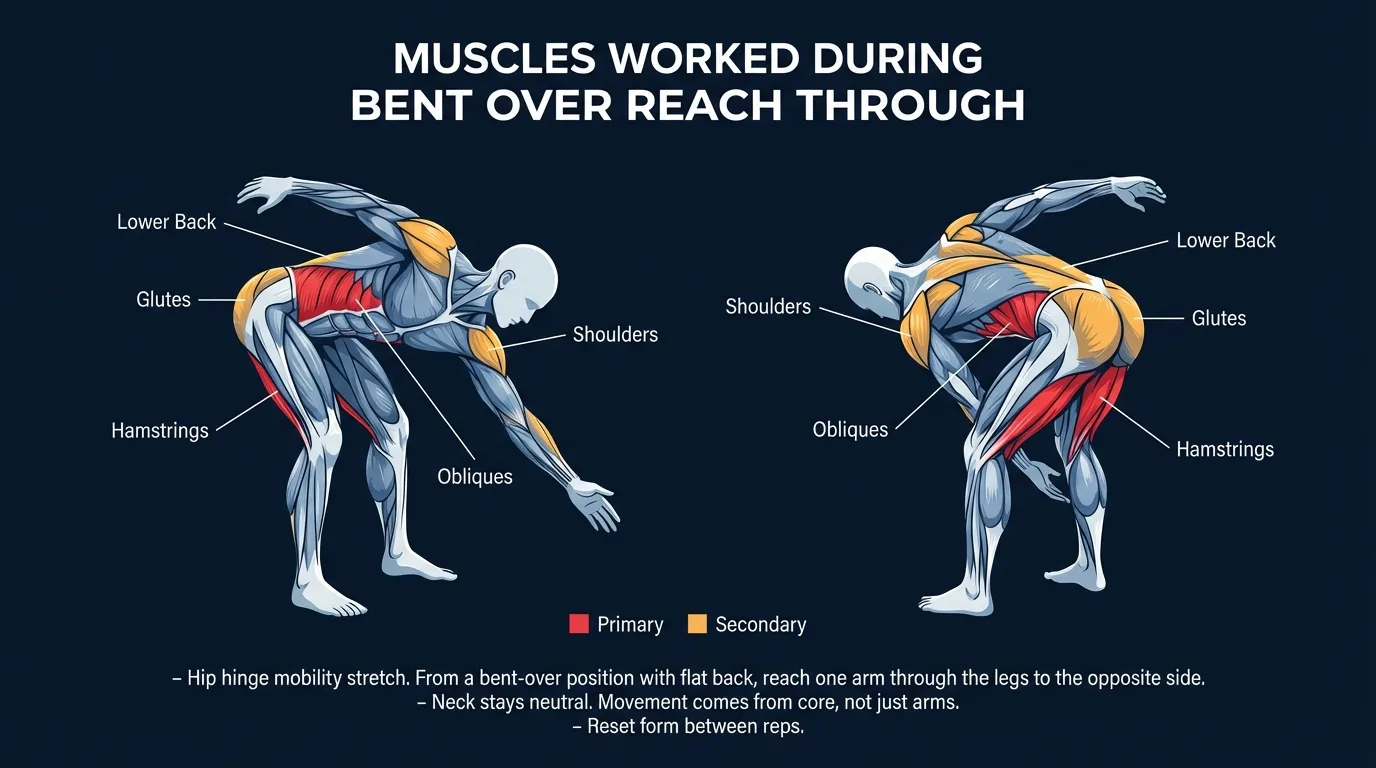
Areas Stretched and Mobilized
Primary mobilizers. The bent-over reach-through is a thoracic spine rotation drill. The deep rotators of the spine (the rotatores and multifidus that sit between adjacent vertebrae) and the internal and external obliques drive the rotation. The closing phase (elbow reaching under the torso) loads the obliques on the same side as the moving arm; the opening phase (elbow up toward the ceiling) loads the obliques on the opposite side. Both phases articulate the thoracic vertebrae through transverse-plane motion that the desk-bound spine rarely sees.
Secondary movers. The posterior deltoid and rhomboids of the rotating side work eccentrically through the closing phase and concentrically through the opening phase, contributing to scapular retraction at the top. The latissimus dorsi on the rotating side gets a passive stretch when the elbow reaches under and through.
Stabilizers. The glutes, hamstrings, and erector spinae work isometrically to hold the hip hinge through the entire set. This is where the exercise differs from a pure thoracic rotation drill: you also train the posterior chain to stabilize a hinged position under rotational load. The core (rectus abdominis and transverse abdominis) braces lightly to prevent the lumbar spine from twisting along with the thoracic.
Mechanism. Thoracic rotation depends on the orientation of the facet joints in the upper back. Each thoracic vertebra is structured to allow several degrees of rotation, summing to roughly 30-35 degrees of total transverse-plane range from T1 to T12 in a healthy adult. When that range shrinks (commonly from prolonged sitting), the lumbar spine and shoulders compensate, which is one mechanism behind chronic lower back stiffness and shoulder impingement. The bent-over reach-through drives controlled articulation through this range and over weeks of consistent practice can restore lost rotation.
How to Do the Bent-Over Reach-Through (Step-by-Step)
- Set up the hip hinge. Stand with feet shoulder-width apart. Push your hips back and bend your knees slightly, hinging your torso forward until it's roughly 45 to 60 degrees from vertical. Keep your spine neutral, flat back, not rounded. Think about pushing your hips toward a wall behind you. Place one hand behind your head with your elbow pointing out to the side. The other hand can hang straight down or rest on the same-side knee for balance.
Coach Ty's cue: "Lock the hips. Belt buckle stays pointed at the ground. If your hips sway, you're rotating from the wrong place."
- Reach through and under. Exhale and rotate your upper back, driving the elbow of your head-hand down and under your torso. Reach it toward or past the opposite knee. Let your eyes follow the elbow. This cue from strength coach Eric Cressey helps pull more rotation out of your cervical and thoracic spine together. Your hips stay locked. Your lower back stays locked. All the rotation is happening between your shoulder blades.
Coach Ty's cue: "Follow the elbow with your eyes. If you stare at the floor the whole time, you're leaving rotation on the table."
- Open up and rotate back. Inhale and reverse the movement. Rotate your thoracic spine the other direction, driving the elbow up toward the ceiling. Follow your hand with your eyes. Open your chest fully. Pause for a beat at the top. You should feel a stretch across the chest and front shoulder on the rotating side.
Coach Ty's cue: "Breathe with the movement. Exhale closing, inhale opening. The breath is the tool that opens another inch of range."
- Repeat, then switch. Do 6-8 slow, controlled reps on one side. Each rep should take about 3-4 seconds in each direction, so roughly 6-8 seconds per complete rep. Then switch hands and repeat on the other side. Keep the hip hinge the entire time. If you stand up between reps, you lose the positional benefit.
Coach Ty's cue: "Don't force the range on rep one. The first two reps are your warm-up. Push for end-range by rep four or five, not earlier."
Get this exercise in a personalized workout
FitCraft, our mobile fitness app, uses its AI coach Ty to program mobility work like this into your plan at the right volume and intensity, based on your level, goals, and equipment. Ty was designed and trained by Domenic Angelino, MPH (Brown University) and NSCA-CSCS, with research published in the Journal of Strength and Conditioning Research and Medicine & Science in Sports & Exercise.
Take the Free Assessment Free · 2 minutes · No credit card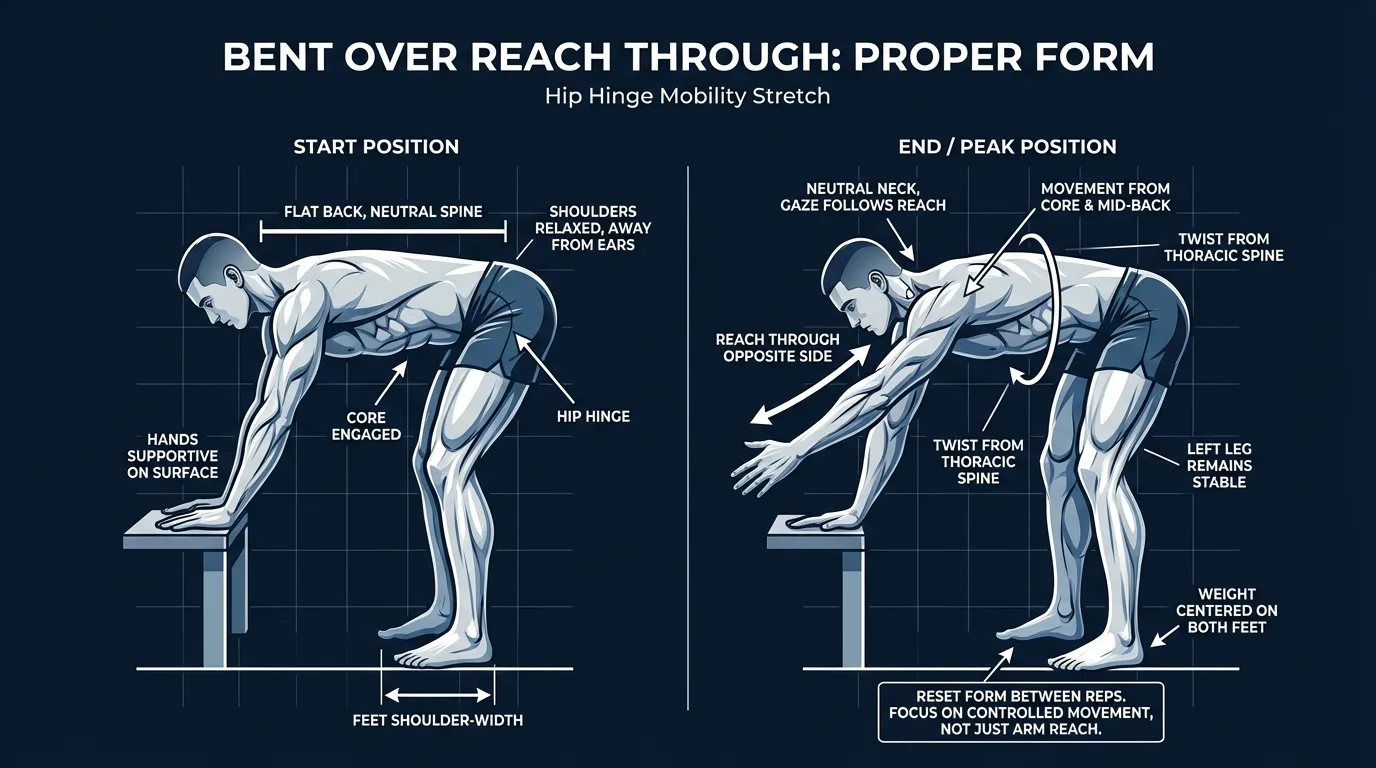
Common Mistakes to Avoid
The bent-over reach-through has a higher technique floor than most mobility exercises because it combines two positions (hip hinge plus rotation) simultaneously. These are the mistakes that waste the exercise:
- Rotating from the lower back. If your hips are swaying side to side or your lower back is twisting, you've turned a thoracic mobility drill into lumbar stress. The fix: put your free hand on your hip bone. If you feel it moving, your hips are rotating. Lock them down. The movement should feel like it's happening entirely between your shoulder blades and mid-back.
- Rounding the back in the hinge. If your back is rounded before you even start rotating, you've compressed your thoracic vertebrae into a position where they can barely rotate at all. A 2020 study in the Journal of Physical Therapy Science confirmed that thoracic spine posture meaningfully affects available rotational range of motion. Set up with a neutral spine first, then rotate.
- Going too fast. Each rep should take 6-8 seconds. If you're cranking through 8 reps in 15 seconds, you're just swinging your arm around. The slow, controlled tempo is what creates the mobility stimulus. Think about each vertebra moving individually, like a wave traveling through your spine.
- Standing too upright. If your torso is barely hinged, you change the exercise from a thoracic rotation into a standing trunk twist, which loads differently and targets different ranges. Commit to the hinge. Your torso should be at least 45 degrees forward. This locks out lumbar rotation and forces the thoracic spine to do the work.
- Holding your breath. Bracing without breathing reduces the available rotation range. Exhale into the closing rotation (it compresses the ribcage and lets you reach further). Inhale into the opening rotation (it expands the chest and lets you open more). Use the breath as your range-of-motion tool on every rep.
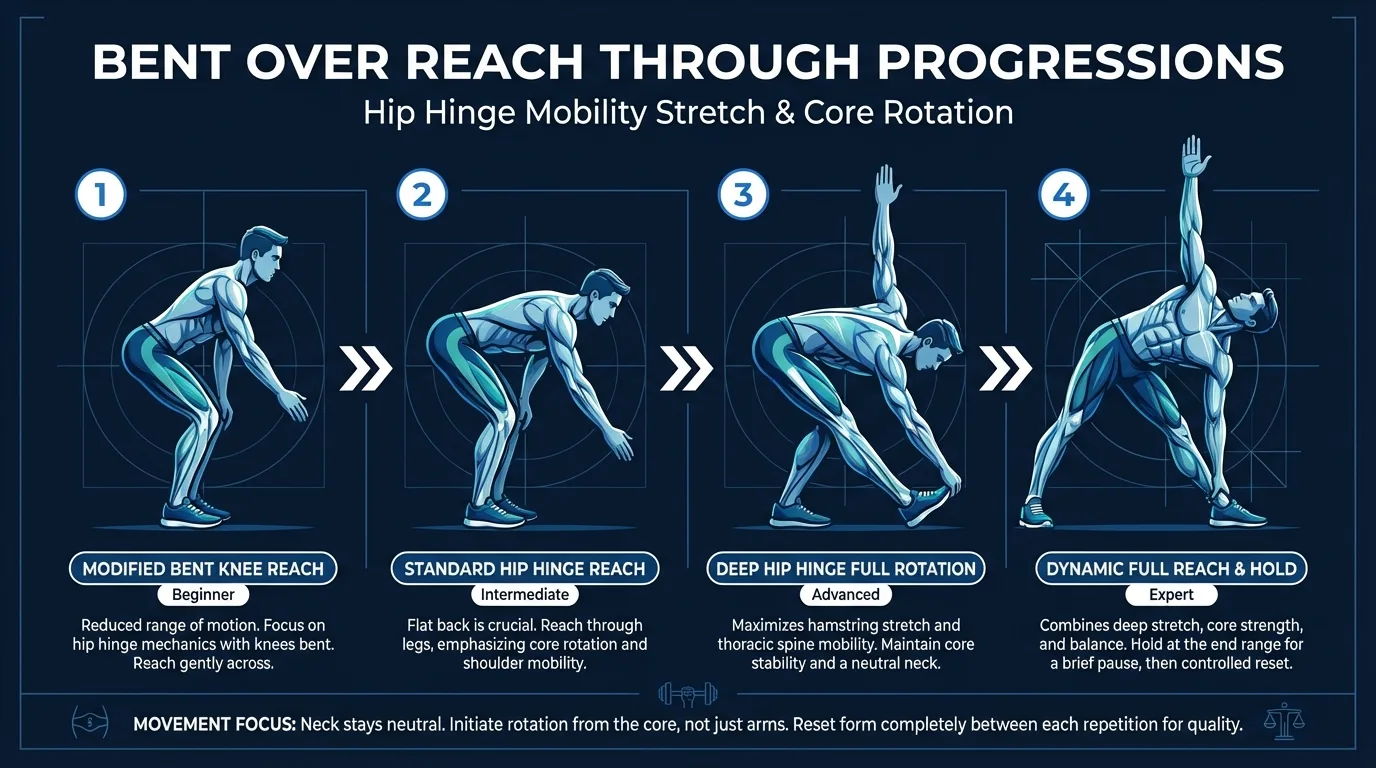
Variations and Progressions
Quadruped Thread-the-Needle (Easier)
If the hip hinge is too demanding or you lose your balance, do the quadruped thread-the-needle on all fours instead. Start in tabletop position, place one hand behind your head, and rotate your elbow down and under your body, then up toward the ceiling. Same thoracic rotation pattern, zero balance demand. This is the go-to regression for beginners or anyone with hamstring tightness that makes the standing hinge uncomfortable.
Bent-Over Reach-Through with Arm Extension (Harder)
Instead of keeping your hand behind your head, start with the working arm hanging straight down. Reach it through and under your body (toward the opposite side), then rotate open and extend the arm straight toward the ceiling. The longer lever arm increases the rotational demand on the thoracic spine. This is the progression to graduate to once you've mastered the basic version with consistent form.
Bent-Over Reach-Through with Resistance Band (Harder)
Anchor a light resistance band at knee height and hold it in the rotating hand. The band adds a small resistance during the opening phase, which turns the mobility drill into a combined mobility-plus-strength exercise. Use a light band. The goal is still mobility. If the band pulls you out of position, it's too heavy.
When to Avoid or Modify Bent-Over Reach-Throughs
The bent-over reach-through is safe for most healthy adults, but a few conditions warrant modification. None of these are permanent restrictions. They're starting points. Always consult your physician or physical therapist for personalized guidance.
- Acute lower back pain or known disc pathology. The combined hip hinge and rotation can load a sensitive lumbar spine. Start with the quadruped thread-the-needle on all fours, which removes the hip-hinge demand and isolates the thoracic rotation. Avoid the standing version entirely while pain is acute. Reintroduce gradually once symptoms resolve and only with clearance from a spine specialist.
- Active sciatica or radiating leg symptoms. Any forward-folded position can compress the lumbar discs. Sciatic symptoms triggered or worsened by rotation are a signal to stop. Use seated or supine thoracic rotation drills instead until the radicular symptoms resolve.
- Hypermobility, Ehlers-Danlos, or other connective tissue disorders. Avoid pushing into end-range rotation. Stay in the controlled middle range and emphasize the active engagement of the rotators rather than passive stretch. Consult a PT with hypermobility expertise for individualized loading.
- Second or third trimester pregnancy. Relaxin loosens the SI joint and pelvic ligaments, increasing the risk of overstretching, and the forward-hinged position becomes uncomfortable as the belly grows. Modify with seated thoracic rotations or stay in the quadruped variation. Stop any movement that produces pelvic pain.
- Acute oblique or intercostal strain. The rotation directly loads these muscles. Wait until the strain resolves before reintroducing any rotational drill. Use gentle cat-cow for sagittal-plane spinal mobility in the meantime.
- Acute neck pain or recent cervical injury. The "follow the elbow with your eyes" cue requires cervical rotation. If your neck is acutely sensitive, keep the gaze fixed at the floor and let only the thoracic spine rotate, or substitute a position-only mobility drill until the neck settles.
Related Exercises
If the bent-over reach-through is part of your warm-up routine, these movements complement or extend the same training pattern:
- Same area, different mobility direction: Cat-Cow mobilizes the spine in the sagittal plane (flexion and extension) rather than rotation. Pair the two for full three-dimensional spinal warm-up.
- Easier rotation alternative: Quadruped Thread-the-Needle trains the same thoracic rotation pattern on all fours, removing the hip-hinge demand. The primary regression for anyone struggling with balance or tight hamstrings.
- Floor-based rotation alternative: Spinal Twist (supine or seated) is a static rotation hold that complements the dynamic reach-through. Use it post-workout for sustained tension.
- Upright rotation alternative: Standing Twists train rotation from a fully upright position with less hip-hinge demand. Easier for beginners, though the lumbar spine contributes more freely so the thoracic stimulus is less specific.
- Hip flexor + thoracic combo: Half-Kneeling Triplanar Stretch combines hip flexor opening with thoracic rotation. Useful for desk workers who need both at once.
- Movement this prepares for: Pressing, pulling, and overhead movements all rely on thoracic mobility. Use the bent-over reach-through before push-ups, shoulder press, or any pulling pattern to unlock more shoulder range.
How to Program the Bent-Over Reach-Through
Mobility work follows different programming logic than resistance training. The American College of Sports Medicine (ACSM) Position Stand on resistance training (Ratamess et al., 2009) treats flexibility and mobility as complementary to strength work, with daily frequency tolerated when load is low. For active mobility drills like the bent-over reach-through, hold time, rep count, and consistency matter more than intensity.
| Level | Sets × Reps per side | Rest between sets | Frequency |
|---|---|---|---|
| Beginner (quadruped regression, gentle range) | 1-2 × 5-8 | None (switch sides immediately) | 5-7 sessions/week |
| Intermediate (standing, working into resistance) | 2-3 × 6-8 | None or 20-30 seconds | 5-7 sessions/week |
| Advanced (extended-arm or band-loaded) | 2-4 × 8-10 | 20-30 seconds | Daily |
Where in your workout: The bent-over reach-through belongs at the start, during your dynamic warm-up. Thoracic mobility directly affects shoulder function, so do it before any upper-body pressing, pulling, or overhead work. A 2022 randomized controlled trial found that thoracic spine mobility exercises reduced neck pain and improved cervical range of motion in office workers (Lee et al., 2022). It also works as a movement break between long sitting bouts. Avoid loading it after heavy strength work when the spine is already fatigued.
Form floor over rep targets: if your hip hinge breaks down or your lumbar starts rotating with the thoracic, stop the set there. Hitting 8 reps with sloppy form trains the wrong pattern. 5 clean reps per side beats 8 messy ones every time.
How FitCraft Programs This Exercise
Knowing how to do a bent-over reach-through is step one. Knowing when to program it, how many reps for your mobility profile, and which variation matches your level is where most people get stuck.
FitCraft's AI coach Ty handles that. During your personalized diagnostic assessment, Ty maps your fitness level, mobility goals, and any flagged restrictions (desk-bound posture, shoulder restriction, back pain history). Then Ty slots the bent-over reach-through into your warm-up flows on the days when it matters most: upper-body training days, full-body sessions, and dedicated mobility blocks.
As your thoracic mobility improves, Ty adjusts the variation and volume to match your level. Quadruped becomes standing. Standing gets paired with the extended-arm progression or the band-loaded version. Every program is designed by an Ivy League-trained exercise scientist and NSCA-certified strength coach using evidence-based mobility programming, then adapted to you by the AI.
Frequently Asked Questions
Can I do bent-over reach-throughs with lower back pain?
If your lower back pain is acute or you have a known disc herniation, skip the standing version. The combined hip hinge and rotation can load a sensitive lumbar spine. Start with the quadruped thread-the-needle on all fours instead, which removes the hip-hinge demand and isolates the thoracic rotation. If pain persists or worsens with rotation in any position, stop and consult a physical therapist before progressing. For chronic, non-acute stiffness, the standing version is often helpful for redistributing load away from the lower back to the thoracic spine, but introduce it gradually.
What muscles does the bent-over reach-through work?
The bent-over reach-through primarily mobilizes the thoracic spine rotators (rotatores, multifidus) and the internal and external obliques. Secondary muscles include the erector spinae holding the hip hinge position, posterior deltoids, rhomboids, and the glutes and hamstrings working isometrically. It's a mobility exercise focused on range of motion rather than strength.
How many bent-over reach-throughs should I do?
6-8 reps per side for warm-ups. For dedicated mobility work, 2-3 sets of 8 reps per side. Move slowly. Each rep should take about 6-8 seconds. Rushing defeats the purpose. The quality of each rotation matters far more than the total number of reps.
Can beginners do the bent-over reach-through?
It's an intermediate exercise because it requires holding a hip hinge while rotating the upper back, two patterns at once. Beginners should start with quadruped thread-the-needle or seated thoracic rotations, which train the same rotation without the balance and hip stability demands. Graduate to the bent-over version once the hip hinge feels stable.
When should I do bent-over reach-throughs in my workout?
During your warm-up, before any upper body or full-body training. Thoracic mobility directly affects shoulder function. A 2020 study showed that thoracic mobilization improved shoulder function in patients with subacromial impingement. Mobilize first, then load. It's also useful as a movement break between long periods of sitting.