Standing twists look simple because the movement is small: stand tall, brace, rotate, return. The value is in what stays still. Your feet stay planted, your hips stay forward, and your ribcage rotates over a stable pelvis.
That combination makes standing twists useful for people who want rotational core work without getting on the floor. Slow reps build control. Faster reps can raise your heart rate for a low-impact circuit. The same exercise changes based on tempo and range.
Quick Facts: Standing Twists
- Equipment needed: None
- Difficulty: Beginner to Intermediate
- Modality: Core / low-impact cardio
- Body region: Core and hips
- FitCraft quest category: Core
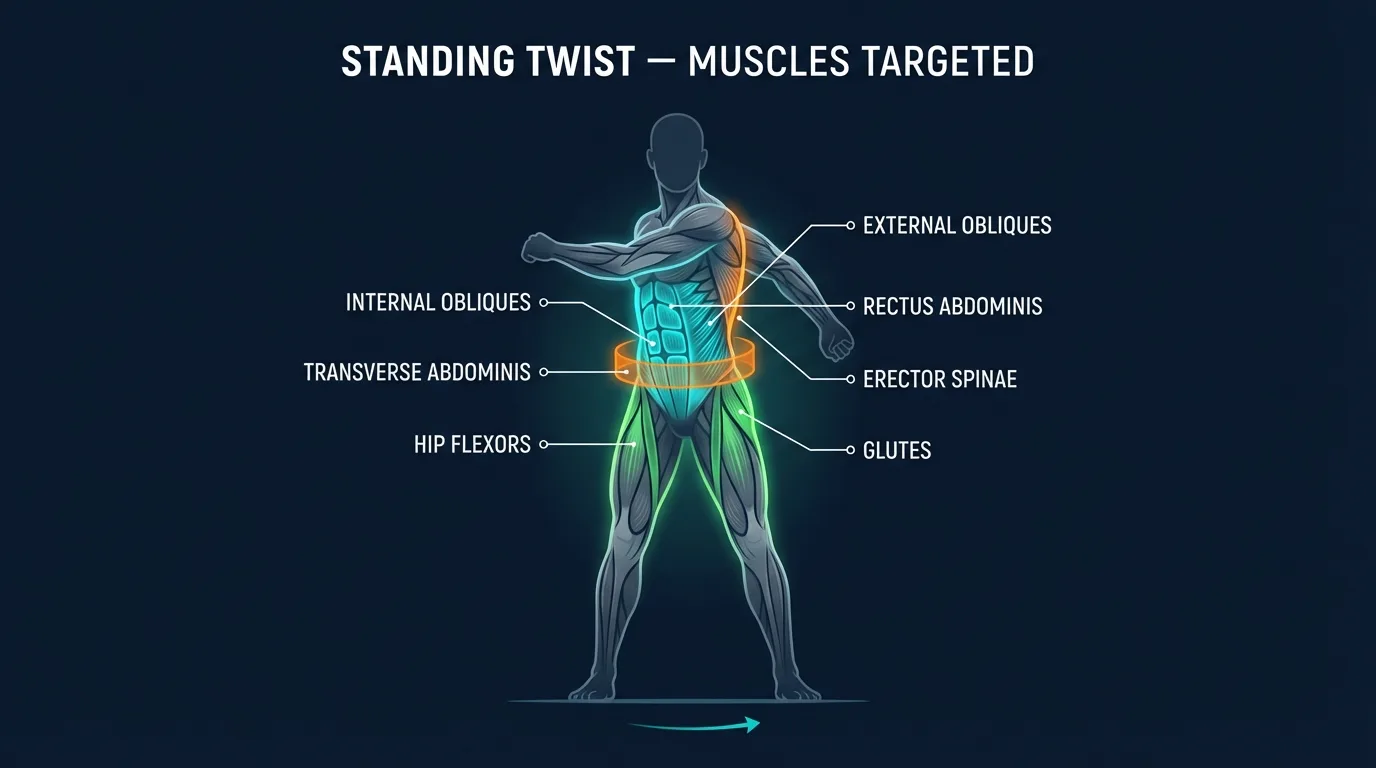
Muscles Worked
Primary movers: the internal and external obliques. They create and control trunk rotation, shortening as you twist toward one side and lengthening under control as you return through center.
Secondary movers: the rectus abdominis and transverse abdominis help brace the trunk so the movement does not collapse into lower-back extension or side bending. The hip flexors assist when the knee-drive variation is used.
Stabilizers: the glutes, deep hip rotators, spinal erectors, diaphragm, and pelvic floor hold the pelvis and spine steady. The legs also work isometrically because you are rotating from a standing base rather than a supported floor position.
Why the movement works: standing twists train controlled rotation through the trunk while asking the lower body to resist being pulled along for the ride. That makes the exercise a rotation drill and a bracing drill at the same time. No exercise-specific PubMed, PMC, or DOI citation is included in the verified FitCraft citation library for standing twists, so this section uses mechanism-based biomechanics instead of a proxy citation.
Step-by-Step: How to Perform Standing Twists
Step 1: Set Your Stance
Stand with your feet about shoulder-width apart and your knees slightly bent. Keep your weight balanced over the middle of both feet. Bring your hands to chest height, or reach your arms forward if you want a longer lever.
Coach Ty's cue: "Soft knees, tall chest, feet rooted."
Step 2: Brace Before You Move
Tighten your abs as if preparing for a light punch. Keep your ribs stacked over your pelvis and breathe normally. A steady brace keeps the rotation in the trunk instead of the lower back.
Coach Ty's cue: "Brace first. Then twist."
Step 3: Rotate Your Ribcage Right
Turn your upper body to the right while your hips face forward. Let your head follow your chest, but do not yank through your neck or arms. Stop when you feel your obliques working and your pelvis is still quiet.
Coach Ty's cue: "Belt buckle forward. Ribs rotate."
Step 4: Return Through Center
Use your obliques to slow the motion and pull your torso back to neutral. Pause briefly in the middle so every rep starts from control instead of rebound.
Coach Ty's cue: "Own the center before you switch."
Step 5: Rotate Left and Continue Alternating
Turn to the left with the same range, speed, and posture. Exhale into each twist and inhale as you pass through center. For core control, slow down. For a light cardio effect, speed up only as much as your form allows.
Coach Ty's cue: "Same rep both ways."
Get this exercise in a personalized workout
FitCraft, our mobile fitness app, uses its AI coach Ty to program core stability work like this into your plan at the right volume and intensity, based on your level, goals, and equipment. Ty was designed and trained by Domenic Angelino, MPH (Brown University) and NSCA-CSCS, with research published in the Journal of Strength and Conditioning Research and Medicine & Science in Sports & Exercise.
Take the Free Assessment Free · 2 minutes · No credit card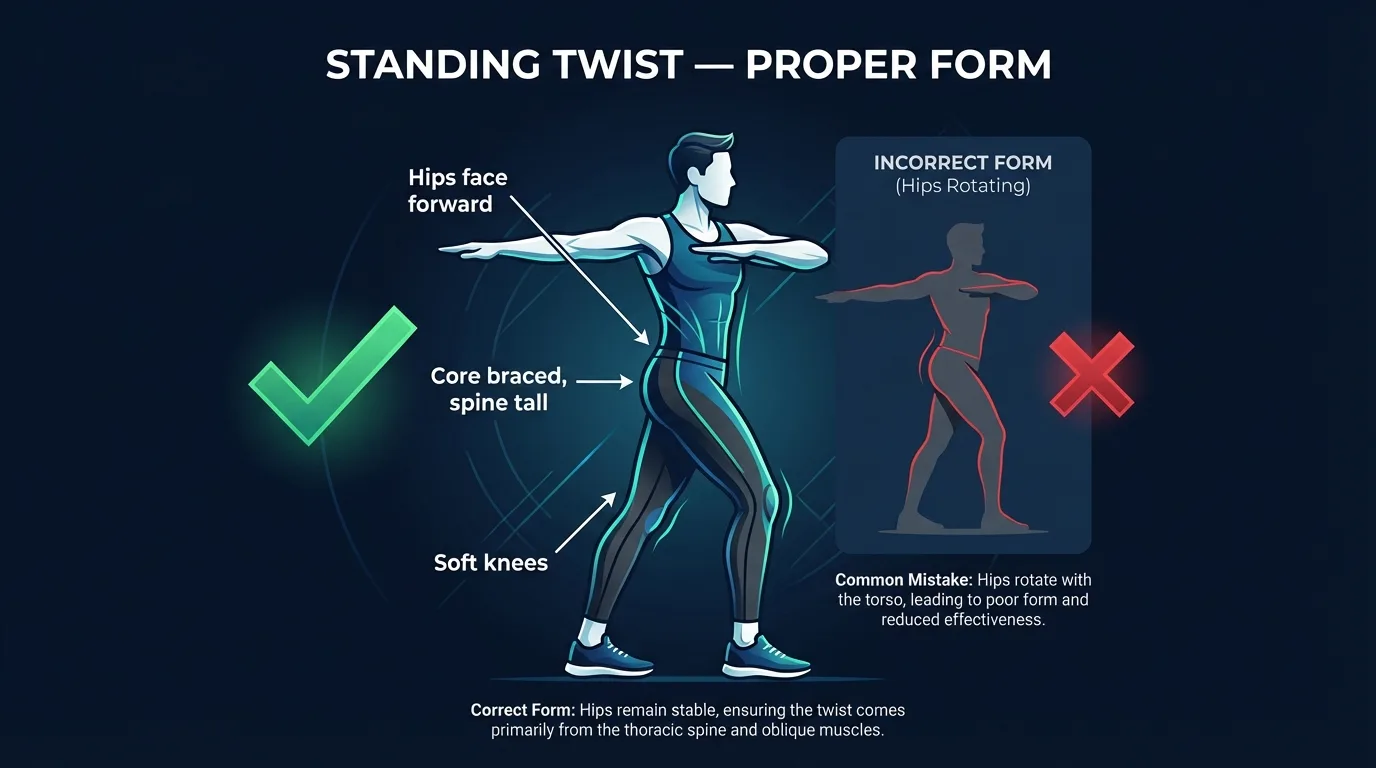
Common Mistakes (and How to Fix Them)
- Letting the hips swivel. If the hips turn with the torso, the obliques lose most of the job. Keep your belt buckle facing forward and reduce the range until you can control it.
- Throwing the arms. Swinging the arms makes the movement look bigger while the core does less. Keep the arms quiet and rotate from the ribcage.
- Twisting too far. More range can turn into lumbar rotation. Stop at the point where the obliques are working and your pelvis is still stable.
- Locking the knees. Locked knees make it harder to absorb rotation. Keep a small bend so the hips and trunk can organize the movement.
- Holding your breath. Breath-holding can make the brace feel stronger for a few reps, then it falls apart. Exhale on the twist and inhale through center.
- Chasing speed before control. Fast reps only help conditioning when the movement stays crisp. If your shoulders, hips, or lower back start leading, slow down.
Standing Twist Variations: Regressions and Progressions
Short-Range Standing Twist (Beginner Regression)
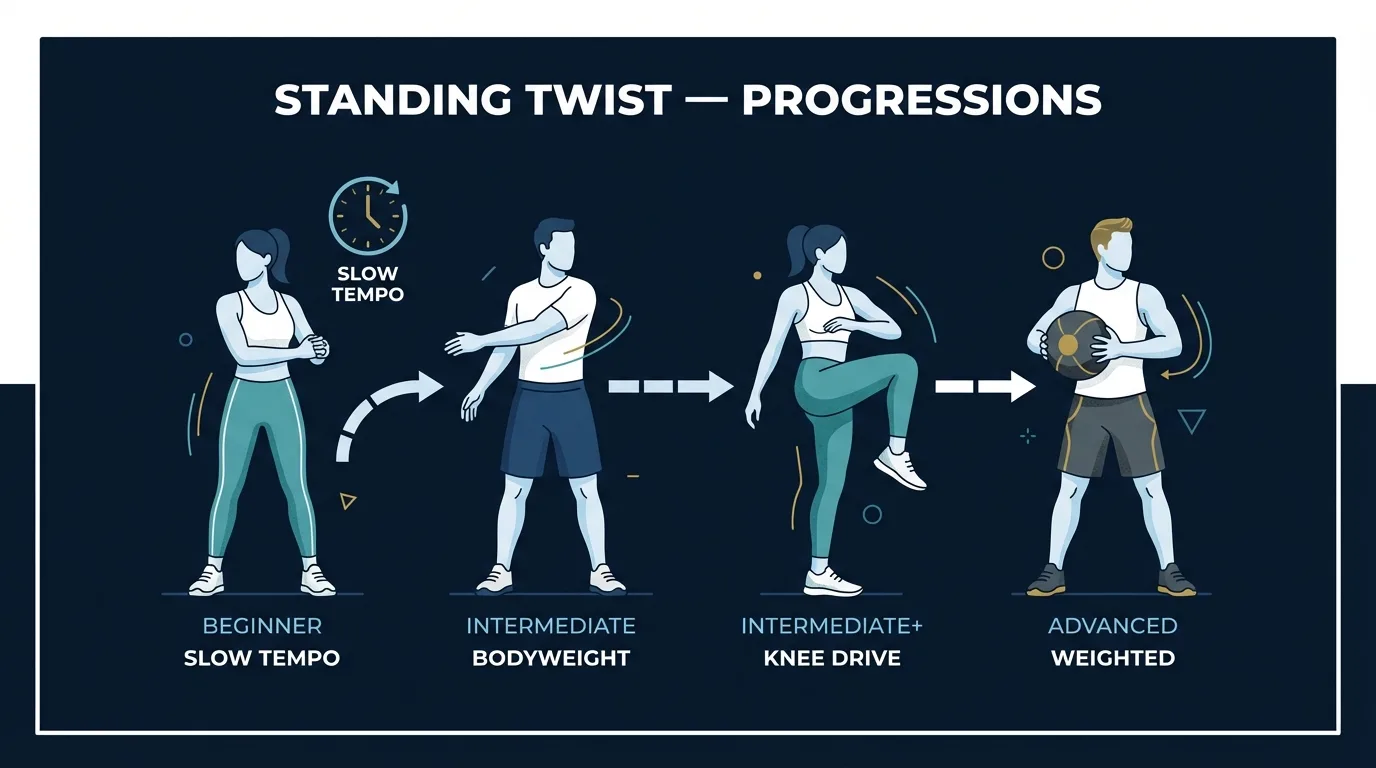
Use a smaller twist and keep your hands close to your chest. This reduces leverage and helps you feel the difference between ribcage rotation and hip rotation.
Slow-Tempo Standing Twist (Core Control)
Take 2 to 3 seconds to rotate, pause for 1 second, then take 2 to 3 seconds to return. This version removes momentum and makes the obliques control both directions.
Standing Twist with Knee Drive (Intermediate)
As you rotate right, drive your left knee toward your right elbow. Alternate sides. This adds hip flexor work, balance demand, and a stronger cardio effect.
Loaded Standing Twist (Advanced)
Hold a light dumbbell or medicine ball at chest height. Start very light because added load makes the end range harder to decelerate.
Speed Twist (Low-Impact Cardio)
Use a faster rhythm for 20 to 45 seconds while keeping the hips quiet. This version fits best in a warm-up, finisher, or low-impact circuit.
When to Avoid or Modify Standing Twists
Standing twists are safe for most healthy adults, but rotation is still rotation. Modify the range, tempo, or exercise choice when symptoms suggest the spine or abdominal wall is not ready. Always consult your physician or physical therapist for personalized guidance.
- Acute lower-back pain or known disc pathology. Fast or end-range rotation can irritate symptoms. Use deadbugs, bird-dogs, or forearm planks until basic bracing is pain-free.
- First 6-8 weeks postpartum or active diastasis recti. Rotational core work can increase abdominal pressure and pulling across the midline. Rebuild with diaphragmatic breathing, transverse abdominis activation, deadbugs, and bird-dogs first.
- Recent abdominal surgery. After a C-section, hernia repair, appendectomy, or similar procedure, get clearance before twisting drills. Most return-to-exercise plans start with breathing, gentle bracing, and short-range motion.
- Hernia or pelvic-floor dysfunction. Loaded or fast twists can raise intra-abdominal pressure. Keep the movement slow, skip added load, and work with a clinician if you notice pressure, heaviness, bulging, or leaking.
- Pregnancy, especially second and third trimesters. Rotational core work often needs to be reduced or replaced. Use gentler standing mobility or side-lying core options recommended by your prenatal clinician.
- Dizziness, balance issues, or uncontrolled tempo. Use a wall or chair for light support, shorten the range, or choose a seated option like seated side bends until balance improves.
Related Exercises
If standing twists fit your routine, these movements train nearby core patterns and progression paths:
- Same rotation family: Russian twists, twist crunches, and cross-toe touches train oblique rotation from floor-based positions.
- Dynamic plank rotation: Plank twists add shoulder and trunk bracing while the hips move under more load.
- Lower-pressure core foundations: Deadbugs and bird-dogs build the bracing base that makes rotation cleaner.
- Anti-extension strength: Forearm planks and hand planks teach the ribs-and-pelvis control standing twists rely on.
- Glute and pelvis support: Glute bridges and glute bridge partials help the hips stay steady during trunk movement.
How to Program Standing Twists
Standing twists follow dynamic core programming: enough reps to practice control, enough rest to keep the trunk from getting sloppy, and progression only after form stays clean. The American College of Sports Medicine position stand on resistance training supports matching volume, rest, frequency, and progression to training status (Ratamess et al., 2009).
| Level | Sets × Reps | Rest between sets | Frequency |
|---|---|---|---|
| Beginner | 2-3 × 8-12 per side | 45-60 seconds | 2-4 sessions/week |
| Intermediate | 3 × 10-20 per side | 45-60 seconds | 3-5 sessions/week |
| Advanced | 3-4 × 15-30 per side, slow tempo or light load | 60 seconds | 4-6 sessions/week |
Where in your workout: use standing twists in a warm-up, as a low-impact cardio station, or near the end of a strength session as a core finisher. Avoid doing high-rep twisting before heavy squats, deadlifts, carries, or presses that need fresh trunk stiffness.
Form floor over rep targets: stop the set when the hips start swinging, the lower back feels pinchy, or your breathing gets stuck. Clean rotation matters more than hitting a rep number.
How FitCraft Programs This Exercise
Standing twists are easy to overdo because they feel low-stakes. FitCraft treats them like a core stability drill first, then layers tempo, reps, and variation based on your level.
FitCraft's AI coach Ty can place core stability work into a balanced plan alongside strength, cardio, mobility, and recovery days. The goal is simple: the right movement at the right dose, with progressions that match what you can control.
As your bracing improves, Ty adjusts the variation and volume to match your level. Slow bodyweight reps can progress to knee-drive twists, timed low-impact circuits, or light loaded twists when your form is ready.
Frequently Asked Questions
What muscles do standing twists work?
Standing twists primarily train the internal and external obliques, with the rectus abdominis and transverse abdominis helping brace the trunk. The glutes, hip stabilizers, spinal erectors, and legs work isometrically to keep the pelvis steady while the ribcage rotates.
Can I do standing twists with lower-back pain?
Avoid fast or deep standing twists during acute lower-back pain, disc symptoms, or pain that worsens with rotation. Use gentler bracing drills like deadbugs, bird-dogs, or forearm planks until rotation is pain-free, and ask a clinician or physical therapist for guidance if symptoms persist.
Are standing twists good cardio?
They can be light cardio when you use a steady, controlled rhythm for timed sets. They will not replace hard intervals, but they work well as a low-impact warm-up, active recovery drill, or core-cardio station in a circuit.
How many standing twists should beginners do?
Start with 2 to 3 sets of 8 to 12 reps per side, resting 45 to 60 seconds between sets. Keep the range small at first, then add reps, tempo, or a light load only when your hips stay still and your lower back feels calm.
What is the difference between standing twists and Russian twists?
Standing twists are upright and require the legs, hips, and trunk to coordinate balance during rotation. Russian twists are seated, usually harder on the hip flexors and trunk flexors, and place the torso in a reclined position. Standing twists are usually the easier entry point.