Cross toe touches look easy on paper. Twist, tap your ankle, stand up, do the other side. But the first time you actually grind through a full 45-second set of them, you notice fast that this is not a stretch. It is cardio. Your heart rate climbs. Your lower back and glutes fire on every rep. Your lungs start working. That is the whole point.
Here is how it actually works. You start standing tall, core braced. You twist to one side and coil your body down to tap your hand to the opposite ankle. Then, and this is the part most people miss, you drive back up out of the twist, using your legs, glutes, and lower back to spring yourself upright. Not a lazy stand. An actual upward drive. Then immediately twist to the other side and do it again. Coach Ty's favorite cue is "picture your body as a spring, coiling down as you reach for your foot and releasing energy as you rise back up." That image captures it better than any technical breakdown.
What makes cross toe touches versatile is the combination. You get rotational core work that adds load to the obliques, and you get the cardio demand of a continuous standing movement. That is why you will see them in HIIT circuits, warm-ups, and total-body conditioning finishers. They fit almost anywhere.
Quick Facts: Cross Toe Touches
- Equipment needed: None (bodyweight only)
- Difficulty: Intermediate (Beginner with shin-tap regression)
- Modality: Cardio and Core
- Body region: Total-body (core, posterior chain, hamstrings)
- FitCraft quest category: Cardio
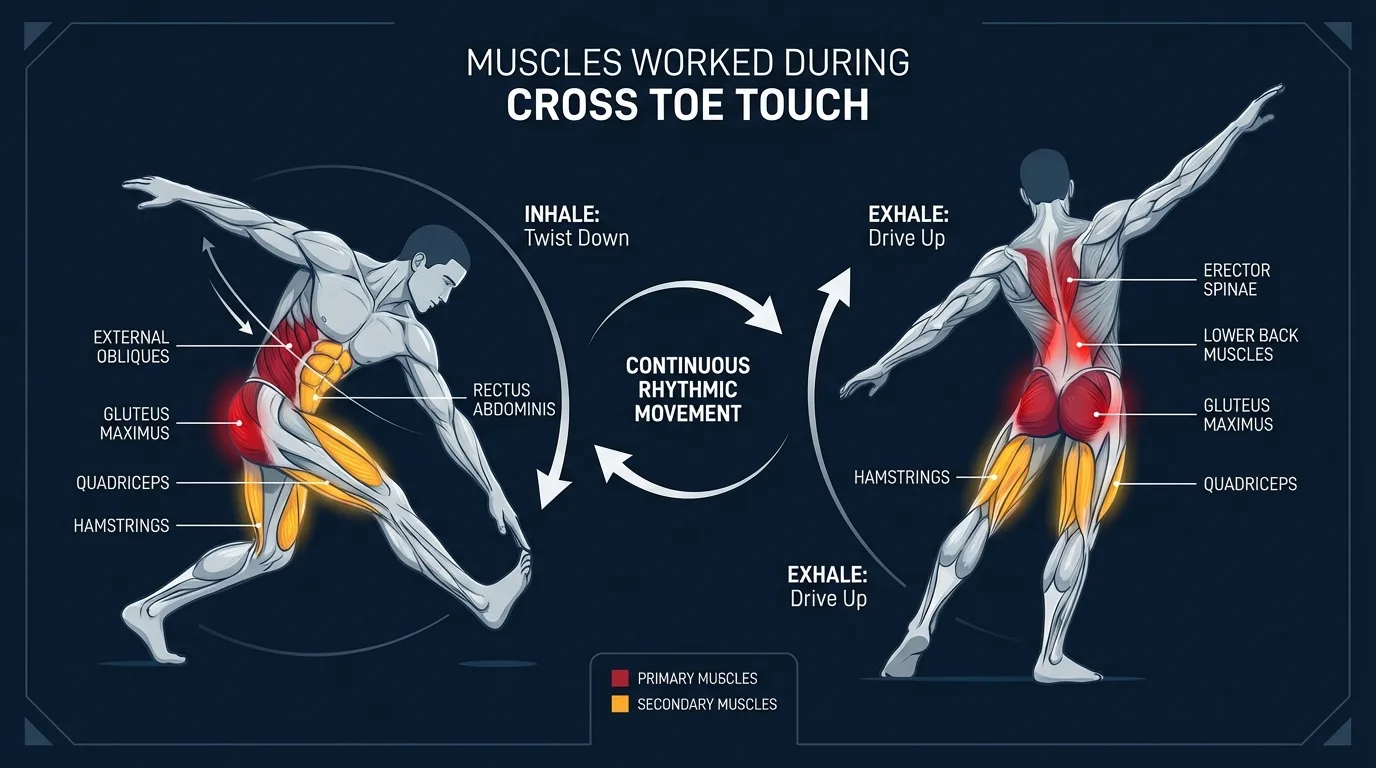
Muscles Worked
Primary movers: the internal and external obliques (the side abs that wrap around your torso) drive the trunk rotation that turns this into more than a forward bend. The rectus abdominis (the long sheet of muscle from your sternum to your pelvis) shortens to add trunk flexion as you coil down toward your foot. The combined flexion-plus-rotation pattern is what loads the obliques far more than a straight-plane toe touch.
Secondary movers: the hamstrings stretch under load as you coil down (eccentric demand), then contribute to extending the hips on the drive back up. The gluteus maximus fires hard on the upward drive, working with the erector spinae of the lower back to extend the hips and spine from the bottom position back to standing. The hip flexors assist on the way down, and the deltoids assist by swinging the arms in counter-rotation for balance.
Stabilizers: the transverse abdominis (the deep corset-like muscle that compresses the abdominal wall) braces isometrically throughout every rep. The diaphragm and pelvic floor work with the transverse abdominis as the deep-core canister. The breath is a key stabilizer here. Exhaling on the upward drive reinforces transverse abdominis activation and gives you more power out of the bottom. Ankle and foot stabilizers fire continuously because the movement is performed from a standing base.
Evidence: a 2013 study in the Journal of Strength and Conditioning Research measured oblique activation across standing and floor-based rotational exercises and found that standing variants produced higher external oblique EMG than floor variants, likely because the standing position demands more whole-body stabilization (Saeterbakken & Fimland, 2013). That stabilization demand is also why cross toe touches drive heart rate up so quickly. The body has to brace, rotate, and propel itself back to standing on every rep, recruiting large muscle groups at a continuous cadence.
How to Do Cross Toe Touches (Step-by-Step)
-
Stand tall and load the spring. Start with your feet about hip-width apart, knees slightly soft, arms at your sides, core braced. Think of your body as a loaded spring. Every rep is a coil and a release.
Coach Ty's cue: "Picture your body as a spring. Coil down as you reach for your foot, release the energy as you rise back up. If you move like a spring instead of a stick, everything clicks."
-
Twist and coil down toward your right ankle. Twist your torso to the right and let your body coil down, reaching your left hand across to tap your right ankle. Tap the shin if your hamstrings are tight. Your right arm naturally swings back for balance. You are bending, twisting, and loading your legs, glutes, and lower back all at the same time.
Ty's cue: "Aim for the opposite ankle. That target keeps the movement honest and the rotation real."
-
Drive upward out of the twist. This is the cardio part. Drive through your legs, glutes, and lower back to spring your body back up to standing. Exhale as you rise. It should feel like releasing stored energy, powerful, not passive.
Ty's key cue: "Drive upward from the twist. Don't just stand up. Drive up. A lazy return kills the whole effect."
-
Immediately coil to the other side. Without pausing at the top, twist to the left and coil down to tap your right hand to your left ankle. Drive back up. That is one full rep, both sides. Keep alternating.
Ty's reminder: "Stay engaged and controlled. Every rep should feel like your whole body is involved, not just your arms swinging around."
-
Let your breath set the rhythm. Inhale as you twist and coil down, exhale as you drive up. Keep the reps continuous and rhythmic. Cross toe touches are cardio, so the goal is continuous work. Aim for 30 to 45 seconds per set, or 3 sets of 20 total reps (10 each side). Keep your heart rate up.
Ty's cue: "Let your breath guide the movement. When your breath syncs with the reps, the rhythm locks in and the set actually flows."
Get this exercise in a personalized workout
FitCraft, our mobile fitness app, uses its AI coach Ty to program core stability work like this into your plan at the right volume and intensity, based on your level, goals, and equipment. Ty was designed and trained by Domenic Angelino, MPH (Brown University) and NSCA-CSCS, with research published in the Journal of Strength and Conditioning Research and Medicine & Science in Sports & Exercise.
Take the Free Assessment Free · 2 minutes · No credit card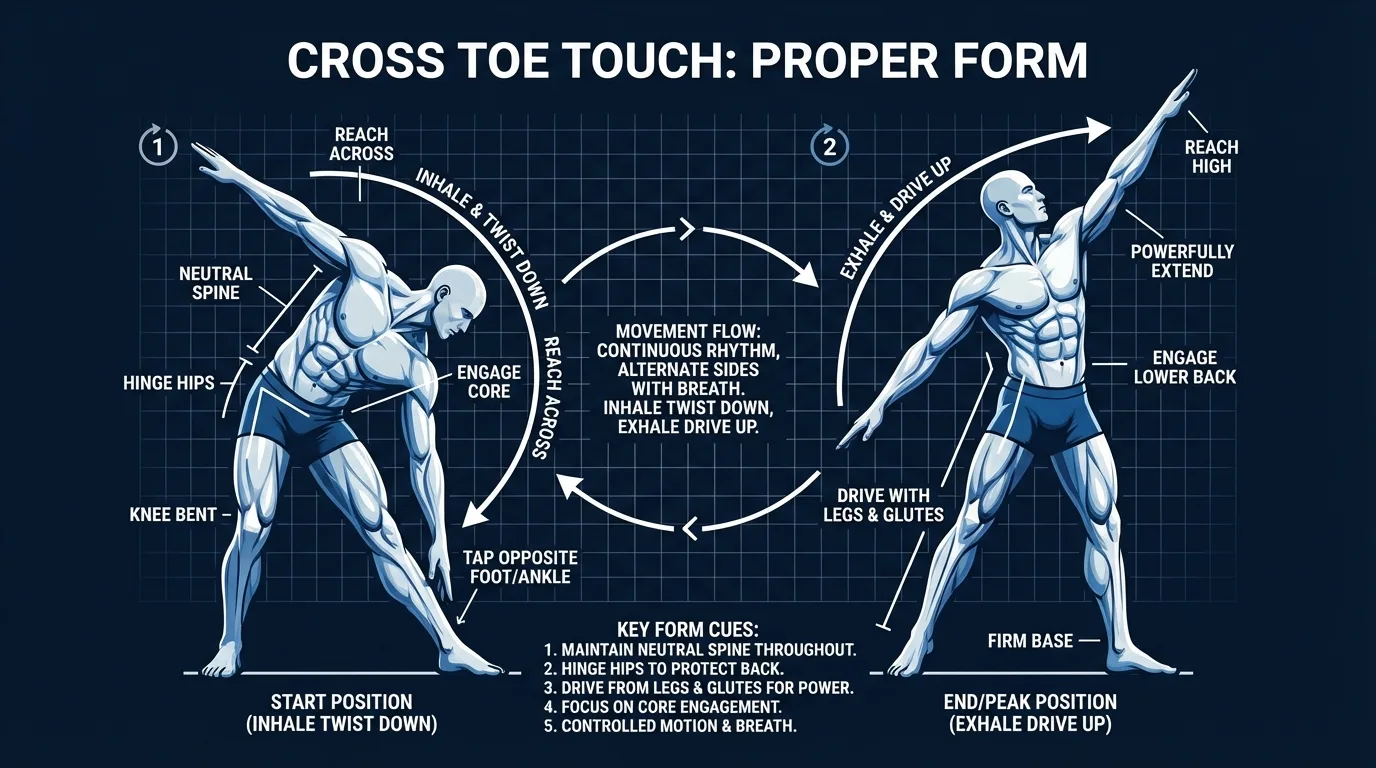
Common Mistakes (and How to Fix Them)
Cross toe touches are forgiving enough for most people to try. But these mistakes turn a great cardio and core move into something that either does nothing or leaves you sore in the wrong places.
- Treating it like a stretch. The biggest mistake. People see "toe touch" in the name and move slowly like they are warming up their hamstrings. That is not what this is. Cross toe touches are a rhythmic cardio movement. Fix: if your heart rate isn't climbing, you are going too slowly or not driving hard enough out of the bottom. Speed up the upward drive and let breathing set the pace.
- Standing up passively. Many people coil down fine, then just kind of stand back up. That is half the exercise gone. The upward drive (pushing through your legs, glutes, and lower back out of the twist) is where most of the cardio benefit comes from. Fix: spring up. Don't stand up. Feel a forceful exhale and a powerful glute squeeze on every rise.
- Arms only, no twist. Some people leave their torso facing forward and just swing an arm across to the opposite ankle. That is not a cross toe touch. Your whole torso should rotate on every rep. Fix: if your belly button isn't turning, you aren't twisting. Lead with your shoulder, and let your hand follow your shoulder across.
- Holding your breath. Cross toe touches are cardio. You need your breath working with you. Holding your breath spikes blood pressure and kills your rhythm inside of 20 seconds. Fix: inhale as you twist and coil down, exhale as you drive up. Repeat.
- Locking your knees. Keep a slight bend in your knees the whole set. Locked knees force the entire load into your lower back and hamstrings and rob the movement of its spring. Fix: soft knees mean a better coil and a better drive. If you feel pulling in the back of your knees, bend them more.
Cross Toe Touch Variations: Regressions and Progressions
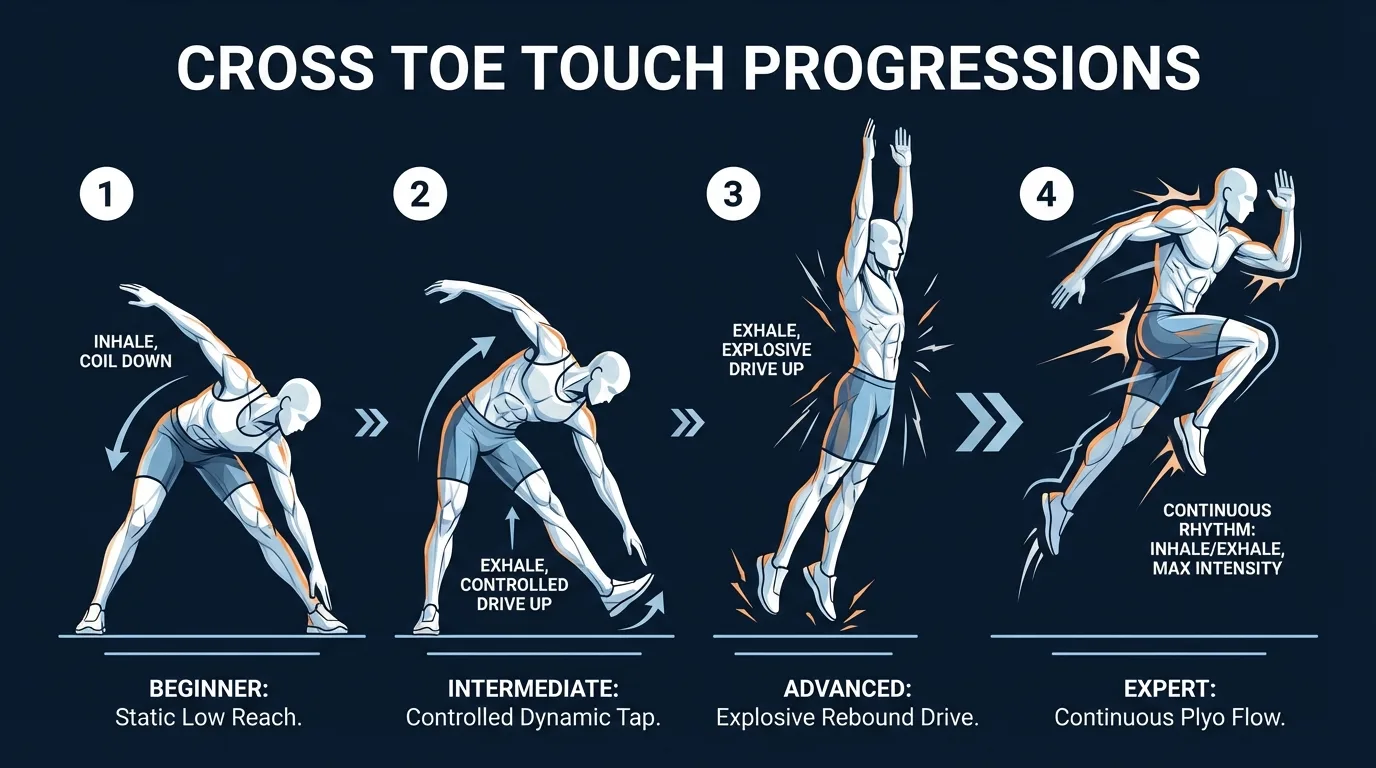
Start where your form holds. Progress when the current level feels controlled, not the moment you can grind through reps.
Shin-Tap Cross Touches (Beginner Regression)
Same twist-and-coil pattern, but you only reach down to shin or knee height instead of all the way to the ankle. This is the right starting point if your hamstrings are tight or if you are still learning how to drive back up powerfully out of the coil. Keep the tempo steady. When you can do 3 sets of 45 seconds with a strong upward drive on every rep, you are ready to reach lower.
Standard Cross Toe Touches (Intermediate)
The full version described above. Twist, coil down to tap your hand to the opposite ankle, drive back up, alternate sides in a continuous rhythm. This is the version Coach Ty programs for most FitCraft users as a cardio-plus-core movement.
Fast-Tempo Cross Toe Touches (Advanced Progression)
Same movement, faster pace. This turns the exercise into a full cardio burner while still demanding rotational core control and a powerful drive out of every coil. Your heart rate climbs fast. Only increase tempo if your form stays clean. Keep driving upward hard every rep, and don't let the twist collapse into a sloppy bounce.
Cross Toe Touch with Knee Drive (Advanced Progression)
After you tap the opposite ankle, drive that same knee up toward your chest as you spring back to standing. So you tap your right ankle with your left hand, then explode up and drive your right knee up. This adds a hip flexor and lower-ab component and cranks up the cardio demand. Each rep becomes a coordination challenge. Great for HIIT finishers.
When to Avoid or Modify Cross Toe Touches
Cross toe touches are safe for most healthy adults, but a handful of conditions call for modification or substitution. None of these are permanent restrictions. They are starting points. Always consult your physician or physical therapist for personalized guidance.
- Acute lower-back pain or known disc pathology. Cross toe touches load the spine in combined forward flexion and rotation under bodyweight (the same plane in which lumbar discs are most vulnerable) and repeat that load many times in a set. If you have an active back flare-up or imaging-confirmed disc issues, skip standing rotational flexion and rebuild with anti-rotation and anti-extension patterns first. Start with deadbugs and bird-dogs, then progress to forearm planks. Reload flexion-rotation only when the pain has fully resolved and you have PT clearance.
- First 6-8 weeks postpartum or active diastasis recti. The combined flexion-plus-rotation pattern increases intra-abdominal pressure across the linea alba and can widen an active abdominal separation. Restore deep-core function first with diaphragmatic breathing, transverse abdominis activation, and bird-dogs and deadbugs. Add standing rotational work back only after a women's-health PT confirms the gap has closed enough.
- Hernia (umbilical, inguinal, or ventral) or pelvic-organ prolapse. Both conditions can worsen with high intra-abdominal pressure movements like cross toe touches. Work with your physician or a pelvic-floor physical therapist on safe alternatives. Lower-pressure isometric patterns like deadbugs are usually the safer starting point.
- Pregnancy (second and third trimesters). Avoid deep forward flexion combined with rotation, which loads the linea alba at exactly the time it is naturally stretching. Substitute with upright standing cardio like marching in place or seated rotational work, or with anti-rotation patterns from a kneeling or standing position. Talk to your OB or pelvic-floor PT about what fits your trimester.
- Vertigo, low blood pressure, or balance issues. The repeated up-and-down standing motion can trigger lightheadedness in people with positional vertigo (BPPV), orthostatic hypotension, or vestibular issues. Switch to a seated rotational pattern or to floor-based core work like bicycle crunches until the underlying issue is managed.
- Acute hamstring strain or tendinopathy. The deep hip hinge stretches the hamstrings under load on every rep, which can aggravate a fresh strain. Skip the full ankle reach and use the shin-tap regression until tendon tolerance rebuilds, or substitute with a non-hinging cardio pattern like high knees.
Related Exercises
If cross toe touches are part of your routine, these movements complement or extend the same training pattern:
- Same plane (standing flexion-rotation): Standing Twists isolate the rotational component without the deep hinge, and Twist Crunches train the same flexion-rotation pattern from the floor when you want lower spinal load.
- Standing cardio alternatives: High Knees and Mountain Climbers deliver similar continuous-rhythm cardio with less rotational spinal load. Useful swaps when your lower back needs a break.
- Floor-based rotational core: Bicycle Crunches hit the same rectus abdominis and obliques through flexion-rotation, but from a supine position with no impact on the lower back.
- Foundation for spinal bracing: Deadbugs and Bird-Dogs teach the anti-rotation and anti-extension bracing patterns that protect the lower back during dynamic rotational work like cross toe touches. Run these as warm-ups before standing rotational sessions.
- Isometric core foundation: Forearm Planks and Hand Planks build the static bracing endurance that supports continuous standing rotation. A strong plank usually means a cleaner cross toe touch.
How to Program Cross Toe Touches
Cross toe touch programming follows evidence-based cardio and core training ranges. The American College of Sports Medicine (ACSM) Position Stand on resistance training recommends progressing volume and intensity gradually, with adequate recovery between sessions training the same muscle group (Ratamess et al., 2009). Standing core-cardio hybrids like cross toe touches generally tolerate higher frequency than compound lifts because the loads are lower and recovery is faster, but the lower back still accumulates fatigue across sessions.
| Level | Sets × Work (reps per side or seconds) | Rest between sets | Frequency |
|---|---|---|---|
| Beginner (shin-tap variant) | 2–3 × 8–12 per side (or 30s) | 45–60 seconds | 2–4 sessions/week |
| Intermediate (standard ankle-tap) | 3 × 10–20 per side (or 30–45s) | 30–45 seconds | 3–5 sessions/week |
| Advanced (fast-tempo or knee-drive) | 3–4 × 15–30 per side (or 45–60s) | 15–30 seconds | 4–6 sessions/week |
Where in your workout: cross toe touches work well in three spots. As a dynamic warm-up (2 sets of 30 seconds at a moderate pace) to elevate heart rate and prime rotation before a main workout. As cardio intervals in a HIIT circuit (40 seconds on, 20 seconds off, paired with high knees and mountain climbers). As a core finisher at the end of a resistance-training session (3 sets of 20 total reps at a controlled-but-continuous pace, paired with planks or bicycle crunches).
Form floor over rep targets: if your last reps of a set break form (lower back rounds aggressively, you stop driving upward, rotation collapses into a sloppy bounce), stop the set there. Hitting a rep target with broken form is worse than hitting fewer reps cleanly. Standing rotational cardio compounds over sessions, not in any single set.
How FitCraft Programs This Exercise
Knowing how to do a cross toe touch is step one. Knowing which variant fits your level, how long to work, and when to push tempo or add the knee drive is where most people get stuck.
FitCraft's AI coach Ty handles that. During your personalized diagnostic assessment, Ty maps your cardio level, core strength, and rotational mobility. Then Ty slots cross toe touches into a balanced program at the right variant for your level: shin-tap if you are building the rotation pattern, standard if you can drive upward cleanly, fast-tempo or knee-drive if you are chasing a harder stimulus.
As your conditioning improves, Ty adjusts the variation, work duration, and rest intervals. Shin-tap becomes standard. Standard becomes fast-tempo. Knee-drive gets paired with other plyometric cardio in HIIT circuits. The 3D demonstrations show the coil-and-drive rhythm from multiple angles so you can see what it looks like when your body moves like a spring. Every program is designed by an Ivy League-trained exercise scientist and NSCA-certified strength coach using evidence-based periodization, then adapted to you by the AI.
Frequently Asked Questions
Can I do cross toe touches if I have lower-back pain?
Cross toe touches combine repeated forward flexion with rotation under bodyweight load, which can aggravate disc-related lower-back pain or active flare-ups. If your back hurts during the movement, stop and switch to anti-rotation and anti-extension patterns like bird-dogs and deadbugs first. These build the deep-core bracing you need before reloading the flexion-rotation pattern. If pain persists for more than a week or two, see a physical therapist or physician for an assessment before returning to standing cross-body movements.
What muscles do cross toe touches work?
Cross toe touches are a total-body movement. The obliques and rectus abdominis drive the rotation, the legs, glutes, and lower-back erector spinae power you back up out of the twist, and the hamstrings stretch as you coil down. Because it is a rhythmic standing cardio exercise, your heart rate climbs while every major posterior chain and core muscle contributes to the movement.
How many cross toe touches should I do?
Because cross toe touches are a cardio movement, most people program them by time rather than reps. A good starting point is 3 sets of 30 to 45 seconds with 30 seconds of rest, or 3 sets of 20 total reps (10 each side). Advanced exercisers can push to 45 to 60 second intervals in a HIIT circuit. The goal is a continuous, rhythmic pace.
Are cross toe touches good for losing belly fat?
Cross toe touches burn calories as a standing cardio exercise and engage the whole core on every twist, but no exercise spot-reduces belly fat. Because they use the whole body (legs, glutes, back, and core driving every rep), they elevate heart rate quickly and contribute to a caloric deficit. Combined with proper nutrition, that supports overall fat loss.
Can I do cross toe touches every day?
Yes, they are low-impact enough to do daily, especially as a warm-up or short conditioning finisher. For higher-intensity cardio sessions, 3 to 5 times per week allows adequate recovery for your lower back and hamstrings. If your lower back is sore, take a rest day.
What is the difference between cross toe touches and regular toe touches?
Regular toe touches involve bending straight forward from a stationary stance to reach both hands toward your toes, primarily a hamstring and lower-back stretch. Cross toe touches are a dynamic, alternating cardio move: you twist and coil down to tap one hand to the opposite ankle, drive powerfully back up, and immediately repeat on the other side. The alternating rhythm turns a static stretch into a total-body conditioning exercise.