Twist crunches take the familiar crunch pattern and add rotation. That change shifts more work toward the obliques, the side-ab muscles that help turn and control your trunk.
The movement is small on purpose. You are not trying to sit all the way up or slam your elbow across your body. You are curling the upper back, rotating the ribcage, and keeping the lower back anchored to the mat.
That control is the whole exercise. When you rush, pull on your head, or rock your hips, the obliques stop doing the clean work you came for.
Quick Facts: Twist Crunches
- Equipment needed: None (exercise mat optional)
- Difficulty: Intermediate
- Modality: Core strength
- Body region: Core
- FitCraft quest category: Core
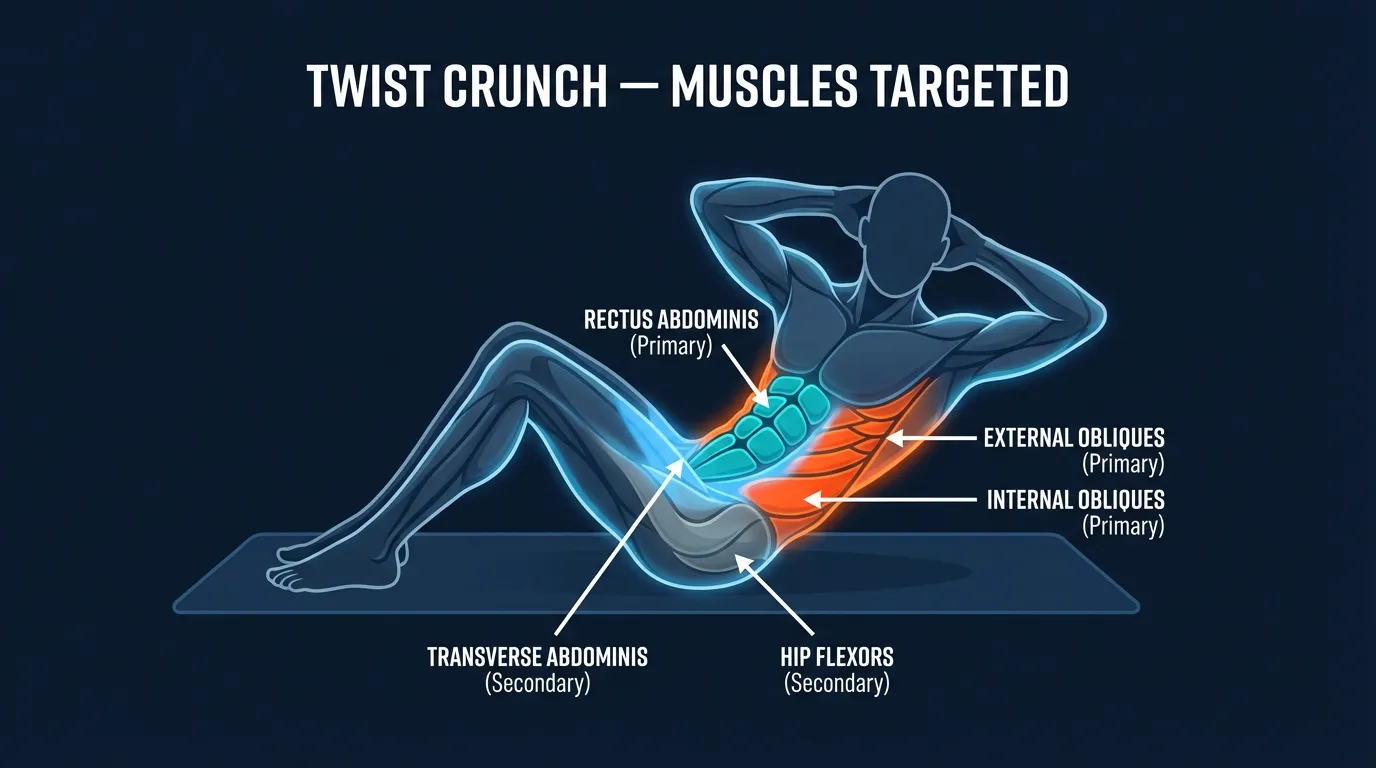
Muscles Worked
Primary movers: the internal and external obliques. During the crunch-and-rotate phase, the obliques on one side shorten to help turn the ribcage toward the opposite knee. On the way down, they lengthen under control so you do not flop back to the mat.
Secondary movers: the rectus abdominis helps flex the spine and lift the shoulder blades, while the hip flexors lightly anchor the lower body when the feet stay planted. The movement should still feel like an abdominal exercise, with only light help from the hip flexors.
Stabilizers: the transverse abdominis, diaphragm, pelvic floor, and spinal erectors help manage pressure and keep the lower back from arching. Your glutes and hip stabilizers also help keep the pelvis quiet while the ribcage rotates above it.
Why the twist matters: a straight crunch mainly asks the trunk to flex. A twist crunch adds controlled rotation, so the obliques have to create the turn and then brake the return. That is why the best reps feel deliberate, short, and controlled rather than big and fast.
How to Do a Twist Crunch Step by Step
Step 1: Set Your Starting Position
Lie face-up on a mat with your knees bent and feet flat on the floor about hip-width apart. Place your fingertips lightly behind your ears and keep your elbows wide. Press your lower back into the mat before the first rep.
Coach Ty's cue: "Light fingers, heavy core."
Step 2: Crunch and Rotate Toward One Knee
Exhale as you curl your upper back off the floor and rotate your ribcage toward one knee. Think right shoulder toward left knee, then left shoulder toward right knee. Your elbow comes along for the ride, but it does not lead the rep.
Coach Ty's cue: "Imagine your sternum is a flashlight. Point it toward the opposite knee."
Step 3: Pause at the Top
Hold the top position for a short count when you feel the oblique contract. Keep your chin away from your chest and your neck relaxed. One shoulder blade can stay closer to the floor while the rotating side lifts higher.
Step 4: Lower With Control
Return to the mat over about 2 seconds. Keep your abs engaged instead of dropping your head or letting your ribs flare. Reset to the middle before you rotate to the other side.
Step 5: Alternate Sides and Breathe
Repeat the same pattern to the opposite side. Exhale on each crunch, inhale on the return, and stop the set once you start pulling your head forward or lifting your feet.
Get this exercise in a personalized workout
FitCraft, our mobile fitness app, uses its AI coach Ty to program core stability work like this into your plan at the right volume and intensity, based on your level, goals, and equipment. Ty was designed and trained by Domenic Angelino, MPH (Brown University) and NSCA-CSCS, with research published in the Journal of Strength and Conditioning Research and Medicine & Science in Sports & Exercise.
Take the Free Assessment Free · 2 minutes · No credit card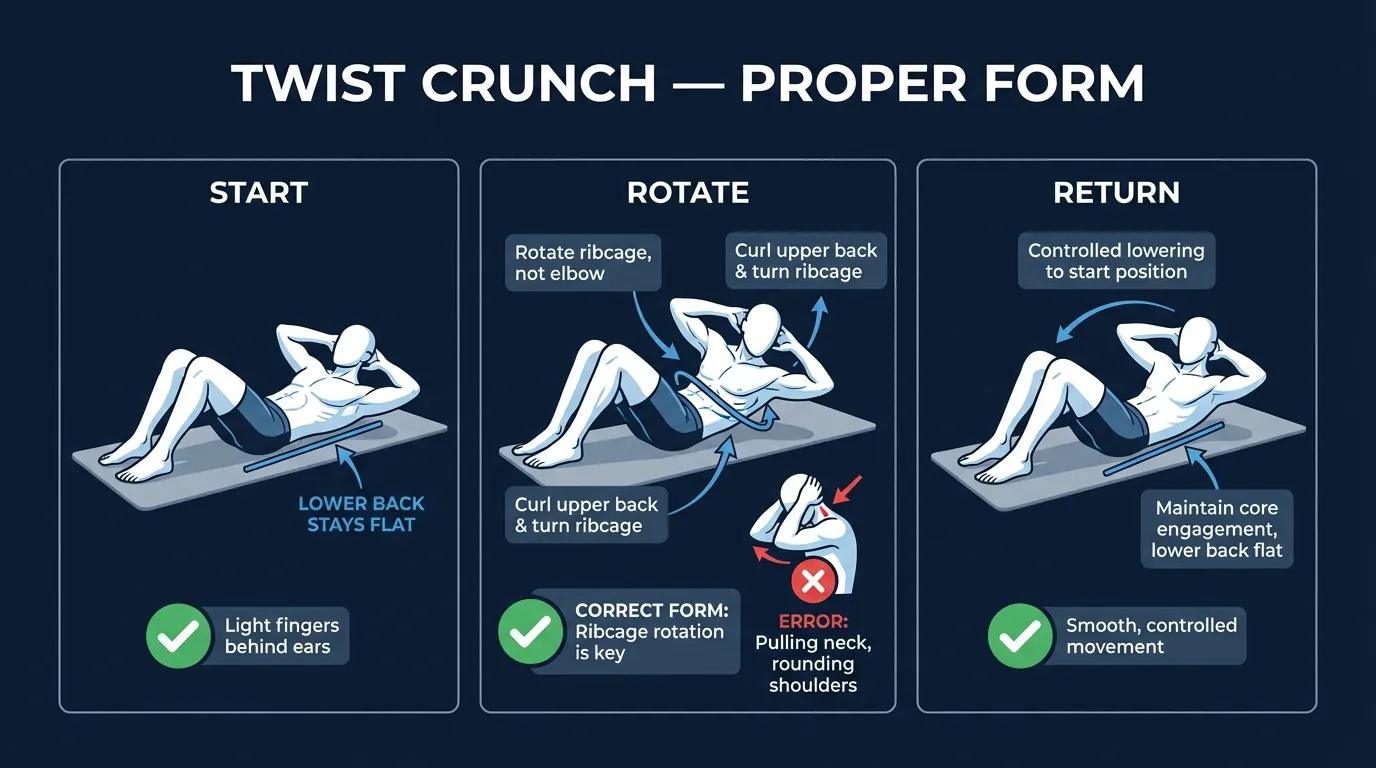
Common Mistakes to Avoid
The twist crunch is easy to fake because the elbow can move even when the torso barely rotates. These are the fixes that keep the work in your core.
- Pulling on your neck. Your hands are there for light support, not leverage. Fix it by keeping your fingertips soft, chin slightly tucked, and tongue on the roof of your mouth.
- Reaching with the elbow. If your elbow crosses your body but your ribs barely turn, your arms are doing theater. Fix it by aiming your shoulder or sternum toward the opposite knee.
- Lifting the feet. Feet popping up usually means you are rotating with momentum. Press both feet into the floor and use a smaller range of motion.
- Rocking the hips side to side. The pelvis should stay quiet while the ribcage rotates above it. If your hips roll, slow down and reduce the twist.
- Rushing through reps. Fast reps make the exercise easier and messier. Use a small pause at the top and a controlled lower.
- Trying to sit up too high. Twist crunches are not sit-ups. Lift the shoulder blades, rotate, squeeze, and return.
Twist Crunch Variations: Regressions and Progressions
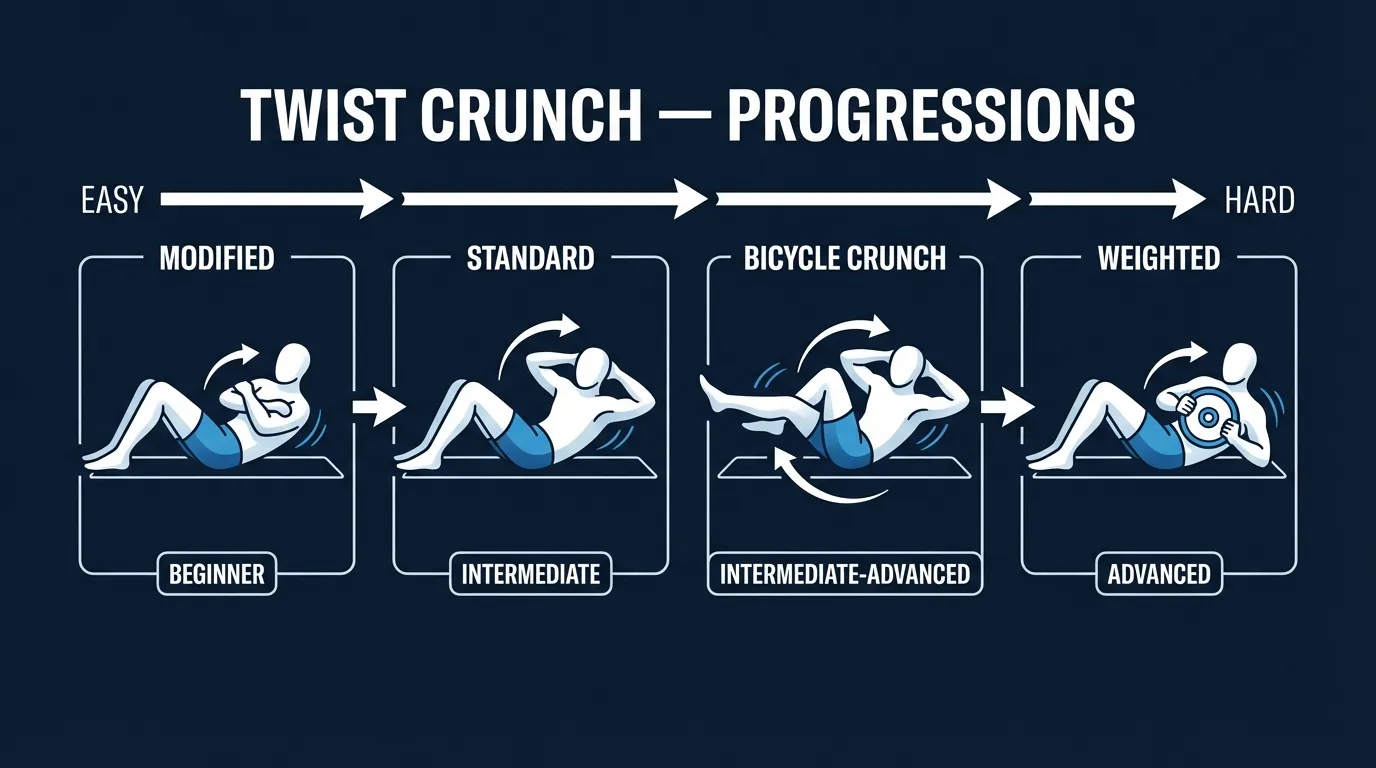
Modified Twist Crunch
Cross your arms over your chest instead of placing your hands behind your ears. This removes the temptation to pull on the neck and lets you learn the ribcage rotation first.
Short-Range Twist Crunch
Use the same setup, but rotate only as far as you can control without hip rocking. This is useful when you feel the exercise in your neck or lower back before your obliques.
Bicycle Crunches
Bicycle crunches add a pedaling leg action to the rotational crunch pattern. They are harder to coordinate, so earn them by keeping twist crunches smooth first.
Weighted Twist Crunch
Hold a light dumbbell or plate against your chest. Keep the weight close and move slower than usual. If the load makes your back arch or your hips rock, go back to bodyweight reps.
Cable or Band Rotation
A standing cable or band rotation trains the same rotational theme from an upright position. Use it as a progression when you want more resistance without adding more spinal flexion.
When to Avoid or Modify Twist Crunches
Twist crunches are safe for most healthy adults, but spinal flexion plus rotation deserves respect. Use the modifications below as starting points, and always consult your physician or physical therapist for personalized guidance.
- Acute lower-back pain or known disc pathology. Flexion plus rotation can aggravate symptoms. Swap in deadbugs, bird-dogs, or forearm planks until symptoms settle.
- First 6-8 weeks postpartum or active diastasis recti. Crunching and rotation can increase abdominal pressure and doming. Rebuild deep-core control first with breathing drills, deadbugs, and bird-dogs.
- Recent abdominal surgery. Hernia repair, C-section, appendectomy, and similar surgeries need medical clearance before loaded bracing or trunk rotation.
- Known hernia. Crunch variations can increase intra-abdominal pressure. Ask your physician which core patterns are appropriate before training through it.
- Pregnancy, especially second and third trimesters. Long supine positions, high spinal flexion, and rotation are usually poor fits. Use side-lying, standing, or clinician-approved alternatives.
- Pelvic-floor dysfunction or pelvic-organ prolapse. If you feel pressure, heaviness, or leaking during crunches, shift to lower-pressure bracing work and consult a pelvic-floor physical therapist.
Related Exercises
Use these exercises to build the same rotational pattern, fill in core foundations, or choose a friendlier alternative.
- Same rotation family: Russian twists and bicycle crunches train oblique rotation with different setups and coordination demands.
- Easier flexion base: Crunches teach the basic upper-back curl before you add rotation.
- Lower-ab pairing: Reverse crunches train posterior pelvic tilt and lower-ab control from the opposite direction.
- Spinal-bracing foundation: Deadbugs and bird-dogs build low-pressure core control without repeated spinal flexion.
- Oblique endurance: Side planks train the obliques isometrically, which is useful if twisting bothers your back.
How to Program Twist Crunches
Twist crunches fit best as controlled accessory core work. The American College of Sports Medicine's resistance-training position stand recommends progressing volume, intensity, and frequency gradually as skill and recovery improve (Ratamess et al., 2009).
| Level | Sets × Reps | Rest between sets | Frequency |
|---|---|---|---|
| Beginner | 2-3 × 8-12 per side | 45-60 seconds | 2-4 sessions/week |
| Intermediate | 3 × 10-20 per side | 45-60 seconds | 3-5 sessions/week |
| Advanced | 3-4 × 15-30 per side, slow tempo | 60 seconds | 4-6 sessions/week |
Where in your workout: place twist crunches near the end of a strength session or in a short core finisher. If you need your trunk fresh for squats, hinges, presses, or heavy carries, do those bigger lifts first.
Form floor over rep targets: stop the set when the lower back arches, the hips rock, or your hands start pulling on your neck. A shorter clean set does more for your core than a longer sloppy one.
How FitCraft Programs This Exercise
FitCraft's AI coach Ty uses your assessment to place core stability work inside a balanced program. That might mean twist crunches, a simpler bracing drill, or a harder rotational progression depending on your level and equipment.
As your strength improves, Ty adjusts the variation and volume to match your progress. The goal is steady core training that fits the rest of your plan, not random ab work tacked onto the end.
Frequently Asked Questions
Can I do twist crunches with lower-back pain?
Skip twist crunches during acute lower-back pain, disc irritation, or pain that increases with spinal flexion or rotation. Use lower-pressure core options such as deadbugs, bird-dogs, or forearm planks until you can brace without symptoms, and get personalized guidance from a qualified clinician.
What muscles do twist crunches work?
Twist crunches train the internal and external obliques, rectus abdominis, and transverse abdominis. The crunch creates controlled spinal flexion, while the ribcage rotation asks the obliques to shorten on one side and control the return on the other.
Are twist crunches the same as bicycle crunches?
They are related, but bicycle crunches add a pedaling leg action and usually demand more coordination. Twist crunches keep both feet planted, which makes the torso rotation easier to control.
How many twist crunches should I do?
Start with 2 to 3 sets of 8 to 12 reps per side, 2 to 4 times per week. Add reps only while you can keep your lower back down, rotate from the ribcage, and keep your neck relaxed.
Do twist crunches slim your waist?
Twist crunches strengthen the obliques, but they do not spot-reduce fat from the waist. They can help your midsection feel stronger and more controlled, while visible waist changes come from overall training, nutrition, and body composition.