The seated side bend gives your trunk a range most daily movement skips: clean side bending with the hips anchored. That matters for obliques, ribs, lats, and the deep side of the lower back.
Done well, it feels like a long line from the outside hip to the fingertips. Done poorly, it turns into a forward fold or a low-back crank. The difference is usually small: sit taller, keep both sit bones down, and bend only sideways.
Quick Facts: Seated Side Bend
- Equipment needed: None
- Difficulty: Beginner to Intermediate
- Modality: Core mobility
- Body region: Core and side body
- FitCraft quest category: Core
Muscles Worked
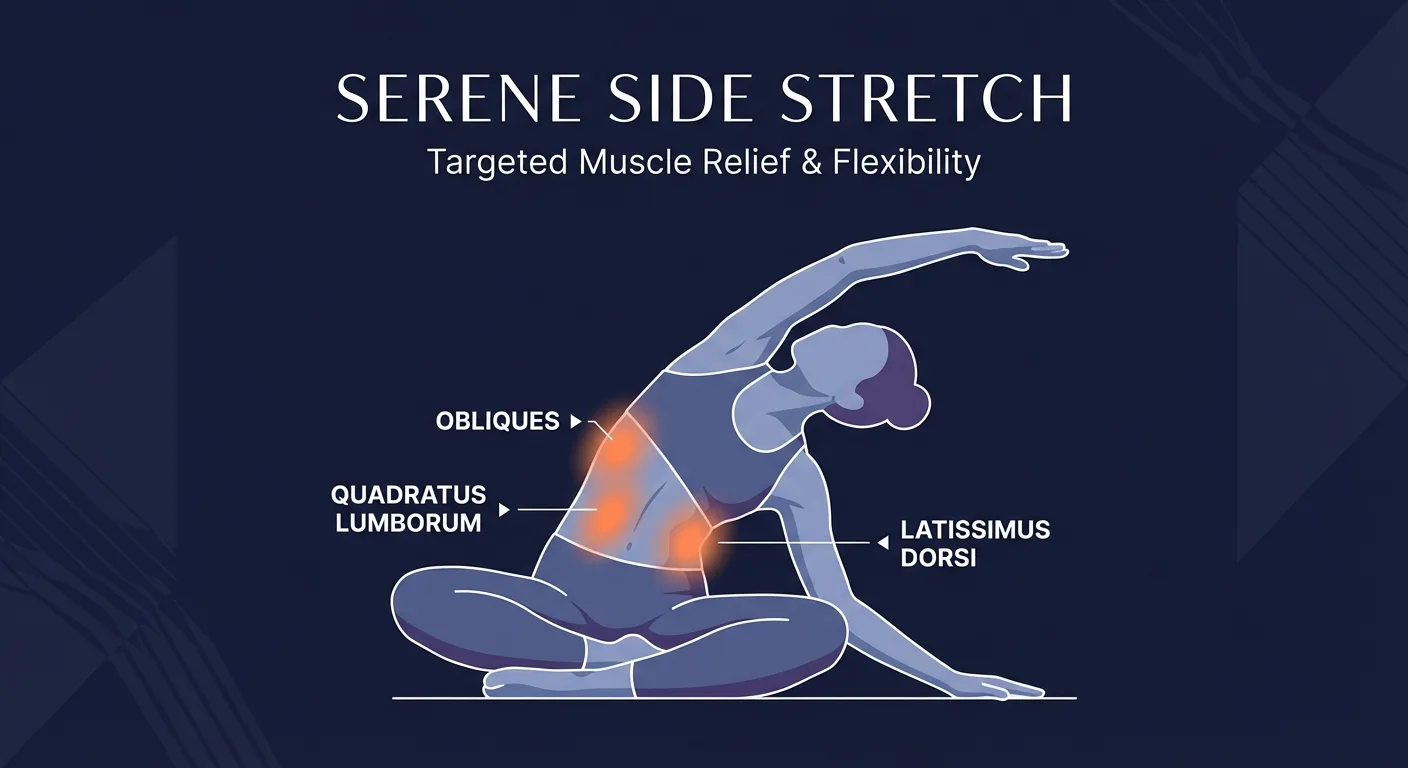
Primary movers: the internal and external obliques and quadratus lumborum control the side bend. On the stretched side, they lengthen under tension as you move into the position. On the return to center, the opposite-side trunk muscles help bring you upright.
Secondary movers: the latissimus dorsi and intercostals contribute to the long overhead reach. The lat adds the hip-to-shoulder line most people feel under the armpit, while the intercostals between the ribs help the ribcage expand as you breathe into the stretch.
Stabilizers: the diaphragm, pelvic floor, transverse abdominis, spinal erectors, and hip stabilizers keep the pelvis quiet while the trunk moves. Exhaling slowly at the end range helps the deep core stay engaged without turning the stretch into a hard brace.
Mechanism: anchoring both sit bones limits hip shifting, so the range has to come from lateral trunk flexion and ribcage opening. That is why the seated version often feels more precise than a standing side bend. The floor gives your pelvis a reference point.
Step-by-Step: How to Do the Seated Side Bend
Step 1: Sit Tall with Grounded Hips
Sit cross-legged, in a straddle, or with your legs extended in front of you. Plant both sit bones evenly on the floor. If your pelvis tucks under, sit on a folded towel or yoga block so your spine can stay tall.
Step 2: Anchor One Hand
Place your right hand on the floor beside your right hip. Use it as a light support point rather than a post to collapse into. Keep your chest open and your shoulders relaxed.
Coach Ty's cue: "Keep both hips heavy before you reach."
Step 3: Reach the Opposite Arm Overhead
Reach your left arm toward the ceiling with your palm facing inward. Grow tall through the left ribs before you bend. This length-first setup gives you room to move without pinching the lower back.
Step 4: Bend Directly to the Side
Lead with your left fingertips as you bend to the right. Keep your breastbone facing forward, your ribs stacked over your pelvis, and both sit bones connected to the floor.
Coach Ty's cue: "Reach long and over. Stay in one flat plane."
Step 5: Hold, Breathe, and Switch
Hold for 15 to 30 seconds at first. Breathe into the stretched side, then return to center with control. Switch sides and repeat for 1 to 3 rounds per side.
Get this exercise in a personalized workout
FitCraft, our mobile fitness app, uses its AI coach Ty to program core stability work like this into your plan at the right volume and intensity, based on your level, goals, and equipment. Ty was designed and trained by Domenic Angelino, MPH (Brown University) and NSCA-CSCS, with research published in the Journal of Strength and Conditioning Research and Medicine & Science in Sports & Exercise.
Take the Free Assessment Free • 2 minutes • No credit card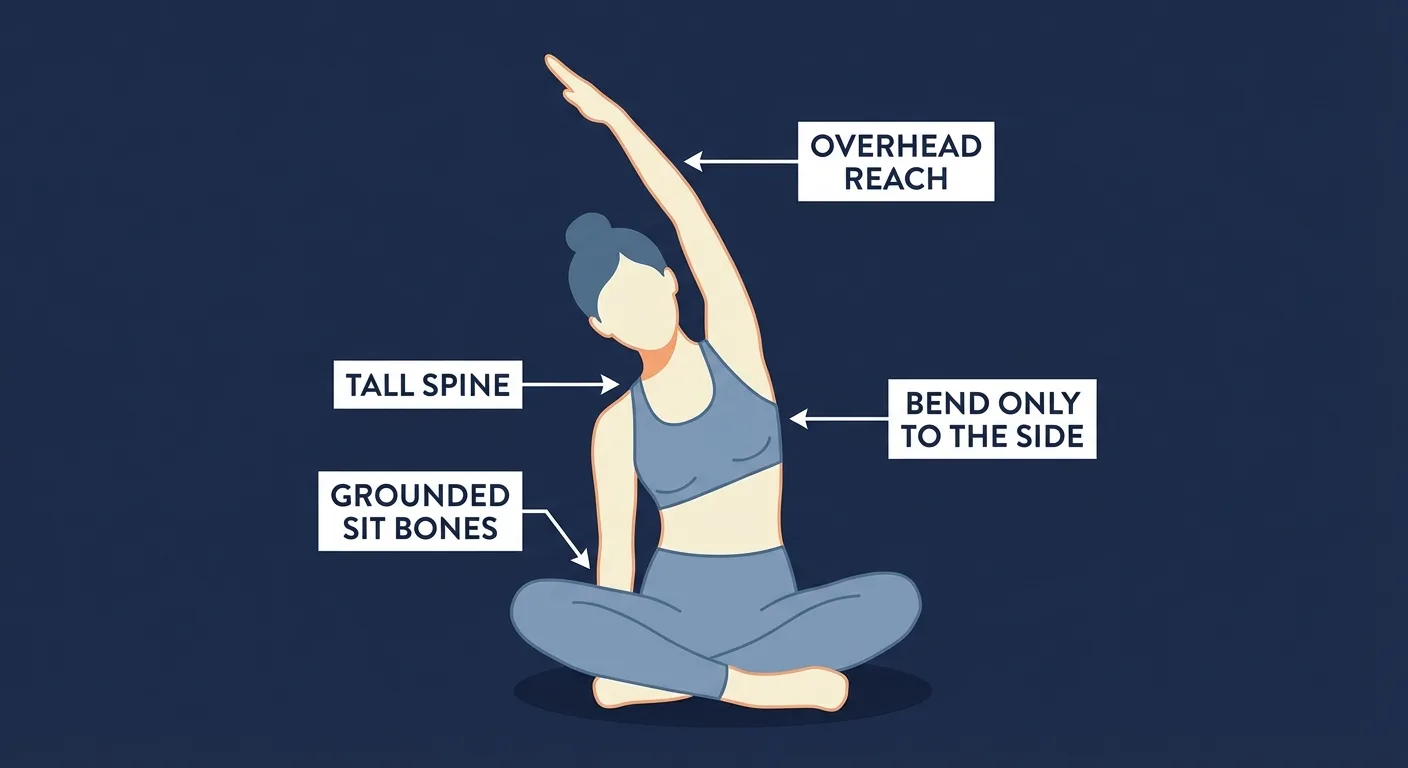
Common Mistakes (and How to Fix Them)
- Leaning forward or backward. The stretch turns into a twist or a rounded-back fold. Fix it by keeping your breastbone facing forward and making the bend smaller.
- Lifting the opposite sit bone. The pelvis hikes up and steals the stretch from the side body. Press the opposite sit bone down before you chase more range.
- Collapsing into the bottom arm. The supporting hand becomes a crutch and the ribs compress. Keep the bottom arm light and use the top arm to create length.
- Forcing the range. More bend is not better if your breathing locks up. Stop where you can breathe slowly and return to center without a jerk.
- Pulling on the neck. If you use a hand-behind-head variation, keep the hand light. The neck should stay long and relaxed.
- Rushing the hold. A quick side dip misses the mobility benefit. Hold long enough for the ribs and side waist to soften.
Seated Side Bend Variations: Regressions and Progressions
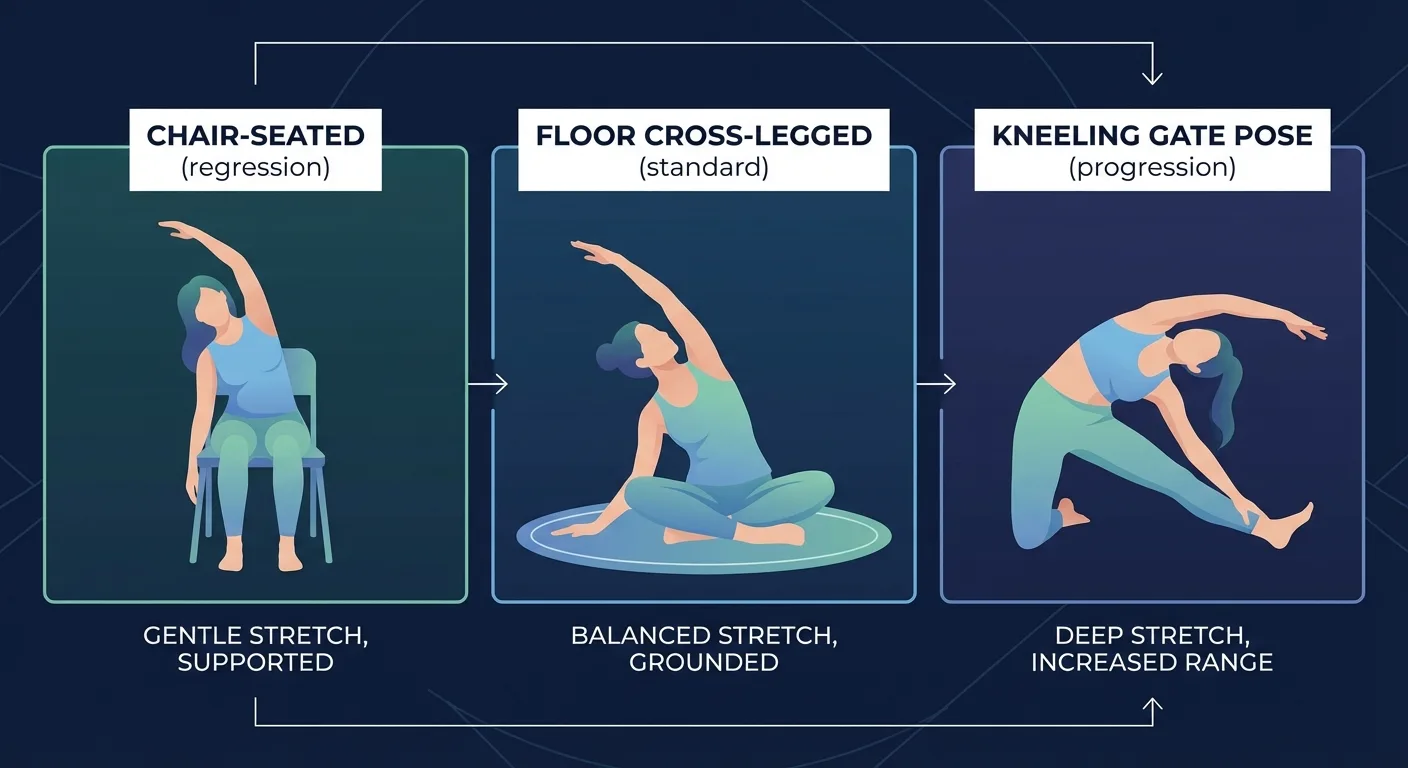
Chair-Seated Side Bend (Beginner Regression)
Sit in a chair with both feet flat. Hold the side of the seat with one hand, reach the other arm overhead, and bend sideways. This is the best option if floor sitting bothers your hips, knees, or lower back.
Short-Lever Seated Side Bend (Gentler Regression)
Place the top hand lightly behind your head instead of reaching the arm fully overhead. The shorter lever reduces shoulder demand and makes the stretch easier to control.
Standard Floor Seated Side Bend
Use the full overhead reach from a cross-legged, straddle, or legs-extended seat. Hold 20 to 30 seconds per side and keep the bend clean before adding range.
Single-Leg Extended Side Bend (Longer-Line Progression)
Extend one leg out to the side and bend away from it. This adds more hip and inner-thigh involvement while keeping the same lateral trunk focus.
Active Pulse Side Bend (Advanced Control)
Move in and out of the end range with small, slow pulses. Keep the motion smooth and pain-free. This should feel controlled, never bouncy.
When to Avoid or Modify Seated Side Bends
Seated side bends are safe for most healthy adults, but a few situations call for a smaller range, a chair version, or a different core drill. Always consult your physician or physical therapist for personalized guidance.
- Acute lower-back pain or known disc pathology. Side bending can irritate symptoms if the spine is already sensitive. Use a small chair-seated range, or swap in deadbugs and bird-dogs until a physical therapist clears more trunk motion.
- First 6-8 weeks postpartum or active diastasis recti. Avoid forcing end-range trunk motion if your deep core cannot control pressure yet. Rebuild with diaphragmatic breathing, deadbugs, and bird-dogs first.
- Recent abdominal surgery or hernia. Get medical clearance before loaded or end-range trunk work. Start with breathing and gentle bracing before adding larger side bends.
- Pregnancy in the second or third trimester. Use an upright chair version, keep the range easy, and avoid breath-holding or deep end-range pressure.
- Pelvic-floor dysfunction or pelvic-organ prolapse. Skip hard bracing and long holds that increase pressure. Work with a pelvic-floor physical therapist on safe core options.
- Hip or knee discomfort during floor sitting. Move to a chair, sit on a folded blanket, or choose standing twists for upright trunk mobility.
Related Exercises
Use these movements to build the same side-body control, round out trunk mobility, or support the seated position:
- Same lateral core pattern: Side Planks and Side Plank Raise train the obliques and quadratus lumborum to resist side bending under more load.
- Rotational core partner: Standing Twists and Cross-Toe Touches add controlled rotation after you own the side-bending range.
- Spinal mobility pairing: Cat-Cow and Seated Cat Cow cover flexion and extension, which pairs well with lateral flexion.
- Core foundation: Deadbugs, Bird-Dogs, and Forearm Planks build the bracing control that keeps side bends clean.
- Hip-friendly mobility: Butterfly Pose and Cobra Pose make a simple floor mobility flow around the seated side bend.
How to Program Seated Side Bends
Seated side bends are mobility-focused, but they still follow the same progression principle as any exercise: dose the movement to your level and progress gradually. The American College of Sports Medicine position stand on resistance training uses progressive volume, intensity, and frequency as the foundation for safe adaptation (Ratamess et al., 2009).
| Level | Sets × Reps | Rest between sets | Frequency |
|---|---|---|---|
| Beginner | 1-2 × 15-30 second holds per side | 30-45 seconds | 3-5 sessions/week |
| Intermediate | 2-3 × 30-60 second holds per side | 30-60 seconds | 4-6 sessions/week |
| Advanced | 2-4 × 45-90 second holds or 5-10 slow pulses per side | 45-60 seconds | 5-7 sessions/week |
Where in your workout: use seated side bends after a general warm-up, during a cooldown, between upper-body sets as a light reset, or as part of a short mobility block with cat-cow and butterfly pose. Long static holds fit best after training or away from heavy lifting.
Form floor over time targets: end the hold when your opposite sit bone lifts, your chest rotates, your breathing gets tight, or the stretch moves into sharp lower-back sensation.
How FitCraft Programs This Exercise
Knowing the stretch is useful. Knowing when to use it matters more.
FitCraft uses its AI coach Ty to place core mobility work into a broader program based on your level, goals, and equipment. For a movement like the seated side bend, that usually means warm-ups, cooldowns, mobility blocks, or short resets on days when your trunk and hips need more range.
Ty adjusts the variation and volume to match your level. A chair-seated version can come first. Longer floor holds or active pulses can come later. The point is clean movement before deeper range.
Frequently Asked Questions
What muscles does the seated side bend work?
The seated side bend mainly targets the obliques, quadratus lumborum, latissimus dorsi, and intercostal muscles. The outside of the bending side lengthens while the opposite side supports the return to center.
Why do I feel the seated side bend in my lower back?
Lower-back sensation usually means you're folding forward, arching backward, or forcing the range. Sit taller, make the bend smaller, and keep both sit bones grounded so the stretch stays along the side of your torso.
How long should I hold a seated side bend?
Start with 15 to 30 seconds per side for 1 to 2 rounds. Build toward 30 to 60 seconds per side for 2 to 3 rounds if the stretch feels smooth and your breathing stays easy.
Can I do seated side bends in a chair?
Yes. Sit tall with both feet flat on the floor, hold the chair or seat with one hand, and reach the opposite arm overhead. The chair version is often better if floor sitting bothers your hips, knees, or lower back.
Can I do seated side bends with lower-back pain?
Use a smaller range or skip seated side bends if acute lower-back pain, disc symptoms, or sharp pain shows up during the stretch. Try gentle core foundations such as deadbugs or bird-dogs instead, and consult a qualified healthcare provider or physical therapist if pain persists.